



Exams Prep Master
The Mitsunobu reaction is an organic reaction converting alcohol into various functional groups, such as ester, using triphenylphosphine, and an azodicarboxylate such as diethyl azodicarboxylate (DEAD) or diisopropyl azodicarboxylate (DIAD). The reaction was discovered and thus named after a Japanese professor, Oyo Mitsunobu. The reaction allows the conversion of primary and secondary alcohols to esters, phenyl ethers, thioethers, and different other compounds. Here we will emphasize the procedure, reaction mechanism and advantages of the Mitsunobu reaction, and discuss some important questions.
| Table of Content |
Key takeaways: Mitsunobu reaction, organic reaction, ester, triphenylphosphine, nucleophiles, carboxylic acid, diethyl azodicarboxylate (DEAD), di-isopropyl azodicarboxylate (DIAD)
What is Mitsunobu Reaction?
[Click Here for Sample Questions]
The Mitsunobu reaction is a condensation-dehydration reaction, with the loss of a water molecule from the alcohol and the carboxylic acid. This results from the strong affinity for oxygen by TPP, and for hydrogen by DEAD. For the reaction, the typical protocol is to add the phosphine and azodicarboxylate together at -10C, typically in THF or toluene, until a white precipitate forms. This white, cloudy suspension is the ylide. Then a solution of the nucleophile and alcohol are added together and the reaction can, in most cases, be heated to reflux.

Read More:
| Chapter Related Concepts | ||
|---|---|---|
| Methyl Ethyl Ketone | Oximes | Peroxydisulfuric Acid |
| Gaterman-Koch reaction | Stephen Reaction Mechanism | Reformatsky Reaction |
Mitsunobu Reaction Procedure
[Click Here for Sample Questions]
Although Mitsunobu reaction follows nucleophilic substitution reaction, the substitution mechanism is not direction. This is because alcohol; (-OH) is not a good leaving group. The alcohol-containing hydrocarbon usually shows retention in the configuration of the final product due to its bad leaving group characteristic. This is because it has to go through SN1 mechanism. SN2 mechanism shows inversion in the configuration of the final product and the rate of the reaction depends on both the substrate and the nucleophile, that is, the order is 2.
Mechanism of Mitsunobu Reaction
[Click Here for Sample Questions]
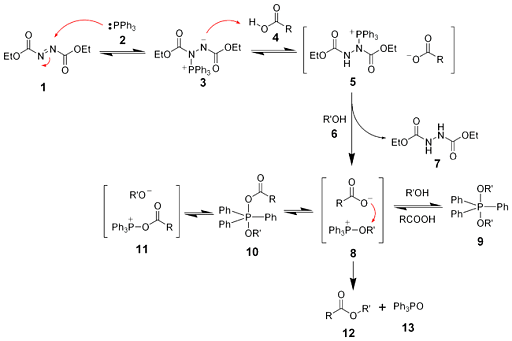
The reaction mechanism of the Mitsunobu reaction is complex, and the identity of reagents and their roles has been the subject of debate.
Initially, the triphenylphosphine makes a nucleophilic attack upon diethyl azodicarboxylate and produces a betaine intermediate. This deprotonates the carboxylic acid, forming the ion pair. Diethyl azodicarboxylate (DEAD) itself deprotonates the alcohol to form an alkoxide that can form the key oxyphosphonium ion. The ratio and interconversion of the intermediates depend on the carboxylic acid pKa and the polarity of the solvent. Despite several phosphorus intermediates being present, only the attack of the carboxylate anion upon intermediate can form the desired product and triphenylphosphine oxide. The overall rate of reaction is controlled by carboxylate basicity and solvation.
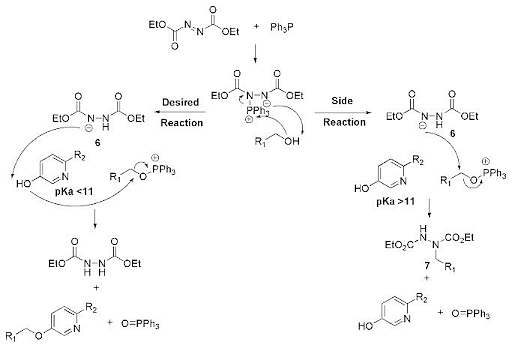
Typically, the alcohol, carboxylic acid, and triphenylphosphine are dissolved in tetrahydrofuran or any other suitable solvent, such as diethyl ether. This is cooled to 0 °C using an ice bath. Then the DEAD dissolved in THF is slowly added and stirred at room temperature for several hours. Sometimes, this process does not succeed, in which case, the betaine may be performed. This can be done by adding DEAD to triphenylphosphine in tetrahydrofuran at 0 °C, followed by adding the alcohol and finally the acid.
Conditions of Mitsunobu Reaction
[Click Here for Sample Questions]
Following are the conditions for successfully performing the Mitsunobu reaction:
- The pKa value of the nucleophile should be 12 or less than 12, in order to avoid the alkylation of azodicarboxylate.
- The reaction should take place in a neutral condition where the conditions are not too acidic or basic and the temperature can also be easily maintained. The reaction can be successfully carried out at 0°C to room temperature.
- Standard non-polar solvents like THF and dichloromethane or polar solvents like DMF must be used for the reaction.
Intramolecular Mitsunobu Reaction
[Click Here for Sample Questions]
As its name suggests, the intramolecular Mitsunobu reaction does not take place between two substrates but is rather produced from the reaction in the substrate itself. The final product of this reaction is cyclic. On activation of the phenolic oximes by the triphenylphosphine and DEAD at a mild neutral condition at 0°C, the cyclic product is obtained. This product is a heteroatom consisting of both oxygen and nitrogen, that is, oxazoles.

The intramolecular Mitsunobu reaction has been used by several groups to prepare 6- and 7- membered cyclic ethers, but this is believed to be the first example of the formation of an optically active 2- substituted chroman-4-one via such an approach.
Advantages of using DEAD/ DIAD
[Click Here for Sample Questions]
Following are the advantages of using DEAD or DIAD as a reagent in Mitsunobu reaction:
- They are solid in nature, which helps in the better study of the Mitsunobu reaction.
- The polarity of the by-product is totally different.
Things to Remember
- Many functional groups such as hydrazoic acid and imide can serve as nucleophiles besides carboxylic acids. For the reaction to be successful, the nucleophile must have a pKa less than 15.
- Bruce H. Lipshutz has developed an alternative to DEAD, called di-(4-chlorobenzyl)azodicarboxylate (DCAD), where the hydrazine by-product can be easily removed by filtration and recycled back to DCAD.
- It has been proved been that triphenylphosphine and diethyl azodicarboxylate can be combined into one reagent: a phosphorane ylide. The ylide acts as the reducing agent as well as the base. The by-products are acetonitrile and trialkyl phosphine oxide.
- The Mitsunobu reaction has been used for the synthesis of quinine, morphine, colchicine, sarain, stigmatellin, eudistomin, oseltamivir, strychnine, and nupharamine.
Read More:-
Sample Questions
Ques: What is the specialty of the Mitsunobu Reaction? (4 marks)
Ans. The nucleophilic reaction is the type of reaction in which the removal of the leaving group and the addition of the nucleophile takes place simultaneously. This is because the nucleophile attacks the substrate from the back, changing the configuration of the substrate, that is, the final product is inverted. However, if the leaving group is alcohol, it does not leave when a nucleophile attacks from behind simultaneously and causes retention in the configuration of the final product.
Thus, the removal of alcohol (bad leaving group) requires the help of the Mitsunobu reaction to undergo a nucleophilic substitution reaction via a betaine formation. The final product’s configuration in this case is inverted.
Ques: What is the experimental procedure to control the by-product formation in the Mitsunobu reaction? (3 marks)
Ans. The following procedure is used to control the by-product formation of the Mitsunobu reaction:
- The reactant primary alcohol, carboxylic acid, or any other nucleophile and triphenylphosphine is dissolved in a non-polar solvent, such as THF.
- The DEAD, which is separately dissolved in THF solvent, is slowly added to this mixture, placed in an ice bath. The mixture is then brought to room temperature and stirred for hours.
If the given steps are not carried out carefully, the formation of the by-product will be more than that of the desired final product.
Ques: What is DIAD? (2 marks)
Ans. Di-isopropyl azodicarboxylate (DIAD) is the diisopropyl ester of azodicarboxylic acid. It is used as a reagent in the production of many organic compounds. It is often used in the Mitsunobu reaction, where it serves as an oxidizer of triphenylphosphine to triphenylphosphine oxide.
Ques: What are the advantages of using DIAD? (2 marks)
Ans: Following are the advantages of using DEAD or DIAD as a reagent in Mitsunobu reaction:
- They are solid in nature, which helps in the better study of the Mitsunobu reaction.
- The polarity of the by-product is totally different.
Ques: What are the conditions required for Mitsunobu reaction? (3 marks)
Ans: The conditions for successfully performing the Mitsunobu reaction are:
- The pKa value of the nucleophile should be 12 or less than 12, in order to avoid the alkylation of azodicarboxylate.
- The reaction should take place in a neutral condition where the conditions are not too acidic or basic and the temperature can also be easily maintained. The reaction can be successfully carried out at 0°C to room temperature.
- Standard non-polar solvents like THF and dichloromethane or polar solvents like DMF must be used for the reaction.
Ques: What are the steps involved in the mechanism of the Mitsunobu reaction? (5 marks)
Ans: The reaction mechanism of the Mitsunobu reaction is complex, and the identity of reagents and their roles has been the subject of debate.
Initially, the triphenylphosphine makes a nucleophilic attack upon diethyl azodicarboxylate and produces a betaine intermediate. This deprotonates the carboxylic acid, forming the ion pair. Diethyl azodicarboxylate (DEAD) itself deprotonates the alcohol to form an alkoxide that can form the key oxyphosphonium ion. The ratio and interconversion of the intermediates depend on the carboxylic acid pKa and the polarity of the solvent. Despite several phosphorus intermediates being present, only the attack of the carboxylate anion upon intermediate can form the desired product and triphenylphosphine oxide. The overall rate of reaction is controlled by carboxylate basicity and solvation.
Typically, the alcohol, carboxylic acid, and triphenylphosphine are dissolved in tetrahydrofuran or any other suitable solvent, such as diethyl ether. This is cooled to 0 °C using an ice bath. Then the DEAD dissolved in THF is slowly added and stirred at room temperature for several hours. Sometimes, this process does not succeed, in which case, the betaine may be performed. This can be done by adding DEAD to triphenylphosphine in tetrahydrofuran at 0 °C, followed by adding the alcohol and finally the acid.
Ques: What is meant by intramolecular Mitsunobu reaction? (4 marks)
Ans: As its name suggests, the intramolecular Mitsunobu reaction does not take place between two substrates but is rather produced from the reaction in the substrate itself. The final product of this reaction is cyclic. On activation of the phenolic oximes by the triphenylphosphine and DEAD at a mild neutral condition at 0°C, the cyclic product is obtained. This product is a heteroatom consisting of both oxygen and nitrogen, that is, oxazoles.

The intramolecular Mitsunobu reaction has been used by several groups to prepare 6- and 7- membered cyclic ethers, but this is believed to be the first example of the formation of an optically active 2- substituted chroman-4-one via such an approach.
Ques: What are the types of organic reactions? (2 marks)
Ans: Chemical reactions that include organic compounds are the organic reactions. Some of the basic forms of organic chemistry reaction are addition reactions, elimination reactions, substitution reactions, pericyclic reactions, rearrangement reactions, photochemical reactions, and redox reactions.
Ques: What is the name reaction in organic chemistry? (2 marks)
Ans: The name reaction is referred to as a type of shorthand that avoids the need to provide an elaborate description of the characteristics of a specific interest transformation. It helps to bring to mind the potential substrates, reaction conditions, by mentioning the word reaction.
Ques: What happens when phenol is heated with zinc dust? (2 marks)
Ans: When phenol is heated with zinc dust benzene is formed.

Ques: Give simple chemical tests to differentiate between the following pairs of compounds: Benzoic acid and Phenol (2 marks)
Ans: Ferric chloride test is the simple chemical test to differentiate the following pairs. Add neutral FeCl3 in both the solutions, phenol reacts with neutral FeCl3 in order to form an iron-phenol complex giving violet colour but benzoic acid does not.
Ques: Explain the mechanism of dehydration steps of ethanol: (4 marks)

Ans:

Ques: Write the mechanism of acid dehydration of ethanol to yield ethene. (5 marks)
Step 1: Formation of protonated alcohol


For Latest Updates on Upcoming Board Exams, Click Here: https://t.me/class_10_12_board_updates
Check-Out:



Comments