



Content Curator
Macromolecules can be defined as large molecules composed of thousands of covalently connected atoms.
- The word macromolecules include micro and molecules.
- Macro means big or large and molecule refers to its components or atoms means large atoms.
- Macromolecules are very interesting to study since they can be found in almost everything, from plastics to materials and even humans.
- One macromolecule is made up of over 10,000 atoms.
- They are generally the result of smaller particles, such as proteins, lipids, and carbohydrates.
- The structure blocks which make up macromolecules are known as monomers.
- Macromolecules can also be referred to as polymers.
| Table of Content |
Key Terms: Macromolecules, Polymers, Monomers, Atoms, Molecules, Lipids, Proteins, Carbohydrates, Nucleic acids, Hydrocarbons, Fibres, Plastics
Macromolecules
[Click Here for Sample Questions]
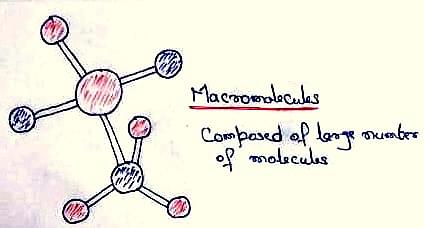
Macromolecules are composed of many smaller molecules called monomers that are polymerized into larger molecules.
The term molecule refers to very large molecules that include more than one atom.
- It was coined by Herman Staudinger in 1920.
- Macromolecules are so large that they include 10,000 or more atoms.
- Macromolecules are also known as polymers.
- Polymerization of molecules such as carbon, hydrogen, and oxygen results in their formation.
- The monomer units of macromolecules are polar in nature, with differing physical and chemical characteristics in their heads and tails.
Also check:
| Related Concepts | ||
|---|---|---|
| Amino Acid | Diagram of Mitochondria | Vitamin B |
| Lipids | Discovery of Cells | Plasma Membrane |
Classification of Macromolecules
[Click Here for Sample Questions]
According to mammalian systems, different types of macromolecules are
- Carbohydrates
- Lipids
- Proteins
- Nucleic acids
- Polysaccharides
Carbohydrates
They are polymers of carbon, hydrogen, and oxygen.
- They can be delegated monosaccharides, disaccharides, and polysaccharides.
- Carbs are found in starch, organic products, vegetables, milk, and sugars.
- They are a significant wellspring of a sound eating regimen.
- Carbs include monosaccharides (single sugars) disaccharides (double sugars) polysaccharides (long chains of mono) monosaccharides serve as a major fuel for cells and as raw material for building molecules.
Lipids
Lipids are the only class of large organic molecules that do not typically form polymers.
- Their hydrophobic nature, meaning they repel water, stems from their composition of hydrocarbons with predominantly nonpolar covalent bonds.
- Examples of lipids include fats, phospholipids, and steroids.
- These polymers include amino corrosive structure blocks.
- Living life forms comprise hundreds and thousands of proteins.
- Many are additionally made out of different hundred amino corrosive monomers.
Proteins
Proteins are the most intricate macromolecules.
- A protein is a direct particle involved in amino acids.
- Twenty unique amino acids are found in proteins.
- The arrangement of a protein's amino acids is dictated by the succession of bases in the DNA coding for the amalgamation of this protein.
- A solitary protein particle might include many amino acids.
- This succession of amino acids is a protein's essential construction.
- Proteins perform numerous essential functions within the cell.
- Many proteins fill in as catalysts, which control the pace of compound responses, and subsequently the responsiveness of cells to outside improvements.
Nucleic acids
Nucleic acids are the carriers of genetic information. In every single living creature, the inherited data is put away in deoxyribonucleic acid (DNA), which is a particle framed by the redundancy of nucleotides (making DNA a polymer).
- There are four unique nucleotides in DNA, which structure an all-inclusive code for innate data.
- Ribonucleic acid (RNA), the other sort of nucleic corrosive, is a connected atom to DNA.
- It is additionally a polymer of four nucleotides, three of which are equivalent to DNA while the fourth one is somewhat unique.
- It has many capacities in cells, notably acting as the intermediate between DNA and proteins.
- Rather than DNA, some viruses even store their genome in the form of an RNA molecule.

Examples of Macromolecules
[Click Here for Sample Questions]
The following are the major examples of macromolecules
Synthetic Fibres
Nylon, rayon, and spandex are all made up entirely of macromolecules. These are made in the following steps
- When the monomers react, they form prepolymers or a liquid, primitive macromolecule.
- The prepolymers are then passed through a cell where they solidify and reach the required thickness.
- This process is known as spinning.
Genetic Transfer
DNA is a type of genetic material that comprises nucleic acids that code for genetic information. The DNA is no longer complete during meiosis, and the nucleotides that remain are responsible for passing genetic information to the gametes.
Industrial Applications of Macromolecules
[Click Here for Sample Questions]
Apart from biological macromolecules, three major categories of macromolecules are essential in the industry. These are known as industrial macromolecules. These are
- Elastomers
- Fibres
- Plastics
Elastomers
An elastomer is a polymer with the property of flexibility.
- As such, it is a polymer that twists under pressure and gets back to its unique shape when the pressure is taken out.
- The term is a withdrawal of the words "versatile polymer".
- There are many kinds of elastomers, a large portion of which are rubbers.
- Elastomers are utilized for counterfeit and normal elastic, froth making, delicate and hard warm protection sheets, and entryways.
- These are also used to make window handles for households and cars, vehicle run sheets, vehicle run sheet handles, guards, CV joint boots, suspension bushings, window &door trim, seals, and floor mats.
Fibres
Nylon, rayon, and spandex are among the most notable, these non-breathable textures are comprised predominantly of macromolecules.
- Natural fibres can be categorized into two main groups - plants and animals.
- Plants are cellulosic (made of cellulose), like cotton and hemp.
- And, animal fibres are protein-based, like wool.
- Realizing this will help a ton when we begin to discuss distinctive colour types later on in another smaller-than-expected course.
- Synthetic fibres are man-made in a lab and are made through a process called extrusion.
- Synthetic fibres are divided into three groups cellulosic, protein, and petroleum-derived.
Plastics
Plastics are very flexible materials and are great for a wide scope of buyers and modern applications.
- The moderately low thickness of most plastics gives plastic items the benefit of being lightweight.
- What's more, although most have astounding warm and electrical protection properties, a few plastics can be made to direct power when required.
- Polyethylene terephthalate and polyvinyl chloride are usually alluded to as PET and PVC, while frothed polystyrene and polymethyl methacrylate are known by their reserved names, Styrofoam and Plexiglas.
- Plastics likewise can be partitioned into two unmistakable classes based on their synthetic piece.
- One classification is plastics that are comprised of polymers having just aliphatic (straight) carbon iotas in their spine chains.
- All the items plastics recorded above fall into this class.
Also check:
| Multicellular Organisms | Cell Biology | Atoms and Molecules NCERT Solutions |
| Phospholipid | Prokaryotic and Eukaryotic Cells | Atoms and Molecules |
Things to Remember
- Macromolecules are made up of a number of smaller molecules known as monomers, which are polymerized to form larger molecules.
- Macromolecules can be classified as biological and industrial macromolecules.
- An elastomer is a polymer with the property of flexibility.
- Nylon, rayon, and spandex are all made up entirely of macromolecules.
- Macromolecules are also known as polymers.
- Proteins are the most intricate macromolecules.
- Nucleic acids are the carriers of genetic information
Sample Questions
Ques. What are macromolecules? (2 Marks)
Ans. A macromolecule, such as a protein or nucleic acid, is an extremely large molecule that is essential in biological processes. It is made up of thousands of atoms that are covalently bound. Many macromolecules are polymers composed of smaller molecules known as monomers.
Ques. What are polymers? (1 Mark)
Ans. A polymer is a substance or material composed of large molecules known as macromolecules comprising many repeating subunits.
Ques. What are monomers? (2 Marks)
Ans. A monomer is a simple molecule having two or more binding sites that create covalent bonds with other monomer molecules to produce a macromolecule.
Ques. What are four important biological macromolecules? (2 Marks)
Ans. The four important biological macromolecules are
- Carbohydrates
- Proteins
- Lipids
- Nucleic acid
Ques. What is the importance of macromolecules? (2 Marks)
Ans. Most of the biological nutrients are macromolecules that the body uses to carry out multiple biological processes. These are formed through the combination of monomers.
Ques. What is the difference between polymers and macromolecules? (2 Marks)
Ans. Macromolecules are molecules which are large in size while polymers consist of repetitive molecules. All polymers are macromolecules but not all macromolecules are polymers.
Ques. State the functions of the four major macromolecules. (3 Marks)
Ans. The following are the functions of macromolecules
- Carbohydrates- energy source for living organisms to carry out various functions.
- Proteins- proteins are produced using long chains of amino acids (these acids have an amine bunch toward one side and a carboxyl gathering on the other, with a carbon in the middle. They are the essential primary units of everything in our body.
- Lipids- consist of wax and fats they are a long source of energy, consisting of long-chain hydrocarbons
- Nucleic acid- DNA and RNA consist lot of information, and their job is to transmit and store hereditary information.
Ques. What is the largest macromolecule? (1 Mark)
Ans. DNA can be the largest macromolecule after that protein is the largest. 1gm of DNA can comprise 455 exabytes of data.
Ques. How are fibres distinguished? (2 Marks)
Ans. Natural fibres can be further divided into two main groups - plants and animals. Plants are made of cellulose, like cotton and hemp. Animal fibres are protein-based, like wool also Synthetic fibres which are man-made in a lab.
Ques. How is a prepolymer different from a monomer? (2 Marks)
Ans. Prepolymers are made during the production of engineered textures. They are the fluid type of genuine polymers and can be controlled before they are polymerized, or hardened.
For Latest Updates on Upcoming Board Exams, Click Here: https://t.me/class_10_12_board_updates
Also Read:



Comments