



Education Journalist | Study Abroad Lead
Mouth, also known as the oral cavity or buccal cavity, is the aperture through which food and air enter the body of an organism. The mouth cavity is the first part of the digestive tract. Its primary function is to serve as an entrance to the alimentary canal, allowing salivation and pharyngeal propulsion of the alimentary bolus, where digestion may commence. It also functions as a chemosensory organ, a secondary respiratory conduit, and a sound modification location for speech generation. There are numerous salivary glands that surround the mouth and secrete saliva through a network of small channels.
Table of Contents
| Table of Content |
Key Terms: Mouth, Anatomy, Oral Cavity, Buccal Cavity, Speech, Vestibule, Sensory Receptors, Salivary Glands, Digestion, Mouth Cavity, Invertebrates, Vertebrates
Read More: Inbreeding Depression
What is Mouth?
[Click Here for Sample Questions]
The mouth, also known as the oral cavity or buccal cavity, and its structures are critical in the production of speech in humans, in addition to their fundamental role in food intake and first digestion. It can be defined as the aperture through which food and air enter the body. The lips open to the outside and empties into the neck at the back.
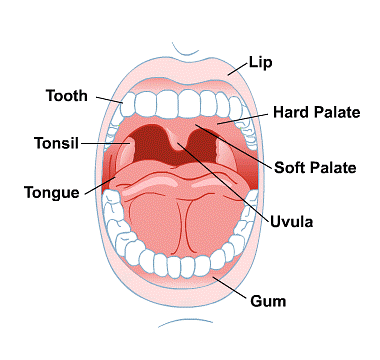
The vestibule, the region between the cheeks and the teeth, and the oral cavity are the two sections of the mouth. The oral cavity and vestibule are lined by mucous membranes, which contain multiple small glands that are in conjunction with the three pairs of salivary glands. The tongue, a big muscle firmly connected to the floor of the mouth by the frenulum linguae, fills the latter part.
Mouth
Read More: Human Body- Anatomy & Physiology
The teeth rip and ground ingested food into little bits that can be digested; the tongue places and mixes food and also contains sensory receptors for taste; and the palate separates the mouth from the nasal cavity, permitting separate passageways for air and food. By altering the movement of air through the mouth, all of these structures, along with the lips, are involved in the creation of speech sounds.
Anatomy of Mouth
[Click Here for Sample Questions]
Though vertebrates and invertebrates have similar defining characteristics of the oral cavity, however, there can be significant differences between the microscopic mouth inside the anatomy of vertebrates and invertebrates.
- Invertebrates
The mouth portions of some kinds of invertebrates with a hard exoskeleton are involved in feeding behaviour. Insects have a variety of inner mouth anatomy appropriate to their feeding patterns, with mandibles (lower jaw), maxillae (upper jaw), and labium (a fused mouth portion that offers support for holding food in the mouth) being the most common. These inside structures are transformed into chewing, cutting, piercing, sponging, and sucking appendages. Surprisingly, the mouth structure of some less advanced invertebrates, such as sea anemones, is structured in such a way that it even helps the outflow of undigested food, i.e. it works as an anus.
Read More: Mouth Cancer (Oral Cancer)
- Vertebrates
Vertebrates have a complete digestive system, with a mouth on one end for ingesting food and an anus on the other end for expelling undigested or leftover food particles. The mandibles, maxillae, and tongue, as well as the base of the oral cavity, are the three primary elements of a vertebrate's mouth. Only the avian vertebrates do not have teeth in their jaws. Birds, on the other hand, have beaks made up of enlarged mandibles.
Anatomy of the Human Mouth
[Click Here for Sample Questions]
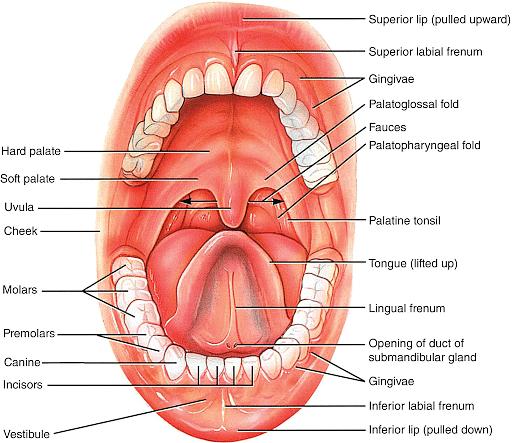
The vestibule and the oral cavity are the two components of the human mouth anatomy. In addition, Homo sapiens' inner mouth anatomy is primarily defined by the following:
- The teeth are responsible for tearing and grinding food into digestible particles. The gums support these teeth and keep them in place. There are 20 teeth in a full set of deciduous teeth. A complete permanent set has 32 teeth. Each tooth type has a different form that corresponds to how it handles food.
- The tongue is the one part that aids in the placing and mixing of food during the chewing process. There are also taste receptors on it. Many little papillae on the tongue's top surface contain these taste buds or sensory receptors. In higher animals, the tongue and teeth are commonly found in the mouth anatomy. The tongue is used to handle food in the mouth and to communicate.
- The palate is the barrier between the mouth and the nasal cavity. This allows for the separation of food swallowing into the oesophagus and air intake into the trachea. The palate also serves as a roof for the mouth structure, enclosing the mouth anatomy. The hard palate's anterior section is supported by bone.
- On the rear, the soft palate ends in a protrusion known as the uvula. The soft palate and uvula migrate upward during swallowing to route food into the oropharynx and away from the nasal cavity.
Read More: Types of Teeth in Humans
By mixing food with digestive enzymes found in animal saliva, this combined team of mouth interior anatomy kicks off the digestive process. Saliva not only aids digestion but also keeps the mouth moist and free of debris. Saliva is a fluid produced by three pairs of salivary glands located in the mucous membranes lining the oral cavity and vestibule, as well as several more tiny glands.
Anatomy of Human Mouth
Read More: Absorption of Digested Food
What are the Functions of Mouth?
[Click Here for Sample Questions]
The following are the functions of the Mouth:
- Swallowing
The mouth lubricates our digestive tract and allows us to eat. The tongue is more than just a single-nerve muscle. The tongue is a specialised organ system that is powered by our basic embryonic developmental arches' five major cranial nerves. The tongue–hyoid bone system is responsible for swallowing and speech.
Read More: Difference Between Tissues and Organs
- Tongue-Powered Speech
It is a term used to describe speech that is powered by the tongue. Our all-powerful Tongue, which is driven by all five developing nerves and is uniquely human in its design and capacity to make speech sounds, combined with the unique airway of humans, is responsible for producing various speech sounds. The architecture of the mouth and the inner mouth aids these species in producing and emitting vocal sounds and variations.
- Thermoregulation
Also Known as temperature management, it is a crucial feature of the mouth's internal architecture. When panting or heavily breathing after a hard workout, certain mammals utilise their mouths to accelerate the evaporation of water from the wet surfaces of their mouths, tongues, and lungs.
- Aids in Face Structuring
When a tooth on either side of the jaw is lost, several of the adjoining teeth may move or tilt towards the empty gap. As the jaw bone loses support from the teeth, this will result in alterations to a human’s facial anatomy. This is more frequent in the elderly, who are lacking the entire row of teeth on one side of their jaw, resulting in a sunken profile and sagging facial features. Teeth aid in the shaping and structure of our faces.
Common Diseases of Mouth
[Click Here for Sample Questions]
Some common diseases associated with the mouth are given below:
- Thrush
Thrush is a mouth infection that has been caused by a fungus. It is most commonly found in the mouth and tongue lining. It can also manifest itself in the throat and other parts of the body.
When thrush affects the mouth, it causes the following symptoms:
- White lesions on the (inner) cheeks and tongue that are raised.
- Pain and redness in the mouth
- A cottony sensation
- Taste deterioration
A throat culture is used to diagnose thrush, which is caused by an excess of Candida or other fungi.
- Cavities
Adults and children alike are susceptible to cavities. It is caused by dental decay and results in a hole in the tooth. This occurs when the tooth enamel, or hard outer layer, is eroded by acids and bacteria in the mouth. Regular dental examinations and cleanings, as well as brushing and flossing properly and consistently, are all vital in preventing cavities.
A cavity can aid in the following symptoms:
- Toothache
- Inside the mouth is red.
- Gums that are bleeding
- Intolerance to hot or cold beverages or foods
- Breath problems
Too many sugary foods and drinks, as well as poor brushing and flossing, are all factors that contribute to cavities. Foods high in sugar and starch, which convert to acids, are known to nourish the bacteria in the mouth. The acids will then eat away at the tooth enamel, causing holes and cavities.

Cavities
Read More: Test for Starch
- Gingivitis
Gingivitis is a kind of gum disease that begins in the early stages. Bacteria infect the gums, causing them to become red, swollen, and frequently bleeding. Gingivitis can be controlled by frequent dental exams, brushing, and flossing as directed by a dentist.
Given below are some of the signs and symptoms:
- Breath problems
- Chewing food causes pain.
- Gums that are red and swollen
Bacteria in the mouth is natural and healthy in most cases. However, certain bacteria can produce plaque, which can lead to an infection in the places where the teeth touch the gums, resulting in gingivitis. When plaque hardens and turns into tartar, which is more difficult to remove from the teeth, it can get worse.

Gingivitis
- Oral Herpes
The herpes simplex virus causes an infection in the mouth known as oral herpes. Once infected with herpes, a person will be infected for the rest of their life. It's possible that it's inactive within nerve cells. Some people never develop symptoms, while others may experience flare-ups on a regular basis. Sores in the mouth and around the lips are common symptoms.
Read More: Viral Diseases
- Periodontal disease
Gingivitis has progressed to periodontal disease. The gums and bones that support the teeth might become inflamed and red if they are infected. They also begin to pull away from the bone and tooth structure. The teeth may loosen or fall out as a result of this disease. Periodontal disease causes the following symptoms:
- Gums that are painful, swollen, or bleeding
- Teeth that be loose and sensitive
- Gums that are separating from their teeth
- Changes in the way dentures fit
- Bad breath/Unpleasant taste
Cleaning the teeth, removing tartar, and receiving adequate advice and treatment from a dental expert are all crucial steps in slowing the spread of periodontal disease.
Things to Remember
- The main application of mouth is to receive food, which is then digested in the digestive system. The mouth has "teeth," which are used to grind food into a pulp before swallowing, as well as a tongue, which pushes food into the body in humans and many other animals.
- The mouth is also the medium via which many animals, including humans, emit noises. This takes the form of speech, as well as various sorts of noises made by humans.
- Its job is to break down food mechanically, moisten it with saliva, and swallow it into the oesophagus and stomach.
- While the throat produces the majority of vocal sounds, the tongue, lips, and jaw are also required to produce the full range of sounds found in human language.
- The parotid, submandibular, and sublingual salivary glands are the three primary pairs that create saliva. The resulting wad is known as a bolus, and it is formed when food is chewed and combined with saliva.
- Finally, it is apparent that the mouth is an essential organ in terms of digestion and that it is a sign of a highly evolved multicellular creature.
Sample Questions
Ques. What is the function of the mouth? (2 Marks)
Ans. The fundamental function of the mouth, which is universally utilised by organisms, is food intake. Before swallowing, the food particles are chewed, ground, and mixed with digestive enzymes in the mouth after they have been taken in. Aside from that, the mouthparts contribute to communication through assisting with speaking.
Ques. What parts inside the mouth do humans have? (3 Marks)
Ans. The following parts can be found inside a human’s mouth:
- Gums are the connective tissue that holds a human’s teeth in place.
- The oral mucosa (mucous membranes) is a lining that runs the length of a human’s mouth.
- Saliva is produced by three pairs of salivary glands (spit).
- Sensory receptors: Sensory receptors in a human’s mouth let humans detect the warmth and texture of foods and beverages.
- Taste buds: These cells assist in the detection of flavours and tastes (sweet, salty, sour, and bitter).
- Teeth: For swallowing and digestion, the human’s mouth possesses 32 teeth that crush and tear food.
- Taste buds are located on the tongue, which is a strong muscle. It helps human’s talk by moving food around human's mouths.
- The uvula is a segment of flesh that hangs from the rear of the palate and aids in the passage of food from the mouth to the throat.
Ques. What does healthy mouth anatomy look like and how does it feel? (3 Marks)
Ans. Given below are the conditions that make the mouth look healthy:
- The tissues in a healthy mouth are pink, firm, and moist. Human’s breath will smell nice or neutral if humans have a healthy mouth.
- Gums that are healthy are firm and pink, not red or white. They are not enlarged or inflamed. Teeth that are not wobbly should be firmly placed in the gums. Chewing or brushing human’s teeth should not be painful.
- There will be no lumps, flaps, gaps, or rough spots in a healthy mouth.
Ques. How can a person maintain a healthy mouth? (3 Marks)
Ans. With good oral hygiene, regular dental examinations, and a healthy lifestyle, he can keep your teeth, gums, and mouth healthy. Consider the following scenario:
- Smoking and chewing tobacco should be avoided.
- Brush your teeth twice a day, as well as your tongue and the rest of your mouth. Use fluoride-containing toothpaste.
- Limit sugary drinks like soda and drink plenty of water.
- Eat healthful foods and limit your sugar intake.
- Once a day, floss between your teeth.
- Do try to see a dentist at least twice a year.
Ques. When should a person consult a dentist concerning his or her mouth? (3 Marks)
Ans. If a person has any of the following symptoms in your mouth, contact a healthcare physician or a dentist:
- Sores or bumps that refuse to go away or return.
- Soreness or pain.
- Bleeding often.
- Teeth-to-gum gaps are spaces between the teeth and the gums.
- There is a foul odour.
- Teeth that are loose (in adult, permanent teeth).
- A person has a dry mouth that won't go away.
Breathing, talking, eating, and drinking all need the use of your mouth, or oral cavity. Tissues in a healthy mouth are moist, pink, firm, and painless. If a person has any oral problems, talk to a preferred doctor or dentist, and get a dental exam at least once a year.
Ques. What are the four different types of teeth? (3 Marks)
Ans. Teeth are the most durable and hard materials in the human body. An adult's teeth are split into four categories: incisors, canines, molars, and premolars. The wisdom teeth, often known as the third molar, emerge in a person's late teens or early twenties.
A crown with one or more points, a neck, and a root make up each tooth. The pulp cavity is the centre of the tooth, and it is packed with blood vessels, nerves, and connective tissues. It is bordered by enamel, which protects the tooth from scratch, cut, and germs in the mouth.
Ques. What is Buccal Mucosa Carcinoma? (3 Marks)
Ans. The buccal mucosa is the lining of the cheeks and rear of the lips that touch the teeth on the inside. Carcinoma buccal mucosa is a kind of mouth cancer caused by the growth of cancer cells or tumours in this region. Squamous cells, which are thin and flat and border the lips and mouth, are where it usually begins. If cancer buccal mucosa is detected early enough, it is straightforward to treat. Men are more likely than women to develop this form of cancer. It must be treated right away, or it will spread to the lips, tongue, and other regions of the body. The earlier cancer is detected and treated, the easier it is to eradicate it totally.
Ques. Describe the Anatomy of Mouth? (3 Marks)
Ans. The anatomy of the mouth has been elaborated in detail below:
- The lips are soft, fleshy tissues that create the front edge of the mouth's external aperture. Lips are highly flexible and elastic structures with many collagen and elastin fibres as well as adipose tissue.
- The cheeks, which are fleshy tissues that constitute the sides of the mouth, are lateral to the lips. The surface of the cheeks has keratinized stratified squamous epithelium while the inside has nonkeratinized stratified squamous epithelium.
- The tongue is located in the lower part of the mouth and is covered with papillae, which are tiny ridges that assist it to hold and carrying food around the mouth. Taste buds detect molecules in the food to generate the feeling of taste and also aids in speech production by changing or interrupting the passage of air through the mouth to generate a variety of consonant sounds.
- The roof of the mouth is made up of hard and soft palates that collaborate to keep the mouth and nasal cavities distinct. The hard palate is created by the inferior surface of the maxillae and the palatine bones on the front end of the mouth. The soft palate, a flexible fleshy mass of tissues that ends in the uvula, extends the roof of the mouth posteriorly.
- The gums, also known as gingiva, are soft mucous membranes that surround the teeth and serve to keep them in place by protecting the roots from decay.



Comments