



Content Curator
Natural gas is a mixture of gases primarily rich in hydrocarbons. It is extracted mostly from deep underground petroleum sources. Since gases are lighter than oil, it occurs directly above the crude oil layer. The remains of plants and animals buried beneath the soil are converted into naturally occurring gas, as well as coal and petroleum when exposed to high temperature and pressure. Natural gas is not used in its pure form. It is converted into a cleaner fuel for consumption.
Read More: Fossil Fuels
| Table of Content |
Key Takeaways: Natural Gas, Fossil Fuels, Methane, Non-Renewable Energy, Hydrocarbons, Renewable Resources
Natural Gas
[Click Here for Sample Questions]
Natural gas, also known as methane gas, is mixture of gaseous hydrocarbons occurring naturally. The primary component of natural gas is methane. Methane along with small amounts of higher alkanes constitutes natural gas. It is a non-renewable energy resource.
- It is an odourless, colourless, and highly combustible gaseous hydrocarbon that is one of the world’s most widely used energy resources.
- It is the most environmental-friendly hydrocarbon that is abundant and versatile, helping to fulfill the world’s expanding energy needs.
- It is also known as ‘Fossil Gas’ or simply ‘Gas’.
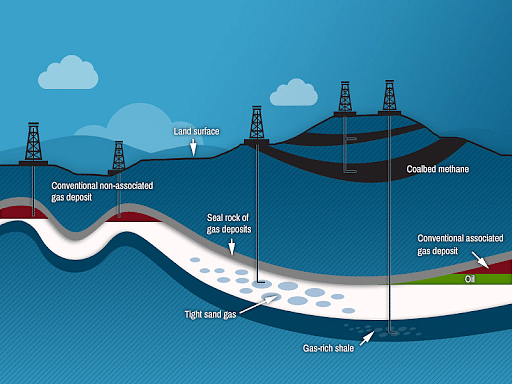
Extraction of Natural Gas
Natural gas is a product of nature that primarily consists of methane with minor amounts of other higher alkanes and on rare occasions, carbon dioxide, nitrogen, hydrogen sulphide, or helium. It is a fossil fuel that is used for cooking, heating and generation of power.
Read More:
| Natural Gas Related Topics | ||
|---|---|---|
| Conversion of Energy | Geothermal Energy | Uses of Solar Panel |
| Effects of Burning Fossil Fuels | Types of Fuel | Resources on Earth |
Uses of Natural Gas
[Click Here for Sample Questions]
Natural gas is used for both domestic and industrial purposes. Some of the uses of natural gas are given below.
Domestic Uses
The domestic use of natural gas includes the following:
- Energy generated from natural gas can be used for powering up residential energy needs.
- It is more cost-effective and faster to heat water at home using natural gas than to heat it using electricity.
- It is used directly while cooking as it provides better temperature control.
- Natural gas cooking is also more cost-efficient than electric oven since it consumes less energy.
- Natural gas clothes dryers are more cost-efficient than electric clothes dryers since they can save upto 50 per cent of the energy.
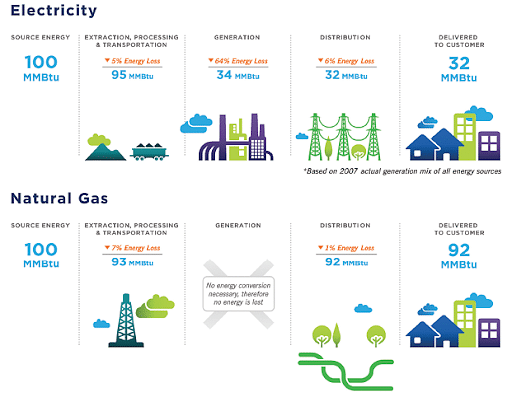
Comparison of Electricity and Natural Gas
Industrial Uses
The industrial uses of natural gas are as follows:
- Chemicals, fertilizers, and hydrogen are all made with natural gas as raw material and as a source of heat.
- Acetic acid, ammonia, methanol, butane, propane, and ethane are some of the compounds that are made with natural gas.
- As a heat source, natural gas is utilised in the production of glass, steel, cement, bricks, ceramics, tile, paper, food, and a variety of other goods.
- In addition, it is used for combustion at a number of industrial facilities.
- It is a more cost-effective option for vehicles than other fuels like petroleum.
Read More: Difference Between Renewable and Non-Renewable Sources
Advantages of Natural Gas
[Click Here for Sample Questions]
The various advantages of using natural gas have been listed below:
- Due to the general high proportion of methane in natural gas, it is extremely combustible.
- It can quickly evaporate in the air in the event of a breach because it has a lower density compared to that of air.
- Natural gas is cost-effective because it is less expensive than other forms of energy.
- It is less corrosive due to its high methane and low carbon content.
- Natural gas is safer to use at homes since it has a lower density, so if there is a leak, it quickly dissipates in the air and does not catch fire.
- When compared to other different types of gases, like propane, natural gas burns more efficiently.
- It can be distributed quickly and easily using a pipeline network.
- Natural Gas is more readily available than crude oil or similar products.

Natural Gas is Eco-friendly
Disadvantages of Natural Gas
[Click Here for Sample Questions]
The various disadvantages of natural gas are given below:
- The problem with developing countries such as India is that they lack enormous natural gas deposits, so the majority of the natural gas utilised has to be imported from other countries. As a result, it becomes a costly asset over time.
- Although it is convenient to carry, it has four times the volume of gasoline, increasing the cost of additional storage space.
- Natural gas is extremely flammable. The leakage of natural gas is difficult to figure out because it has no odour.
Check Also:
Things to Remember
- Natural gas is a non-renewable resource which is extracted from deep underground sources.
- It is mainly made up of methane and rich in hydrocarbons.
- It is a much more clear energy when compared to other non-renewable resources.
- Natural gas has a density lighter than air and therefore it gets dispersed easily.
- It has a wide variety of applications in domestic, transport and industrial purposes.
- Natural gas is flammable.
- It is a more cost-effective resource than the other fuels.
Sample Questions
Ques. Give a brief description of Natural Gas. (2 Marks)
Ans. Natural gas is extracted mostly from deep underground petroleum sources. Since gasses are lighter than oil, it occurs directly above the crude oil layer. Natural gas is a colourless and odourless mixture of gases rich in hydrocarbons.
Ques. Name some countries that are the largest producers of Natural Gas. (2 Marks)
Ans. The largest natural gas producing countries around the world are Russia, Iran, United States, and Canada. All the mentioned countries are also the world’s top consumers of natural gas.
Ques. Is it conceivable for Natural Gas to run out in the same way that oil does? (2 Marks)
Ans. Yes, natural gas will face the same challenges as oil. The push for natural gas, on the other hand, is new, so we may anticipate it to endure a little longer. Natural gas on the other hand, is considered as a transitional fuel from the non-renewable and fossil fuel era to the renewable era.
Ques. Why is Natural Gas preferable to coal and oil as a source of energy? (2 Marks)
Ans. When natural gas is used, it produces nitrogen oxides and carbon dioxide, albeit in considerably fewer amounts than coal or oil. Natural gas has a lower molecular complexity than other fossil fuels, which makes it a more preferred energy resource.
Ques. List down some of the advantages of Natural Gas? (3 Marks)
Ans. The advantages of Natural Gas are as follows:
- It can quickly evaporate in the air because it has a lower density compared to that of air.
- Natural gas is less expensive than various other forms of energy.
- Natural gas burns more efficiently than other gases.
- It can be distributed quickly and easily using a pipeline network.
Ques. What are the characteristics of Natural Gas? (3 Marks)
Ans. The properties of Natural Gas are as follows:
- Natural Gas is the most environment-friendly hydrocarbon that is abundant and versatile.
- It is scentless, colourless, and highly combustible.
- The state of Compressed Natural Gas (CNG) is gaseous.
- Natural gas has a high calorific value.
- It is not at all toxic and also there is no kind of explosion or smoke when burnt.
Ques. State the various uses of Natural Gas in industries. (3 Marks)
Ans. The different uses of Natural Gas in industries have been listed below for your reference:
- Natural gas is utilised as a raw material in numerous industries, as well as a source of heat in the manufacturing of hydrogen, fertilisers, and chemicals.
- It is widely utilised in the glass, steel, and brick-making industries.
- It is a key source of compounds such as butane, propane, and ethane.
- It is used to make cement, paper, and several food goods. It is also used in incinerators.
Ques. Give some disadvantages of Natural Gas? (3 Marks)
Ans. The disadvantages of Natural Gas are given below:
- As many places lack natural gas deposits, so it has to be imported from other countries. As a result, it becomes a costly proposition over time.
- It has four times the volume of gasoline, increasing the cost of additional storage space.
- The leakage of natural gas is difficult to detect because it is odourless.
Check Out:



Comments