



Education Journalist | Study Abroad Lead
Energy is a property of any system through which it performs. It can not be created or destroyed, it can only be transferred from one system to another. Energy is available from nature in the form of many sources that are known as sources of energy. From time to time, these energy sources change. For instance, in the stone age, wood was used as the primary energy source. In the iron age, it was replaced by coal. In the modern age, we now use fossil fuels such as natural gas and petroleum. Sun is the main source of energy on Earth.
- There are different sources of energy such as coal, wind energy, geothermal energy, biomass, nuclear energy, etc.
- On the basis of sustainability, energy can be classified as renewable sources of energy and non-renewable sources of energy.
Key Terms: Renewable Energy, Non-Renewable Energy, Conventional Sources of Energy, Non-Conventional Sources of Energy
What is Energy?
[Click Here for Sample Questions]
Energy refers to the ability of a system to work or simply to make things happen. There are various sources of energy such as chemical energy, heat/thermal energy, electrical energy, mechanical energy, nuclear energy, and energy that is in the form of electromagnetic radiation such as light.
- The SI unit of energy is Joule (J).
- Joule can be defined as the amount of energy that is spent in moving an object through a distance of 1m, against an applied force of 1 Newton.
- The flow of this energy is governed by the Laws of Thermodynamics.
Sources of energy contain energy in various forms that can’t be directly used. Living organisms derive energy from food in the form of chemical energy. Our body needs this energy to function properly and stay alive.
Read More:
Sources of Energy
[Click Here for Sample Questions]
The sources of energy can be classified as:
- Renewable Sources
- Non-Renewable Sources
Renewable Source of Energy
A renewable energy source is a natural resource that practically has no impact on nature.
- They are abundantly available and can be naturally regenerated.
- The use of these sources of energy is safe for the environment also.
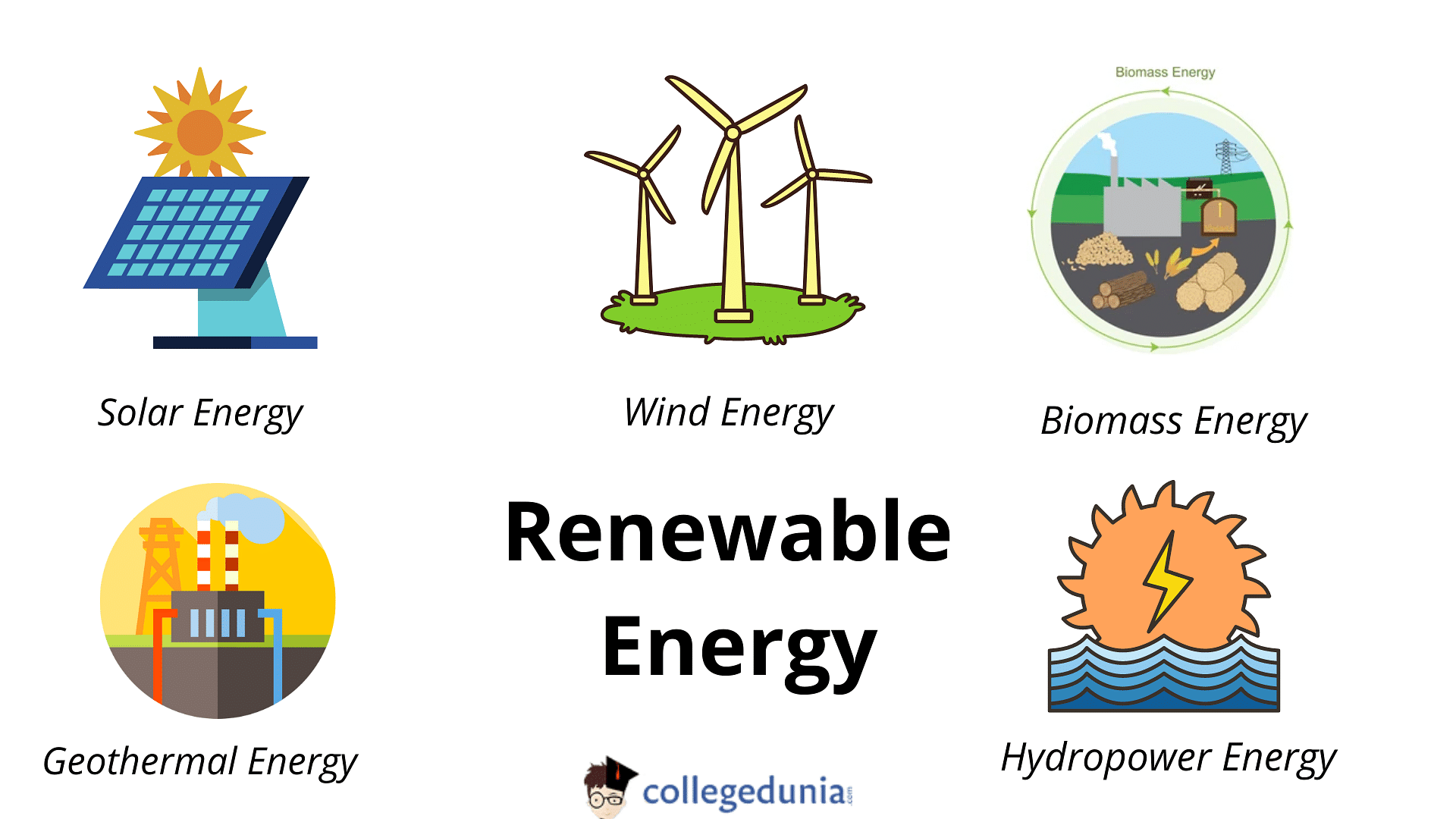
- Examples of renewable resources of energy: Wind energy, Solar Energy, Biomass, Geothermal energy, Tidal Energy, and Hydropower
Solar energy
Our sun is a very essential resource of renewable energy. It produces light internally and does not reflect it onto any other body. For our living world and ecosystem, this sunlight is the most basic source of light and heat.
- The natural light of the sun helps reduce the usage of artificial lights in the daytime.
- It promotes the growth of plants.
- It helps in the production of solar energy which is also utilized as solar thermal energy.
Wind Energy
The wind is one of the abundantly available and environment-friendly sources of energy. The potential of wind can be harnessed through windmills for the generation of wind power or wind energy.
- The blades of the turbine are rotated by the wind which acts as an electric generator in order to produce electricity.
- The turbine transforms or converts the kinetic energy of the wind into mechanical energy.
- The generator further changes the mechanical energy into electricity for daily use.
Hydropower
Water or hydel energy refers to the source of energy derived from the flowing water. The electricity produced through dams is known as hydroelectricity.
- A dam captures the energy from the river's moving water and makes it fall at a greater height.
- The water which is falling then rotates the turbine which powers the generator.
- The dam controls the flow of water and eventually the amount of electricity produced by it.
Read More: Wave Power
Non-Renewable Sources of Energy
Non-renewable sources of energy on the other hand have a significant impact on nature when they are used because they are only available in a limited quantity in nature.
- They are extracted from the Earth in order for non-renewable energy to be utilized and with time eventually, they will run out or get extinguished.
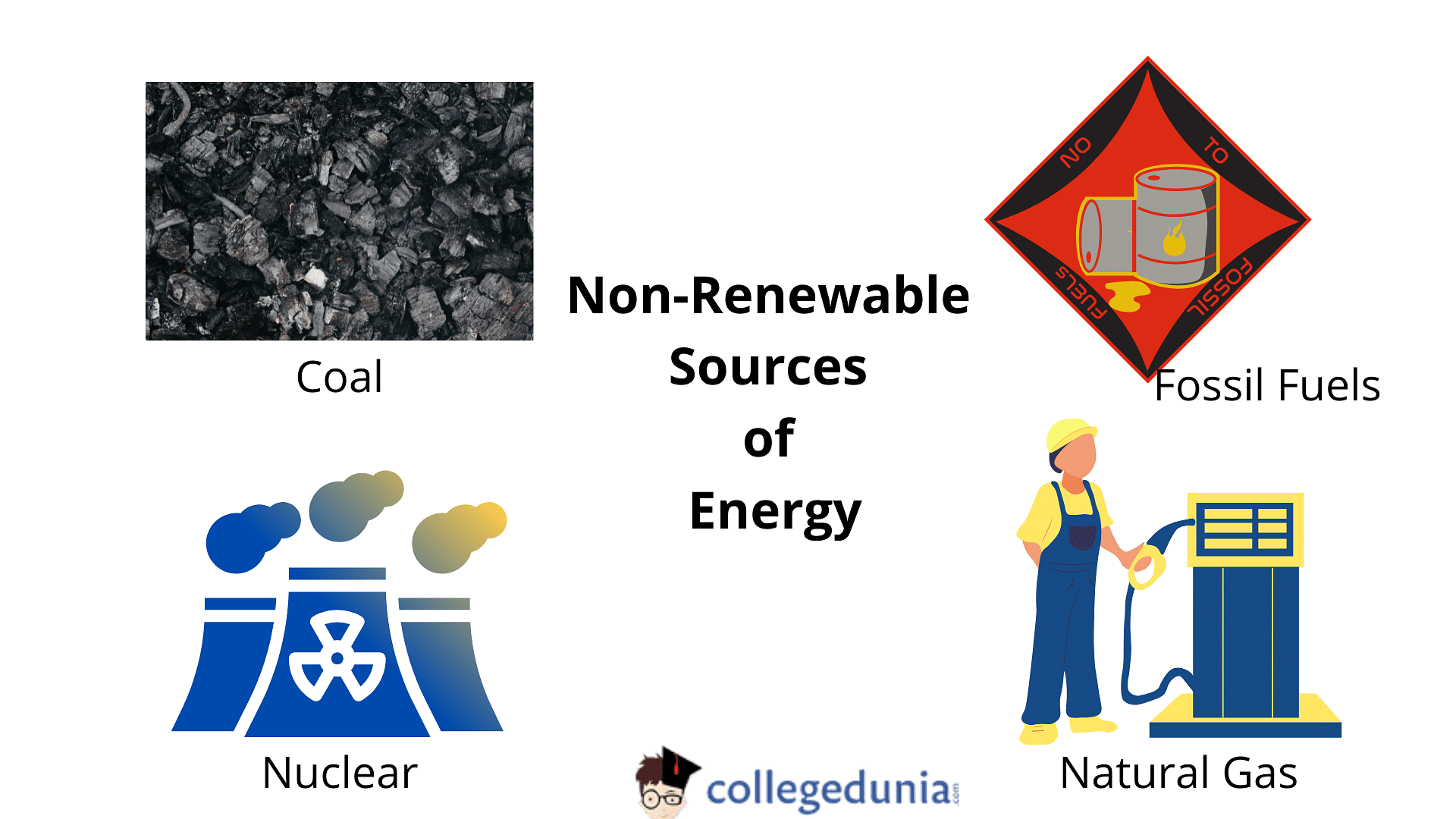
- Examples of non-renewable resources of energy: Coal, petroleum, natural gas, hydrocarbon gas liquids, and nuclear energy
Non-Renewable Sources of Energy
Fossil fuels
Most non-renewable sources of energy comprise coal and petroleum. Fossil fuels are formed as the remains of marine fauna and flora and terrestrial remains which decayed millions of years ago and have eventually got buried in layers that are under a lot of heat and pressure. To produce energy and in turn electricity, most fossil fuels are burnt. Coal is also known as a kind of fossil fuel.
Read More: Advanced Sunrise and Delayed Sunset
Coal
Coal is a rock-like fuel that is black in color. Coal can be burnt in order to generate electricity. It is popularly used at home to make food in the form of domestic fuel. It is mainly formed of hydrogen, carbon, and oxygen. The formation of coal is a result of the decay of vegetation. The production of energy through coal is harmful to the environment as it produces harmful smoke while burning. Coal is formed in four stages which are peat, lignite, bituminous, and anthracite.
Petroleum
Petroleum is a kind of liquid fossil fuel that is very useful in nature. It is composed of various kinds of hydrocarbons. However, the drilled-out petroleum from the oil wells is known as crude oil and it has to go through a process of refining known as fractional distillation. In fractional distillation, various hydrocarbons are separated in order to form various fractions such as paraffin, diesel, kerosene, and petrol. This petrol is used in vehicles as fuel for the purpose of transportation. It is also used in the production of various products such as polyester, tires, and plastics. However, like coal, the burning of petroleum is also harmful to the environment.
Difference between renewable and non-renewable sources of energy
[Click Here for Sample Questions]
The differences between renewable and non-renewable sources of energy are tabulated below:
| Renewable Sources of Energy | Non-Renewable Sources of Energy |
|---|---|
| Renewable sources of energy can be replenished or renewed for use again. | Non-renewable sources of energy are extinguished once used and can not be renewed once again. |
| They are not harmful to the environment as their use does not cause pollution. | They are harmful to the environment as they cause pollution. |
| They are abundantly present in nature and hence are inexhaustible. | As they are available in limited quantities in nature, they are exhaustible. |
| Renewable sources of energy are not affected by human activities. | Non-renewable sources of energy are impacted by human activities. |
| Examples include water, air, and solar energy | Examples include coal, oil, and minerals |
Read More: Mass-Energy and Nuclear Binding Energy
Natural sources of energy
[Click Here for Sample Questions]
Natural sources of energy are abundantly available to us and provide us with a huge amount of energy. For instance, during the stone age, wood was the most popular energy source. In the iron age, coal was used and now fossil fuels and natural gas are used in abundance.
Properties of good sources of energy
A good source of energy has the following characteristics:
- They are easy to transport
- They do not or in a minimal way pollute the environment
- They are economical
- They have optimum production of heat per unit of mass or volume used.
There was a shift from the use of coal to fossil fuels as it was difficult to transmit from one place to another in the world. Petroleum is better than fossil fuels in all the parameters of good fuel and therefore it replaced the usage of coal in present times.
Types of Natural Sources of Energy
[Click Here for Sample Questions]
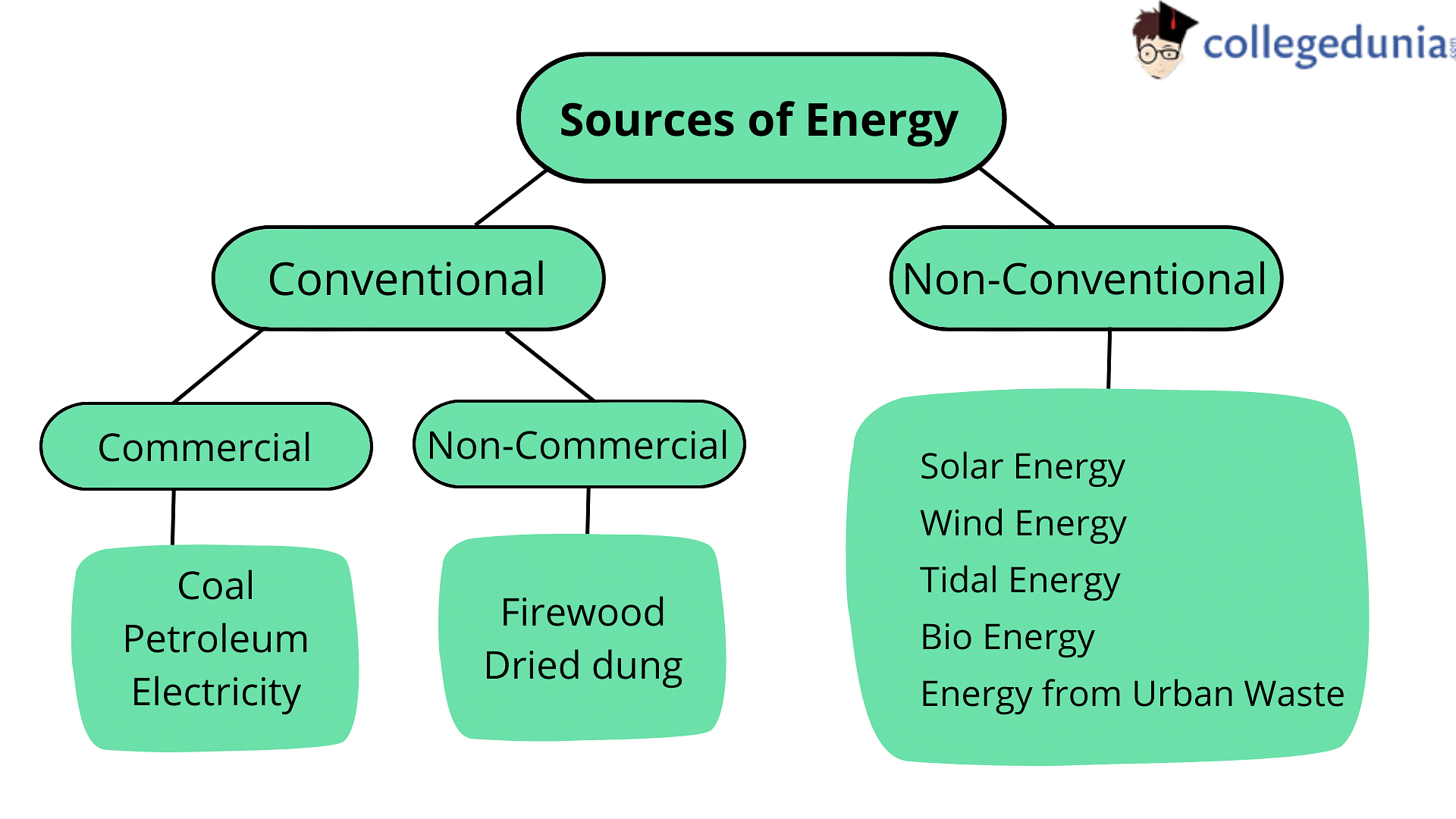
On the basis of their use and their popularity, there are two types of classification of natural sources of energy which are as follows
- Conventional energy sources
- Non-conventional energy sources
Classification of natural sources of energy: Conventional and Non-Conventional sources of energy
Difference between conventional and non-conventional sources of energy
The difference between conventional and non-conventional sources of energy are as follows:
| Conventional Sources of Energy | Non-Conventional Sources of Energy |
|---|---|
| Conventional sources of energy have been in use for a longer duration of time in nature. | Non-conventional sources of energy are the energy sources that are still in the development stage over the last few years. |
| These resources can get extinguished faster and hence are exhaustible. | These sources are abundant and hence are inexhaustible |
| They are not very economical as they are quite expensive to store, transmit or maintain. | These resources are economical as they are less expensive to store, maintain or even transport. |
| Conventional sources of energy emit ash and smoke into the environment and therefore they can cause pollution. | Non-conventional sources of energy do not cause any harm to the environment as they don't cause pollution. |
| Examples include natural gas, solar power, petroleum, and coal. | Examples include wind energy, solar, tidal, biogas, biomass, and geothermal energy. |
Read More:
Things to Remember
- Energy is a property of any system through which it performs. It can not be created or destroyed, it can only be transferred from one system to another.
- A renewable energy source is a natural resource that practically has no impact on nature.
- Non-renewable sources of energy on the other hand have a significant impact on nature when they are used because they are only available in a limited quantity in nature
- Natural sources of energy are abundantly available to us and provide us with a huge amount of energy.
- Conventional sources of energy have been in use for a longer duration of time in nature and are exhaustible.
- Non-conventional sources of energy are the energy sources that are still in the development stage over the last few years and are inexhaustible.
Sample Questions
Ques. State some sources of energy. (3 marks)
Ans. Some examples of sources of energy are as follows:
- Wind energy
- Geothermal Energy
- Biofuel Energy
- Tidal Energy
- Solar Energy
- Hydropower
- Nuclear Energy
Ques. Why are renewable sources of energy referred to as non-conventional energy sources? (3 marks)
Ans. For a long time, non-renewable sources such as petroleum, natural gas, and coal have been used in our country traditionally to meet the needs for energy. However as the population is increasing, so are the energy needs. The technologies are becoming advanced and research is performed on the production of natural energy such as wind and sunlight. Since these technologies are now only coming into use and are developed recently, they are still not completely adopted in practice and therefore these renewable energy sources are referred to as non-conventional sources of energy.
Ques. State the pros and cons of wind energy. (5 marks)
Ans. Wind energy is a renewable source of energy. Its pros and cons are as follows:
Pros
- It is one of the cleanest sources of energy.
- In its application, no harmful gas is released into the environment.
- Local communities can generate revenue through the generation of wind energy.
Cons
- The storage of wind energy becomes a little difficult and needs improvement.
- The initial setup for wind power requires a lot of investment.
- Various areas of land would be used for its generation.
Ques. How can a pollution-free energy source still contribute to pollution in the environment? (2 marks)
Ans. Energy sources can be pollution-free. However, their production or transformation into something that can be used will have a certain impact on the environment
For instance: solar energy is a pollution-free resource of energy however, its installation setup impacts the environment and therefore causes a certain amount of damage to the environment.
Also, in the case of nuclear energy, though there are no waste products produced which are harmful to the environment, the temperature at which the fusion reactions start are 107 K, which is given by fission reactions and the waste that is produced by fission reactions is extremely toxic and harmful to the environment.
Ques. What are the main sources of energy used in India? (1 mark)
Ans. In India, the main sources of energy that are used for commercial purposes are natural gas, oil, and coal.
Ques. What can be referred to as good fuel? (2 marks)
Ans. A good fuel can be defined as:
- It produces lots of heat when it is burnt.
- It does not produce a huge amount of smoke.
- It is available easily.
Ques. What are the characteristics of a good source of energy? (5 marks)
Ans. A good source of energy has the following characteristics:
- It produces a huge amount of heat per unit of volume or mass
- It is accessed easily
- A good source of energy is easy to store
- It can be transmitted easily
- It is economical
- A good source of energy is safe for the environment
Ques. State a few disadvantages of fossil fuels. (3 marks)
Ans. The disadvantages of fossil fuels are as follows:
- The burning of fossil fuels such as petroleum and coal releases a lot of harmful pollutants in the air contributing to air pollution.
- The oxides of sulfur, nitrogen, and carbon are released through fossil fuels. These harmful gases when mixed with air and rain result in the phenomenon of acid rain.
- The harmful gases released by the burning of fossil fuels also contribute to global warming.
Ques. How has the use of water and wind energy been modified? (5 marks)
Ans. Traditionally, in earlier times, waterfalls were mainly used as a source of potential energy. This energy was then converted into the form of electricity with the help of turbines. Now since the availability of waterfalls is limited on Earth, there has been a large-scale construction of dams. These hydro dams are used for the purpose of harnessing the stored water’s potential energy. In these hydro dams, the water is made to fall from a certain height upon the turbines which are then rotated and in turn generate electricity.
To extract wind energy, traditionally the windmills were used to perform mechanical work which includes lifting water from a well. Nowadays, windmills are used in order to generate electricity. The windmill harnesses the kinetic energy of the wind and then transforms it into electricity as the wind rotates the blades of the turbine that powers the electric generator.
Ques. What are the limitations of energy derived from water? (3 marks)
Ans. The various forms of energy that are derived from oceanic water are wave energy, tidal energy, and ocean thermal energy. The limitations in harnessing these types of energies are as follows:
- To convert tidal energy into electricity, huge dams that are built at a greater height are required.
- Tidal energy also depends on Earth's relative positioning with respect to the sun and the moon.
- For harnessing wave energy, very strong waves are required.
- In order to efficiently transform the ocean thermal energy, the difference in temperature between the surface water which is hot, and the water present in-depth which is cold must be either 20°C or more than that.
Also Read:



Comments