



Content Curator
A closed two-dimensional planar shape with three sides and three angles that has three sides, and three angles is called a triangle. Different kinds of triangles can be created based on the sides and interior angles of a triangle, and Obtuse-angled triangle is one of them. Obtuse-angled triangle is formed when one of the internal angles of the triangle is obtuse (i.e., more than 90°) and other two angles are always less than 90°. Hence, the angle sum property of the triangle remains the same. The circumcentre and orthocentre of Obtuse-angled triangle lies outside the triangle.
Read more: Congruence of Triangles
| Table of Content |
Key Terms: Interior Angles, Angle Sum Property, Perpendicular, Concurrency, Orthocentre, Circumcentre, Incentre, Heron's Formula
Definition of Obtuse Angled Triangle
[Click Here for Sample Questions]
Obtuse-angled triangle or obtuse triangle is a triangle in which one of the angles is an obtuse angle or more than 90 degrees. The inner angles of an obtuse triangle are all equal to 180 degrees. This indicates that every triangle's angle sum attribute remains the same. As a result, if one angle is obtuse or greater than 90 degrees, the other two angles are either acute or less than 90 degrees.
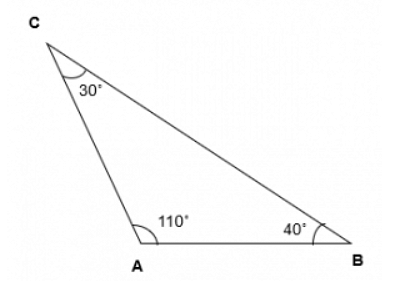
Obtuse Angled Triangle
Also Read: Acute Angled Triangle
Formulas of Obtuse Angled Triangle
[Click Here for Sample Questions]
The perimeter and area of an obtuse triangle are calculated using separate methods. Let's take a closer look at each of the formulae.
- Perimeter of Obtuse Angled Triangle
The perimeter of an obtuse triangle is equal to the sum of its sides' measurements. As a result, the perimeter of Obtuse-angled triangle is calculated using the formula:
Perimeter of obtuse-angled triangle = (a + b + c) units
- Area of Obtuse Angled Triangle
A perpendicular line is formed outside of the triangle where the height is determined to find the area of an obtuse triangle. Because one of the angles in an obtuse triangle is more than 90 degrees. Once we have the height, we can use the formula below to calculate the area of an obtuse triangle.
A triangle has three altitudes from the three vertices to the opposing sides in the supplied obtuse triangle ABC. An obtuse triangle's altitude, or height from the acute angles, is outside the triangle.
Hence,
Area= ½ (base) x (height)
- Area using Heron’s Formula
The area of an obtuse triangle can also be calculated using the Heron’s Formula. Consider the triangle ABC, which has sides a, b, and c of different lengths.
The area of an obtuse triangle may be calculated using Heron's formula:
ss-as-bs-c
Here, (a + b + c) is the triangle's perimeter and S is the semi-perimeter (s): (a + b + c)/2
Read Also: trigonometric ratios definition formula and examples
Finding an Obtuse Angled Triangle
[Click Here for Sample Questions]
It is simple to determine if a triangle is an obtuse triangle or not if any two angles of the triangle are given. But to determine whether a triangle is an obtuse angled through the three sides, an inequality along the lines of Pythagorean identity can be used.
If the total of the squares of the lesser sides is less than the square of the greatest side, the triangle is an obtuse triangle. If the lengths of the sides of triangle ABC are a, b, and c, and c is the greatest side, the triangle is obtuse.
a2 + b2 < c2
Properties of Obtuse Angled Triangle
[Click Here for Sample Questions]
Each triangle has its unique set of characteristics that characterize it. There are four main properties of an obtuse triangle.
- A triangle's longest side is the side opposite the obtuse angle. Consider the ABC, where side BC is the longest and the obtuse angle A is the shortest.
- There can only be one obtuse angle in a triangle. All the inner angles add up to 180 degrees. One of the angles in an obtuse triangle is more than 90 degrees. If one of the angles is 91 degrees, the total of the other two angles will equal 89 degrees. As a result, because the total of all the angles cannot exceed 180 degrees, a triangle cannot have two obtuse angles.
- In an obtuse triangle, the sum of the other two angles is always less than 90 degrees. The sum of a triangle's angles is 180 degrees, according to the angle sum property. As a result, angle 1 + angle 2 + angle 3 = 180°, and angle 1 > 90°. After subtracting the first two, we get angle 2 + angle 3< 90°.
- Obtuse-angled triangle's circumcentre and orthocentre are located outside the triangle. In an obtuse triangle, the orthocentre (O), the point where all a triangle's altitudes connect, is outside.
Read Also: Quadratic equations formula definition methods and examples
Things to Remember
[Click Here for Sample Questions]
- A triangle with one interior angle larger than 90 degrees is called an obtuse triangle. The triangle is called Obtuse-angled triangle if one of its inner angles is more than 90 degrees.
- Obtuse-angled triangle can be a scalene or isosceles triangle, but it can never be equilateral since an equilateral triangle has equal sides and angles, each measuring 60 degrees.
- Other than the obtuse angle, the total of the two angles is less than 90 degrees.
- The longest side of the triangle is the side opposite the obtuse angle.
- The circumcentre and orthocentre, which are points of concurrency, are on the outside of an obtuse triangle, whereas the centroid and incentre are on the interior.
Also Read: Pascal’s Triangle, Construction of Triangles
Sample Questions
Ques. Calculate the height of Obtuse-angled triangle with an area of 60 in2 and a base of 8 in. (2 marks)
Ans. Area of an obtuse angled triangle= ½ x base x height
Hence, height = (2 x area)/ base
height= (2 x 60)/ 8
height = 15 inches
Ques. In a given triangle ABC, angle A+ angle B < 90 degrees and AC2 + BC2 < AB2. What type of triangle can ABC be? (2 marks)
Ans. Through the inequality along the lines of Pythagorean identity, the triangle is obtuse if the sum of the squares of the lesser sides is smaller than the square of the largest side. The triangle ABC is obtuse if the lengths of the sides are a, b, and c, with c being the biggest side.
Hence, a2 + b2 < c2 is an obtuse angled triangle
Ques. Is it possible to make an obtuse triangle with sides of 3 inches, 4 inches, and 6 inches? (5 marks)
Ans. The sum of the squares of any two sides of an obtuse triangle should be smaller than the square of the third side.
As, a= 3 inches, b= 4 inches, and c= 6 inches
a2= 9, b2= 16 and c2= 36
a2 + b2 < c2 is an obtuse angled triangle
9 + 16 < 36
The measurements may be used to make the sides of an obtuse triangle. As a result, the sides of an obtuse triangle can be 3 inches, 4 inches, and 6 inches.
Ques. Is there a triangle with sides that are 10.2 cm, 5.8 cm, and 4.5 cm in length? (3 marks)
Ans. Assume that such a triangle exists. The lengths of any two sides would therefore add up to more than the length of the third side.
4.5 + 5.8 >10.2 is a triangle
5.8 + 10.2 > 4.5 is a triangle
And 10.2 + 4.5 > 5.8 is a triangle
Hence, the triangle with the above-mentioned measurements is possible.
Ques. Two of a triangle's sides are 6 cm and 8 cm long. Which two integers may the length of the third side lie between? (3 marks)
Ans. We know that the sum of two triangle sides is always bigger than the total of the third. As a result, the third side must be smaller than the total of the two sides. As a result, the third side is smaller than 8 + 6 = 14 cm.
The difference between the two sides cannot be smaller than the side. As a result, the third side must be greater than 8 – 6 = 2 cm.
The length of the third side might be anywhere between 2 and 14 cm.
Ques. Which of the angles below may be used to make Obtuse-angled triangle? (2 marks)
a) 60°, 70°, 50° b) 95°, 30°, 55° c) 89°, 45°, 46° d) 90°, 60°, 30°
Answer: One of the vertex angles of Obtuse-angled triangle is obtuse (> 90°). Option (b) is the only one that meets the requirement. As a result, option b, 95 degrees, 30 degrees, and 55 degrees, creates an obtuse triangle.
Ques. Calculate the area of a triangle with two sides of 18 cm and 10 cm and a perimeter of 42 cm. (5 marks)
Ans. The triangle's three sides are a = 18 cm, b = 10 cm, and "c" cm.
Perimeter of the triangle is 42cm
So, 42 = 18 + 10 + c
14 cm = 42 – (18 + 10) cm
The semi-perimeter (s) of a triangle is 42/2 = 21 cm.
Using Heron's formula,
ss-as-bs-c
2121-1821-1021-14
2111 cm2
Ques. Find the value of third side x, if the perimeter of an isosceles triangle is 40 cm with equal sides being 2x – 5. (5 marks)
Ans. Perimeter of the triangle= 40 cm
Perimeter = a+b+c
40= (2x-5)+(2x-5)+x
5x-10= 40
5x=50
x=10
Hence, x pr the length of the third side is 10 cm.
Ques. Is it possible to have two obtuse angles that are supplementary? (2 marks)
Ans. Two obtuse angles, each more than 90°, cannot form a supplementary pair of angles since the aggregate is greater than 180°, which contradicts the definition of supplementary angles.
Ques. Why is it impossible to form a triangle with sides of 3 cm, 4 cm, and 8 cm? (3 marks)
Ans. We know that if the total of any two sides of a triangle is always more than the sum of the third side (greater side), then the triangle may be built.
We can see that 3 cm + 4 cm < 8 cm for measurements of 3 cm, 4 cm, and 8 cm.
As a result, it is not possible to build a triangle with sides of 3 cm, 4 cm, and 8 cm.
Read Also:



Comments