



Education Journalist | Study Abroad Lead
Structural formula of an organic compound is the graphical representation of the arrangements of the atoms of the molecule in a three-dimensional space where chemical bonding is also depicted implicitly or explicitly. There are various different ways of depicting the structural formulas of organic compounds. Lewis structure, Condensed structural formula and skeletal formula are some of the methods used widely to represent and understand the spatial arrangement of atoms in the organic molecules.
Key Terms: Organic Compounds, Lewis Structures, Structural formulas, Condensed structural formula, Skeletal formula, Stereochemistry
Read More : Concepts in Chemistry
What is an Organic Compound?
[Click Here for Sample Questions]
Organic compounds fundamentally are those chemical compounds that contain any kind of carbon-hydrogen bond. Carbon has a fascinating property called catenation that allows it to quickly form bonds with any given elements it interacts with. The specific branch of chemistry that deals with properties, synthesis, reactions etc. of such organic compounds is called Organic Chemistry.
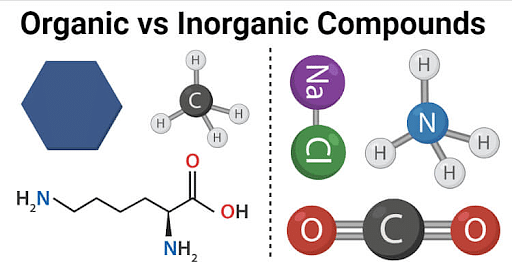
Organic and Inorganic Compounds
Organic compounds can be natural or synthetic. Natural organic compounds are those which are directly extracted from natural resources such as petrochemicals. These compounds do not occur in a large quantity in the earth strata but they are a fundamental chemical constituent of living beings. On the other hand, synthetic ones are synthesized using the known reactions of other compounds. There are certain examples of organic compounds like ethanol and insulin which are manufactured using microorganisms.
The video below explains this:
Organic Compound Detailed Video Explanation:
Read More:
Structural Representation of Organic Compounds
[Click Here for Sample Questions]
Structural formula of an organic chemical compound is the graphical representation of the arrangements of the atoms of the molecule in a three-dimensional space. The chemical bonding is also shown implicitly or explicitly. Structural formulas give a more comprehensive geometric representation of the molecular structure of the organic compound. Thus, we can easily distinguish between the chemical compounds with the same chemical formulas but different structural orientations.

Organic Compounds structural representation
Structurally the organic compounds can be depicted in different ways:
- Lewis structures
- condensed structure formulas
- Bond-line structural formula
Lewis Structures
Lewis structure or Lewis dot structures are flat graphical representations that show atom connectivity and lone pair or unpaired electrons. It is not a three-dimensional structure. This formula is usually used for small organic molecules. Here, each of the lines represents two electrons of a single bond while two or three parallel lines between pairs of atoms represent double and triple bonds respectively. All the non-bonded paired or unpaired electrons or any other charges are also indicated.

Lewis dot structure of Water
Read More:
Condensed Structural Formula
[Click Here for Sample Questions]
The condensed structural formula is a typographic system arose to describe organic structures in a line of text. It is a convenient way of representing simple chemical structures however, its use is limited while representing the cyclical molecules.
Eg: CH3CH2OH (ethanol)
Here, parentheses are also used to show multiple identical groups, usually indicating attachment to the nearest non-hydrogen atom on the left when appearing within a condensed structural formula.
Eg: (CH3)2CHOH or CH(CH3)2OH (2- propanol)
Read More:
Skeletal Formula
[Click Here for Sample Questions]
Skeletal formulas are another standard way of representing complex organic molecules. Here, the carbon atoms are implied to be located at the vertices or corners and end of the line segments rather than being indicated with the letter ‘C’. Hydrogen atoms attached to carbon atoms are not indicated. However, the hydrogen atoms attached to atoms other than carbon atom must be mentioned explicitly. Here, each of the carbon atoms is thought to be associated with hydrogen atoms to give the carbon atom its four bonds.

Skeletal formula of Isobutanol (CH3)2CHCH2OH
Read Also: Carbonyl Compounds
Stereochemistry: 3D Representation of Organic Molecules
[Click Here for Sample Questions]
There are several ways to represent the three-dimensional structure of the organic molecules. These three-dimensional arrangement of atoms in a molecule is called stereochemistry.
Stereochemistry in Skeletal Formula
The chirality of an organic compound can be represented by Natta Projection method. Here, solid wages showcase bonds pointing above the plane of the paper while dashed wages are indications of bonds pointing below the plane.

Skeletal formula of Strychnine
Unspecified Stereochemistry
Wavy single bonds represent unspecified stereochemistry or sometimes a mixture of isomers.

Fructose
The above diagram shows the fructose molecule with a wavy bond to HOCH2 group. The wavy bond represents the bond of unspecified characteristics.
Read More:
Things to Remember
- Organic compounds are those chemical compounds that contain any kind of carbon-hydrogen bond.
- The catenation property of the carbon atoms allows the formation of organic compound formation.
- Structure formula refers to the graphical representation of the arrangements of the atoms of the molecule in a three-dimensional space.
- Lewis structures are two-dimensional flat graphical representations that show atom connectivity and lone pair or unpaired electrons.
- Each line represents two electrons of a single bond while two or three parallel lines between pairs of atoms represent double and triple bonds respectively.
- Condensed structural formula is a typographic system used to describe organic structures in a line of text. It is of limited use in representing cyclical structures.
- In the case of skeletal formula, the carbon atoms are implied to be located at the vertices or corners and end of the line segments while “C” is never written. However, the hydrogen atoms are indicated.
Read More:
Sample Questions
Ques: What is catenation? (2 marks)
Ans: In Chemistry catenation refers to the bonding of the atoms of the same element in a series, also known as a chain. A chain can be ring-shaped or open-ended if its ends are not bonded.
Ques: What is Lewis Structure? (2 marks)
Ans: Lewis structures are 2-D flat graphical representations that show atom connectivity and lone pair or unpaired electrons. Here, each line represents two electrons of a single bond while two or three parallel lines between pairs of atoms represent double and triple bonds respectively.
Ques: what do you mean by stereochemistry? (2 marks)
Ans: The three-dimensional arrangement of atoms in a molecule is called stereochemistry. It shows the interior of a molecule.
Ques: “ No atom is shown while representing chemical structure in the bond-line formula” True or false? Cite reason. (2 marks)
Ans. False.
In the case of bond-line representation, only carbon and hydrogen atoms are not depicted. But other atoms such as nitrogen, oxygen, chlorine etc. are shown.
Ques: What is condensed structural formula? (2 marks)
Ans: Condensed structural formula refers to a typographic system used to describe organic structures in a line of text. It is a convenient way of representing simple chemical structures.
Ques: what is a structural formula? (2 marks)
Ans: Structure formula of a chemical compound is the graphical representation of the arrangements of the atoms of the molecule in a three-dimensional space. It helps us to comprehend what a chemical compound would look like in a 3-D space.
Ques: What is Natta projection? (2 marks)
Ans: Natta projection is a useful way of representing molecule stereochemistry in the 2D skeletal formula. Here, in a hydrocarbon, the carbon atoms make up the backbone in a tetrahedral molecular geometry. Chemical bonds are represented as solid wages (bonds towards the viewer) or dashed wages (away from the viewer).
Ques: What is Newman projection? (2 marks)
Ans: In a Newman projection, the conformation of a chemical bond is visualized from front to back. The front atom is represented by a dot and the back atom is represented by a circle. The front atom is called proximal and the back atom is called distal.
Ques: What is Haworth projection? (2 marks)
Ans: A Haworth projection is used to represent cyclic structure of monosaccharides with a simple 3D perspective. It is mostly used in organic chemistry especially biochemistry.
Ques: What is Fischer projection? (2 marks)
Ans: Fischer projection is a two-dimensional representation of a three-dimensional molecule by projection. It is usually used to depict carbohydrates but is generally used in biochemistry.
Related Links:



Comments