




CBSE Class 12 Physics Exam Pattern 2027 is expected to continue the established structure, with a 70-mark theory paper and a 30-mark practical assessment, making 100 marks in total.
| Check the CBSE Class 12 Physics Exam Pattern 2027 |
- The theory examination is conducted for 3 hours in offline pen-and-paper mode.
- The Physics theory paper carries 70 marks, while 30 marks are allotted to practical/internal assessment.
- The CBSE 12th Physics Exam Pattern 2027 includes a mix of MCQs, assertion-reasoning, short-answer, case-based, and long-answer questions.
- The paper tests students’ conceptual understanding, numerical-solving skills, and ability to apply Physics concepts.
- Optics (14 marks), Electrostatics (10 marks), Magnetic Effects & Magnetism (11 marks), and Modern Physics & Electronic Devices (19 marks) are the major scoring blocks in the current blueprint.
- Ray Optics [10 marks (14.3%)], Current Electricity [6 marks (8.6%)], Moving Charges & Magnetism [6 marks (8.6%)], Electrostatics [10 marks (14.3%)], Semiconductor Electronics [7 marks (10%)], Atoms & Nuclei [8 marks (11.4%)], Electromagnetic Induction [4 marks (5.7%)] have featured prominently across recent CBSE papers and PYQ analyses, making them priority areas for preparation.
- The paper assesses conceptual clarity, numerical-solving ability, application of formulas, interpretation of situations and scientific reasoning.
- For practical assessment, students are evaluated through experiments, activities, project work, practical record and viva, making regular laboratory preparation important.
Related Links:
- CBSE Class 12 Physics Syllabus 2026-2027: Chapter-Wise Overview & Key Derivations
- CBSE Class 12 Chemistry Syllabus 2026-2027: Important Topics & Practical Guidelines
- CBSE Class 12 Biology Syllabus 2026-27: Check Practical Syllabus, Weightage, Books, and Download PDF
- CBSE Class 12 Maths Syllabus 2026-27: Download PDF, Check Weightage, Topics, and Books
CBSE Class 12 Physics Exam Pattern 2027 Overview
In the 2026 session, the CBSE also rolled out On-Screen Marking system for Class 12 evaluation and results. Results were declared on May 13 with an overall pass rate near 88%.
The CBSE Physics Exam Pattern 2027 is expected to continue emphasising structured evaluation through a mix of conceptual, numerical, and application-based questions.
| Particulars | Details |
|---|---|
| Total Marks | 100 |
| Theory Paper | 70 marks |
| Practical Exam | 30 marks |
| Exam Duration (Theory) | 3 hours |
| Exam Mode | Pen and paper |
| Passing Marks (Theory) | 33% |
| Passing Marks (Aggregate) | 33% |
| Competency-Based Questions (CBQs) | ~50% of theory paper |
| Select-Response MCQs | ~20% of theory paper |
| Short/Long Answer Questions | ~30% of theory paper |
| Negative Marking | None |
| Calculator Use | Not permitted |
| Theory Exam Window | February 17 – April 9, 2026 |
| Practical Exam Window | January 1 – February 14, 2026 |
| Evaluation Mode | On-Screen Marking (OSM) for Class 12 |
| Result Declared | May 13, 2026 |
Also Read:
What’s New in CBSE Class 12 Physics Exam Pattern 2027?
- Nothing new has been announced in the structure of CBSE Class 12 Physics pattern for the 2026‑27 session.
- The current format continues as is.
- Since 2023, CBSE has increased Competency-Based Questions (CBQs), including case-, source-, data-based, and assertion-reasoning questions.
- CBSE set 50% competency-focused, 20% MCQ, and 30% short/long-answer questions for Classes 9-12, up from 30% to 40% to 50% over three sessions.
Section-wise CBSE Class 12 Physics Exam Pattern 2027
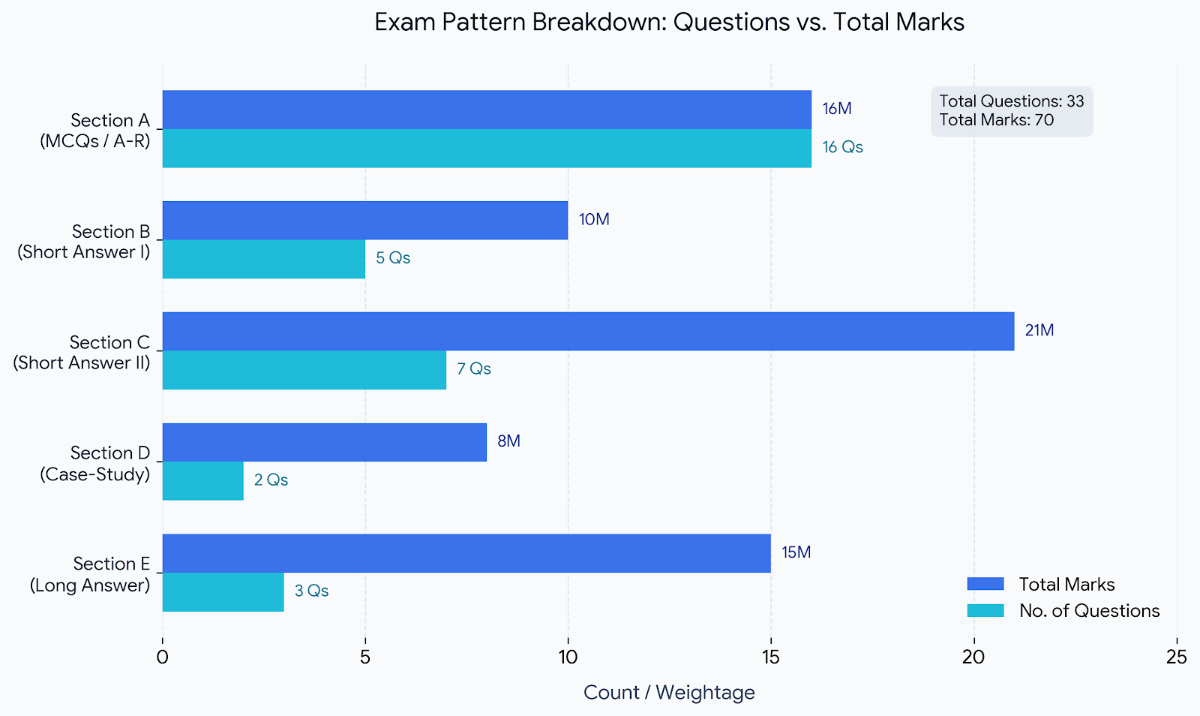
The CBSE 12th Physics Pattern comprises a 70-mark theory paper with 33 questions divided into five sections.
The question paper contains 33 compulsory questions split across five sections:
- Section A: 16 questions (12 Multiple Choice Questions and 4 Assertion-Reasoning questions) worth 1 mark each.
- Section B: 5 short-answer questions worth 2 marks each.
- Section C: 7 short-answer questions worth 3 marks each.
- Section D: 2 case study-based questions worth 4 marks each.
- Section E: 3 long-answer questions worth 5 marks each.
| Section | Question Type | No. of Questions | Marks Each | Total Marks |
|---|---|---|---|---|
| A | MCQs / Assertion-Reason | 16 | 1 | 16 |
| B | Short Answer (Type I) | 5 | 2 | 10 |
| C | Short Answer (Type II) | 7 | 3 | 21 |
| D | Case-Study/Sources-Based | 2 | 4 | 8 |
| E | Long Answer | 3 | 5 | 15 |
| Total | 33 | 70 |
Has the Subject-wise question distribution trend changed in past years?
The CBSE Physics question pattern has increasingly emphasised competency and application-based assessment, with competency-based questions reaching 50% in 2025.
- 2024: CBSE continued its focus on competency-based questions, with 40% competency-based, 20% MCQs, and 40% short/long-answer questions.
- 2025: Competency-based questions increased to 50%, placing greater emphasis on application and real-world understanding.
- 2026: The pattern included 20% MCQs, 30% case/source-based questions, and 50% short- and long-answer questions.
| Year | MCQs | Competency/Case-Based Questions | Short & Long-Answer Questions |
|---|---|---|---|
| 2024 | 20% | 40% | 40% |
| 2025 | — | 50% | 50% |
| 2026 | 20% | 30% | 50% |
Physics Class 12 Syllabus: Weightage to Different Topics
The unit-wise marks distribution of the Physics subject is provided below.
| Unit No. | Name of Unit | Marks |
|---|---|---|
| Unit–I | Electrostatics | 16 |
| Chapter–1: Electric Charges and Fields | ||
| Chapter–2: Electrostatic Potential and Capacitance | ||
| Unit-II | Current Electricity | |
| Chapter–3: Current Electricity | ||
| Unit-III | Magnetic Effects of Current and Magnetism | 17 |
| Chapter–4: Moving Charges and Magnetism | ||
| Chapter–5: Magnetism and Matter | ||
| Unit-IV | Electromagnetic Induction and Alternating Currents | |
| Chapter–6: Electromagnetic Induction | ||
| Chapter–7: Alternating Current | ||
| Unit–V | Electromagnetic Waves | 18 |
| Chapter–8: Electromagnetic Waves | ||
| Unit–VI | Optics | |
| Chapter–9: Ray Optics and Optical Instruments | ||
| Chapter–10: Wave Optics | ||
| Unit–VII | Dual Nature of Radiation and Matter | 12 |
| Chapter–11: Dual Nature of Radiation and Matter | ||
| Unit–VIII | Atoms and Nuclei | |
| Chapter–12: Atoms | ||
| Chapter–13: Nuclei | ||
| Unit–IX | Electronic Devices | 7 |
| Chapter–14: Semiconductor Electronics: Materials, Devices and Simple Circuits | ||
| Total | 70 |
CBSE Class 12 Physics Exam Pattern 2027: Topic-wise Weightage (Last 5 Years' Trend)
Optics has been the most consistent high-weightage area for 5 years in CBSE Physics Paper Pattern 2027, with Ray Optics contributing the highest chapter-wise share.
- Electrostatics, Current Electricity and Magnetism form a stable core, contributing roughly 22–27 marks each year.
- Electromagnetic Induction & AC is rising in recent years, with more case-based and application questions reflecting the CBQ shift.
- Semiconductor Electronics and Atoms & Nuclei show low variance, with just 1–2 mark shifts yearly, making them reliable scoring chapters.
| Chapter/Unit | Consistent 5-Year Trend | Approx. Weightage |
|---|---|---|
| Ray Optics & Optical Instruments | Highest-weightage single chapter every year | ~10–14 marks |
| Wave Optics | Consistently paired with Ray Optics for high combined Optics weightage | ~4–5 marks |
| Current Electricity | Stable, high-numerical-density chapter | 6–7 marks |
| Electrostatics | Foundational, consistently 8–10 marks | 8–10 marks |
| Magnetic Effects of Current & Magnetism | Stable across all 5 years | 8–11 marks |
| Electromagnetic Induction & AC | Consistently tested through case-based questions in recent years | 7–8 marks |
| Semiconductor Electronics | Steady weightage, more conceptual than numerical | 7 marks |
| Atoms & Nuclei | Smaller but stable presence every cycle | 5–6 marks |
Also Read: CBSE Class 12 Chapter-Wise Weightage: Check Weightage and Important Topics
CBSE Class 12 Physics Exam Pattern 2027: Practical Exam & Internal Assessment
The 30 marks outside the theory paper are split across practical work, a viva, and record-keeping. These components often decide the difference between a good score and an excellent one, since evaluation here tends to be less competitive than the theory paper.
| Component | Marks |
|---|---|
| Two Experiments (1 from each section) | 8 (4+4) |
| Practical Record (Experiments + Activities) | 6 |
| Viva on Experiments and Activities | 6 |
| Project Work | 3 |
| Viva on Project | 3 |
| Investigatory Project / Activity | 4 |
| Total | 30 |
CBSE Class 12 Physics Exam Pattern 2027: Marking Scheme
CBSE Physics Marking Scheme does not award marks on an all-or-nothing basis for numericals and derivations. The marking scheme follows step-wise evaluation, with marks allotted for each correct stage of the solution. Students can therefore earn partial marks even if the final answer is wrong or incomplete.
| Question Type | Evaluation Approach |
|---|---|
| MCQs / Assertion-Reason | Full marks for the correct option only; no partial credit |
| Short Answer (2–3 marks) | Marks split across concept identification, formula/setup, and final calculation |
| Long Answer / Derivations (5 marks) | Marks awarded stage-wise — for correct assumptions, intermediate steps, diagram (where applicable), and final result |
| Numericals | Marks given for correct formula, correct substitution, and correct final answer with units, even if one step has an error |
| Case-Study/Sources Based | Marks distributed across sub-parts, each evaluated independently on the same passage or dataset |
Is there negative marking in CBSE Class 12 Physics Exam Pattern 2027?
No, the CBSE Class 12 Physics Exam Pattern does not have any negative marking in the Physics theory paper. This has held consistently across recent cycles and is expected to continue unchanged for 2027.
- Every MCQ is worth attempting, even under uncertainty, since there's no penalty for an incorrect option. Leaving a question blank is a guaranteed loss of marks, while an educated guess carries no downside.
- This applies uniformly across question types: MCQs, assertion-reason questions, case-based sub-parts, and constructed-response questions are all evaluated purely on correctness or step-wise credit, never penalized for wrong attempts.
- It doesn't apply to practicals either: The 30-mark practical/internal assessment component follows the same no-penalty principle across viva, record evaluation, and project work.
Also Read: CBSE Class 12 Physics Compartment 2026: High-Weightage Units to Score 33+ Marks
CBSE Class 12 Physics Exam Pattern 2027: Physics vs Chemistry vs Maths Difficulty Comparison
In 2026, Physics was widely seen as the toughest of the three, with a lengthy, calculation-heavy, and concept-driven paper. So for 2027, students should prioritise Physics with conceptual clarity, regular numerical practice, and time-bound mocks, keeping the 2026 exam experience in mind.
| Parameter | Physics | Chemistry | Mathematics |
|---|---|---|---|
| Theory + Practical Split | 70 + 30 | 70 + 30 | 80 + 20 (Internal Assessment) |
| CBQ Weightage | ~50% | ~40–50% | ~40–50% |
| Perceived Difficulty Level | High — conceptual depth + numerical rigor | Moderate — high volume, memory + application mix | High — problem-solving speed critical |
| Historical Pass Percentage Trend | ~82–84% (among the lowest) | Comparatively higher,~85–88% | ~82–84% (among the lowest) |
| Core Challenge | Deriving formulas, applying concepts to numericals under time pressure | Balancing Organic (reaction-heavy), Inorganic (memory-heavy), and Physical (numerical) sections | Lengthy calculations, multiple valid solving methods, time management |
| Numerical vs Theory Weightage | Numerical-heavy (Mechanics, Electricity, Optics) | Mixed — Organic/Inorganic more theory, Physical Chemistry numerical | Almost entirely numerical/problem-based |
| Diagram/Derivation Dependency | High (ray diagrams, circuit diagrams, derivations) | Moderate (reaction mechanisms, structures) | Low (occasional graphs, geometric constructions) |
| Common Student Feedback | "Conceptually tough, numerically demanding" | "Vast syllabus, memory-intensive in parts" | "Time is the biggest constraint, not difficulty" |
CBSE Class 12 Physics Exam Pattern 2027: Passing Criteria & Grading
As per CBSE’s official stream-wise analysis, the Class 12 Science stream recorded a 96.88% pass percentage in 2026, providing a useful benchmark for the 2027 exams.
CBSE does not publish official subject-wise pass rates for Physics; based on historical trends, its pass rate is estimated at around 82–84%, slightly below the overall Class 12 average.
| Criteria | Requirement |
|---|---|
| Minimum marks in Theory | 33% |
| Minimum marks in Practical/Internal Assessment | 33% |
| Minimum aggregate (Theory + Practical combined) | 33% |
| Grading System | 9-point scale (as per latest CBSE reforms) |
| Compartment Eligibility | Applicable if failing in one subject only |
Also Read:
CBSE Class 12 Physics Exam Pattern 2027: On-Screen Marking & Evaluation Process
In 2026, CBSE introduced On-Screen Marking (OSM) for Class 12, replacing physical evaluation to improve transparency, accuracy, and result turnaround time.
| Aspect | Details |
|---|---|
| Applicable To | Class 12 answer scripts (2026 onward) |
| Class 10 Evaluation | Continues in physical mode, unchanged |
| Format | Scanned digital copies of answer sheets assessed on-screen by examiners |
| Objective | Greater consistency, faster processing, reduced evaluation errors |
| Marking Scheme Application | Examiners assess against a structured, standardised digital answer key |
Also Read:
How to Prepare based on CBSE Class 12 Physics Exam Pattern 2027
Your CBSE Class 12 Physics 2027 preparation should focus on conceptual clarity, numerical practice, and competency-based questions. Also, keep the following points in mind while preparing for the exam.
- The first and foremost step is to understand the CBSE Class 12 Physics Exam Pattern and chapter-wise weightage.
- Focus on concepts and derivations, as Physics requires both theoretical understanding and the ability to apply formulas correctly.
- Practise numerical problems regularly, especially from topics involving calculations, to improve speed and accuracy.
- Prepare for competency-based questions, including MCQs, assertion-reasoning, case-based and application-based questions.
- Solve previous years' question papers and sample papers to understand the question format, difficulty level, and marking scheme.
- Your practice plan should include daily numerical practice, formula revision, PYQs, mock tests, and analysis of mistakes.
Revise formulas, practise numericals, solve PYQs, and attempt sample papers regularly to improve your accuracy and confidence for CBSE Class 12 Physics 2027.
How to prepare for CBSE Class 12 Physics Exam in 6 months?
Students should dedicate extra time to high-mark units like Optics and Electrostatics while weaving in CBQ practice and timed mock papers from the start rather than saving them for the final weeks.
Consistent practical file upkeep, step-wise derivation practice, and at least 4–5 full-length timed papers before the exam round out a preparation approach built around the pattern itself.
| Month | Focus Area | Key Activities |
|---|---|---|
| September 2026 | Foundation Units — Electrostatics & Current Electricity |
|
| October 2026 | Magnetic Effects, Magnetism & EMI/AC |
|
| November 2026 | Optics (Ray + Wave) — Highest Weightage Unit |
|
| December 2026 | EM Waves, Dual Nature, Atoms & Nuclei, Electronic Devices |
|
| January 2027 | Practical Exams + Full Syllabus Revision |
|
| February 2027 | Final Revision + Mock Tests |
|
On Reddit, a user is sharing that they are scared for physics boards this year because last year’s paper was tough.

Source: Reddit
There’s no need to panic. CBSE generally does not ask questions outside the prescribed syllabus. The paper can be challenging, but difficulty usually comes from application-based and competency-focused questions. Focus on NCERT concepts, numericals, derivations, PYQs, and sample papers to prepare confidently.
Also Read:
CBSE Class 12 Physics Exam Pattern 2027: Sample Paper
In the final stage of preparation, students should focus on solving CBSE Class 12 Physics sample papers. These papers help students familiarise themselves with the exam pattern, question types, marking scheme, and overall difficulty level, while also improving their time management and accuracy.
| CBSE Class 12 Physics Sample Paper | Download PDF |
|---|---|
| CBSE Class 12 Physics Sample Paper 1 | Click here |
| CBSE Class 12 Physics Sample Paper 2 | Click here |
| CBSE Class 12 Physics Sample Paper 3 | Click here |
| CBSE Class 12 Physics Sample Paper 4 | Click here |
| CBSE Class 12 Physics Sample Paper 5 | Click here |
| CBSE Class 12 Physics Sample Paper 6 | Click here |
| CBSE Class 12 Physics Sample Paper 7 | Click here |
| CBSE Class 12 Physics Sample Paper 8 | Click here |
| CBSE Class 12 Physics Sample Paper 9 | Click here |
| CBSE Class 12 Physics Sample Paper 10 | Click here |
Also Read:
FAQs
Ques. What is the duration and mode of the CBSE Class 12 Physics theory exam 2027?
Ans. The theory paper is conducted offline (pen-and-paper) for 3 hours, with an additional 15 minutes of reading time. Calculators are not allowed.
Ques. How is the CBSE Class 12 Physics question paper structured for 2027?
Ans. The 70-mark theory paper has 33 compulsory questions divided into five sections:
Section A: 16 questions (1 mark each; mostly MCQs + assertion-reasoning) = 16 marks
Section B: 5 questions (2 marks each) = 10 marks
Section C: 7 questions (3 marks each) = 21 marks
Section D: 2 case-study-based questions (4 marks each) = 8 marks
Section E: 3 long-answer questions (5 marks each) = 15 marks
Internal choices are available in selected questions (typically in Sections B, C, and E). There is no overall choice and no negative marking.
Ques. What is the unit-wise weightage in the CBSE Class 12 Physics theory paper 2027?
Ans. The unit-wise weightage of the Class 12 Physics theory paper is as follows:
Units I & II (Electrostatics + Current Electricity): 16 marks
Units III & IV (Magnetic Effects of Current & Magnetism + Electromagnetic Induction and Alternating Currents): 17 marks
Units V & VI (Electromagnetic Waves + Optics): 18 marks
Units VII & VIII (Dual Nature of Radiation and Matter + Atoms and Nuclei): 12 marks
Unit IX (Electronic Devices): 7 marks
Ques. What types of questions are asked in the CBSE Class 12 Physics exam 2027?
Ans. The paper emphasizes competency-based assessment. Roughly 20% are MCQs, around 30% are competency/case/source-based questions, and about 50% are short- and long-answer (descriptive) questions. Typology includes remembering/understanding, applying, analysing, evaluating, and creating skills.
Ques. How are the 30 practical marks distributed in CBSE Class 12 Physics 2027?
Ans.
Two experiments (one from each section): 7 + 7 = 14 marks
Practical record (experiments and activities): 5 marks
One activity from any section: 3 marks
Investigatory project: 3 marks
Viva on experiments, activities, and project: 5 marks
Ques. Is there any change expected in the CBSE Class 12 Physics exam pattern for 2027 compared to recent years?
Ans. The pattern remains consistent with recent years (70 theory + 30 practical, five-section paper structure, similar unit weightage, and focus on competency-based questions). Official sample papers and the detailed syllabus for the 2026-27 session confirm continuity with minor refinements in question typology emphasis.
Ques. Are internal choices and overall choices provided in the Physics paper?
Ans. There is no overall choice. Internal choices are provided in a few questions (commonly two in Section B, one in Section C, and all three in Section E). Students must attempt only one option where a choice is given.
Ques. What is the passing criteria for CBSE Class 12 Physics 2027?
Ans. A student must secure at least 33% marks in the theory paper, 33% in the practical exam, and 33% in the aggregate of theory + practical to pass the subject.
Ques. Where can students find the official CBSE Class 12 Physics syllabus, sample papers, and detailed exam pattern for 2027?
Ans. Students should refer to the official CBSE website (cbse.gov.in or cbseacademic.nic.in) for the latest syllabus PDF, sample question papers, and marking schemes for the 2026-27 academic session (board exams in 2027). Reliable educational portals also publish unit-wise and practical details based on the official curriculum.



Comments