




The CBSE Class 12 Physics marking scheme for 2026-27 carries 100 marks in total, with a 70-mark theory paper of 3 hours and 30 marks for practicals.
- Theory paper: The CBSE Class 12 Physics paper has 33 questions divided into five sections (A to E), with internal choice in selected questions of Sections B, C and E.
- Highest weightage: Units V and VI (Electromagnetic Waves and Optics) carry 18 marks, while Units I to VI together account for 51 out of 70 marks (about 73%).
- By knowing the chapter-wise Physics marking scheme, students can prioritize high-mark topics like Electrostatics, Optics, and Electromagnetic Induction while quickly revising smaller units for balanced preparation.
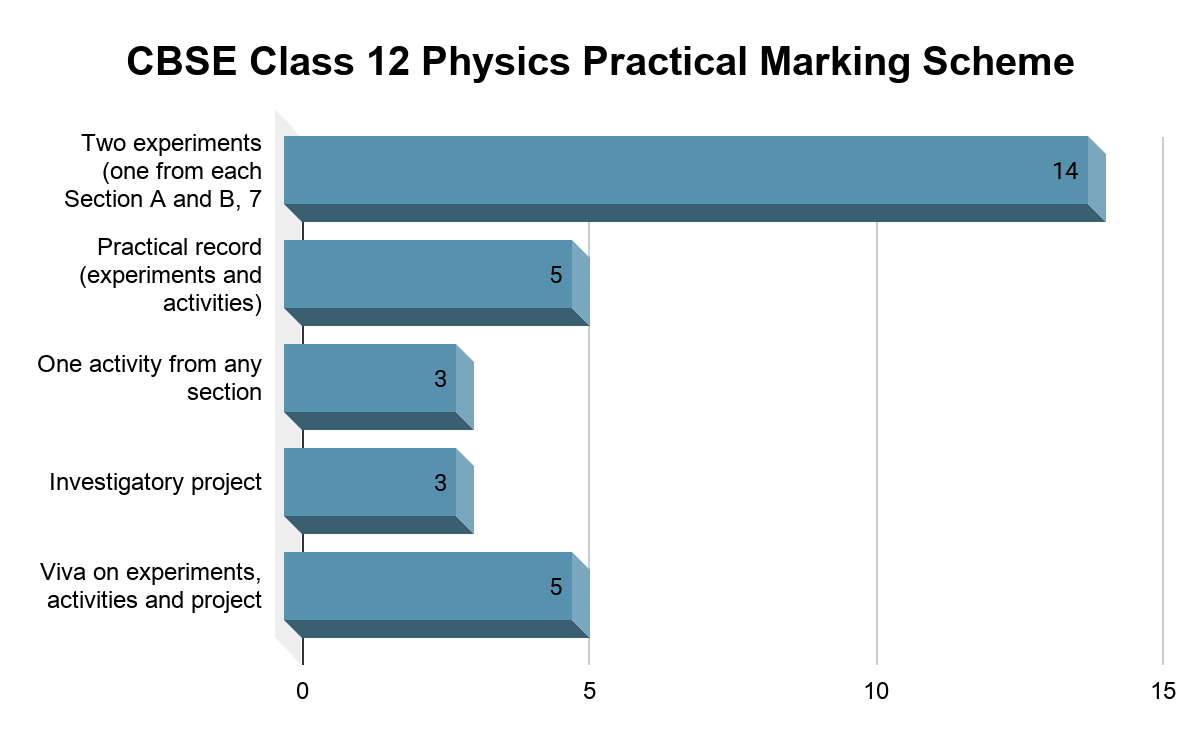
- Practical exam: The 30 marks are split into two experiments (14 marks), practical record (5 marks), activity (3 marks), investigatory project (3 marks) and viva (5 marks).
- Official documents: CBSE has released the Physics sample question paper and marking scheme for 2026-27 on cbseacademic.nic.in.
As per the CBSE Class 12 Physics Marking Scheme, students must score a minimum of 33% aggregate marks to pass the board examination. In addition, it is mandatory to secure at least 33% marks in each subject separately.
Related Articles:
- CBSE Class 12 Exam Pattern 2027: Marking Scheme, Passing Criteria, Subject-wise and Chapter-wise Pattern
- CBSE Class 12 Syllabus 2027: Subject-Wise Topics, Marking Scheme and PDF Download
Key Summary
- The scheme below is based on the official 2026-27 sample question paper and marking scheme released by CBSE for the Class 12 Board Exam 2027.
- The syllabus for 2026-27 was released by CBSE on April 1, 2026, and the theory paper is divided into nine units.
- The final board paper may differ in questions, but the section-wise structure is expected to follow the sample paper.
- Step-wise marking is followed in numericals, derivations and long answers, so writing each step clearly matters.
CBSE Class 12 Physics 2026-27: Theory Paper Marking Scheme
The theory paper of 70 marks has 33 questions spread over Sections A to E, with Section C carrying the highest marks (21 marks).
- Section A has 12 MCQs and 4 Assertion-Reason questions of 1 mark each.
- Section D has 2 case study based questions of 4 marks each, and Section E has 3 long answer questions of 5 marks each.
| Section | Question Type | No. of Questions | Marks per Question | Total Marks |
|---|---|---|---|---|
| A | MCQs (12) and Assertion-Reason (4) | 16 | 1 | 16 |
| B | Very Short Answer | 5 | 2 | 10 |
| C | Short Answer | 7 | 3 | 21 |
| D | Case Study Based | 2 | 4 | 8 |
| E | Long Answer | 3 | 5 | 15 |
| Total | 33 | 70 |
Related Links: CBSE Class 12 Syllabus 2027: Download PDF Link, Topic-Wise Weightage, Question Pattern
Ques. How many marks is the CBSE Class 12 Physics theory paper?
Ans. The theory paper is of 70 marks with a duration of 3 hours. The remaining 30 marks are for practicals, making the total 100 marks.
Ques. Is there internal choice in the CBSE Class 12 Physics paper?
Ans. Yes, internal choice is given in selected questions of Sections B, C and E. Students must attempt only one of the two options in such questions.
CBSE Class 12 Physics 2026-27: Unit-Wise Marks Distribution
Units V and VI (Electromagnetic Waves and Optics) carry the maximum 18 marks, followed by Units III and IV with 17 marks.
- Units I and II (Electrostatics and Current Electricity) carry 16 marks.
- Units VII, VIII and IX together carry 19 marks, and these are generally considered scoring because of their direct, theory-based questions.
| Unit | Chapters | Marks |
|---|---|---|
| Unit I and II | Electric Charges and Fields; Electrostatic Potential and Capacitance; Current Electricity | 16 |
| Unit III and IV | Moving Charges and Magnetism; Magnetism and Matter; Electromagnetic Induction; Alternating Current | 17 |
| Unit V and VI | Electromagnetic Waves; Ray Optics and Optical Instruments; Wave Optics | 18 |
| Unit VII and VIII | Dual Nature of Radiation and Matter; Atoms; Nuclei | 12 |
| Unit IX | Semiconductor Electronics: Materials, Devices and Simple Circuits | 7 |
| Total | 70 |
Ques. Which unit has the highest weightage in CBSE Class 12 Physics?
Ans. Units V and VI (Electromagnetic Waves and Optics) have the highest combined weightage of 18 marks. Ray optics and wave optics usually involve both numericals and derivations.
How Marks Are Awarded in CBSE Class 12 Physics Exam Pattern?
The official marking scheme awards marks step by step, so partial marks are given even when the final answer is incomplete. The examples below are taken from the 2026-27 Physics marking scheme.
| Question Type | Marks | How Marks Are Split (Official Example) |
|---|---|---|
| MCQ and Assertion-Reason (Q1 to Q16) | 1 | Full mark for the correct option; the key gives a short reason |
| Very short answer (Q17) | 2 | Four steps of ½ mark each (refractive index, frequency and spectrum region) |
| Numerical (Q24, binding energy) | 3 | 1 mark each for mass defect, binding energy and binding energy per nucleon |
| Derivation (Q26, Huygens' principle) | 3 | Marks for the principle, the derivation of Snell's law and the experimental verification |
| Case study (Q29) | 4 | 1 mark for each of the four sub-parts |
| Long answer (Q32, microscope) | 5 | 2 + 2 + 1 marks across the three parts |
- Numericals: Writing the formula, substitution and final answer with unit helps secure full marks.
- Diagrams and derivations: Neat ray diagrams, circuit diagrams and wavefront figures carry separate marks in several answers.
CBSE Class 12 Physics Practical Marking Scheme (30 Marks)
The practical exam is of 30 marks, and students should record a minimum of 6 experiments and 3 activities per section in the practical file.
| Component | Marks |
|---|---|
| Two experiments (one from Section A and one from Section B, 7 marks each) | 14 |
| Practical record (experiments and activities) | 5 |
| One activity from any section | 3 |
| Investigatory project | 3 |
| Viva on experiments, activities and project | 5 |
| Total | 30 |
CBSE Class 12 Physics Marking Scheme Official PDFs: Last 3 Years
Students can download the official CBSE Class 12 Physics marking scheme from the links below:
| Session | Document | Download Link |
|---|---|---|
| 2026-27 | CBSE Class 12 Physics Marking Scheme 2026-27 | Download PDF | Official Page |
| 2025-26 | CBSE Class 12 Physics Marking Scheme 2025-26 | Download PDF | Official Page |
| 2024-25 | CBSE Class 12 Physics Marking Scheme 2024-25 | Download PDF | Official Page |
CBSE Class 12 Physics Chapter-Wise Weightage
For maximum score potential, it is recommended to prioritise Ray Optics, Semiconductor Electronics, Current Electricity, Potential & Capacitance, and Alternating Current.
- Students should also prepare the important derivations, numerical problems, and application-based questions highlighted below.
| Chapter | Approx. Weightage | Important Topics to Focus On |
|---|---|---|
| Ray Optics and Optical Instruments | 9 Marks | Lens & mirror formulas, refraction, optical instruments, ray diagrams |
| Semiconductor Electronics / Electronic Devices | 7 Marks | Semiconductor basics, p-n junction, diode, rectifier, logic gates |
| Current Electricity | 6 Marks | Drift velocity, resistivity & temperature dependence, cell combination, Kirchhoff's laws, Wheatstone bridge |
| Electromagnetic Potential & Capacitance | 6 Marks | Potential energy, equipotential surfaces, capacitors and combinations |
| Alternating Current | 6 Marks | LCR circuit, average power, resonance, transformer |
| Moving Charges and Magnetism | 5 Marks | Biot-Savart Law, force between parallel conductors, torque on current loop, galvanometer |
| Dual Nature of Radiation and Matter | 5 Marks | Photoelectric effect, de Broglie wavelength, Einstein's photoelectric equation |
| Electric Charges and Fields | 4 Marks | Coulomb's Law, electric dipole, Gauss's Law and its applications |
| Nuclei | 4 Marks | Nuclear composition, binding energy, radioactivity and nuclear reactions |
| Electromagnetic Induction | 3 Marks | Faraday's Law, Lenz's Law, self-inductance, mutual inductance |
| Magnetism and Matter | 3 Marks | Magnetic properties, diamagnetic, paramagnetic and ferromagnetic materials |
| Electromagnetic Waves | 3 Marks | Displacement current, properties and applications of electromagnetic waves |
| Atoms | 3 Marks | Atomic models, Bohr model, energy levels and spectra |
Check:
CBSE Class 12 Physics Marking Scheme FAQs
Ques. Where can I download the CBSE Class 12 Physics marking scheme 2026-27?
Ans. The marking scheme is available on cbseacademic.nic.in under the Class XII Sample Question Paper and Marking Scheme section for 2026-27. The direct PDF link is given in the table above.
Ques. What is the passing criteria for CBSE Class 12 Physics?
Ans. Students need a minimum of 33% in the subject, and 33% separately in theory and practical. Check the latest CBSE passing criteria notice for exact figures.
Ques. Does CBSE release an official answer key for Physics after the board exam?
Ans. CBSE does not generally release an official answer key right after the exam. Students can use the official sample paper marking scheme to understand how answers are evaluated.



Comments