



Content Writer
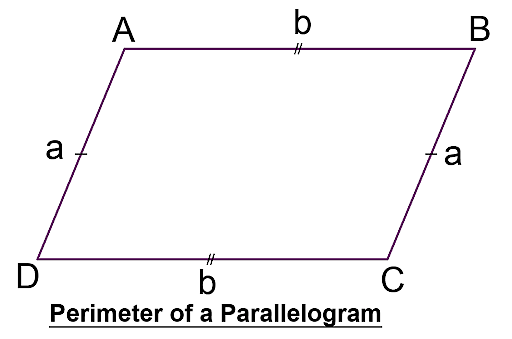
Perimeter of a parallelogram is equivalent to the sum of all sides of the parallelogram. It is a type of quadrilateral that has four sides. When the opposite sides of a quadrilateral are parallel and of equal length, it is termed as parallelogram.
- Perimeter of a parallelogram is the distance covered along the boundary.
- The perimeter is calculated when sides and diagonals are known.
- The opposite angles of the figure are equal.
- Diagonals bisect each other at 90 degrees.
- Θ is the angle formed at the vertex of the parallelogram.
- There is no line of symmetry in the case of the given figure.
- The rhombus, rectangle, and square are all examples of parallelograms.
- Perimeter of a parallelogram is equal to the perimeter of a rectangle.
Read More: Area of Parallelogram
Key Terms: Perimeter of a Parallelogram, Parallelogram, Rectangle, Rhombus, Square, Sides, Diagonals, Quadrilateral, Height
Perimeter of a Parallelogram
[Click Here for Sample Questions]
The perimeter of a parallelogram is equal to the sum of all its sides since it is the length of its outline. Parallelogram is a type of quadrilateral, which has four sides.
- The pair of opposite sides are parallel and equal to each other in a parallelogram.
- The length, width and height measure the area and perimeter of the parallelogram.
The perimeter of a parallelogram is calculated in the following cases:
- When two adjacent sides are known.
- When one side and diagonals are known.
- When the height, base and any angle are given.
Perimeter of a Parallelogram
Read More: Difference between Square and Rhombus
How to find Perimeter of a Parallelogrm?
[Click Here for Sample Questions]
There are three cases available to calculate the perimeter of a parallelogram which are discussed in below section:
Perimeter of a Parallelogram when sides are given
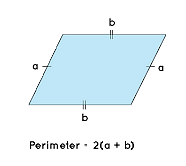
In case of a parallelogram, opposite sides are equal. Let’s consider a parallelogram with two adjacent sides named a and b.Then Perimeter of parallelogram is a+b+c+d or 2a + 2b= 2(a+b). Therefore, P = 2(a+b).
Read More:
Perimeter of a Parallelogram when one side and diagonals are given
Let us consider a parallelogram with sides a & b and diagonals y & x. Now apply the law of cosines rule in triangle ABD,
- x2 = a2 + b2 – 2ab.cos ∠BAD ---(1)
- Also apply cosine rule in triangle ADC,
- y2 = a2 + b2 – 2ab.cos ∠ADC ---(2)
- Now, By adding equation 1 and 2 then we get;
- x2 + y2 = 2a2 + 2b2 – 2ab (cos ∠BAD + cos ∠ADC ) ---(3)
- We know that the two adjacent angles of Parallelogram are 180o.
- So, ∠BAD + ∠ADC = 180o
- ∠BAD = 1800 - ∠ADC
- By applying cos on both sides
- Cos ∠BAD = cos (180o - ∠ADC)
- Cos ∠BAD = - cos ∠ADC ---(4)
- Now, put equation number 4 in equation 3, we get
- x2 + y2 = 2a2 + 2b2 – 2ab (- cos ∠ADC + cos ∠ADC)
- x2 + y2 = 2a2 + 2b2 – 2ab(0)
- x2 + y2 = 2a2 + 2b2
- For length ‘b’
- 2b2 = x2 + y2 - 2a2
- b2 = (x2 + y2 – 2a2) /2
- b = √ [(x2 + y2 – 2a2) /2 ]
- Now the formula for perimeter (P)is:
- P = 2a +2b
- P = 2a + 2 √ [(x2 + y2 – 2a2) /2 ]
- P = 2a + √ [(x2 + y2 – 2a2)
P = 2a + √ [(2x2 +2y2 – 4a2)

Perimeter of a Parallelogram when the height, base and angle are given
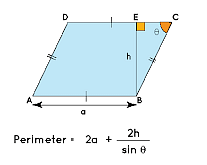
Let consider the parallelogram with one of the sides a and its corresponding to height ‘h’ and with vertex angle θ. Assume the unknown sides of parallelogram be ‘b’.
- By applying sin rule in triangle BEC,
- Sin θ = h/b
- b= h/ sin θ
- therefore, the perimeter of parallelogram is:
- P = 2a + 2b
P = 2a + 2h/ sin θ
Read More: Perimeter of a Trapezoid
Perimeter of a Parallelogram Formula
[Click Here for Sample Questions]
There are different formulas to calculate the perimeter of a parallelogram using different components. Let a and b be the two sides of the parallelogram. Θ is the angle formed between the vertex of parallelogram and h is the height of the parallelogram.
- Perimeter of a Parallelogram when sides are given
P = 2(a+b)
Read More:Surface Area and Volumes
Solved Example for Perimeter of a Parallelogram when sides are givenExample: Find the perimeter of a parallelogram whose adjacent sides are 9 units and 9 units. Solution: The adjacent sides of the given parallelogram are, a = 9 units and b = 9 units. Then its perimeter (P) is, P = 2 (a + b) P = 2 (9 + 9) = 2 (18) = 36 units. |
- Perimeter of a Parallelogram when one side and diagonals are given
P = 2a + √ [(2x2 +2y2 – 4a2)
Read More: Triangle Theorems
Solved Example for Perimeter of a Parallelogram when one side and diagonals are givenExample: Find the perimeter of a parallelogram when one of its sides is 6 units and diagonals are 8 units and 10 units. Solution: Using the formula when a side and diagonals of a parallelogram are given, we P = 2a + √(2x2 + 2y2 - 4a2). Here a = 7, x = 8, y = 10. Substituting these values into the formula, we have P = 2a + √(2x2 + 2y2 - 4a2) = 2 × 6 + √(2(8)2 + 2(10)2 - 4(7)2) = 12 + √(2 × 64 + 2 × 100 - 4 × 49) = 12 + √(128 + 200 - 196) = 12 + √(132) = 12 + 11.49 = 23.49 |
- Perimeter of a Parallelogram when the height, base and angle are given
P = 2a + 2h/ sin θ
Solved Example for Perimeter of a Parallelogram when the height, base and angle are givenExample: What is the perimeter of a parallelogram where one of its sides is 20 yards, its corresponding height is 20 yards, and one of the vertex angles is 30 degrees? Solution: One of the sides of the given parallelogram is, a = 20 yards. Its height is h = 20 yards. One vertex angle is, θ = 30°. Its perimeter (P) is, P = 2a + 2h / sin θ P = 2(20) + (2 × 20) / (sin 30°) = 120 yards |
Read More:
Things to Remember
- The perimeter of a parallelogram is the sum of all lengths enclosed by the boundary.
- A parallelogram is a four-sided polygon with two parallel sides that also has four edges.
- If one of the angles in a parallelogram is a right angle, then all four angles must be right angles.
- The perimeter of a parallelogram is also equivalent to the perimeter of a rectangle.
- The length of the opposite sides of a parallelogram is the same because they are equal in length.
Read More: Areas of Parallelograms and Triangle
Sample Questions
Ques: Find the perimeter of a parallelogram whose length is 10 cm and breadth is 8 cm. (3 marks)
Ans: Given: length =10 cm & breadth = 8 cm
We also know that formula for perimeter of parallelogram;
= 2 (l+ b)
= 2 (10+8)
= 2 (18)
= 36 cm.
Therefore, the perimeter of the parallelogram is 36 cm.
Ques: Find the perimeter of parallelogram which length is 50 cm and breadth is 40 cm. (3 marks)
Ans: Given: length = 50 cm & breadth = 40 cm
We know that the formula for perimeter of parallelogram;
= 2 (l+ b)
= 2 (50+40)
= 2 (90)
= 180 cm
Therefore, Perimeter of the parallelogram is 180 cm.
Ques: What is the perimeter of parallelogram if length of side is 8 cm and diagonals are 10 and 12 cm. (3 marks)
Ans: Given: Side ‘a’ = 8 cm, Diagonals x= 10cm & y = 12 cm
By using the formula of perimeter of parallelogram when side and diagonal given the we get;
P = 2a + √ [(2x2 +2y2 – 4a2)
P = 2(8) + √ [(2(10)2 +2(12)2 – 4(8)2)
P = 31.2 cm
Therefore, Perimeter of the parallelogram is 31.2 cm.
Ques: On a graph, how do you find the perimeter of a parallelogram. (2 marks)
Ans: The perimeter of a parallelogram with adjacent sides 'a' and 'b' is also equal to 2a + 2b, as we know. To find the perimeter of a parallelogram on a graph, we use the distance formula to find the lengths of any two adjacent sides then use the formula 2a + 2b to find its perimeter.
Ques: Find is the perimeter of parallelogram when the height is 20 m and one of its sides is 15 meter & one vertex angle is 450. (3 marks)
Ans: Given; Side ‘a’ = 15 m, height ‘h’ = 20m and vertex angle = 450.
We know the formula of perimeter when side, angle and vertex is given,
P = 2a + 2h/ sin θ
P = 2(15) + 2(20)/ sin 45o
P = 86.56 m
Therefore the perimeter of parallelogram is 86.56 m.
Ques: What is the perimeter of parallelogram when sides are 33 m and 27 m. (3 marks)
Ans: Given: Sides of parallelogram ‘a’ =33 m & ’b’ = 27 m
We also know that the formula for perimeter of parallelogram;
= 2 (a+ b)
= 2 (60)
= 2 (60)
= 120 m
Therefore, the perimeter of the parallelogram is 120 m.
Ques: What is the perimeter of a parallelogram whose length is 5 m and diagonals are 12 m and 10 m. (3 marks)
Ans: Given: length ‘a’ = 5 m, Diagonals x= 12 m & y = 10 m
By using the formula of perimeter of parallelogram when side and diagonal given;
P = 2a + √ [(2x2 +2y2 – 4a2)
P = 2(5) + √ [(2(12)2 +2(10)2 – 4(5)2)
P = 29.69 m
Therefore, the perimeter of parallelogram is 29.69 m.
Ques: Find the perimeter of parallelogram if the length is 44 m and breadth is 36 m. (3 marks)
Ans: Given: length =44 m & breadth = 36 m
By applying the formula for perimeter of parallelogram we get;
= 2 (l+ b)
= 2 (44+36)
= 2 (80)
= 160 m
Therefore, the perimeter of the parallelogram is 160 m.
Ques: The length of parallelogram is 15 inches and the breadth is 9 inch then find the perimeter of parallelogram. (3 marks)
Ans: Given; length =15 in & breadth = 9 in.
By applying the formula for perimeter of parallelogram is;
= 2 (l+ b)
= 2 (15+9)
= 2 (24)
= 48 in.
Therefore, the perimeter of the parallelogram is 48 inches.
Ques: Find the perimeter of a parallelogram whose length is 10 cm and breadth is 18 cm. (3 marks)
Ans: Given: length =10 cm & breadth = 18 cm
We also know that formula for perimeter of parallelogram;
= 2 (l+ b)
= 2 (10+18)
= 2 (28)
= 56 cm.
Therefore, the perimeter of a parallelogram is 36 cm.
Ques: Find the perimeter of parallelogram which length is 150 cm and breadth is 140 cm. (3 marks)
Ans: Given: length = 150 cm & breadth = 140 cm
We know that the formula for perimeter of parallelogram;
= 2 (l+ b)
= 2 (150+140)
= 2 (190)
= 380 cm
Therefore, Perimeter of a parallelogram is 380 cm.
Ques: The perimeter of a parallelogram is equal to 48 cm and one of its sides is 12 cm. Find the length of the other side. (3 marks)
Ans: Given: Perimeter (P) = 48 cm, and side, a = 12 cm. To find the length of the other side b of the parallelogram, we will use the formula of the perimeter of a parallelogram P = 2(a + b).
P = 2(a + b)
⇒ 48 = 2 (12 + b)
⇒ 12 + b = 48/2
⇒ b = 24 - 12
⇒ b = 12 cm
Ques What is the perimeter of a parallelogram when the height is 30cm, the vertex angle is 45°, and one of the sides is 12cm. (3 marks)
Ans: The perimeter of a parallelogram is given by:
- P = 2a + 2h/sinθ
- P = 2 × 12 + 2 × 30/sin45
- P = 24 + 84.5
- P = 24 + 84.5
- P = 108.5 cm
Ques: Find is the perimeter of parallelogram when the height is 60 m and one of its sides is 20 meter & one vertex angle is 450. (3 marks)
Ans: Given; Side ‘a’ = 20 m, height ‘h’ = 60m and vertex angle = 450.
We know the formula of perimeter when side, angle and vertex is given,
P = 2a + 2h/ sin θ
P = 2(20) + 2(60)/ sin 45o
P = 209.01 m
Therefore the perimeter of parallelogram is 209.01 m.
Ques: What is the perimeter of parallelogram when sides are 30 m and 57 m. (3 marks)
Ans: Given: Sides of parallelogram ‘a’ =30 m & ’b’ = 57 m
We also know that the formula for perimeter of parallelogram;
= 2 (a+ b)
= 2 (87)
= 174 m
Therefore, the perimeter of the parallelogram is 174 m.
Read Also:



Comments