



Content Curator
Phenolphthalein is a considered as a white or yellowish-white crystalline compound C20H14O4 which is used in analysis as an indicator as its solution is brilliant red in alkalies and is loses its colour by acids and in medicine as a laxative.
We all know Acids and Bases i.e., acidic or alkaline. But, the function of a pH indicator is far more advanced.
One of the pH testers is called Phenolphthalein, which is usually colorless but, in contact with any acid or base, it changes color from pink (acidic) or purple (base).
It is also used as an indicator in acid–base titrations, and turns colorless in acid based solutions and pink in basic solutions. It basically belongs to the class of dyes known as phthalein dyes.
| Table of Content |
Read More: Degree of Unsaturation Formula
Phenolphthalein
Phenolphthalein is a chemical compound. The formula is C20H14O4 as It contains 20 carbon atoms, 14 hydrogen atom, and 4 oxygen atoms, and written as "HIn" or "phph" as notation. Phenolphthalein does not dissolve well in water, alcohol is used to prepare this solution, and when you add a drop of acid in the solution may sometimes see a white cloud generated in it. Moreover, it turns pink when it comes into contact with a substance of a pH of level 8.2 and purple at higher pH. The change in color is the result of ionization; a process that alters the charge and shape and color of Phenolphthalein molecule.
Also Read:
It is a weak acid, which loses H+ ions in solution. The nonionized phenolphthalein molecule is colorless, the protonated phenolphthalein molecule is orange in color, and the deprotonated phenolphthalein is fuchsia, when the base is added to the solution containing phenolphthalein, the equilibrium between the nonionized and the deprotonated states shifts in favor of deprotonated state as the H+ ions are removed from solution.
Read More: Specific Heat of Water
This table represents the molecular weight and other features of Phenolphthalein:
| Molecular Weight/ Molar Mass | 318.32 g/mol |
| Melting Point | 258–263 °C or 496–505 °F |
| Appearing | White powder |
| Density | 1.277 g/cm3 |
| Solubility in other solvents | Insoluble in benzene |
Structure of Phenolphthalein
It has 3 hexagons, one pentagon, 2 alcoholic groups, and one ketone group. Besides, the structure forms the carbon, hydrogen, and oxygen chains.
Also Read:
The phenolphthalein molecule contains a total of 41 bond(s) There are 27 non-H bond(s), 19 multiple bond(s), 2 rotatable bond(s), 1 double bond(s), 18 aromatic bond(s), 1 five-membered ring(s), 3 six-membered ring(s), 1 nine-membered ring(s), 1 ester(s) (aromatic) and 2 aromatic hydroxyl(s).

This image represents the structure of Phenolphthalein.
Uses of Phenolphthalein (C20H14O4)
- Used in acid base titrations as an indicator
Titration is an experiment, where the volume of one solution concentration is applied to the volume of another solution. Most titrations are acid-based.
Read More: Number of Moles Formula
- It is used in Kastle-Meyer test
The Kastle–Meyer test is a blood test, firstly described in 1903, in which the phenolphthalein is used to detect the presence of hemoglobin in human body; it will turn pink immediately by the addition of the peroxide, because of the phenolphthalein.
Read More: What is Enthalpy
- Medical uses
Laxative products used to contain phenolphthalein but have now been reformulated and used as alternate active ingredients such as; Feen-a-Mint switched to bisacodyl and Ex-Lax switched to a senna extract. Phenolphthalein has also been added to the European Chemicals Agency's list for SVHC substances.
Read More:
Change of Color of Phenolphthalein
Phenolphthalein is weak and colorless in solution and its ion is pink. Ionization is the process that is responsible for the changing of the color of the Phenolphthalein. Ionization happens when one molecule loses or gains an electron, this process gives the molecule a negative or positive electric charge.
Read More:
The ionized molecule attracts other molecules and repels the same charge, and it also affects the shape of the molecule.
Normally all the colors of the light passes through a phenolphthalein appears colorless but when it is exposed to the alkaline it blocks the clue color light and turns pink, and stronger the alkaline solution, the more Phenolphthalein molecules will change and the darker color will appear.
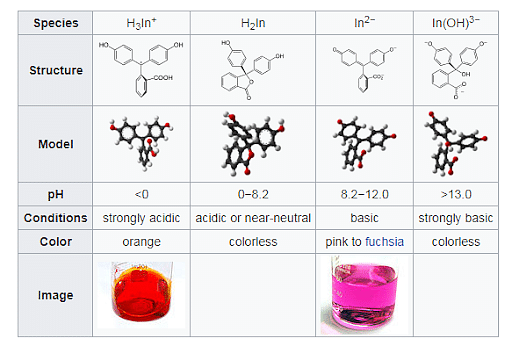
This image represents the change in color of Phenolphthalein.
Working of Phenolphthalein Indicator
- The pH scale has a marking i.e., from 0 to 14 for detecting the acids and bases. 0 to 6.9 are the acids, the less the number the more it is acidic. While the pH 7 is neutral, the pH of water.
- From 7.1 to 14 are the bases. The higher the number of the more basic nature they have. In common practices a chemist uses litmus paper to test the pH of a compound. The litmus paper turns red with acid and turns blue with the base.
Read More: Solvent Examples
- Phenolphthalein is naturally colorless and works differently than litmus paper. It also turns pink in color in an alkaline solution or base. The compound remains colorless in acids but starts turning pink on the pH 8.2 and continues to turn bright in strong bases.

This image represents the phenolphthalein indicator.
Uses of Phenolphthalein for Entertainment
Phenolphthalein is used in toys, for example; disappearing inks or disappearing dyes on Barbie hair. The ink was mixed with sodium hydroxide, which reacts with carbon dioxide. This reaction leads to the falling level of pH below, and the color changes as hydrogen ions are released by the reaction.
OH−(aq) + CO2(g) → CO2-
3(aq) + H+(aq)
Thymolphthalein is also used for the same purpose, when a blue color is required.
Read More:
Things To Remember
- Phenolphthalein is a bit soluble in water and usually dissolves in alcohols for the experiment purpose. It is a weak acid, which loses H+ ions in solution.
- The formula is C20H14O4 as It contains 20 carbon atoms, 14 hydrogen atom, and 4 oxygen atoms, and written as "HIn" or "phph" as notation.
- It has 3 hexagons, one pentagon, 2 alcoholic groups, and one ketone group.
- Phenolphthalein is naturally colorless and works differently than litmus paper. It also turns pink in color in an alkaline solution or base.
Also Read:
Important Questions
Ques 1. What are the uses of Phenolphthalein? (1 mark)
Ans. Phenolphthalein is used as an indicator in acid-base titrations.
Ques 2. Is phenolphthalein a strong acid? (1 mark)
Ans. YES, A strong acid- strong base titration is performed using a phenolphthalein indicator.
Read More:
Ques 3. How does phenolphthalein change color? (1 mark)
Ans. Phenolphthalein is naturally colorless but it turns out pink in alkaline solutions, at a pH level of 8.2 and continues to a bright at pH 10 and above.
Ques 4. What color does phenolphthalein turn into acid? (1 mark)
Ans. It stays colorless when it comes into contact with an acid like vinegar and remains neutral with a substance like water.
Read More:
Ques 5. Why is phenolphthalein pink? (1 mark)
Ans. Phenolphthalein turns pink in presence of a base, due to the formation of ions that turns the solution pink.
Ques 6. Does phenolphthalein turns red in a basic solution? (1 mark)
Ans. YES, Phenolphthalein turns a bright red color as its solution becomes basic. In a strongly basic solution, this red color fades to colorless.
Read More:
Ques 7. What does the phenolphthalein test indicate? (1 mark)
Ans. The phenolphthalein test, also known as the Kastle-Meyer test is a presumptive test for the presence of hemoglobin, a component of the red blood cells in blood.
Ques 8. At what pH does phenolphthalein turn pink? (1 mark)
Ans. At pH 8.2 and becomes purple at an even higher pH.
Read More:
Ques 9. What are the hazards of phenolphthalein? (1 mark)
Ans. May cause eye irritation, skin irritation, gastrointestinal irritation with nausea, vomiting and diarrhea, etc.
Ques 10. How do you remove phenolphthalein from your hands? (1 mark)
Ans. By washing hands with hand wash.
Read More: Antidepressant Drugs
Ques 11. What happens when phenolphthalein is added to NaOH? (1 mark)
Ans. It turns pink, because the base is neutralized in an acid solution, which causes the indicator to become colorless.
Also Read:



Comments