



Content Writer-SME
The plasmodium life cycle is divided in three main stages: Gametocytes, sporozoites, and merozoites. The plasmodium parasite is called malaria parasite as it is responsible for causing malaria. Plasmodium is an intracellular parasitic protozoan that is transmitted to human beings via the female anopheles mosquito.
- The lifecycle of plasmodium or a malarial parasite starts with feeding on the blood of mammals or any other organism.
- Malaria occurs when the anopheles mosquito bites humans or other mammals thereby injecting plasmodium parasite.
- This parasite is known to infect the erythrocytes or RBC present in mammals, birds, or animals.
Plasmodium Parasites
[Click Here for Sample Questions]
Plasmodium is a malarial parasite that infects the female anopheles mosquito and human beings. Inside the host’s body the plasmodium parasite undergoes several changes in its life cycle. To complete their life cycle, it requires two hosts- human and insect. They multiply in the liver and red blood cells of humans as well as in other mammals.
There are various plasmodium species known for causing malaria, but Plasmodium falciparum and Plasmodium vivax causes severe and life-threatening type of malaria in human. The internal structure of a plasmodium parasite is shown below in the figure:
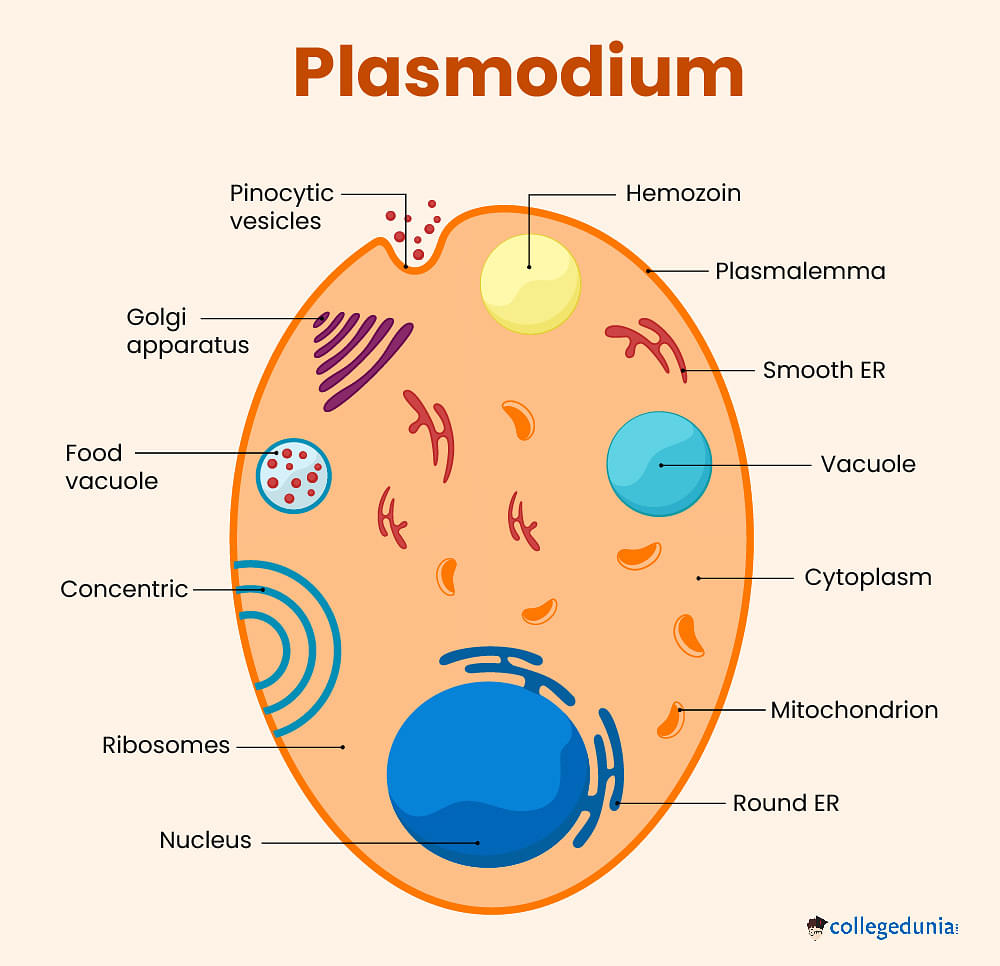
Plasmodium Parasite
Plasmodium Life Cycle
[Click Here for Sample Questions]
The plasmodium life cycle is completed in three stages namely: Gametocyte formation, sporozoites, and merozoites. This cycle occurs first in insects and then completed in human beings. The female anopheles mosquito initiates the lifecycle of plasmodium parasite. Microgametes (male gametocytes) and macrogametes (female gametocytes) are transferred through anopheles mosquito in the blood of host organism. The complete plasmodium life cycle is shown in the figure below in detail:

Life Cycle of Plasmodium
Stages of Plasmodium Lifecycle
Plasmodium, the parasite that causes malaria, has a life cycle that includes three stages and involves two hosts: humans and mosquitoes (Anopheles). The lifecycle of a plasmodium parasite which is completed in three stages is explained below in detail:
Stage 1: Gametocyte formation
In the initial stage of the life cycle of plasmodium, the female anopheles mosquito feeds on the blood meal and transfers the male gametocyte (microgametocytes) and female gametocyte (macrogametocyte).
- The male and female gametocytes convert into sporozoites inside the gut of mosquitoes.
- A crucial step in the Plasmodium life cycle, the gametocyte phase allows the parasite to move from its human host to its mosquito vector.
- The sporozoite parasite formation occurs after 15-18 days when the gametocytes have mated inside the gut of a mosquito.
- Control and eradication attempts for malaria focuses on targeting gametocytes as it disrupts the parasite's life cycle.
Stage 2: Sporozoite formation
The sporozoite is carried by the female anopheles mosquito. The Anopheles mosquito bites humans and injects sporozoites into the bloodstream. The completion of the parasite's transmission cycle depends on the mosquito's sporogonic phase, also known as the sporocyte phase, of the Plasmodium life cycle.
- These sporozoites enter the liver cell, divide asexually, and mature into schizonts.
- Merozoites are released when the schizonts are ruptured, this is also called the pre-erythrocytic phase.
- The production of sporozoites, the infectious forms that carry on the malarial transmission, depends on the sporogonic cycle.
Stage 3: Merozoite formation
Sporozites are injected into a person's bloodstream by an infected female Anopheles mosquito. After migrating to the liver, these sporozoites infiltrate hepatocytes, or liver cells. This is followed by the release of the rupture of liver cells. They enter the blood and divide via asexual mode.
- The damage of red blood cells leads to more production of merozoites and is called the erythrocytic stage.
- Merozoites secrete a poison that induces bone-shaking chills and fever when red blood cells are destroyed.
- Extreme cold chills and fever characterize malaria in humans.
Mosquito Phase
This phase occurs sexually inside the midgut of a mosquito where the fusion of male and female gametocytes takes place to form a zygote. This zygote matures into an ookinete which enters the wall of the midgut to form an oocyst.
- Inside the oocyst, the ookinete nucleus divides repeatedly to form sporozoites.
- As soon as the infected mosquito sucks the blood for its meal, the sporozoites travel to its salivary glands.
- This cycle repeats when the sporozoites are injected into the new host (human) at subsequent mosquito bites.
Types of Plasmodium Parasites
[Click Here for Sample Questions]
There are about 120 plasmodium species that affect different vertebrate groups. Four species are considered true parasites as they use humans as a natural host. In this section, we will discuss the types of plasmodium species:
Plasmodium falciparum
One of the most poisonous species of plasmodium is P.falciparum as it is responsible for causing malignant malaria. If not treated at the earliest might even cause the death of an individual.
Plasmodium vivax
Another species is P.vivax which causes benign tertiary malaria. These are enlarged parasites and cause symptoms like headache, vomiting, shivers, etc.
Plasmodium ovale
A more compact parasite than P.vivax is the P.ovale parasite that can cause ovale malaria. It can last for a year if not treated at the earliest.
Plasmodium malariae
P.malariae symptoms include headache, shivers, nausea, anorexia, etc. If this disease is not treated it can last up to 20 years.

Types of Plasmodium Parasites
Things to Remember
- The plasmodium life cycle begins when the female anopheles mosquito feeds on the blood to nourish her eggs.
- The malaria parasite also affects chickens, monkeys, pigeons, and snakes.
- The parasitic stage where the red blood cells are infected is called merozoites.
- The life cycle of plasmodium includes both sexual and asexual stages.
- P.knowlesi is considered a zoonotic malaria.
Sample Questions
Ques: What causes malaria? (2 marks)
Ans: Malaria is a life-threatening disease that is spread by the bite of an infected anopheles mosquito. These infected mosquitoes carry the parasite plasmodium, which is released into the human bloodstream if the human is bitten by the infected insect. In general, four types of malaria parasites can infect people, as described below:-
- Plasmodium vivax
- Plasmodium ovale
- Plasmodium malariae
- Plasmodium falciparum
Ques: What are some of the signs and symptoms of malaria? (3 marks)
Ans: Malaria symptoms can be similar to those of many other infections caused by bacteria, viruses, or parasites in the early stages. It may begin with symptoms that are similar to those of the flu. Among the signs and symptoms are:
- Fever.
- Chills.
- Headache.
- Sweats.
- Fatigue.
- Nausea and vomiting.
- The whole body hurts.
People who are infected multiple times may get the disease yet show little or no symptoms. The severity of malaria symptoms depends on your age, general health, and the type of malaria parasite you have.
Ques: Mention the different types of malaria parasites. (2 marks)
Ans:The different types of Malaria Parasites are:
- Plasmodium vivax (or P. vivax)
- Plasmodium ovale (or P. ovale)
- Plasmodium knowlesi (or P. knowlesi)
- Plasmodium falciparum (or P. falciparum)
- Plasmodium malariae (or P. malariae)
Ques: What is the procedure for diagnosing malaria? (2 marks)
Ans: Your doctor may prescribe additional tests every 12 to 24 hours if the first blood smear does not reveal malaria. There is also a blood test that can promptly detect malaria. If this rapid test points to malaria, the results are usually confirmed with a blood smear.
Ques: What is the treatment for malaria? (3 marks)
Ans: Malaria is a disease that can be cured with medication. The choice of medicine is influenced by several factors. They are as follows:
- Whether the medication is used to treat or prevent malaria.
- Your predicament (such as your age, your health, or whether you are pregnant).
- How badly you've been infected with malaria.
- Is it possible that the malaria parasite is resistant to specific medications?
- The medicine's side effects.
Ques: What is the duration of the incubation period? (1 mark)
Ans: The incubation period is the time between intake and the onset of the first symptom.
Ques. Where is Plasmodoum located? (1 mark)
Ans. Plasmodium is located in Latin America, Asia and some parts of Africa. It undergoes asexual replication process inside host red blood cells. It will produce a crystalline pigment that is found as the byproduct of digesting the host.
Ques. Explain the Gametocytes and Sporozoites stages of plasmodium? (3 marks)
Ans. Gametocytes are the first stage of plasmodium. Microgametocytes, which are male gametocytes, and macrogametocytes, which are female gametocytes, are transmitted during a blood meal by an anopheles mosquito. A sporozoite develops from the mosquito's gametocytes.
Sporozoite is the second stage of the plasmodium life cycle. When a sporozoite-infected anopheles mosquito bites a human, sporozoites are transmitted from the insect into the human bloodstream. Human liver cells are where sporozoites enter the bloodstream after entering the bloodstream.
Ques. Explain the two different types of host in Plasmodium. (2 marks)
Ans. The two different types of hosts in plasmodium are as follows:
- Intermediate Host: In this category, the host is a blood-sucking insect in which asexual reproduction takes place.
- Definitive Host: In this category, the host is a blood-sucking insect in which sexual reproduction takes place.
Ques. What is the difference between asexual reproduction and sexual reproduction? (4 marks)
Ans. The table below shows the difference between asexual reproduction and sexual reproduction:
| Asexual Reproduction | Sexual Reproduction |
|---|---|
| Asexual Reproduction occurs in prokaryotic and eukaryotic cells. | Sexual Reproduction occurs in multicellular organisms. |
| It is a type of production in which gamete are formed. | It is a type of production in which gamete is not formed. |
| In this no fertilization and reproduction take place. | In this fertilization and reproduction take place. |
| Characteristic of only one parent is inherited. | Characteristic of both parents is inherited. |
Ques. In how many cycles the life cycle of plasmodium is divided? (2 mark)
Ans. The life cycle of plasmodium is divided into three stages:
- Exoerthrocytic Stage: This stage is most common in the liver of man.
- Erythrocytic Stage: This stage is most common in the red blood cells of man.
- Sporogonic Stage: This stage is most common in the female mosquito.



Comments