



Exams Prep Master
A polyatomic ion, also referred to as a molecular ion, is a covalent bonded set of two or more atoms, or of a metal complex, and can be considered to behave as a single unit and that has a net charge that is not zero. Here ions and molecules are made up of two or more groups of atoms linked together by a covalent bond, and more so by coordinate covalent bonds. The ions hold a net charge due to the disproportion between the number of electrons and protons. They can be shown through Lewis Dot structures.
| Table of Contents |
Key Terms: Polyatomic, covalent, cations, anions, polar.
Common Polyatomic Structures
[Click Here for Sample Questions]
There’s a plethora of polyatomic structures found everywhere. Most importantly H2O which is in abundance and the Bicarbonate ion – HCO3-. Here are some common examples.
| Formula | Name |
|---|---|
| H2O | Water |
| NaCl | Sodium Chloride |
| OH- | Hydroxide |
| NH4- | Ammonium |
| H3O- | Hydronium |
| CN- | Cyanide |
| SO42- | Sulfate |
| NO3- | Nitrate |
Polar and Non-polar Molecules
[Click Here for Sample Questions]
| Polar Molecules | Non-polar Molecules |
|---|---|
| Molecules possessing an excess positive charge on one end and an excess negative charge on the other that is, a dipole moment are said to be polar | Molecules having no electric charges are spherically symmetric; they are said to be non-polar |
| Polar substances are hydrophilic | Non-polar substances are lipophilic |
| Pass through lipid membranes through channels. | Easily pass through cell membrane |
| Eg.NH3, SO2 etc. | O2, CO2, etc. |
Naming Polyatomic Ions
[Click Here for Sample Questions]
- If a compound has more than one polyatomic ion, one has to place parentheses around the ion’s formula which states the number of ions in the compound.
- The sum of the charges on the compound is supposed to be zero. This is beneficial in finding out the charge of a compound.
Finding Chemical Formula using Compound Names
[Click Here for Sample Questions]
- Let’s take the example of Calcium Hydroxide.
- Calcium belongs to the group IInd of the periodic table – Alkaline earth metal.
- We know it has ions with a +2 charge and to cancel this out we will require two hydroxide ions.
- We write these in parentheses to show the number of Hydroxide Ions.
Hence, the formula of Calcium Hydroxide becomes: Ca(OH)2.
Structure of Polyatomic Ions
[Click Here for Sample Questions]
A Polyatomic ion as a molecule that has turned into an ions gaining or losing an electron. It carries a net charge due to the difference in number of electrons and protons. In a Lewis Dot structure, the charge on a polyatomic ion is equal to the sum of formal charges on each atom in the ion.
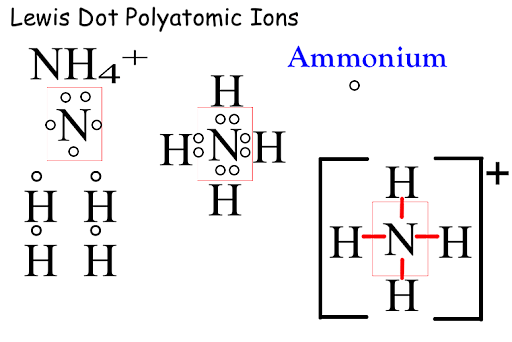
Structure of Polyatomic Ions
The above is the dot structure of the hydroxide ion, containing the hydrogen atom and the oxygen atom. The line between them denotes the covalent bond which is formed by the mutual sharing of electrons between the Hydrogen and the Oxygen atom. The dots around Oxygen denote the lone pairs of electrons and the net charge is denoted by encasing them in square brackets and the charge on the upper right.
Things to Remember
- Polyatomic structures involve more than two atoms.
- They are linked by covalent bonds.
- Better represented by Lewis Dot structures.
- They can be polar or non-polar.
- Polyatomic ions carry a net charge due to the number of electrons being unequal to the number of protons.
Sample Questions
Ques: Why are polyatomic ions highly reactive? (2 marks)
Ans: In order for a reaction to take place, the transfer of electrons must take place. Due to the presence of charge on these ions they are readily able to accept or donate electrons. Thus, being highly reactive.
Ques: Why do polyatomic ions have charges? (2 marks)
Ans: Ions have charges. They are either negatively charged or positively charged: cations or anions. The charge develops due to the disparity in the number of electrons as compared to the number of protons.
Ques: Is CaOH2 the correct representation of Calcium Hydroxide? If not, explain why. (2 marks)
Ans: The formula CaOH2 states that the Calcium atom has bonded with a single oxygen atom and two hydrogen atoms, while that is not the case. Hydroxide is a polyatomic ion. Therefore it is important to understand that it is a single separate entity and cannot be parted. Hence, it is important to use parentheses. And the correct formula for Calcium Hydroxide would be Ca(OH)2.
Ques: State the name of the compound with the formula Ni3(PO4)2. (3 marks)
Ans: To name the compound, we must break it into cations and anions. Nickel is a transition metal and can form multiples kinds of cations with different kinds of charges. Phosphate has a charge of 3-. The overall charge must be 0.
Therefore we can calculate the charge on Nickel.
cations×cation charge=−1×(anions×anion charge)
3xcation=-1(2x3-)=6
Cation charge = 6/3 =2
Hence, the compound name is Nicken (II) Phosphate.
Ques: What is the formula of Lithium hydrogen phosphate? (2 marks)
Ans: The ions in the chemical compound are Li- and HPO42-. The charge on HPO42- is 2- and requires two Li- to balance the charge. Hence the formula is Li2HPO42-.
Ques: What are the ions in the ionic compound FeCr2O7. (2 marks)
Ans: The compound consists of the Dichromate ion Cr2O72-. In order to balance the 2- charge, Fe needs +2 charge.
Hence the ions in the compound is Fe2+ and Cr2O72-.
Ques: When the ionic compound NH4NO3 is put in water, what does it dissociate into? (2 marks)
Ans: NH4+ and NO3- are polyatomic ions. When a compound made up of polyatomic ions ionizes in water, it separates into original constituent atoms.
NH4NO3 à NH4+ + NO3-.
Ques: What are the ions in the compound Ca(MnO4)2? (3 marks)
Ans: Firstly we look at the ions in the compound, MnO4 permanganate ion is one of the ions. It carries a negative charge and is two in number, therefore it carries a 2- charge. We already know in an ionic compound, the net charge must be zero. Hence, the Calcium must have 2+ charge in order to balance out the 2- charge of the permanganate ions.
Thus, the ionic compound contains Ca2+ cation and MnO4- anion.
Ques: Differentiate between polyvalent ions and polyatomic ions. (3 marks)
Ans: Polyvalent ions has the valency of more than one. O2- has a valency of more than one, but it is a monoatomic ion.
Polyatomic ion is the one formed by two or more atoms bonded by a covalent bond. Eg: NH4 ion. It has more than one atom: nitrogen and hydrogen. Although it is not polyvalent as its charge is only one.
Check-Out:



Comments