



Content Curator
Area of the scalene triangle is equal to half of the product of its base-length and height. The formula can be expressed as: A = hbb/2. Scalene triangle Formula is used to calculate the area and perimeter of a specific triangle where the length of the sides differ or if the height and base are only provided. A triangle with all sides equal is called an equilateral triangle, and a triangle with no sides equal is called a scalene triangle.
Key Terms: Scalene Triangle, Obtuse Angle, Acute Angle, Area, Perimeter, Isosceles
What is a Scalene Triangle?
[Click Here for Sample Questions]
The term "scalene triangle" refers to a certain type of triangle in which the lengths of the three sides are not equal and the angles are all measured differently. The internal angles of a scalene triangle, therefore, always add up to 180 degrees. The Scalene triangle is explained in the following.
- There are three vertices and three edges in a scalene triangle.
- Three sorts of triangles are formed by the Scalene Triangle.
- The lengths of the triangle's sides vary among scalene triangles.
Also check:
| Important Relevant Concepts | ||
|---|---|---|
| Congruence Of Triangles | Triangles Important Question | Triangles Revision Notes |
| Triangles MCQs | Elimination Method | Pythagoras Theorem |
Properties of Scalene Triangle
[Click Here for Sample Questions]
Properties of a Scalene Triangle are listed below:
- The scalene triangle have different length of sides which forms another type of angle.
- The scalene triangle cannot be divided into two halves because there is no b.
- No symmetry point exists for the Scalene Triangle.
- If all the angles of scalene triangles are smaller than 90 degrees i.e. .acute, the centre of the circumscribing circle will fall inside a triangle.
- Obtuse scalene triangles have circumcenters that are outside of the triangle.
- Obtuse, acute, or right triangles can all be used to represent scalene triangles.
Types of Scalene Triangle
[Click Here for Sample Questions]
Different types of triangles are elaborated in the following section:
Acute-Angled Scalene Triangle
Acute angles are supposed to be less than 90 degrees. So, Each of the triangle's angles is fewer than 60 degrees which makes it an Acute-angled Scalene Traingle.
Obtuse-angled Scalene Triangle
Obtuse Angles are supposed to be greater than 90 degree in measure and less than 180 degreebut the two of the angles should measure less than 90 degree. In scalene triangle, all the measure of side differ which can make it an obtuse-angled scalene triangle.
Right-angled Scalene Triangle
In a Right angle triangle, one of the angle measure 90 degrees, with the difference in measurement of the sides of their Angle. So, In the Scalene triangle, the measurement of the side differs so it can be Right angled scalene triangle.
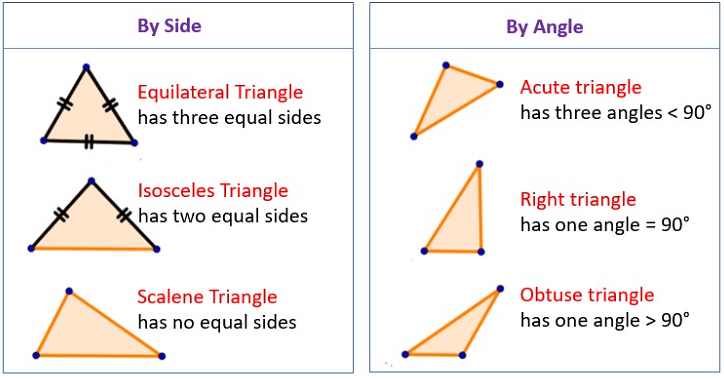
Types of Triangles
Difference between Scalene, Equilateral and Isosceles Triangle
[Click Here for Sample Questions]
Key difference between Scalene, Equilateral and Isosceles Triangles are tabulated below:
| Scalene | Equilateral | Isosceles |
|---|---|---|
| When all the sides of the triangle differ in the measurement is known as scalene triangle. | When all sides of the triangle are equal is known as Equilateral triangle. | When two sides of the triangle are equal is known as Isoceles triangle. |
| All the angles differ. | All the angles are equal to 60 degrees. | Angles which are opposite to the Equal sides are Equal. |
Scalene Triangle Formula
[Click Here for Sample Questions]
As we know, Area of the Scalene Triangle is Area = \(\frac{1}{2}\) x b x h Square Units (here, B- base, H- height).
Area of the Scalene Triangle using Heron’s formula
Let’s calculate area when the length of the sides is given.
Here is some step on how Heron’s Formula is used.
- Length of the side is given as P, Q, R.
- Semi-perimeter calculated of the triangle in this step S.
Formula to calculate the semi-perimeter: \(\frac{P+Q+R}{2}\)
- Formula used to find the Area of the Scalene Triangle using
Heron’s Formula: \(\sqrt{}\)S(S−P)(S−Q)(S−R)
Perimeter of the Scalene Triangle
Perimeter Of The Scalene Triangle = Sum Of The Length Of Sides
= P+Q+R units
Things to Remembers
- Scalene triangle have different length of the sides.
- Heron’s Formula is used to find the area when the length of the sides is given.
- Scalene Triangle can be described as a Right-angled, Acute-Angle and Obtuse-angles scalene Triangle.
- Scalene Triangle have no symmetry point.
Also check:
Sample Questions
Ques 1. Determine the area of a triangle with two sides as 20 cm, 30 cm and the angle between the two sides as 30°, using those measurements. (2 Marks)
Ans: Area of triangle = ab/2 × Sin C……..(Formula)
Area = 20 30/2 ×sin 30 cm
= 300 × 1/2
= 150 cm²
Ques 2. calculate the area of the scalene triangle PQR when the sides given are 8 cm, 6 cm and 4 cm. (3 Marks)
Ans: Given- P= 8 cm ,Q = 6 cm,R= 4 cm
Heron’s formula is used when all the sides of triangle is given.
Area of the triangle =\(\sqrt{}\) S(S−P)(S−Q)(S−R) square units
Here, Value of Semi perimeter is calculated
s = (P+Q+R)/2
s = (8+6+4)/2
s = 18/2
s = 9 cm
Now substitute the value of S=9in the area formula,
Area of the triangle= \(\sqrt{}\)9(9−8)(9−6)(9−4)
= \(\sqrt{}\)9(1)(3)(5)
= \(\sqrt{}\)135
=11.6
Therefore,The area of the triangle is 11.6cm²
Ques 3. Calculate the perimeter when the measurements of triangle are given as follow: 9cm, 13 cm and 14cm. (2 Marks)
Ans: Given- side 9cm,13cm,14cm.
Perimeterof the triangle = 9 + 13 + 14
= 36 cms
Therefore,the the perimeter of the triangle is 36cm.
Ques 4. Find the Area of the Triangle When the Sides are 10 cm, 12 cm and 18 cm. (3 Marks)
Ans: Given-sides 10cm,12cm,18cm.
Heron’s formula is used when all the side of triangles are given
First,the value of semi perimeter is calculated
S=10+12+18/2 cm
S =40/2
S =20 cm
Now, substitute the value of S=20 into heron’s formula to get the area of the Triangle
Area of the triangle=\(\sqrt{}\)20(20−10)(20−12)(20−18)
=\(\sqrt{}\)20(10)(8)(2)
=\(\sqrt{}\)20(160)
=\(\sqrt{}\)320
=17.8cm²
Therefore, The area of the triangle is 17.8cm².
Ques 5. Calculate the Area of a Triangle when the Base is 18 cm and the height is 20 cm. (2 Marks)
Ans: Given- base = 18cm
Height = 20cm
Area of the triangle= ½ x 18 x 20
= ½ × 360
= 180 cm²
Therefore,The Area of the triangle is 180 cm².
Ques 6. Can a triangle be classified as a scalene triangle if its sides are 9 cm, 13 cm, and 14 cm? (2 Marks)
Ans: Given-Sides-9 cm,13 cm,14 cm
Here, the length of the sides is unequal in measurement
Therefore, It can be classified as a scalene triangle.
Ques 7. What is a Scalene Triangle in Geometry? (1 Mark)
Ans: In Geometry, A scalene triangle is triangle which has different length of the sides.
Ques 8. Is it possible for a scalene triangle to be a right-angle triangle? (1 Mark)
Ans: Yes, Scalene triangle can bea right angle and it is known as Right angled scalene triangle.
Ques 9. What is the perimeter of the scalene Triangle? (1 Mark)
Ans: The sum of the three different side lengths is the perimeter.
Ques 10. How is the perimeter of the Scalene triangle is calculated? (1 Mark)
Ans: The perimeter of the Scalene triangle is calculated by using the perimeter formula which, Perimeter of the triangle=sum of all the different/ unequal lengths of the side.
Ques 11. What’s the difference between an Equilateral and a scalene triangle? (2 Marks)
Ans: The Difference between an Equilateral and scalene triangle is that In an equilateral all the lengths of the sides are equal and in a Scalene triangle are all opposite which means all the sides of the length differ.
Read More:



Comments