



Education Content Expert
Shear Modulus is one of the mechanical properties of solids that tells how a body will resist the force applied to change its shape.
- Shear modulus is the ratio of shear stress to shear strain in a body.
- It is denoted by G or S or μ.
- It is also known as the Modulus of Rigidity.
- Lateral deformation is observed when a shear force is applied to a body.
- This elastic coefficient is known as the shear modulus of elasticity.
- It is the measurement of the rigidity of an object.
Shear Modulus Formula is given as
| \(G = \frac{Fl}{A\Delta x}\) |
Here F refers to the force acting on the object, l is the initial length, ∆x is the change in length, and A denotes the area.
Read More: NCERT Solutions for Class 11 Physics Mechanical Properties of Solids
Key Terms: Shear Modulus, Shear Strain, Shear Stress, Force, Deformation, Rigidity, Lateral Deformation, Pascal, Modulus of Rigidity
What is Shear Modulus?
[Click Here for Sample Questions]
Shear Modulus is one of three measures of the mechanical properties of solids along with Young’s Modulus and Bulk Modulus. It is the ratio of shear stress to shear strain in a body or an object.
- Shear Modulus is commonly denoted by the symbol G.
- It is also represented through S or μ.
- It is measured using the SI unit pascal or Pa (Nm–2).
- The dimensional formula of the Shear Modulus is M1L-1T-2.
- Shear Modulus tells how a material resists transverse deformations.
- A material with a high shear modulus is a rigid solid which will take a large force to cause deformation.
- A material with a low shear modulus is a soft solid that would be deformed with very little force.
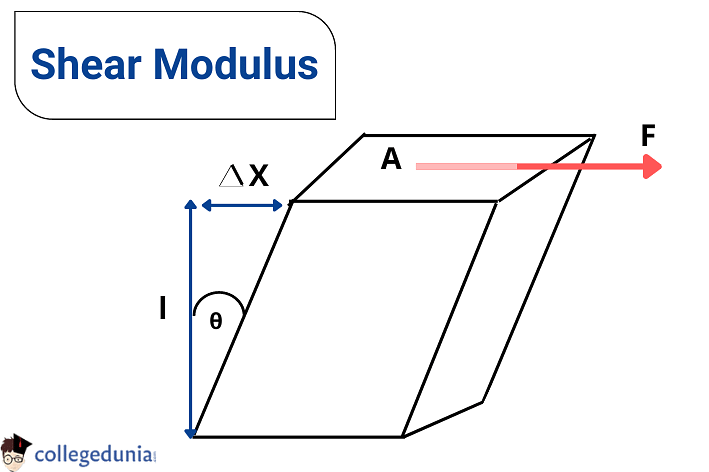
Shear Modulus
Shear Modulus is practical only for small deformations, after which they return to their original state. The reason for the same is that large shearing forces lead to permanent deformations.
Read More:
Shear Modulus Formula
[Click Here for Previous Years' Questions]
Shear Modulus is calculated as the ratio of shear stress to shear strain. Shear Modulus Formula is given as:
| \(G = \frac{Fl}{A\Delta x}\) |
Where
- G is Shear Modulus (in N.m-2).
- F is the Force acting on the object or body.
- l refers to the initial length.
- ∆x denotes the change in length.
- A refers to the area.
Read More: Important MCQs on Mechanical Properties of Solids
Solved ExamplesExample 1: If the stress experienced by a body is 5×10⁴ N/m2 and strain is 4×10⁻², what will be the Shear Modulus? Solution: Given parameters are,
Shear Modulus (G) = Shear Stress/Shear Strain G = (5×10⁴)/ (4×10⁻²) G = 1.25×10⁶ N/m2 Thus, the shear modulus is 1.25×10⁶ N/m2. Example 2: A steel block is kept in such as manner that the bottom face of the box is placed on the table. Consider that the rectangular box is experiencing a shear force. The dimensions of the block are 50 mm x 50 mm x 10 mm, the shearing force is 0.300 N, and the deformation caused is 8 mm. What will be the shear modulus of rigidity of the steel? Solution: First we will calculate Shear Stress and Shear Strain,
Shear Modulus (G) = (Shear Stress) / (Shear Strain) G = 600 / (1/10) G = 6,000 N/m2 Thus, the shear modulus of the steel is 6,000 N/m2. |
Read More: Mechanical Properties of Solids Important Questions
Derivation of Shear Modulus Formula
[Click Here for Sample Questions]
Let us consider that upon applying a force F tangentially on the top surface of a box fixed at the bottom, the top surface gets displaced by x and a plane perpendicular to the force gets turned by an angle θ.
Shear Stress
- When a certain force is applied to an object, the internal restoring forces make the elastic bodies get back their initial shape.
- This restoring force acting on per unit area of a deformed object is known as stress.
- It is also referred to as tangential or shearing stress.
- It is denoted by the symbol σ.
Shearing Stress = Force / Surface Area
| σ = F/A |
Shear Strain
- Strain is defined as the measure of the deformation experienced by a body in the direction of the force applied.
- It is denoted by the symbol ε.
| Shear Strain = tan θ = Δx/l |
l refers to the perpendicular distance (on a plane perpendicular to the force) to the layer displaced by an extent x, from the fixed layer.
Thus,
Shear Modulus (G) = Shear Stress/Shear Strain
Shear Modulus (G) = (F/A)/(x/L) = FL/Ax
Check More:
Handwritten Notes on Class 11 Mechanical Properties of Solids
[Click Here for Previous Years' Questions]
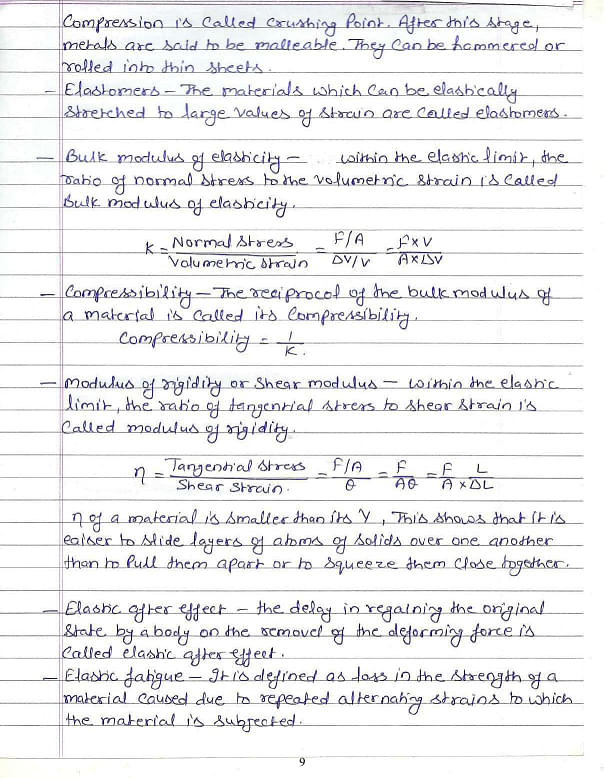
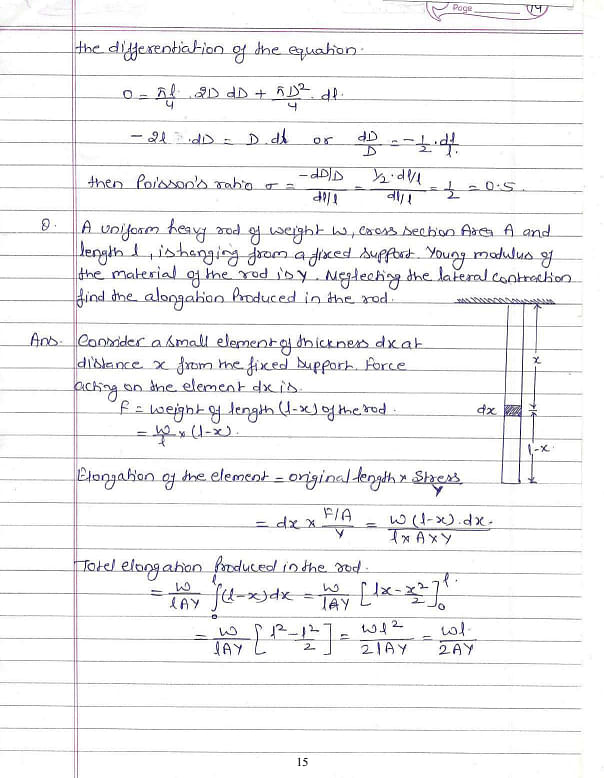
Here are the handwritten notes on the Mechanical Properties of Solids and related concepts:




Things to Remember
- Shear Modulus is a mechanical property of solids that gives the measure of the rigidity of the body.
- Shear Modulus is the ratio of shear stress to shear strain in a body or an object.
- The SI unit of Shear Modulus is pascal or Pa (Nm–2).
- It is expressed using the symbols G or μ or S.
- Shear Modulus is practical for small deformations only as large shearing forces lead to permanent deformations.
- Shear Modulus Formula is given as \(G = \frac{Fl}{A\Delta x}\).
Previous Years’ Questions
- The ratio of shearing stress to the shearing strain is defined as…
- The relation between Shear modulus (G) , Young Modulus…
- Modulus of rigidity of ideal liquids is…
- If Y,K and η are the values of Young's modulus, bulk modulus and modulus of rigidity… (JEE Main 2021)
- For an ideal liquid…
- Steel ruptures when a shear of 3.5×10⁸ N/m2 is applied…
- Shear stress is related to…
- Strain energy per unit volume in a stretched string is…
- Longitudinal strain is possible in…
- The ratio of hydraulic stress to the corresponding strain… (KEAM)
- The dimension of the modulus of rigidity is… (AIIMS 1994)
- The edge of an aluminum cube is 10cm long. One face of the cube…
- Two rods A and B of the same material and length…
- The stress-strain graphs for two materials A and B…
- According to Hooke’s law of elasticity, if stress is increased…
Sample Questions
Ques. A block made up of unknown material is kept on a table with the square face of the material being placed on the table. The block is under a shearing force. Calculate the Shear Modulus if the dimensions of the box are 60 mm x 60 mm x 20 mm, the shearing force is 0.245 N and the displacement is 5 mm. (3 Marks)
Ans. Given parameters are:
- Dimensions of Block = 60 mm x 60 mm x 20 mm
- Shearing Force = 0.245 N
- Displacement = 5 mm
Substituting the values in Shear Modulus Formula,
Shear Stress = F/A = 0.245/60×20×10-6 = 2450/50 Nm-2
Shear Strain = Δx/l = 5/60 = 1/12
Now, Shear Modulus G = Shear Stress/Shear Strain
Shear Modulus = 2450 × 12/12
Shear Modulus = 2450 N/m2
Thus, the Shear Modulus of the block is 2450 N/m2.
Ques. A thin square plate given with dimensions 80 cm × 80 cm × 0.5 cm is fixed vertically on one of its smaller surfaces. The plate is subjected to a shearing force of 2.8 ×10⁴ N at the top. The top face of the cube is displaced by 0.16 mm with respect to the bottom surface of the cube. What will be the shear modulus of elasticity of the material of the plate? (3 Marks)
Ans. Given that,
- Force = 2.8 ×10⁴ N
- x = 0.16 mm = 0.16 ×10⁻³ m,
- L = 0.8 m,
- Area = 0.8 × 0.5×10–2 m2
- Shear Modulus G =?
Using the Shear Modulus Formula,
Shear Modulus G = FL/Ax
G = [2.8×104×0.8] / [0.8×0.5×10−2×0.6×10−3]
G = 3.5×10¹⁰Pa
Thus, the shear modulus of elasticity of the material of the plate is 3.5×10¹⁰Pa.
Ques. A cylindrical bar of width 10 mm is stretched from its original length to 10 mm with the help of a force of 100 N. Calculate the Shear modulus of the system. (3 Marks)
Ans. Given parameters are:
- Width of Cylindrical Bar (Diameter) = 10 mm
- Area A = π (d/2)2 = π (5 mm)2 = π (0.005 m)2 = 2.5*10-5 m2
Using the Shear Modulus Formula,
G= (F L) / (A Δx)
G= (100 N x 0.1 m) / (2.5*10-5 m2 * (0.01 m))
G= 10 N*m/0.025*10-5 m3 = 40000000 N/m2 = 40000 KN/m2
G= 40000 KPa
Ques. Explain Shear Modulus with the help of an example. (3 Marks)
Ans. Given below is an example that will show how the shear modulus helps in defining the rigidity of any material.
- The shear modulus of steel is 7.2×10¹⁰ Pa
- The shear modulus of wood is 6.2×10⁸ Pa
It shows that steel is a lot more rigid than wood, which is around 127 times more.
Ques. A metal plate has a thickness of 0.3 inches. A hole of a radius of 0.6 inches is drilled into the plate. What will be the force required to make the hole if the shear strength is FA=4×10⁴ lb square inch? (3 Marks)
Ans. The shear stress is being exerted over the surface of a metal plate which is in a cylindrical shape.
Area of the cylindrical surface = 2πrh = 2×3.14×0.06×0.30
Area of Plate = 0.11304 square inch
Given that, F/A = 4×10⁴ lb square inch
Thus, Force needed = =4×104×0.11304= 4521.6 lb
Thus, the force required to drill a hole is 4521.6 lb.
Ques. Given that Material A has a shear modulus of x pascals, while Material B has a shear modulus of 30x pascals. What does this imply? (1 Mark)
Ans. According to the given situation, Material B has a greater value of Shear Modulus. It means that Material B is more rigid and stiffer than Material A.
Ques. Is there any effect of temperature and pressure on the shear modulus? (3 Marks)
Ans. The response of a material to an applied force changes with temperature and pressure. Shear Modulus decreases in metals with increasing temperature. Thus, the rigidity of an object decreases as pressure increases. In metals, it is observed that there is an area of temperature and pressure where there is a linear change in the shear modulus.
Ques. What is Shear Strain, and what does it indicate? What is the SI Unit of Shear Strain? (2 Marks)
Ans. Shear Strain is the measurement of the deformation of a body in the direction of the applied force. Shear strain is a dimensionless physical quantity and thus, it has no unit.
Ques. What do you mean by Shear Modulus? (3 Marks)
Ans. Shear Modulus is a measure of the mechanical characteristics of solids. It refers to the ratio of shear stress to shear strain in a body or an object.
- It is represented by the symbol G or S or μ.
- Shear Modulus is measured in its SI unit pascal or Pa.
- Shear modulus tells us how an object will act when force is applied to it.
Ques. Are the Shear Modulus and Young'sModulus the same? (2 Marks)
Ans. There is a very basic difference between the shear modulus and Young's modulus and in fact the bulk modulus. Young's modulus is the ratio of tensile stress to tensile strain. Bulk modulus is the ratio of volumetric stress to volumetric strain. Lastly, the shear modulus is the ratio of shear stress to shear strain.
Ques. Is shear modulus less than Young's modulus? (3 Marks)
Ans. The shear modulus of a material or an object is less than Young's modulus. It depicts that it is easier to slide layers of atoms than to pull them apart or squeeze them close together. The shear modulus is usually one-third of the young modulus. Shear modulus is the stress required to cause a lateral deformation in a material while Young's modulus is the stress required to bring a linear deformation in a material.
Ques. What is Shear Force? (3 Marks)
Ans. Shear force refers to a type of force that acts in a direction that's parallel to (over the top of) a surface or cross-section of a body. The word shear means that it is such a force that can cut, or shear, through the surface or object under strain. Some examples of Shear Force are as follows:
- Force experienced on the side walls of a building due to wind.
- Transversal force on beams.
- Frictional force between two bodies placed over one another.
Check-Out:



Comments