



Education Journalist | Study Abroad Lead
Shell model is a nuclear model of the atomic nucleus which explains the energy level distribution of electrons around the atom’s nucleus. To explain the structure of the nuclear energy level, the shell model uses the principle of Pauli exclusion. Different nuclear shell models were proposed to study the complete nucleus of an atom structure. Dmitry Ivanenko in 1932 first introduced the shell model and later in 1949 this shell model was developed by different Physicists namely Eugene Paul Wigner, Maria Goeppert Mayer, and J.Hans.D. Jensen.
| Table of Content |
What is Nuclear Shell Model?
[Click Here for Sample Questions]
Nuclear shell model explains energy level distribution of different electrons around the atom’s nucleus. The shell can be explained as the energy level, in which the existing particles have the same energy. In the nuclear shell model, the nuclear particles are combined one to one, for instance, a proton with a proton and a neutron with a neutron.

Shell Model
The combined protons and neutrons in nuclear energy levels are filled once the number of protons and neutrons is equal to 2, 8,20,28,50,82, or 126. Shell model helps to find out and accurately predict the properties in nuclei like angular momentum.
Also Read:
| Related Articles | ||
|---|---|---|
| Atoms | Difference between Elements and Compounds | Properties of Matter |
| Discovery of Electron | Charge to mass ratio of Electron | Isotopes and Isobars |
Magic Numbers of Neutrons and Protons
[Click Here for Sample Questions]
The magic number refers to the number of nucleons that are available in a nucleus. It means complete shells present in the nucleus of an atom. Such a type of nucleus consisting of magic numbers generally has more average binding energy per nucleon compared to the predictions depending on the von Weizsaecker’s mass formula.

Magic numbers of neutrons and protons
Closed shell nuclei are more tightly bound in the atom as compared to the next higher number. The closing shell occurrence happens at Z or N = 2, 8, 20, 28, (40), 50, 82, 126. Nuclei having an even number of neutrons and protons are more stable in comparison to odd numbers of neutrons and protons. The nuclei having either a proton number or a neutron number that equals one of the magic numbers is known as ‘double magic’ and these types of nuclei are considered stable.
Also Read: Hund’s rule
Enegry Levels of Shell Model
[Click Here for Sample Questions]
Energy levels of the shell model mean quantization of energy. It is also similar to the harmonic oscillator potentials and the square well. Shell model’s energy levels determine the energy to observe nuclear energy level’s modeling.
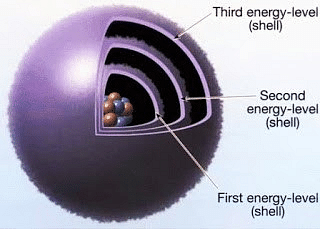
Shell Model
Energy level labels are different from the atomic energy levels’ corresponding symbols. With the increase in quantum number l and orbital angular momentum, the energy level increases just like in the case of atomic energy levels.
Here, the quantum number I is represented in terms of l = 0,1,2,3, 4, depending upon the corresponding energy level.
Atom's Shell Model
[Click Here for Sample Questions]
An atom’s shell model explains different electron arrangements around the nucleus depending on energy levels.
Atomic Number = number of electrons in an atom
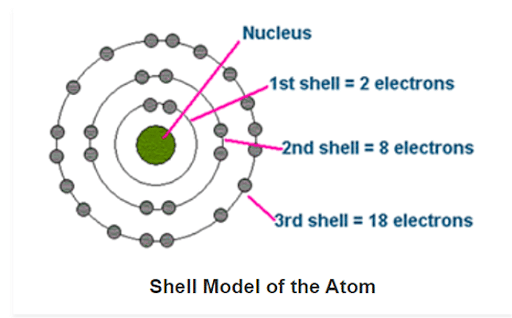
Shell Model of an atom
Things to Remember
- The physics shell model is generally a nuclear model of the atomic nucleus.
- Nuclear shell model explains energy level distribution of different electrons around the atom’s nucleus.
- In the nuclear shell model, the existing particles have the same energy.
- The nuclear particles are combined one to one, for instance, the proton with a proton and neutron with a neutron.
- The nucleons number that is also available in a nucleus are the magic numbers.
- Quantization of energy refers to the energy level of the shell models.
Also Read:
Sample Questions
Ques. What is an atom’s shell model? (2 marks)
Ans. An atom’s shell model is an electron and in atoms, it is thought of as settling diffuse shells surrounding densely in space that are positively charged nuclei. The shell that is closest to the nucleus is the first shell. The other shells expand outward from the nucleus and then they overlie on each other.
Ques. Mention the basic features of the shell model? (2 marks)
Ans. All the nuclear particles of the shell model are one-to-one paired. That means protons with a proton and neutrons with neutrons. In nuclear energy, these paired neutrons and protons are filled in that time when protons or neutrons are equal to 2, 8, 20, 28, 50, 82, or 126. These magic numbers show the most static nuclei.
Ques. What are the drawbacks of the Rutherford Model? (5 marks)
Ans. The drawbacks of the Rutherford model are as follows:
- When a body is moving in an orbit, it achieves acceleration. Thus, an electron moving around the nucleus in an orbit is under acceleration.
- According to Maxwell’s electromagnetic theory, charged particles when accelerated must emit electromagnetic radiation. Therefore, an electron in an orbit will emit radiation, the energy carried by radiation comes from electronic motion. Its path will become closer to the nucleus and ultimately should spiral into the nucleus. But actually, this does not happen.
- Thus, Rutherford’s model cannot explain the stability of atoms if the motion of electrons is described on the basis of classical mechanics and electromagnetic theory.
- Rutherford’s model does not give any idea about the distribution of electrons around the nucleus and about their energies.
Ques. What are the advantages of the shell model? (2 marks)
Ans. The main advantage of using a simple shell model is that with shell-model wave functions energy level diagrams can be successfully calculated. Also using the shell model effective two-body interactions can be calculated.
Ques. Write down the limitations of the shell model? (2 marks)
Ans. With the shell model the quadrupole’s large value moment ‘Q’ cannot be explained. Moreover, the strong interaction of spin-orbit is also not applicable in this model. These are the limitations of the shell model.
Ques. Why do stable nuclei never have more protons than neutrons? (3 marks)
Ans. The reason is that protons, being charged particles, repel each other. This repulsion becomes so great in nuclei with more than 10 protons or so, that an excess of neutrons which produce only attractive forces, is required for stability. As you get to heavier elements, with each new proton you add, there is a larger repulsive force.
The nuclear force is attractive and stronger than the electrostatic force, but it has a finite range. So you need to add extra neutrons, which do not repel each other, to add extra attractive force. You eventually reach a point where the nucleus is just too big and tends to decay via alpha decay or spontaneous fission.
To view this in quantum mechanical terms, the proton potential well is not as deep as the neutron well due to the electrostatic repulsion. [Due to the Pauli exclusion principle, you only get two particles per level (spin up and spin down)]. If one well is filled higher than the other, you tend to get a beta decay to even them out. As the nuclei get larger, the neutron well gels deeper as compared to the proton well and you get more neutrons than protons.
Ques. Why is the shell model also called the nuclear model? (2 marks)
Ans. Shell model is also called the nuclear model as it was the first model of Rutherford and it also features a nucleus in its model.
Ques. Explain Rutherford’s Nuclear Model of an Atom. (3 marks)
Ans. The postulates of Rutherford’s Nuclear model are:
- The positive charge and most of the mass of the atom was densely concentrated in an extremely small region. This very small portion of the atom was called the nucleus by Rutherford.
- The nucleus is surrounded by electrons that move around the nucleus with a very high speed in circular paths called orbits.
- Electrons and nucleus are held together by electrostatic forces of attraction.
Ques. What is the name of the hydrogen shell? (2 marks)
Ans. The outer part of the hydrogen shell is known as the valence shell whereas the available electrons in the shell are called valence electrons.
Ques. Consider a radioactive nucleus A which decays to a stable nucleus C through the following sequence:
A → B → C
Here B is an intermediate nucleus that is also radioactive. Considering that there are N0 atoms of A initially, plot the graph showing the variation of a number of atoms of A and B versus time. (3 marks)
Ans. Consider radioactive nucleus A that has N0 atoms of A initially; or at t = 0, NA = N0 (maximum) whole NB = 0. As time increases, NA decreases exponentially and the number of atoms of B increases. After some time NB becomes maximum. As B is an intermediate nucleus which is also radioactive, it also starts decaying and finally drops to zero exponentially by radioactive decay law. We can represent the situation as shown in the graph.

For Latest Updates on Upcoming Board Exams, Click Here: https://t.me/class_10_12_board_updates
Check-Out:



Comments