



Content Writer
A Slope of a Line is defined as the ratio of rise over run that is change in “y” divided by change in “x”. In simple terms, slope of a line is a measure of its steepness.
\(Slope=\frac{rise}{run}=\frac{\Delta y}{\Delta x}\)
Slope of a line is generally denoted by “m”. In geometry, we have seen lines in a coordinate plane. To understand whether these lines are parallel, perpendicular or at a certain angle without using geometrical tools, the best way is by measuring its slope.
Read more: Polygon curve angle
| Table of Content |
Key Terms: Slope, Parallel Line, Perpendicular Line, Collinear Points, y-intercept.
What is a Slope?
[Click Here for Sample Questions]
Slope is basically the measure of how steep a straight line is. It is denoted by “m” and measured by the change in value of y (Δy) divided by the change in value of x (Δx).
Hence, the equation of slope of a line can be written as,
m = \(\frac{change in y}{change in x}\)
Or, m =\(\frac{\Delta y}{\Delta x}\)
The slope of a line can also be represented by “tan θ”.
Therefore, the equation of slope can also be written as,
tan θ = \(\frac{\Delta y}{\Delta x}\)
Hence, the slope of a straight line formed by two points P and Q with coordinates (x1 , y1) and (x2 , y2) respectively can be determined by the difference of the coordinates of the points P and Q.
The formula of slope thus formed will be,
m = \(\frac{y_2- y_1}{x_2- x_1}\)
Based on the above formula, we can easily determine the slope of a line between two points.
Equation of a Line
[Click Here for Sample Questions]
Equation of a Line is a mathematical expression that shows the relation between the coordinate points lying on a straight line. The equation of a straight line are of 3 types namely:
- Standard Form: ax+by=c where a, b, c are constants and x and y are variables.
- Slope-Intercept Form: y = mx + c where m is the slope and c is the y-intercept.
- Point-Slope Form: y-y1=m(x-x1) where (x, y) is an arbitrary point on the line and (x1, y1) is a known point on the line.
Slope of Parallel Lines
[Click Here for Sample Questions]
Slope of two lines which are parallel to each other is always equal since parallel lines are equally inclined or steep. If two lines l1 and l2 who are parallel to each other have slopes m1 and m2 respectively, then we have,
m1 = m2
Derivation:
Let, two lines l1 and l2 have slopes m1and m2 respectively forms an angle “θ” between them.
Therefore,
tan = \(\frac{m_2- m_1}{1+ m_1m_2}\)
Since the lines are parallel, the angle between them is 0˚ or 180˚.
Thus, tan 0˚ = tan 180˚ = 0,
Therefore we get,
0= \(\frac{m_2- m_1}{1+ m_1m_2}\)
Or, 0 = m2 – m1
Or, m1 = m2 [Derived]
Slope of Perpendicular Lines
[Click Here for Sample Questions]
Slope of two lines that are perpendicular to each other is such that the slope of one line is the negative reciprocal of the slope of another line.
In simple terms, the product of the slope of two perpendicular angles is equal to -1.
Therefore, two lines l1 and l2 having slopes m1 and m2 respectively and are perpendicular to each other can be represented as,
m1 . m2= – 1
Derivation:
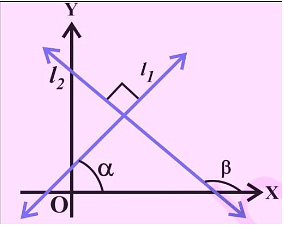
The above figure shows two perpendicular lines l1 and l2 with inclinations α and β.
Since they are perpendicular, we can say that β = α + 90˚ [using properties of angles].
Therefore their slopes can be represented as,
m1 = tan (α + 90°) and m2= tan .
Or, m1 = – cot cot α
Or, m1= – \(\frac{1}{tantan}\) = – \(\frac{1}{m_2}\)
Or, m1× m2 = – 1 [Derived]
Thus, two lines are perpendicular to each other only if their slopes are negative reciprocals of each other.
Read more:
| Relevant Concepts | ||
|---|---|---|
| Perpendicular bisector | Line and angles | Corresponding angles axioms |
| Analytical geometry | Reflex angle | Cartesian Plane |
Slope for Collinearity
[Click Here for Sample Questions]
For three points A, B and C to be collinear, the slope of lines formed by any two points (say AB and BC) should be equal and there should be at least one common point through which they should pass. In other words, three points A, B and C will be collinear only if,
Slope of line AB = Slope of line BC = Slope of line AC
The slope of each line can be determined by the equation,
m = \(\frac{y_2- y_1}{x_2- x_1}\)
Angle between Two Lines
[Click Here for Sample Questions]

Angle between Two Lines
Let L1 and L2 be two lines with slopes m1 and m2 respectively. The point of intersection created a pair of vertically opposite angles and a pair of adjacent angles. If α1 and α2 are the inclinations of the two lines L1 and L2 respectively, then,
m1 = tan 1 and m2 = tan2
Let, θ and ɸ be the adjacent angles of L1 and L2.
Θ = α2 – α1 and α1, α2 ≠ 90˚.
Therefore,
tanθ = tan tan (α2 – α1) = \(\frac{tan \alpha_2-tan\alpha_1}{1+tan\alpha_1\alpha_2}\) = \(\frac{m_2- m_1}{1+ m_1m_2}\)
As, 1 + m1m2 ≠ 0 and ɸ = 180˚ – θ,
tanɸ = tan (180˚ – θ) = – tanθ = – \(\frac{m_2- m_1}{1+ m_1m_2}\)
Here two cases arise.
- If \(\frac{m_2- m_1}{1+ m_1m_2}\) is positive, the tanθ will be positive and tanɸ will be negative which determines that θ is acute and ɸ is obtuse.
- If \(\frac{m_2- m_1}{1+ m_1m_2}\) is negative, then tanθ will be negative and tanɸ will be positive which determines that θ is obtuse and ɸ is acute.
Thus the acute angle θ can be found by,
tan tan θ = \(\frac{m_2- m_1}{1+ m_1m_2}\)
And the obtuse angle ɸ can be found by,
ɸ = 180˚ – θ.
Things to Remember
- Using two points of a line to calculate its slope.
- By picking different points on a line you can double check your answer.
- If the line is going up from left to right, the slope of the line is positive and if it is going down from left to right, the slope of the line is negative.
- There are 4 types of slope: Positive, Negative, Zero and Undefined.
- A horizontal line has a slope 0 whereas a vertical line has an undefined slope.
- Equation of a line passing through the origin is y=mx.
Sample Questions
Ques. What is the slope of a line parallel to y = 2x + 3, and is passing through (-1, 2)? (2 marks)
Ans. The given equation of a line is y = 2x + 3. Comparing this with the slope-intercept form of the equation of line y = mx + c, we have m = 2
The required slope of the parallel line is equal to the slope of this given line and is equal to 2. Also, the given point (-1, 2) is not required to find the slope of the parallel line.
Therefore the slope of the parallel line is m = 2.
Ques. Find the equation of a line passing through (-1, 2) and the slope of a parallel line is 2/3. (5 marks)
Ans. The given slope of the parallel line is m = 2/3, and hence the slope of this required line is also m = 2/3.
The given point is (x1,y1)(x1,y1) = (-1, 2)
The equation of a line can be calculated using the point slope form of the equation of a line.
(y−y1) = m(x−x1)(y−y1) = m(x−x1)
(y−2) = 23(x−(−1))(y−2) = 23(x−(−1))
3(y−2) = 2(x+1)3(y−2) = 2(x+1)
3y – 6 = 2x + 2
2x - 3y + 2 + 6 = 0
2x -3y + 8 = 0
Therefore the required equation of the line is 2x - 3y + 8 = 0.
Ques. What is the slope of a line perpendicular to the line 4x - 3y + 7 = 0. (3 marks)
Ans. The given equation of the line is 4x - 3y + 7 = 0
Comparing this with ax + by + c = 0, the slope of the line is m = -a/b, which is equal to m1 = -4/(-3) = 4/3.
Here we use the formula of slope of perpendicular line m1.m2 = -1.
(4/3).m2 = -1
m2 = -1/(4/3)
m2 = -3/4
Thus the slope of the perpendicular line is -¾
Ques. Find the equation of a line passing through (4, -3), and have the slope of the perpendicular line as 2/3. (5 marks)
Ans. The given point is (x1,y1)(x1,y1) = (4, -3), and the slope of the perpendicular line is m1=2/3.
We know that the product of the slopes of two perpendicular lines is m1.m2 = -1.
2/3 . m2 = -1
m2 = -1 × 3/2
m2 = -3/2
The required equation of the line can be found using the formula of point slope form.
(y−y1)=m(x−x1)(y−y1)=m(x−x1)
y - (-3) = -3/2(x - 4)
2(y + 3) = -3(x - 4)
2y + 6 = -3x + 12
3x + 2y + 6 - 12 = 0
3x + 2y - 6 = 0
Thus the required equation of the line is 3x + 2y - 6 = 0.
Ques. Find out whether the points P(1, 2), Q(2, 3), and R(3, 4) are collinear points or not. (5 marks)
Ans. To check the collinearity of points, we will use the slope formula and find the slope of any two pairs of lines formed by the points
Let us find the slope of the lines PQ and QR, and check if we get the slopes equal to each other. If they are equal, then the points will be collinear.
Slope of line PQ is
m2=(y2−y1)/(x2−x1)
m2=(3−2)/(2−1)
m2=1/1
m2=1
Slope of line QR is
m1=(y3−y2)/(x3−x2)
m1=(4−3)/(3−2)
m1=1/1
m1=1
As the slope of both the lines is equal, the points are collinear.
Ques. Find the slope of a line whose coordinates are (2,7) and (8,1)? (2 marks)
Ans. Given, (x1, y1) = (2, 7)
(x2, y2) = (8, 1)
The slope formula is m = (y2 − y1 / x2 − x1)
m = (1 − 7/ 8 − 2)
m = −6/6
m = − 1
Ques. If the slope of a line passing through the points (4, b) and (2, -9) is 3, then what is the value of b? (3 marks)
Ans.
Given,
Slope = m = 3
Points:
(x1 , y1 ) = (4, b)
(x2, y2) = (2, -9)
We know that,
Slope (m) = (y2– y1 )/(x2– x1)
3 = (-9 – b)/(2 – 4)
3 = (-9 – b)/(-2)
-9 – b = 3(-2)
-9 – b = -6
b = -9 + 6 = -3
Therefore, the value of b = -3.
Ques. Find the equation of a straight line that passes through the points (1, 3) and (-2, 4). (4 marks)
Ans. To determine the equation of the line, we will use the formula point-slope form.
For this, we first need to find the slope of the line.
Slope = (4-3)/(-2-1) = -1/3
Therefore, the equation of the line passing through (1, 3) and (-2, 4) is y - 4 = (-1/3) (x + 2)
⇒ y - 4 = -x/3 - 2/3
⇒ y + x/3 = 4 - 2/3
⇒ x + 3y = 10
Ques. The cost of a notebook is Rs.5 more than twice the cost of a pen. Represent the situation as an equation of a straight line. (2 marks)
Ans. Assume cost of pen = Rs. x and cost of notebook = Rs. y. Then, according to the question, we have
y = 2x + 5 which is the equation of a straight line.
Ques. What is the equation of a line with slope of 3 and a y-intercept of –5? (2 marks)
Ans. These lines are written in the form y = mx + b, where m is the slope and b is the y-intercept.
We know from the question that our slope is 3 and our y-intercept is –5,
So, putting these values in we get the equation of our line to be,
y = 3x – 5.
For Latest Updates on Upcoming Board Exams, Click Here: https://t.me/class_10_12_board_updates
Check out:



Comments