



Content Writer
Spermatogenesis is the process of cell development within the male reproductive system. In this, male sperm cells undergo the process of meiosis to produce spermatocyte cells.
- It is the male version of gametogenesis.
- In humans, the process of spermatogenesis starts at the puberty stage and continues until they die.
- The testes of human cells are composed of a number of tubules called seminiferous tubules.
- The process is carried out in the basement membrane of tubules.
- Within the seminiferous tubules, there are many scattered cells, which are called Sertoli cells.
- Sertoli cells are responsible for providing nourishment and blood products to immature sperm cells.
- It requires a temperature lower than the normal body temperature.
- In mammals, the process is initiated at the seminiferous tubules of male testes.
| Table of Content |
Key Terms: Gametogenesis, Reproductive Systems, Tubules, Cell Development, Zygote, Mitotic Division, Chromosomes, Down syndrome
What is Spermatogenesis?
[Click Here for Sample Questions]
Spermatogenesis is the cell division process within the immature cells of male reproductive organs. It usually occurs during puberty at the bottom of the seminiferous tubules.
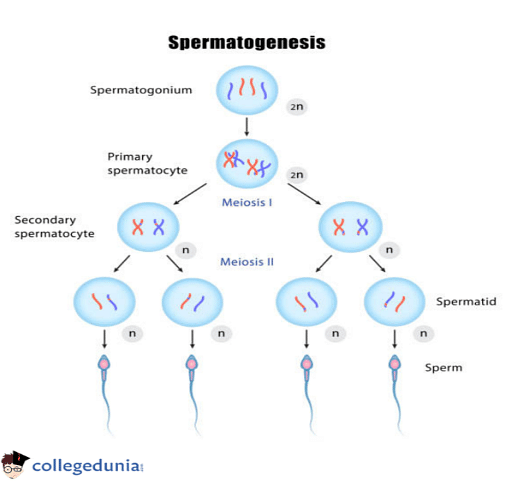
Spermatogenesis
- The process starts with the mitotic division of spermatogonial stem cells.
- In this, the primary spermatocyte cell divides into two secondary spermatocytes cells through the process of meiosis.
- The spermatocyte division will produce two spermatocyte cells, which are further divided into four spermatozoa and four haploid cells.
- It is highly dependent on the optimal conditions and is important for the sexual reproduction of cells within the body.
- A group of cells created simultaneously during the division process is called a spermatogenic wave.
Purpose of Spermatogenesis
[Click Here for Previous Year Questions]
The main purpose of Spermatogenesis is to produce a mature male sperm that can easily combine with the female gametes.
- Spermatogenesis primarily aims to produce male sperm that can easily combine with a female gamete called oocyte.
- Sexual reproduction aims to create a single-cell organism called the zygote.
- The number of chromosomes must be maintained properly for the normal division of cells.
- In case the number of chromosomes is more than the normal level, then chances of serious abnormalities can arise.
- As a result, this will lead to abnormal birth defects, continuous abortion and Down syndrome.
Location of Spermatogenesis
[Click Here for Sample Questions]
For a proper understanding of Spermatogenesis, it is important to determine the exact location of each cell within the process.
- The process starts within the testes, where gametes are formed and stored until they reach the stage of ejaculation.
- At the seminiferous tubules, spermatogonial cells start moving toward the lumen to produce immature sperm.
- A cell's maturation occurs when it reaches the stage of epididymis.
Duration of Spermatogenesis
[Click Here for Previous Year Questions]
Within the male reproductive system, sperm cells are produced at regular intervals. However, all sperm cells are not produced at the same time, thus indicating the importance of understanding the duration of each process of Spermatogenesis.
- The entire process is said to be completed in 74 days for humans.
- According to the analysis, one complete seminiferous epithelium cycle usually takes 16 days.
- The number of viable stages is increased from 6 to 12.
Also Read:
| Related Articles | ||
|---|---|---|
| Difference between sperm and ovum | Female reproductive system | Difference between spermatogenesis and oogenesis |
| Reproductive system in humans | Control and Coordination | Environment |
Factors Affecting the Process of Spermatogenesis
[Click Here for Sample Questions]
Spermatogenesis is an important process for the development of normal zygotes during the process of sexual reproduction. The factors affecting the process of Spermatogenesis are as follows:
- Change in the temperature of the body during reproduction.
- Abnormalities in hormones
- Consumption of alcohol and drugs
- Stress and tension
- Improper diet
- Disturbed sleeping pattern
Stages of Spermatogenesis
[Click Here for Previous Year Questions]
There are three stages of Spermatogenesis, which help in the production of good quality of gamete and reduce the chance of abnormalities.

Process of Spermatogenesis
Spermatocytosis
This is the first stage of Spermatogenesis, where the division of diploid cells is carried out for the creation of four haploid cells.
- Testes are made of seminiferous tubules, which are combined with stem cells.
- Stem cells work as a raw material for different processes of cell division.
- The stem cells also result in the formation of immature cells called spermatogonia.
- The division of stem cells occurs mitotically, in which the first half will produce the sperm cells.
- The other division of stem cells is responsible for maintaining consistency in tubules.
- The cells are allowed to rest for a suitable duration of time.
- After resting, the cells undergo the process of meiotic division, which results in the formation of two haploid spermatocytes.
Spermatidogenesis
The second stage in the process of Spermatogenesis is the process of Spermatidogenesis.
- In this stage, meiosis of spermatocytes takes place to produce spermatids.
- The process results in the formation of four spermatids from a single spermatogonia.
- There are 23 chromosomes in spermatogonia, in which one chromosome is a sex chromosome.
- During division, the sex chromosome will enter into the different spermatids.
- Thus, waiting with which sex chromosomes the spermatids will produce the required zygote.
Spermiogenesis
This is the last stage of Spermatogenesis, where spermatids undergo structural changes to produce one fine sperm cell.
- At this stage, spermatids are changed into a proper structure comprising the head and tail.
- Half of the head is covered with a thick cap called acrosome.
- The acrosome is responsible for fertilising the sperm into a zygote.
- The cells are stored within the body until they reach the stage of ejaculation.
Things to Remember
- Spermatogenesis is the process of creating mature sperm within the male reproductive system.
- The process is carried out in the seminiferous tubules.
- For proper functioning of the reproductive cycle, the temperature of the body should be maintained accurately.
- The number of chromosomes must be within the normal range during the time of division.
- Abnormalities in hormones, diet and stress can affect the process of spermatogenesis.
- The process of spermatogenesis is carried out in three stages, namely Spermatocytes, Spermatidogenesis and Spermiogenesis.
Previous Year Questions
- Extraction of metal from the ore cassiterite involves...[JEE Advanced 2011]
- Commonly used vectors for human genome sequencing are...[NEET UG 2014]
- Interfascicular cambium and cork cambium are formed due to..
- Pneumotaxic centre is present in...[UP CPMT 2007]
- Reaction of HBr with propene in the presence of peroxide gives….[NEET UG 2004]
- Assuming the expression for the pressure exerted by the gas on the walls of the container, it can be shown that pressure is...[MHT CET 2016]
- Which among the following is the strongest acid?...[TS EAMCET 2017]
- Isopropyl alcohol on oxidation forms..
- A vector is not changed if..
- Which of the following arrangements does not represent the correct order of the property stated against it?...[JEE Main 2013]
Sample Questions
Ques. Which hormones regulate Spermatogenesis? (2 marks)
Ans. Testosterone is the main hormone that regulates the process of Spermatogenesis. Testosterone basically serves as a paracrine that goes into the seminiferous tubules and is responsible for stimulating the hormone, which in return helps in the production of sperm cells in the body.
Ques. What is the total duration of Spermatogenesis? (1 mark)
Ans. The process of Spermatogenesis is said to be completed in a maximum of 74 days. According to analysis it is found that one cycle of seminiferous epithelium is completed in 16 days.
Ques. What is the main purpose of Spermatogenesis? (3 marks)
Ans. The primary purpose of Spermatogenesis is to produce a suitable male sperm that can easily combine with a female gamete during the process of sexual reproduction. The process of spermatogenesis is assumed to start at puberty due to the interaction of pituitary glands and hypothalamus. The process starts when spermatozoa is released into the lumen and stored in the cauda region until they reach the stage of ejaculation. The entire process of spermatogenesis is based on the number of chromosomes as chromosomes help in the cell division during the time of conception.
Ques. Is Spermatogenesis a haploid or diploid process? (2 marks)
Ans. Spermatogenesis is basically a haploid process where 23 pairs of chromosomes are located at the periphery of the seminiferous tubules. In this, the division of diploid cells is carried out for the creation of four haploid cells. It is highly dependent on the optimal conditions and is important for the sexual reproduction of cells within the body.
Ques. Explain the process of spermatidogenesis? (3 marks)
Ans. This is the second stage of Spermatogenesis, in which meiosis of spermatocytes takes place to produce spermatids by two types of division, which are meiosis division I and meiosis division II. The primary spermatocyte cell will enter the meiosis division I with duplicated DNA to produce secondary spermatocytes. In the next stage, the secondary spermatocytes will enter the meiosis division II, which helps in the formation of four spermatids. During cell division, the sex chromosome, made of X and Y chromosomes, will enter into the different spermatids, which in turn wait for the required spermatids to produce the required zygote.
Ques. What is the exact location where the process of Spermatogenesis takes place? (3 marks)
Ans. The exact location where the process of Spermatogenesis takes place is the testes. In testes, gametes are formed and stored until they reach the stage of ejaculation. Within the seminiferous tubules, spermatogonial cells start moving toward the lumen to produce immature sperm. The maturation of a cell occurs when it reaches the stage of epididymis. It is an important process for the development of normal zygotes during the process of sexual reproduction.
Ques. Explain the process of spermiogenesis that is carried out in Spermatogenesis. (3 marks)
Ans. Spermiogenesis is the final stage of Spermatogenesis. In this stage, spermatids are converted into an elongated structure called spermatozoa. Each spermatozoa has a head and a tail and consists of highly condensed genetic material within them. Around two-thirds of the head is covered with a thick cap called acrosome. The acrosome is responsible for fertilising the sperm into a zygote with the help of spermatids DNA that are in the condensed state. The maturation of cells takes place in the testes and will be released from the body when they are ready for ejaculation.
For Latest Updates on Upcoming Board Exams, Click Here: https://t.me/class_10_12_board_updates
Check-Out:



Comments