



Content Writer
Sugar is a simple carbohydrate that is soluble in water and has a sweet flavor. Sugar is a white substance that has no odor. It is the most abundant energy source. In organic chemistry, the sugar molecule is the most commonly used phrase in biomolecules. Sucrose molecular formula is another name for sugar formula.
| Table of Content |
Key Terms: Fructose, Sucrose, Carbohydrate, Protein, Starch, Polysaccharide, Disaccharide, Monosaccharide
Sugar
[Click Here for Sample Questions]
Sugar is a sweet-tasting substance that is extensively utilized in cuisine. These are very carbohydrate soluble. Monosaccharides such as glucose, fructose, and galactose make up simple sugar. The compound sugar, on the other hand, is made up of disaccharides or double sugars that are linked together by glycosidic linkages. Sugars include sucrose, which is made up of glucose and fructose, lactose, which is made up of glucose and galactose, and maltose, which is made up of two glucose molecules.
Sugar's general formula is Cn(H2O)n, where "n" is a number between 3 and 7.
Read More:
Types of Carbohydrate
[Click Here for Sample Questions]
Monosaccharides, oligosaccharides, and polysaccharides can be categorized based on the number of saccharides in the hydrolysis process.
Monosaccharides
C6H12O6 is the molecular formula for simple sugars. These are the chemicals that dissolve quickly in water.
This also comprises three different sugars: glucose, fructose, and galactose.
- These are the most basic sugars that can't be hydrolyzed any further.
- The fact that x is always equal to y in their generalized formula indicates that the amount of carbon and oxygen atoms is the same.
- Except for dihydroxyacetone, all monosaccharides exist in d and l forms.
- It might take the form of a ring or a straight chain.
- Pyranose is a six-membered ring, while furanose is a five-membered ring.
- Glucose, fructose, galactose, and mannose are examples of sugars.
Fructose Formula
Fruit sugars are another name for these sugars. Fructose has a cyclic structure with five hydroxyl groups and one carbonyl group. Apart from that, monosaccharides of this sort dissolve easily in water. Fructose can also be found in honey, cane sugar, and various vegetable roots. Fructose is a glucose isomer. C6H12O6 is its chemical formula. In this formula, C denotes carbon, H is hydrogen, and O denotes oxygen.
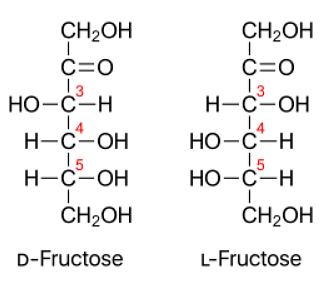
Chemical Formula of Glucose
Glucose is a fructose isomer and the epimer of galactose and mannose. C6H12O6 is its chemical formula. C stands for carbon, H for hydrogen, and O for oxygen in the chemical formula for glucose. Glucose is a major result of photosynthesis that occurs naturally in fruits and plants. Glucose has its unique chemistry. This is frequently used and serves a variety of purposes. The starch from plants is turned into glucose.
Oligosaccharides
- These are carbohydrates that break down into 2 to 10 monosaccharides when hydrolyzed.
- The monosaccharide is joined together by glycosidic linkages in oligosaccharides.
- Disaccharides, trisaccharides, tetrasaccharides, and pentasaccharides are different types of sugars.
- Sucrose, maltose, and lactose are examples of sugars.
Sucrose
The molecules sugar, sucrose, and cane sugar are the same. C12H22O11 is the chemical formula for sucrose. C stands for carbon, H for hydrogen, and O for oxygen in the sugar chemical formula. One molecule of sucrose is made up of 12 carbon atoms, 22 hydrogen atoms, and 11 oxygen atoms.
- Sucrose is a glucose-fructose disaccharide.
- Cane sugar, table sugar, and commercial sugar are all terms for sucrose.
- Invert sugar is another name for sucrose.
- It is a non-reducing sugar.
- In sucrose, glycosidic linkage occurs in a 1'-2" direction.
- This has a molecular mass of 342.3 g/mol.

Polysaccharides
Polysaccharides are made up of a lot of monosaccharide molecules. These are insoluble in water and have a bitter flavor. Starch and cellulose are two examples.
Galactose
Monosaccharides of this kind do not exist in a free form and are a component of the disaccharide lactose. Monosaccharides of this sort are also known as milk sugar because they are far less sweet than glucose. These can be seen on the surface of red blood cells or blood types in general.
Disaccharides
Disaccharides are made up of two monosaccharides separated by a water molecule. The disaccharide's chemical formula is C12H22O11. Lactose, maltose, and sucrose are among them.
Lactose
Lactose is a sugar that is commonly present in milk. Lactose is made up of two sugars: galactose and glucose. When they are ingested, the enzyme lactase helps to break them down into their constituent particles during digestion.
Maltose
Maltose is present in grains such as barley during germination, and it is then transformed into malt. Two molecules of glucose make up the maltose's component particles. These sugars are generally less sweet than glucose, fructose, or sucrose. Starch is broken down into amylase, which then splits to generate maltose during the digestive process.
Sucrose
These are mostly found in the roots of sugar beets and sugarcane. These are grown sideways of fructose and glucose in other plants, particularly in plants and fruits. Glucose and fructose are the two main components of sucrose. With the aid of enzymes known as sucrases, they are broken down into their constituent particles after being consumed.
Things To Remember
- Sugar was not introduced to the West as a sweetener but as a spice.
- Sugar cane or sugar beets are used to extract sucrose. It can also be found in the nectars of many plants.
- Sucrose is a crystalline substance that is white, odorless, and has a sweet flavor. Water (2000 g/L) and other polar solvents are very soluble in it. It has a density of 1.587 g per mL.
- Sucrose has no melting point and decomposes at 186 degrees Celsius.
- Sugar is also used as a preservative.
Read More:
| Chapter Related Concepts | ||
|---|---|---|
| Carbohydrate Metabolism | RNA and DNA | |
| Cellulose | Fats and Oils | Test for Starch |
Sample Questions
Ques. How can you identify a monosaccharide? (2 marks)
Ans. Monosaccharides are classed based on three factors: the placement of their carbonyl group, the number of carbon atoms in their structure, and their chirality. The monosaccharide is an aldehyde if the carbonyl group is an aldehyde. The monosaccharide is a ketose if the carbonyl group is a ketone.
Ques. Why is glucose a monosaccharide? (2 marks)
Ans. Because glucose cannot be broken down further by hydrolysis, it is categorized as a monosaccharide. It's also known as a hexose, thanks to its six-carbon skeleton, and an aldose, thanks to the presence of an aldehyde group on carbon 1.
Ques. Which monosaccharide is often called blood sugar? (2 marks)
Ans. Glucose is a well-known monosaccharide that circulates in the bloodstream and is also known as blood sugar. It's also used to make disaccharides like sucrose, lactose, and maltose by combining them with other sugars. Two sugar molecules are joined together to form a disaccharide.
Ques. What is meant by crystallization? (2 marks)
Ans. The method by which solid forms are organized into a structure known as a crystal, in which the atoms or molecules are well structured, is known as crystallization. Crystals can form in a variety of ways, including as a result of a gas precipitating, freezing, or, more rarely, is deposited from a solution.
Ques. Why is glucose called dextrose? (2 marks)
Ans. The most prevalent carbohydrate is glucose, which is categorized as a monosaccharide, an aldose, a hexose, and reducing sugar. It's also known as dextrose since it's dextrorotatory (meaning it spins plane polarized light to the right as an optical isomer) and serves as an origin for the D designation.
Ques. What is the work of sucrose? (2 marks)
Ans. Sucrose is a carbohydrate that gives your body the energy it needs to execute physical and mental processes. During digestion, carbohydrates like sucrose and starch are broken down into fructose and glucose. Your body metabolizes fructose and glucose to provide energy to your cells.
Ques. What happens when sucrose is digested? (2 marks)
Ans. Because sucrose is a disaccharide, it must be broken down before it can be used by your body. Lactase breaks down lactose (or "milk sugar") into glucose and galactose, whereas enzymes in your tongue partially break down sucrose into glucose and fructose. The monosaccharides (glucose) generated are absorbed and subsequently utilized to generate energy in metabolic processes. The majority of sugar digestion, however, takes place in the small intestine.
Ques. How are monosaccharides formed? (2 marks)
Ans. A nucleophilic addition reaction between the carbonyl group and one of the hydroxyls of the same molecule converts an acyclic (open-chain) monosaccharide to a cyclic form. A ring of carbon atoms is formed, which is closed by one bridging oxygen atom.
For Latest Updates on Upcoming Board Exams, Click Here: https://t.me/class_10_12_board_updates
Check Out:



Comments