



Exams Prep Master
A solid figure or shape with three dimensions that has 6 faces is called a cuboid, which has 12 edges and 8 vertices. Among all the other shapes or the articles made in different shapes, a cuboid is a three-dimensional figure. It has length, height, and width. A cuboid (3-dimensional) is formed when many rectangular (2-dimensional) shapes are placed in accordance with one another. These rectangular shapes should be coherent with one another. However, this should be noted that a cube and a cuboid are different from each other. Here, we will be discussing the surface area of cuboid, its formula, derivation along with some examples and important questions.
| Table of Content |
Keyterms: Cuboid, three-dimensional figure, rectangular shape, 2-dimensional shape, matchbox, cardboard box
Read More: Trigonometry Table
What is Cuboid?
[Click Here for Sample Questions]
As already discussed, a cuboid is a three-dimensional figure or solid which possesses six rectangular sides called faces. Each face of a cuboid is rectangle-shaped and all of its corners are 90-degrees. Moreover, a cuboid has 8 vertices and 12 edges, where the opposite faces of a cuboid are always equal. Meaning, the opposite surfaces of the cuboid are in the same dimension.
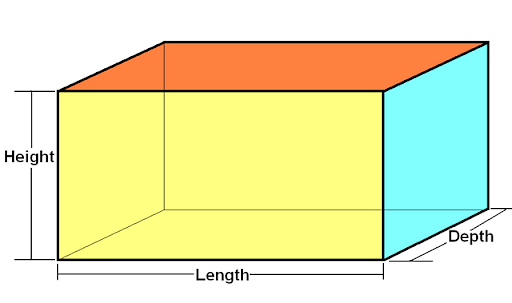
The edges of the cuboid do not share a common length. The above diagram shows you a shape of a cuboid. Now you can easily relate the common real objects that you see or use in your daily lives. A cuboid, for example, is:
- A matchbox containing match sticks that we use for lighting fire.
- A cardboard box that we get the articles packed in after shopping.
- A building that is erect and is hollow inside to hold small or big cabins inside.
- Refrigerators that we store food in to prevent it from getting spoiled.
The three dimensions of a cuboid are denoted as ‘l’ for length, ‘h’ for height, and ‘w’ for width.
Also Read:
| Related Articles | ||
|---|---|---|
| Circle | Area of Segment of a Circle | Semicircles |
| Surface Area of a Cylinder Formula | Sphere Formula | Slope Formula |
| Transversal | Isosceles triangle | Scalene Triangle |
Surface Area of a Cuboid
[Click Here for Sample Questions]
As we know that a cuboid is comprised of more than one rectangle, we calculate the area of a cuboid by applying the formula of a rectangle. Since a cuboid contains rectangular shapes, a rectangular formula has to be used. There can be two types of surface areas a cuboid can have:
The total surface area of a cuboid (TSA) and the Lateral Surface area LSA.
Total Surface Area of a Cuboid
The total surface area of a cuboid (TSA) is equal to the sum of the areas of its 6 rectangular faces, and it is given by:
The Total Surface area of a Cuboid (TSA) = 2 (lb + bh+lh) square units
Lateral Surface Area of a Cuboid
The lateral surface area of a cuboid is the sum of 4 planes of a rectangle, excluding the upper and the lower surface. Mathematically, the Lateral Surface Area of a cuboid (LSA) is represented as:
The Lateral Surface area of a cuboid (LSA) = 2h (l+b)
Where,
- l is the length
- b is the breadth (width)
- h is the height
Example 1: The length of a cuboid = 10cm
Breadth (Width) = 4cm
Height = 8cm
Solution: The Total surface area of a cuboid = 2 (lb + bh+lh)
2 (10x4 + 4x8 + 10x8)
2 (40 + 32 + 80)
2 (152)
= 304 cm
Therefore, the total surface area of a cuboid = 304 cm
Example 2: The length of the cuboid = 8 feet
The height of the cuboid = 6 feet
The width of the cuboid = 2 feet
Solution: By applying the above formula: 2h (l+b), we get
2x6 (8+2)
12 (10)
= 120
Therefore, the Lateral surface area of a cuboid = 120 feet.
Also Read:
| Related Articles | ||
|---|---|---|
| Eccentricity | Eccentric Formula | Inverse Trigonometric Formulas |
| Integers As Exponents? | Ordinate? | Collinear points? |
Volume of a Cuboid
[Click Here for Sample Questions]
All the space inside a hollow cuboid is considered to be the volume of the cuboid. The volume of the cuboid is all about its height, length, and width. The volume of a cuboid can be calculated by using the following formula:
The volume of a cuboid = Base area x height
The base area of a cuboid = l x b
Therefore, the volume = l x b x h
Where, l = length
b = breadth
h = height
By proving the above information about the cuboid, you now have got a sure idea about what kind of a shape is the cuboid. We have discussed the shape, area (including the total surface area and the lateral surface area) of a cuboid, and the volume of a cuboid. You can easily calculate the dimensions with one another and get the area and the volume of a cuboid.
Total Surface Area of a Cuboid Derivation
[Click Here for Sample Questions]
As it is already known that the cuboid has six rectangular faces, the total surface area of the cuboid is calculated as follows:
Let us assume that, l, b, h be the length, breadth, and height of the cuboid respectively.
Thus,
The front face area of cuboid = l x h
The back face area of the cuboid = l x h
The upper face area of the cuboid = l x b
The lower face area of the cuboid = l x b
The left face area of the cuboid = h x b
The right face area of cuboid = h x b
Thus, the total surface area is the sum of all the faces of a cuboid, then the TSA of a cuboid is:
Total Surface Area of Cuboid = lh + lh + lb+ lb+ hb+ hb
Total Surface Area of Cuboid = 2 lh + 2 lb + 2 hb
Total Surface Area of Cuboid = 2 (lh + lw+ hb)
Therefore, the total surface area of the cuboid is 2 (lh + lw+ hb) square units.
Also Read:
Things to Remember
- A solid figure or shape with three dimensions that has 6 faces is called a cuboid. A matchbox, refrigerator, building, and cardboard box are examples of cuboids.
- The three dimensions of a cuboid are denoted as ‘l’ for length, ‘h’ for height, and ‘w’ for width.
- There can be two types of surface areas a cuboid can have: The total surface area of a cuboid (TSA) and the Lateral Surface area LSA.
- The Total Surface area of a Cuboid (TSA) = 2 (lb + bh+lh)
- The Lateral Surface area of a cuboid (LSA) = 2h (l+b)
- While calculating the area of a cuboid, we should note that l is the length, b is the breadth (width) and h is the height.
- The Total surface area of a cuboid is the calculation of the total sum of the areas of its sides (the sides of its 6 rectangles).
- The Lateral surface area of a cuboid is the area of all the sides of a cuboid excluding the base and the top.
- The volume of the cuboid is all about its height, length, and width.
- The volume of a cuboid can be calculated by using the following formula: The volume of a cuboid = Base area x height, The base area of a cuboid = l x b
Also Read:
Sample Questions
Ques: What is the surface area of cube and cuboid? (2 marks)
Ans: The surface area of the cube can be calculated by using the formulas given below:
LSA = 4a2
TSA = 6a2
The surface area of the cuboid can be calculated by using the formulas given below:
LSA = 2h(l + b)
TSA = 2(lb + bh + hl)
Ques: What is the lateral surface area of a cuboid? (2 marks)
Ans: The lateral surface area of a cuboid is the sum of 4 planes of a rectangle, excluding the upper and the lower surface. Mathematically, the Lateral Surface Area of a cuboid (LSA) is represented as:
The Lateral Surface area of a cuboid (LSA) = 2h (l+b)
Where,
- l is the length
- b is the breadth (width)
- h is the height
Ques: How can the surface area and volume of a cuboid be found? (3 marks)
Ans: The surface area, i.e. the total surface area of a cuboid is the sum of areas of all the faces which is represented by:
The Total Surface area of a Cuboid (TSA) = 2 (lb + bh+lh) square units
All the space inside a hollow cuboid is considered to be the volume of the cuboid. The volume of the cuboid is all about its height, length, and width. The volume of a cuboid can be calculated by using the following formula:
The volume of a cuboid = Base area x height
The base area of a cuboid = l x b
Therefore, the volume = l x b x h
Where, l = length
b = breadth
h = height
Ques: Differentiate between total surface area and curved surface area. (2 marks)
Ans: The primary difference between the total surface area (TSA) and curved surface area (CSA) is that the total surface area refers to the area of all the faces of the solid, while, on the other hand, the curved surface area is referred to as the area of the curved region of the solid which excludes the areas of top and bottom regions.
Ques: If each edge of a cuboid of surface area S is doubled, then the surface area of the new cuboid will be: (2 marks)
(a) 2 S
(b) 4 S
(c) 6 S
(d) 8 S
Ans: The correct answer is b. 4 S.
Let the edges of the cuboid be = l, b, h
The surface area of cuboid = 2(lb + bh + hl)
New edges of cuboid = 2l , 2b , 2h
Thus, the new surface area of cuboid = 2(4lb + 4bh + 4hl)
= 4 x 2(lb + bh + hl) = 4S
Ques: What is the volume of a cuboid whose length = 12 cm, breadth = 8 cm, height = 6 cm. (2 marks)
Ans: Length of a cuboid = 12 cm
Breadth of a cuboid = 8 cm
Height of a cuboid = 6 cm
By using the formula:
Volume of a cuboid = length × breadth × height = 12 × 8 × 6 = 576 cm3.
Ques: What is the height of a cuboid of volume 100 cm3, whose length and breadth are 5 cm and 4 cm respectively. (2 marks)
Ans: Given: Volume of a cuboid = 100 cm3
Length of a cuboid = 5 cm
Breadth of a cuboid = 4 cm
Let the height of cuboid be ‘h’ cm
We know that, l × b × h = 100cm
h = 100/( l × b)
= 100/(5×4)
= 5cm
Ques: Find the total surface area of the following cuboids: (3 marks)

The total surface area of cuboids
Ans: (i) I = 6 cm, b = 4 cm, and h = 2 cm
Therefore, the total surface area of the cuboids = 2(lb + bh + hl)
= 2 (6 x 4 + 4 x 2 + 2) x 6 cm2
= 2 (24 + 8 + 12) cm2
(ii) I = 4 cm, b = 4 cm, and h = 10 cm
Therefore, the total surface area of the cuboids = 2(lb + bh + hl)
= 2(4 x 4 + 4 x 10 + 10 x 4) cm2
= 2(16 + 40 + 40) cm2
= 2 x 96 cm2
= 192 cm2
For Latest Updates on Upcoming Board Exams, Click Here: https://t.me/class_10_12_board_updates
Check-Out:



Comments