



Content Curator
Thermal energy refers to the energy contained in a system that is responsible for the temperature of the system. Thermal energy is the energy retained by an object or system as a result of particle movement inside the object or system.
- Thermal energy can be described as an object's ability to perform work.
- It is the energy contained within a system that causes it to heat up.
- Therefore, we can say that the kinetic and thermal energy of the particles is the same.
| Table of Content |
Key Terms: Energy, Temperature, Heat, Thermal energy, Kinetic energy, Atoms, Molecules, Natural gas, Thermodynamics
Checkout Important Question: What are the five types of energy?
What Is Thermal Energy?
[Click Here for Sample Questions]
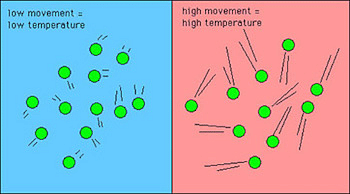
Thermal energy or heat energy is the energy that is produced when a rise in temperature causes atoms and molecules to move faster and collide with each other.
- The temperature of a substance has a direct relationship with its thermal energy.
- It's also known as the measure of the average kinetic energy of a substance's constituent particles, which is responsible for their movement.
- Thermodynamics is a discipline of physics that studies how heat is transmitted across systems and how work is done in the process.
Sources of Thermal Energy
[Click Here for Sample Questions]
The various sources of thermal energy are:
Mechanical energy
Mechanical energy is the energy stored in objects due to stress. Compressed springs and stretched rubber bands store mechanical energy, which can be converted to thermal energy. A good example of thermal energy is the energy released as a result of friction.

Mechanical energy
Chemical Energy
Chemical energy is the amount of energy held in the bonds between atoms and molecules. Chemical energy can be found in batteries, biofuels, petroleum, natural gas, and coal. When people burn wood in a fireplace or gasoline in a car's engine then chemical energy is transformed to thermal energy.

Chemical Energy
Solar Energy
It is one of the most efficient producers of thermal energy. It is the most environmentally friendly and widely available source of thermal energy.

Solar Energy
Fossil Fuels
Fossil fuels are combustible substances formed from the dead remains of animals and plants that have been buried deep beneath the earth's surface for millions of years. Some examples of fossil fuels are coal, petroleum, natural gas, etc.

Fossil Fuels
Geothermal Energy
Geothermal energy is the energy derived from the earth. The energy emitted by volcanoes, hot springs, and geysers is a good example of geothermal energy.
How Mass is Linked with the Thermal Energy
[Click Here for Sample Questions]
Imagine the following circumstance where you have a glass of water and a beaker of water of the same temperature. The volume of water in the beaker is twice as much as in the glass.
- Due to the same temperature, the average kinetic energy of the water molecule is the same in both.
- However, due to the increase in the volume, the total kinetic energy of water molecules in the beaker is twice that of water molecules in the glass.
- Therefore the thermal energy of the water in the beaker is twice that of the water in the glass.
- Thus thermal energy in an object increases when the mass of the object increases.

Thermal Energy Application
[Click Here for Sample Questions]
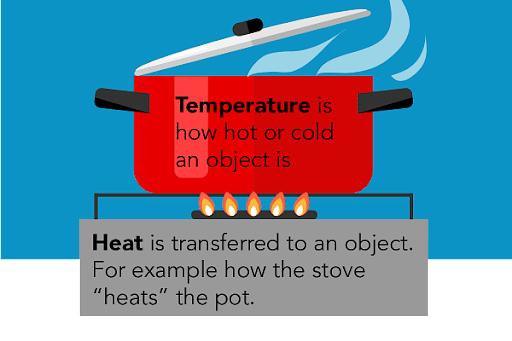
A stove's heated element holds thermal energy, and the higher the temperature, the more internal energy the stove has.
- The molecules are moving even though you can't see them.
- The faster the molecules move, the more internal heat energy they have.
- Immediately place a container of water on top of the hot element.
- So, what happens next? The stove's heat energy accelerates the movement of the particles in the pot and finally, the water.
It's critical to know the difference between these terminologies. Heat is used in this context to refer to the movement of thermal energy from one item or system to another, with the transfer being the crucial word.
- Thermal energy is the energy stored within an object or system as a result of particle movement.
- If you hold your palm above the stove, you can feel the heat.
- You can watch the temperature rise if you put a thermometer in the water as it heats up.
- A rise in internal energy will result in a rise in temperature.
Application of Thermal Energy
Thermal Energy from friction
Consider the case of a man pushing a box at a consistent speed across a rough floor.
- The work done is not stored as potential energy because the friction force is non-conservative.
- All of the friction force's work results in a transfer of energy into the box-floor system's thermal energy.
- This thermal energy is transferred as heat to the box and the floor, raising their respective temperatures.

Thermal Energy from Drag
When an object moves through a fluid, it transfers momentum and causes the fluid to flow. There would still be some leftover fluid motion if the object stopped moving. After a while, this would fade away.
- The large-scale motions of the fluid are eventually re-distributed into a vast number of smaller random motions of the molecules in the fluid.
- The increased thermal energy in the system is represented by these motions.

Thermal Energy Storage
[Click Here for Sample Questions]
Thermal energy storage is described as a system that permits heat energy to be transferred and stored. This strategy is embedded into modern technologies that work in tandem with renewable energy sources such as solar and hydropower systems.
- They can be stored so that when the demand for power rises, a steady supply can be maintained.
- The term "thermal energy storage" refers to a technique for storing heat.
- It is obtained by heating and cooling the storage system on a continuous basis.
- The thermal energy (chilled or hot water) is created during periods of low electrical demand or use, then stored in a thermal energy storage tank before being extracted and sent to the facility during peak hours.
- Diffusers at the top and bottom of the tank allow heated or cooled water to enter and exit the tank.
- Diffusers are used to reduce turbulence and allow the water in the tank to stratify, with cooler water at the bottom and hotter water at the top.
- A narrow and abrupt transition layer of water forms between the warm and cold water zones.

Thermal energy storage system
Working Of Thermal Energy Storage System
[Click Here for Sample Questions]
An example of a chiller system to understand how the thermal energy storage system works is given below:
- A chiller cools the water, which contains 25% ethylene glycol.
- The solution circulates through the ice bank's heat exchanger, freezing 95% of the water that surrounds the heat exchanger.
- Using counterflow heat exchanging tubes, ice is created consistently in the ice bank tank.
- While ice is being created, the water continues to flow freely, preventing harm to the tank. The ice bank tank takes six to twelve hours to fully charge.
-
The glycol solution cycles through the ice storage tank during peak daytime hours, supplying stored energy to the target.
-
The cold glycol is transported to the cooling coil in the air at the right temperature.
Thermal energy storage systems can be of two types:
- Sensible heat storage: Heat energy is stored in either liquid or solid in this form.
- Latent heat storage: Heat energy is preserved in Solid-Solid materials, Solid-Liquid materials, or Liquid-Gas state.

Thermal Energy Storage Applications
[Click Here for Sample Questions]
- Thermal Energy used in solar power facilities is used to provide dispatchable power even at night.
- To run more and faster load changes in thermal power plants.
- Provide heat supply security and temporally separate heat and power generation in combined heat and power plants.
- In process industries, to recover and utilise heat that would otherwise be lost.
- Cooking, baking, water heating, and heating all consume thermal energy.
Things to remember
- The temperature of a substance has a direct relationship with its thermal energy.
- When higher the thermal energy, the more the molecules vibrate and thus hotter the substance.
- The energy contained within a system that is accountable for its temperature is referred to as thermal energy.
- Energy is measured in Joules.
- When heat is in or out of the object then the thermal energy changes.
- The thermal energy absorbed by water is equal to the thermal energy released by an object.
Sample Questions
Ques. What is the difference between Kinetic Energy and Thermal Energy? (2 marks)
Ans. The energy of a moving item is known as kinetic energy. Thermal energy is a type of kinetic energy because it arises from moving particles. Thermal energy is produced by a substance whose molecules and atoms vibrate quicker as the temperature rises.
Ques. Is frictional thermal energy considered internal energy? (2 marks)
Ans. Yes, the thermal energy due to friction is frequently the most relevant component of internal energy.
Ques. Is it possible to convert kinetic energy to thermal energy? (2 marks)
Ans. Yes, thermal energy is a type of kinetic energy; some of it pertains to the movement of microscopic particles within a substance. Because the particle orientations are random and change very quickly, we don't detect the kinetic energy in this motion. This is the easiest to visualise in a box of gas, where particles collide randomly at high speeds. The particles move around with this thermal energy in liquids and solids.
Ques. What is geothermal energy? (2 marks)
Ans. Energy stored as heat in certain regions of the earth (called hot spots) is called geothermal energy. Hot spots are the locations below the earth’s crust where upward-moving magma gets collected due to geological changes. When underground water comes in contact with the hot spots, steam is generated. This steam is utilized to generate electricity using pipes and turbines. Sometimes hot water from the hot spot finds an outlet at the surface. Such outlets are called hot springs.
Ques. Mention why is it not possible to make use of solar cells to meet all our energy needs. State three reasons to support your answer. Also, mention three uses of solar cells. (5 marks)
Ans. It is not possible to make use of solar cells to meet all our energy needs because:
(i) of limited availability of special grade semiconducting materials such as silicon and germanium.
(ii) Solar cells have lower efficiency as they depend entirely on the intensity of solar radiation.
(iii) The process of manufacturing solar cells is very expensive, silver used for interconnection of cells in the panel further adds to the cost.
Uses of solar cells:
(i) They provide electric power to satellites and space probes.
(ii) They provide electric power to off-shore drilling platforms and lighthouses.
(iii) TV relay stations or wireless transmission systems located in remote areas use solar panels to get electric power.
Ques. How has the traditional use of wind and water energy been modified for our convenience? (3 marks)
Ans. The wind possesses kinetic energy. This energy was harnessed by windmills in the past to do mechanical work. Today, wind energy is also used to generate electricity.
Another traditional source of energy was the kinetic energy of flowing water or the potential energy of water at a height. Hydropower plants convert the potential energy of falling water into electricity.
Ques. What are the two types of thermal energy storage systems? (2 marks)
Ans. Thermal energy storage systems can be of two types:
Sensible heat storage: Heat energy is stored in either liquid or solid in this form.
Latent heat storage: Heat energy is preserved in Solid-Solid materials, Solid-Liquid materials, or Liquid-Gas state.
Ques. Why are we looking at alternate sources of energy? (2 marks)
Ans. Fossil fuels are non-renewable sources of energy. So we need to conserve them. If we were to continue consuming these sources at such alarming rates, we would soon run out of energy. In order to avoid this, alternate sources of energy were explored.
Ques. What are the disadvantages of fossil fuels? (2 marks)
Ans. Fossil fuels are non-renewable. The burning of coal or petroleum products causes air pollution. The oxides of carbon, nitrogen, and sulphur that are released on burning fossil fuels are acid oxides. These lead to acid rain, which affects water and soil resources.
Ques. What is a good source of energy? (3 marks)
Ans. A good source of energy would be one,
(i) That can do a large amount of work per unit volume or mass
(ii) Be easily accessible.
(iii) Be easy to store and transport, and
(iv) Perhaps most importantly, be economical.
Ques. What is a good fuel? (2 marks)
Ans. A good fuel would be one,
(i) Which is easily available.
(ii) It should not produce too much smoke.
(iii) On burning should release less amount of heat.
Also Read:



Comments