



Exams Prep Master
The tongue is an organ present in the mouth. It is covered with a moist pink tissue called the mucosa. Some of the main functions of the tongue is swallowing, tasting, licking, breathing and speaking. The reason behind the rough texture of the tongue is the presence of papillae on it. The tongue has multiple taste buds and numerous nerves that help the tongue in transferring taste signals to the brain and allows taste sensation. In this article, we will discuss the structure of the tongue in detail with a diagram, and also about the different functions performed by it.
Check also: Digestion and Absorption Revision Notes
| Table of Contents |
Key Takeaways: Tongue, Papillae, Mucosa, Taste Sensation, Salivary Glands
Anatomy of Tongue
[Click Here for Sample Questions]
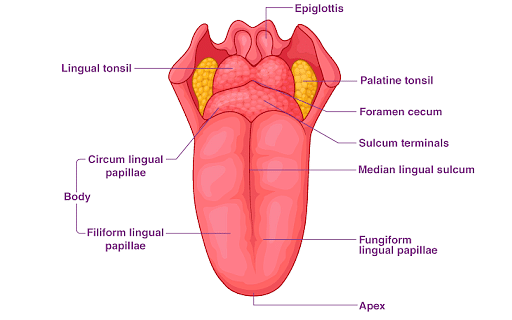
Anatomy of Tongue
Also Read: Tongue Structure and its Functions
Structure of Tongue
[Click Here for Sample Questions]
The length of the human tongue is 3.3 inch in men and 3.1 inch in women. It is present in the oral cavity. The tongue is mainly divided into three parts that are as follows:
- Tip
- Body
- Base
Embryologically, the tongue is bifurcated into two parts: anterior and posterior. The anterior part of the tongue is known as the presulcal part or oral. It consists of roots attached to the bottom of the oral cavity. On the other hand, the posterior part is known as postsulcal part or pharyngeal. It includes the base that forms the ventral wall of the oropharynx. Three elements of the tongue are:
- Epithelium
- Muscles
- Glands
Read Also: Mouth Anatomy
Epithelium
It consists of taste buds and papillae. The taste buds present in epithelium allow one to sense taste. They have a broad bottom and are lined by squamous epithelial tissue. The cells are slender and rod-shaped. They have a nucleus in the centre. They help in comprehending taste, which mixes with the saliva for proper sensation.
The papillae are minute projections of the mucous membrane. There are a total of five types of papillae in a tongue. These are Circumvallate Papillae, Fungiform Papillae, Filiform, Conical (Conic) Papillae and Foliate Papillae.
Muscles
The muscles of the tongue are voluntary and contain cross-striated muscular fibres.
Glands
The tongue has small glands. There are three types of glands:
- Mucous Glands
- Serous Glands
- Lymph Nodes
The lymph nodes are an important and present at the posterior part of the tongue. They are also known as lingual tonsils.
Also read: The small intestine
Functions of Tongue
[Click Here for Sample Questions]
The tongue plays numerous crucial functions in the human body. Below mentioned are the prominent functions performed by the tongue.
- Mastication: One of the basic functions of the tongue is it helps in chewing the food.
- Deglutition: One the food is chewed, the tongue also helps in swallowing food.
- Taste: We can sense food because of the tongue only. It transmits the taste signals to the brain and allows it to sense taste.
- Speech: One of the most important functions performed by the tongue is to allow a person to speak.
- Secretion: The tongue helps in keeping the mouth moist as It secretes mucous and serous fluid.
Things to Remember
- Tongue is an important organ of the human body. Some of the important functions performed by the tongue are swelling, talking, chewing, tasting etc.
- The moist pink tissue that covers the tongue is known as mucosa.
- Papillae is the reason why the texture of the tongue is rouge.
- The tongue has three elements which are: Epithelium, Muscles and Glands.
Sample Questions
Ques. Why is the colour of the tongue pink? (2 marks)
Ans. The reason behind the colour of the tongue being pink is the presence of mucosa. It is moist pink tissue which provides pink colour to the tongue.
Ques. Name a few of the functions performed by the tongue? (1 marks)
Ans. Some of the common functions performed by the tongue are chewing, swelling, licking etc.
Ques. Name three elements of the tongue? (2 marks)
Ans. The tongue has three elements which are as follows:
- Epithelium
- Muscles
- Glands
Ques. Where is the tongue present in the human body? (2 marks)
Ans. The tongue is an organ in the human present body inside the mouth. To be precise, it is present in the oral cavity.
Ques. What is the length of the tongue in males and females? (1 mark)
Ans. The length of the tongue is 3.3 inches and 3.1 inches in males and females respectively.
Ques. How many types of papillae are present in the tongue? (2 marks)
Ans. The tongue has a total of five types of papillae: Circumvallate Papillae, Fungiform Papillae, Filiform, Conical Papillae and Foliate Papillae.
Ques. What are the different types of glands present in the tongue? (2 marks)
Ans. The glands present in the tongue are small in size. Three glands present in the tongue are: Mucous Glands, Serous Glands and Lymph Nodes.
Ques. Which part of the tongue allows it to sense taste? (1 mark)
Ans. The taste buds present in the epithelium recognise taste and send signals to the brain.
Ques. What is lingual tonsils? (1 mark)
Ans. Lingual tonsils also known as the lymph nodes are the type of a gland that is present at the posterior part of the tongue.
Ques. The tongue is bifurcated into how many parts? (1 mark)
Ans. The tongue is mainly divided into two parts: anterior and posterior.
Check-Out:



Comments