



Education Journalist | Study Abroad Lead
Trichloroacetic Acid can be described as an organic compound that is similar to Acetic Acid. The only difference between them is in the case of Trichloroacetic Acid, chlorine (Cl) atoms replace the three hydrogen (H) atoms of the methyl (-CH3) group that are present in Acetic Acid. It is known as Trichloroethanoic acid or Aceto-caustin as well. Trichloroacetic acid is represented by the chemical formula- C2HCl3O2. French Chemist Jean Baptiste Dumas first identified Trichloroacetic Acid back in 1893. This acid is mostly used in biochemical experiments and other clinical products as it is a strong acid.
| Table of Content |
Key Terms: Trichloroacetic Acid, Acetic Acid, Chlorine, Chemical Formula, Biochemistry, Organic Compound, Monocarboxylic Acid
What is Trichloroacetic Acid?
[Click Here for Sample Questions]
Trichloroacetic acid is an organic monocarboxylic acid that is a doppelganger of Acetic Acid with the chemical formula- C2HCl3O2.
- It is well known for its protein-precipitating agent-like qualities.
- The salts and esters made from this acid are known as trichloroacetate.
- It is a white crystalline compound.
- The Trichloroacetic Acid can be also represented as CCl3COOH.
Also Read:
| Related Links | ||
|---|---|---|
| Dipole Moment | Indicators | Weak Acid Examples |
| Acid Test | Difference Between Acid and Base | Ammonium Chloride |
| Base Meaning | Weak Base | Metallurgy |
Structure of Trichloroacetic Acid
[Click Here for Sample Questions]
Trichloroacetic acid is a covalent compound that is formed by replacing the Hydrogen atoms with Chlorine atoms in Acetic Acid.
Hence, the core Trichloroacetic acid structure looks like the picture below-
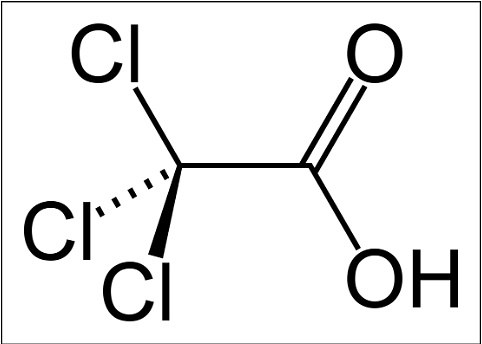
Structure of Trichloroacetic Acid
Read More: Covalent Bond
Properties of Trichloroacetic Acid
[Click Here for Sample Questions]
Here are the most prominent properties of Trichloroacetic acid-
- The molar mass of Trichloroacetic acid is 163.38 g/mol.
- Trichloroacetic acid is normally a white crystalline compound with a strong sour smell.
- It is highly soluble in nature.
- Trichloroacetic acid has a boiling point of 197 oC, and a melting point of 58 oC.
- It is acidic in nature with a pH of 1.2.
- The blue litmus paper turns red when it comes to contact with Trichloroacetic acid.
- Trichloroacetic acid is highly reactive to Proteins.
- The pKa value of this acid is 0.66.
- The density of Trichloroacetic acid is given as 1.63 g.cm-3.
Preparations of Trichloroacetic Acid
[Click Here for Sample Questions]
Trichloroacetic Acid can be prepared by replacing the Hydrogen atoms with Chlorine atoms in Acetic Acid. In this case, a catalyst must be present to initiate this reaction.
This reaction can be represented as
CH3COOH + 3Cl2 → CCl3COOH + 3HCl
Another way to prepare Trichloroacetic Acid is by the oxidation of trichloroacetaldehyde as well.
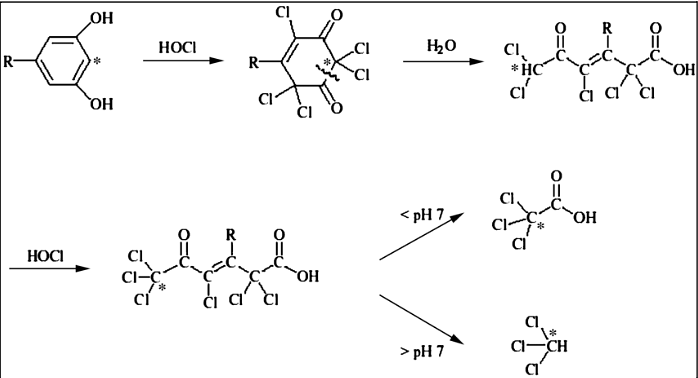
Preparation of Trichloroacetic Acid
Uses of Trichloroacetic Acid
[Click Here for Sample Questions]
Trichloroacetic Acid is strong and stable, hence, it is used in various fields.
- It is used in the skin treatment process, especially while treating acne and wrinkles.
- Trichloroacetic Acid is also used in the precipitation of macromolecules such as DNA, RNA, and proteins.
- It is also used for removing permanent tattoos.
- Trichloroacetic acid is used in microscopic procedures as a fixative.
- This acid is widely used in clinical chemistry as well.
- Trichloroacetic acid is used in wart chemoablation.

Using Trichloroacetic Acid in Skin Treatments
Effects of Trichloroacetic Acid
[Click Here for Sample Questions]
As this acid is very strong, it certainly has some adverse effects on living beings and the environment. Here are some common effects of Trichloroacetic Acid-
- Being a corrosive chemical, this acid can severely burn or irritate the skin if it comes in contact.
- Overuse of this product can lead to skin damage.
- This acid can be lethal for rats if taken more than an amount of 5000 mg/kg.
Also Read:
| Related Articles | ||
|---|---|---|
| Carboxylic Acid | Hydrobromic Acid | Periodic Acid |
| Perchloric Acid | Pyrosulfuric Acid | Nitric Acid |
| Properties of Acids | Weak Acid Examples | Sulphuric Acid |
Things to Remember
- Trichloroacetic acid can be explained as an organic monocarboxylic acid that is a carbon copy of Acetic Acid.
- It is a covalent compound that is formed by replacing the Hydrogen atoms with Chlorine atoms in Acetic Acid.
- The chemical formula of Trichloroacetic acid is C2HCl3O2.
- It is normally a white crystalline compound with a strong sour smell.
- This acid is widely used in clinical chemistry.
- This acid can severely burn or irritate the skin if it comes in contact.
Sample Questions
Ques. What is Trichloroacetic acid? (3 Marks)
Ans. Trichloroacetic acid can be explained as an organic monocarboxylic acid that is a carbon copy of Acetic Acid. The only difference between Trichloroacetic acid and acetic acid is that, in the case of Trichloroacetic Acid, chlorine (Cl) atoms replace the three hydrogen (H) atoms of the methyl (-CH3) group that is present in Acetic Acid. The chemical formula of Trichloroacetic acid is C2HCl3O2.
Ques. What are the uses of trichloroacetic acid? (3 Marks)
Ans. Being a strong and stable acid, Trichloroacetic Acid has a wide range of uses-
- Trichloroacetic Acid is also used in the precipitation of macromolecules such as DNA, RNA, and proteins.
- It is also used for removing permanent tattoos and in the skin treatment process, especially while treating acne and wrinkles.
- Trichloroacetic acid is used in microscopic procedures as a fixative and is widely used in clinical chemistry as well.
- Trichloroacetic acid is also used in wart chemoablation.
Ques. What are the harmful effects of Trichloroacetic Acid? (3 Marks)
Ans. Here are some common effects of Trichloroacetic Acid-
- Overuse of Trichloroacetic acid can lead to skin damage.
- The acid can turn out to be lethal for rats if taken more than an amount of 5000 mg/kg.
- The acid can severely burn or irritate the skin if it comes in contact as it is a corrosive metal.
Ques. Mention the important properties of Trichloroacetic acid. (3 Marks)
Ans. Here are the most important properties of Trichloroacetic acid-
- Trichloroacetic acid has a boiling point of 197 °C, a melting point of 58 °C and a molar mass of 163.38 g/mol.
- It has a density of 1.63 g.cm-3.
- It is acidic in nature with a pH of 1.2 and is highly soluble in nature.
- It is highly reactive to Proteins.
- It appears as a white crystalline compound with a strong sour smell.
Ques. What are the atoms that are included in the Trichloroacetic acid structure? Is TCA acid toxic? (3 Marks)
Ans. Trichloroacetic Acid includes 2 carbons atoms, 1 hydrogen atom, 3 chlorine atoms and 2 oxygens atoms.
TCA is harmful if not handled properly and used more than required as it is a corrosive chemical.
Ques. Can we say that Trichloroacetic Acid is carcinogenic? (3 Marks)
Ans. According to product labels, the skin peels of Trichloroacetic Acid contain about 15-50% cancer-causing chemicals. Apart from cancer, Trichloroacetic Acid has been linked with genetic damage, decreased fertility, birth defects, and various other serious health problems in animal studies.
Ques. List down the functions of trichloroacetic acid. (3 Marks)
Ans. In Biochemistry, Trichloroacetic Acid is commonly used for the precipitation of macromolecules such as proteins, DNA, and RNA. TCA and DCA are also used in cosmetic items like chemical peels and the removal of tattoos. It is also used as a topical wart chemoablation drug, including for genital warts.TCA can also be used to kill normal cells.
Also check:



Comments