



Content Writer
Rayon is an artificially manufactured textile fibre that is regenerated from cellulose obtained from wood pulp or cotton. It is considered a semi-synthetic fibre that has the same molecular structure as cellulose.
- Rayon is also known as viscose.
- It is often known as artificial silk because of its appearance and similarity to silk.
- The first artificial textile fibre was invented by French scientist and industrialist Hilaire de Chardonnet.
- The use of rayon on a commercial scale was first produced by a UK company named Courtaulds Fibres.
- It is used in the manufacturing of paper products, such as paper towels and napkins.
- In 1938, uses of rayon reached 300 million pounds in the United States.
Key Terms: Rayon, Cellulose, Polymers, Wood Pulp, Artifical Fibers, Silk, Viscose, Cotton, Uses of Rayon, Properties of Rayon, Wood Pulp, Synthetic Fibre
What is Rayon?
[Click Here for Sample Questions]
Rayon is a synthetic fibre regenerated from cellulose. It is produced when cellulose is treated with chemicals. In this treatment, natural polymer chains are dissolved, and artificial fibres are recreated.
- Most rayon is made from wood pulp.
- However, its production is not sustainable in the long term due to the use of harmful chemicals in manufacturing.
- It is a versatile fibre that was used as cotton linters in the early days.
- Rayon is obtained as the final product after dissolving the pulp of trees.
- The manufacturer will receive the dissolved pulp in the form of sheer or roll.
- Cotton, wood and bamboo are important sources of rayon.
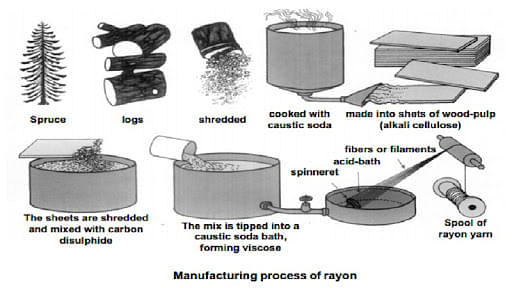
Manufacturing Process Of Rayon
Also Read:
Properties of Rayon
[Click Here for Previous Year's Questions]
The important properties of rayon are as follows:
- Rayon dyes in no time and doesn’t shrink when washed.
- It resembles the texture and sensation of woollen, linen, cotton, and silk.
- The fibre has the lowest elastic modulus.
- It has excellent endurance capacity and is stronger in nature.
- Rayon is prepared using cellulose with a strong base and then a weak acid.
- It is comfortable to wear and is versatile in application.

Rayon
What are the Uses of Rayon
[Click Here for Sample Questions]
Rayon is used in many ways. Uses of rayon are specified below:
- One of the important uses of rayon includes the creation of vests and union suits, which are knitted on circular knitting machines.
- It is used in items of home decor like curtains, bed linens, upholstery, and other items.
- Other important uses of rayon include making tyre cords and surgical products.
- It is used to create blankets, bed sheets, and other textiles.
- The fibre is used in velvets, chenilles and pile floor coverings.
- Preparation of sanitary napkins and carpets are another uses of rayon.
- It is also used in food packaging items.
Benefits of Rayon
[Click Here for Previous Year's Questions]
Benefits of rayon are as follows:
- Rayon is an inexpensive fibre that drapes easily.
- The texture is breathable and can be machine-washed and dried.
- Rayon is similar to cotton and blends well with other fibres.
- The fibre is extremely soft and comfortable to wear.
- It is derived from renewable raw materials.
- The material can easily be dyed with other materials.
Drawbacks of Rayon
[Click Here for Sample Questions]
Disadvantages of rayon are specified below:
- Rayon needs dry cleaning very often.
- The procedure of manufacturing rayon is polluting and harmful to the environment.
- It is prone to stretching and bagging and often doesn’t recover.
- The fabric becomes weaker when wet.
- Rayon is not recommended for home furnishings.
- The fabrics absorb moisture, body oils, and water, which later results in spots, and spots can lead to a permanent mark.
Also Check:
| Chapter Related Topics | ||
|---|---|---|
| History of Clothing Material | Variety in Fabrics | Animal Fibre |
| Thermoplastics | Thermosetting Plastics | Rayon |
Things to Remember
- Rayon is an artificially manufactured textile fibre that includes several cellulose-derived fibres.
- It is considered a semi-synthetic fibre that lacks the highly ordered fibril character of cotton and flax.
- The production of rayon may not be sustainable in the long term.
- Uses of rayon include preparation of tyre cords, carpets and surgical dressings.
- It is often cut and stapled during the bleaching process.
- With advancements in technology during the Second World War, it was used in wood pulp.
Important PYQs Based On Rayon
- Cellulose Fibre Is Obtained From Gossypium… [JIPMER 2004]
- Rayon Is A Semisynthetic Polymer Whose Properties…. [JEE Main 2016]
- Which One Of The Following Is Amorphous…. [VITEEE 2016]
- Dacron Is Polymer Of…. [BITSAT 2005]
- In Case Of Condensation Of Polymers… [JKCET 2008]
- Which Of The Following Fibres Are Made Of Polyamide…..
- Which One Is Classified As A Condensation Polymer…. [BITSAT 2019]
- Which Of The Following Has An Ester Linkage… [VITEEE 2014]
- For Determination Of Molar Mass Of Colloidspolymer…. [NEET 2000]
- Natural Rubber Is A Polymer Of… [NEET 1999]
- NHCH_2NHCOCH_2_4CO_n Is A…. [NEET 2006]
- Polyethylene Glycol Method Is Used For… [NEET 2009]
- Terylene Is A Condensation Polymer Of Ethylene…. [NEET 1999]
Sample Questions
Ques. What is rayon? (2 marks)
Ans. Rayon is a synthetic fiber regenerated from cellulose. It is produced when cellulose is treated with chemicals. In this treatment, natural polymer chains are dissolved and artificial fibers are recreated. Most rayon is made from wood pulp. It is an artificially manufactured textile fiber that is regenerated from cellulose obtained from wood pulp or cotton. It is considered a semi-synthetic fiber.
Ques. What are the properties of rayon? (5 marks)
Ans. The appealing properties of rayon are:
- Rayon dyes in no time.
- It doesn’t shrink when washed.
- It takes well to print and has a good sheen.
- Rayon dries quickly.
- Rayon is comfortable to wear.
Ques. List out the uses of rayon? (2 marks)
Ans. Rayon is used in many ways. Uses of rayon are specified below:
- Curtains
- Clothing
- Home Decor
- Carpet
- Sanitary napkins
Ques. Mention five disadvantages of rayon? (5 marks)
Ans. Disadvantages of rayon are specified below:
- Rayon needs dry cleaning very often.
- The procedure of manufacturing rayon is polluting and harmful to the environment.
- Prone to stretching and bagging and often doesn’t recover
- The fabric is weak, and weaker when wet
- Do not recommend use for home furnishings
Ques. What are the five advantages of rayon? (5 marks)
Ans. Advantages of rayon are mentioned below:
- Rayon is inexpensive
- The fibre drapes easily
- The texture is breathable
- Rayon is similar to cotton
- It blends well with other fibers.
Ques. Is rayon harmful to the environment? (1 mark)
Ans. Yes, the procedure of manufacturing rayon is polluting and harmful to the environment. rayon can be used for the short term due to its fabric and properties.
Ques. What are the steps involved in preparation of rayon? (5 marks)
Ans. The steps are as follows:
- Alkali cellulose sheets are created when sheets of pure cellulose are steeped in sodium hydroxide, often known as caustic soda. After drying and shredding into crumbs, these sheets are aged for two to three days in metal canisters.
- The metal containers are meticulously maintained in terms of temperature and humidity.
- The crumbs are mixed and agitated with liquid carbon disulfide once they have aged, resulting in an orange-colored mixture that is then submerged in caustic soda.
- This produces a viscous liquid that resembles honey.
- Regenerated cellulose filaments are produced when the acid coagulates and solidifies the filaments.
- The filaments are then prepared for spinning into yarn.
- The fibers are prepared for post-treatment chemicals and the several weaving techniques required to create the fabric once they have adequately cured.
Ques. What are the industrial uses of rayon? (2 marks)
Ans. The durability and strength of fabric under extreme conditions is a matter of prime importance in its selection for industrial uses. Since rayon is an inexpensive fibre and less durable than cotton, it is used in industrial applications. The fibre is pertinent to industrial uses, accounting for approximately two-fifths of the cotton consumed in the United States annually.
Ques. Which fabric is better: rayon or cotton? (2 marks)
Ans. Rayon is the most plant-based textile because it is more absorbent than cotton and linen. Cotton and rayon are more breathable and consequently lighter and more comfortable to wear on hot days than synthetic textiles like polyester and acrylic. It also becomes weaker when wet, in contrast to cotton, which does not.
Ques. How is rayon fibre prepared? (2 marks)
Ans. Rayon is prepared from cotton linters, which are leftover fibers from cotton seed that stick to the plant after ginning, and cellulose from wood pulp, which is often derived from pine, spruce, or hemlock trees.
Ques. What is the example of rayon at home? (2 marks)
Ans. The example of rayon include:
- Cotton
- Jute
- Linen
- Kapok
- Hemp
Also Check:



Comments