


What is the chemical equation for Calcium Hydroxide?

Jasmine Grover logo

Jasmine Grover

Education Journalist | Study Abroad Lead

The chemical equation for Calcium Hydroxide is Ca(OH)2. Calcium hydroxide is an inorganic compound that is also known as slaked lime.

  • It is a colourless crystal or a white powder that is obtained when calcium oxide is mixed with water.
  • Calcium hydroxide is formed by the combination of a Calcium cation (Ca2+) and two OH− anions, hence its chemical formula is Ca(OH)2.
  • Calcium is in group 2 of the periodic table – hence it has 2 valence electrons it must lose in order to be stable.
  • Oxygen is in group 6 – hence, it needs to gain 2 electrons to be stable.
  • Oxygen gets one electron from a hydrogen atom and forms a hydroxide (OH−) anion.
  • Now the atom needs just one more electron, while calcium offers two. 
  • Therefore, two OH− groups combine together to form calcium hydroxide and each hydroxide group gets one electron from calcium giving the chemical formula Ca(OH)2.
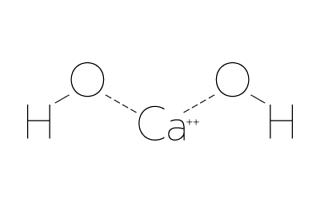
Calcium Hydroxide


Read More:

CBSE CLASS XII Related Questions

  • 1.
    An organic compound (X) has the molecular formula \(C_5H_{10}O\). Draw structures for (X) if it:
    (I) does not give Tollen's test but gives a positive iodoform test.
    (II) does not give Tollen's test and iodoform test but undergoes Aldol condensation.
    (III) undergoes Cannizzaro's reaction.


      • 2.
        Following reaction takes place in one step:

        \(2A + B \rightarrow 2C\)

        How will the rate of above reaction change if the volume of the reaction vessel is decreased to one third of its original volume? Will there be any change in the order of reaction with the reduced volume?


          • 3.
            Draw the structure of 'X' in the following reaction:


              • 4.
                For the first order thermal decomposition reaction, following data was obtained :

                \(C_2H_5Cl(g) \rightarrow C_2H_4(g) + HCl(g)\)

                Calculate rate constant.
                [Given : log 3 = 0.48]


                  • 5.

                    Conductivity of \( 2.5 \times 10^{-4} \) M methanoic acid solution is \( 5.25 \times 10^{-5} \) S cm\(^{-1}\).

                    (a) Calculate its molar conductivity.

                    (b) Calculate its degree of dissociation.

                    [Given : \( \lambda^{\circ}_{(\mathrm{H^+})} = 349.5 \) S cm\(^2\) mol\(^{-1}\) and \( \lambda^{\circ}_{(\mathrm{HCOO^-})} = 50.5 \) S cm\(^2\) mol\(^{-1}\)]


                      • 6.
                        An organic compound (A) with molecular formula $\mathrm{C_3H_5N}$ on reaction with $\mathrm{C_6H_5MgBr}$ followed by hydrolysis, gives a compound (B). Compound (B) forms an orange-red precipitate with 2,4-DNP reagent and does not give iodoform test. It neither reduces Tollens' or Fehling's reagent nor does it decolourise bromine water. On drastic oxidation with chromic acid it gives a carboxylic acid (C) having molecular formula $\mathrm{C_7H_6O_2}$. Identify the compounds (A), (B) and (C). Write the reactions of compound (A) with $\mathrm{C_6H_5MgBr}$ followed by hydrolysis to give compound (B).

                          CBSE CLASS XII Previous Year Papers

                          Comments


                          No Comments To Show
