


What is the function of intercalary meristem?

Jasmine Grover logo

Jasmine Grover

Education Journalist | Study Abroad Lead

Intercalary meristem is a type of plant tissue found in certain regions of the plant body, such as the base of leaves or internodes of stems.

Functions of Intercalary Meristem

  • Its main function is to promote the growth of the plant in length.
  • Intercalary meristem is responsible for the development of new cells in the regions where it is found, resulting in the elongation of the plant.
  • It helps in the repair of damaged tissues.
  • In some plants, intercalary meristem can also help to regenerate lost or damaged tissues, such as leaves or stems.
  • This type of tissue is particularly important in plants that experience frequent damage, such as those that are regularly grazed by herbivores or subjected to environmental stress.
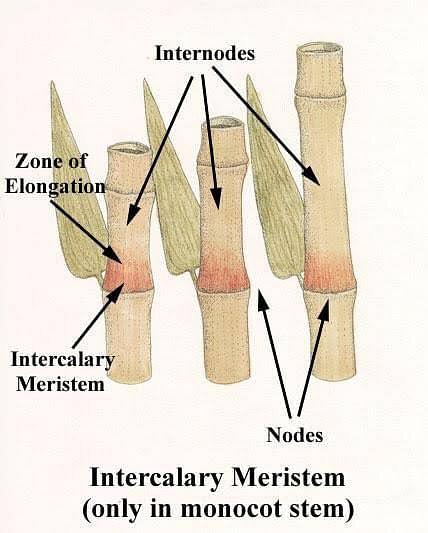
Intercalary Meristem

Overall, the intercalary meristem is essential for the growth and development of plants and plays a key role in maintaining their structural integrity and ability to adapt to changing conditions.

Read More:

CBSE CLASS XII Related Questions

  • 1.

    (i) Differentiate between a DNA and RNA nucleotide.

    (ii) Name the two types of bonds present within a single nucleotide.


      • 2.

        Assertion (A) : Hardy-Weinberg principle says that allele frequencies in a population are stable.

        Reason (R) : Hardy-Weinberg principle is applicable only when genetic drift does not occur.

          • Both Assertion (A) and Reason (R) are true and Reason (R) is the correct explanation of the Assertion (A).
          • Both Assertion (A) and Reason (R) are true, but Reason (R) is not the correct explanation of the Assertion (A).
          • Assertion (A) is true, but Reason (R) is false.
          • Assertion (A) is false, but Reason (R) is true.

        • 3.
          In Pisum sativum, the flower colour may be violet (V) or white (v). What proportion of the offspring in a cross of "VV × vv" would be expected to be violet?

            • 25%
            • 50%
            • 75%
            • 100%

          • 4.

            Assertion (A) : The pyramid of biomass in a pond aquatic ecosystem is always inverted.

            Reason (R) : The biomass of consumers like fishes far exceeds that of the producers like phytoplanktons.

              • Both Assertion (A) and Reason (R) are true and Reason (R) is the correct explanation of the Assertion (A).
              • Both Assertion (A) and Reason (R) are true, but Reason (R) is not the correct explanation of the Assertion (A).
              • Assertion (A) is true, but Reason (R) is false.
              • Assertion (A) is false, but Reason (R) is true.

            • 5.

              A student performed some crosses in plants and represented the result in the form of bar graphs as shown below. Each graph displays the phenotypic proportion of the progeny. Study the graphs and answer the questions :

              (c) What conclusion can you draw from the results of bar graphs of crosses I and II ? Name the genetic principle illustrated.


                • 6.
                  List two major causes of loss of biodiversity.

                    CBSE CLASS XII Previous Year Papers

                    Comments


                    No Comments To Show
