



Study Abroad Expert | Updated On - Aug 14, 2026
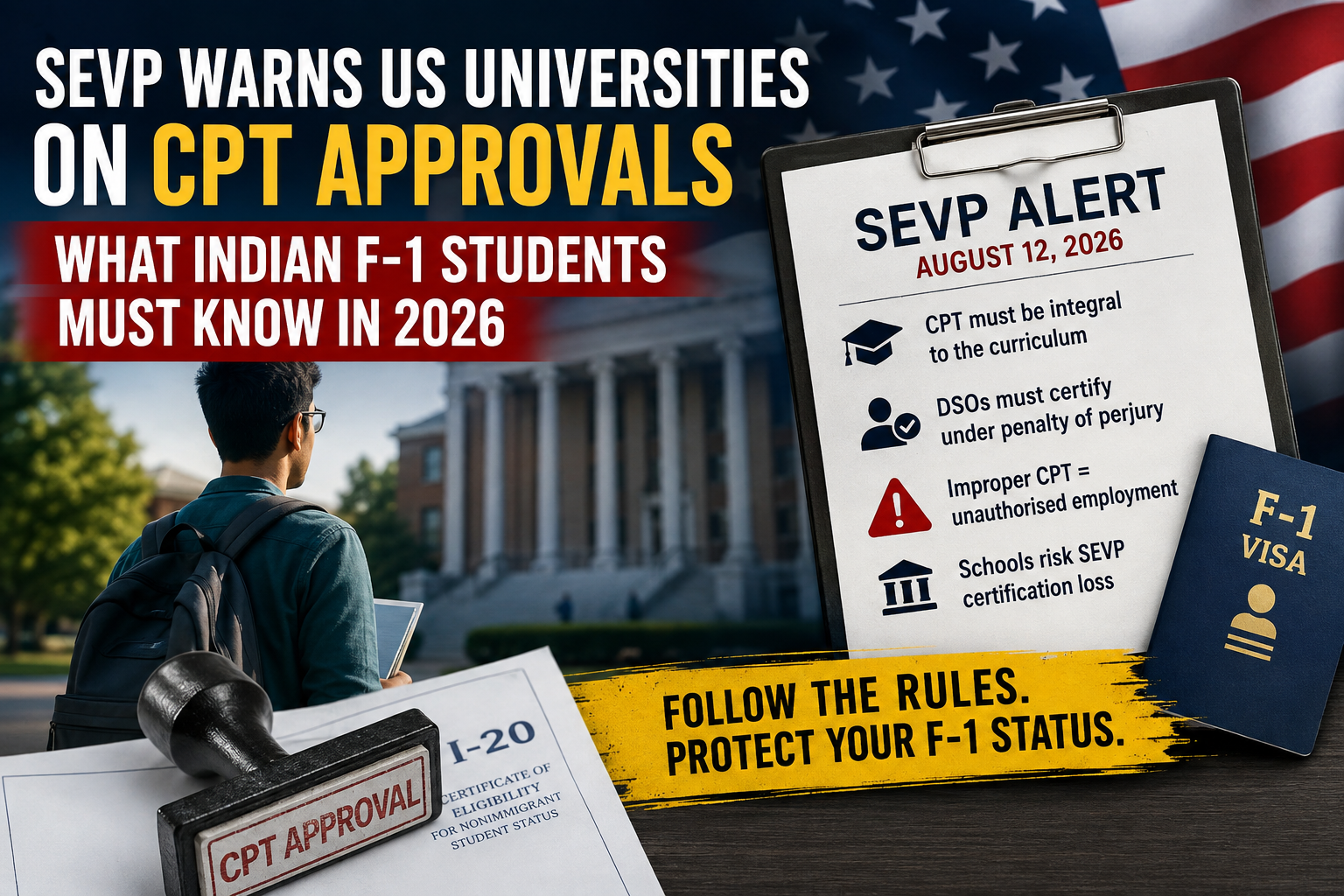
The US Student and Exchange Visitor Program warned universities on August 12, 2026 against improper CPT approvals. Schools now risk losing SEVP certification, which lets them enrol F-1 students. The alert directly hits Indian F-1 students using Curricular Practical Training internships during coursework. SEVP said the training must be integral to the academic curriculum, not a side job.
- SEVP certifies over 8,700 US schools to enrol F-1 students. Losing certification blocks new international admissions at that campus.
- Designated School Officials must now certify each CPT internship under penalty of perjury. The internship has to be integral to the student’s degree.
- Improper CPT counts as unauthorised employment under federal rules. That finding can end F-1 status and block future US visas.
The warning lands as Indian F-1 issuances have fallen sharply in 2025. Indian students form the largest cohort using CPT during study, especially in tech and business master’s programmes.
Also Read: F-1 Visa Off-Campus Work Rules: What Indian Students Risk in 2026
What SEVP Told US Universities on August 12
SEVP issued a broadcast message to every designated school official in the country. The message flagged a rise in CPT authorisations that fail federal rules. In flagged cases, the training was not integral to an established academic curriculum.
The agency said it "remains committed to identifying and investigating schools that attempt to undermine or purposely bypass federal regulations or oversight." SEVP still lets schools define their own degree requirements. But the agency will now audit whether those requirements are real.
Schools found in violation face investigation and SEVP decertification. Cases can be referred to Homeland Security Investigations for further action. Decertification means the school can no longer issue Form I-20 to new international students.
Why This Hits Indian F-1 Students the Hardest
Indian nationals were the largest F-1 cohort in the United States in 2024-25. Many enrol in one-year master’s programmes that build CPT into the second semester. Some rely on Day 1 CPT universities that authorise work from enrolment.
Indian F-1 visa issuances already fell 62% in the peak months of May to August 2025 versus 2024. Tighter CPT scrutiny now adds a second front. A wrongly-approved internship can be treated as illegal work even years later.
What it means for Indian Students: If your CPT is later ruled improper, the fault sits on both the school and you. You can be found to have worked without authorisation. That finding ends F-1 status and blocks future US visa approvals.
How CPT Rules Actually Work
CPT is one of two work authorisations built into the F-1 visa. It runs during studies, not after graduation. The training must be part of an established curriculum, not a job on the side.
| Rule | What it means for an F-1 student |
|---|---|
| Enrolment | One full academic year of study before CPT, unless the programme requires immediate training. |
| Curriculum link | The internship must be required or integral to your degree. |
| Authorisation | Only a Designated School Official can approve CPT on your Form I-20. |
| Start date | No work before you hold the signed CPT authorisation in writing. |
| Hours | Part-time up to 20 hours per week in term; full-time in breaks or if the programme requires it. |
The OPT vs CPT distinction matters here. OPT starts after you finish coursework. CPT sits inside the degree. Confusing the two is one of the errors SEVP is now watching.
Day 1 CPT Programmes Under the Spotlight
A cluster of smaller US universities markets Day 1 CPT as a route for foreign workers. These programmes let students take CPT from the first day of enrolment. USCIS and SEVP have flagged many as non-compliant with federal rules.
Important Distinction: A Day 1 CPT can be legal, but only when a programme genuinely requires practical training from day one. Most master’s programmes do not. Enrolling only to keep an H-1B job running is the exact pattern SEVP is now investigating.
Indian students switching from H-1B or L-1 to Day 1 CPT programmes carry the sharpest risk. If a school loses SEVP certification, all current F-1 students are forced to transfer or leave. Any past CPT work at that school may also be re-examined.
What Should Indian Students Do Right Now?
Anyone on CPT or planning to use it in Spring 2027 should verify three things before starting work. Every step needs written proof from the school, not verbal confirmation from a career office.
- Ask your DSO to confirm in writing that your internship is required or integral to your degree, citing the specific course or curriculum requirement.
- Keep a copy of your CPT-endorsed Form I-20. Never start the internship before the endorsed start date.
- Check that your school appears on the SEVP certified school list with no pending action.
- Avoid enrolling in a programme only to hold F-1 status while working; SEVP’s warning targets this pattern directly.
Next Key Date for CPT Users: Spring 2027 CPT authorisations start rolling out from November 2026 for the January intake. Confirm curriculum integration with your DSO in writing before you request the I-20 endorsement.
Students already working on CPT should not stop mid-term without DSO advice. Ending an authorised CPT early can also create status issues. The safer path is to document everything and consult the international student office in writing.
The SEVP warning does not rewrite the F-1 rulebook. It signals that the existing rules will now be enforced hard. Indian students on the F-1 student visa route need clean CPT paperwork more than ever this cycle. The Spring 2027 intake will be the first full semester under the tighter oversight.



Comments