




These Class 12 Geography Chapter 9 Geographical Perspective on Selected Issues and Problems notes cover every NCERT definition, types of pollution, urban issues, rural-urban migration and land degradation, aligned to the 2026-27 syllabus.

- Concept-first revision: four types of pollution (air, water, land, noise), Namami Gange, urban waste, the slum problem and land degradation with the Jhabua case study.
- Key exam terms, push-pull factors of migration and the NRSC classification of wastelands.
- Cross-pointers to the matching NCERT Solutions, Handwritten Notes and NCERT Book PDF.
Written by Collegedunia geography experts, mapped to the 2026-27 NCERT India: People and Economy textbook.
Student Feedback
71% of students found pollution types the most confusing area. Students who paired these notes with the Solutions PDF wrote fuller 4-to-6 mark answers on urban issues and pollution.
Source: 2026-27 Class 12 Geography poll of 9,420 CBSE students.
Quick Concept Recap: Chapter 9 at a Glance
Chapter 9 uses geography as a lens on five human-made problems: pollution, urban waste, slums, migration and land degradation. Each has a spatial angle CBSE tests.
- Four types of pollution: air, water, land, noise.
- Namami Gange: cleans the Ganga.
- Urban waste and slums: 30 to 50 percent uncollected; Dharavi.
- Migration: push and pull factors; male-dominated.
- Land degradation: NRSC wasteland classes; Jhabua case study.
Use the matching NCERT Solutions for Class 12 Geography Chapter 9 for the longer 150-word answer practice.
Source: Next Toppers - 12th Humanities on YouTube
Key Definitions for Geographical Perspective Class 12 Notes
The definitions below use the one-line form CBSE markers expect.
| Term | One-line definition | NCERT pointer |
|---|---|---|
| Environmental Pollution | Release of substances and energy from waste products of human activities into the environment in quantities that harm living organisms and property. | Chapter opening |
| Pollutant | A specific substance or form of energy (chemical, biological or physical) that when present in the environment at harmful concentrations becomes a pollutant. The distinction: pollution is the state; pollutant is the agent. | Exercise Q 2(i) |
| Air Pollution | Addition of contaminants such as dust, fumes, gas, fog, odour, smoke or vapour to the air in amounts and duration harmful to flora, fauna and property. | Air Pollution section |
| Smog | Smoky fog over urban areas caused by atmospheric pollution from fossil fuel combustion; harmful to human respiratory health. | Air Pollution section |
| Noise Pollution | The state of unbearable discomfort to humans caused by noise from factories, traffic, construction, aircraft and community activities, measured in decibels (dB). | Noise Pollution section |
| Solid Waste | A variety of old and used articles (metals, glassware, plastic, polythene, ash, etc.) discarded from household or industrial sources; also called refuse, garbage or rubbish. | Urban Waste Disposal section |
| Slum | A residential area of least choice, characterised by dilapidated houses, poor hygiene, overcrowding, lack of drinking water, lighting and toilet facilities, and open defecation. | Problems of Slums section |
| Land Degradation | A temporary or permanent decline in the productive capacity of land caused by soil erosion, waterlogging, salinisation, alkalinisation or human misuse. | Land Degradation section |
| Wasteland | Land that has lost its agricultural or ecological productivity due to natural or human-induced processes; classified by NRSC using remote sensing. | Land Degradation section |
| Watershed Management | An integrated approach linking land, water and vegetation management, aiming to improve livelihoods through natural resource management and community participation. | Jhabua case study |
These cover roughly 8 of the 10 theory questions CBSE has asked since 2021.
Environmental Pollution: Types, Sources and Health Effects
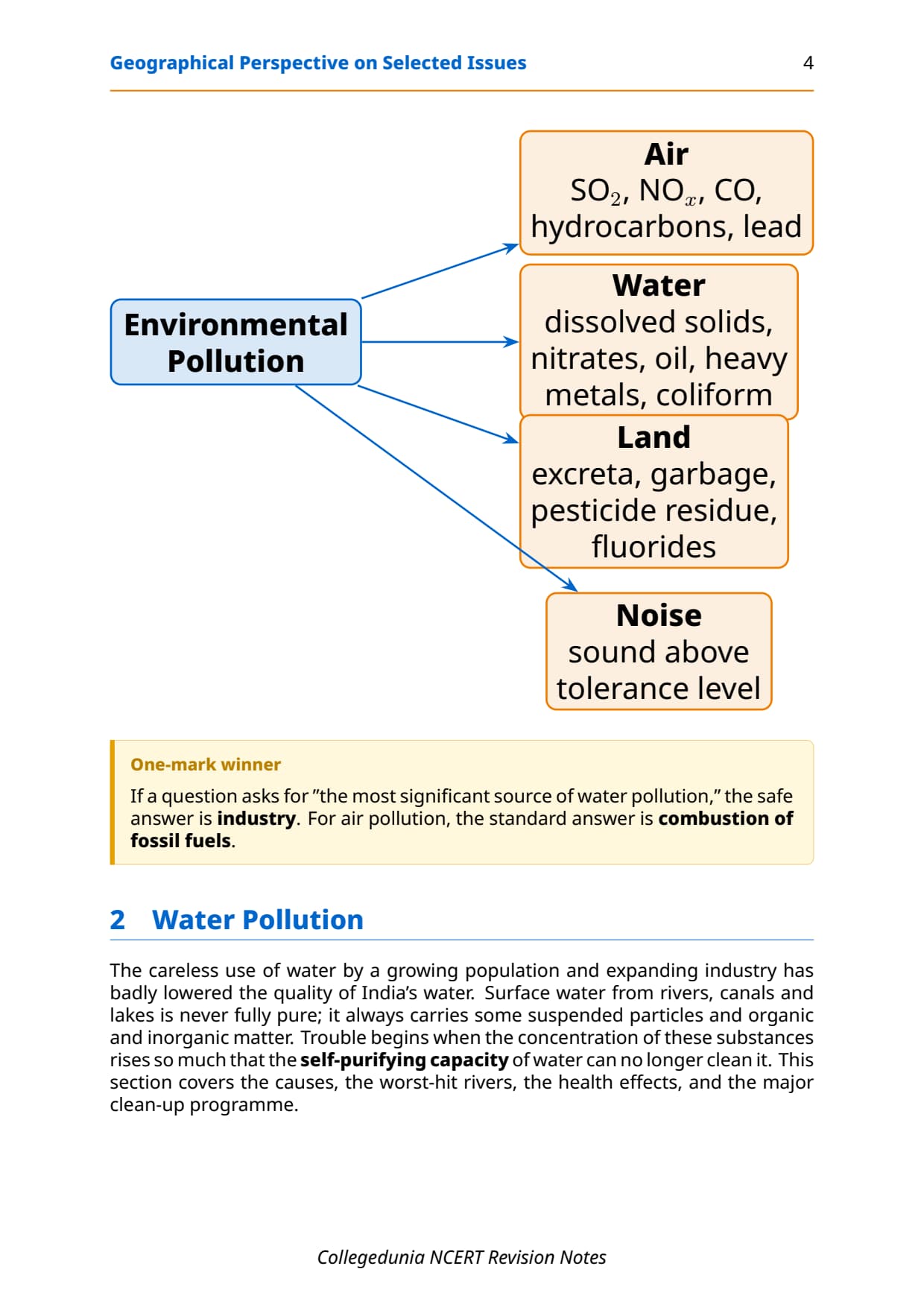
NCERT classifies pollution by the medium pollutants travel through, giving four types.
Air Pollution
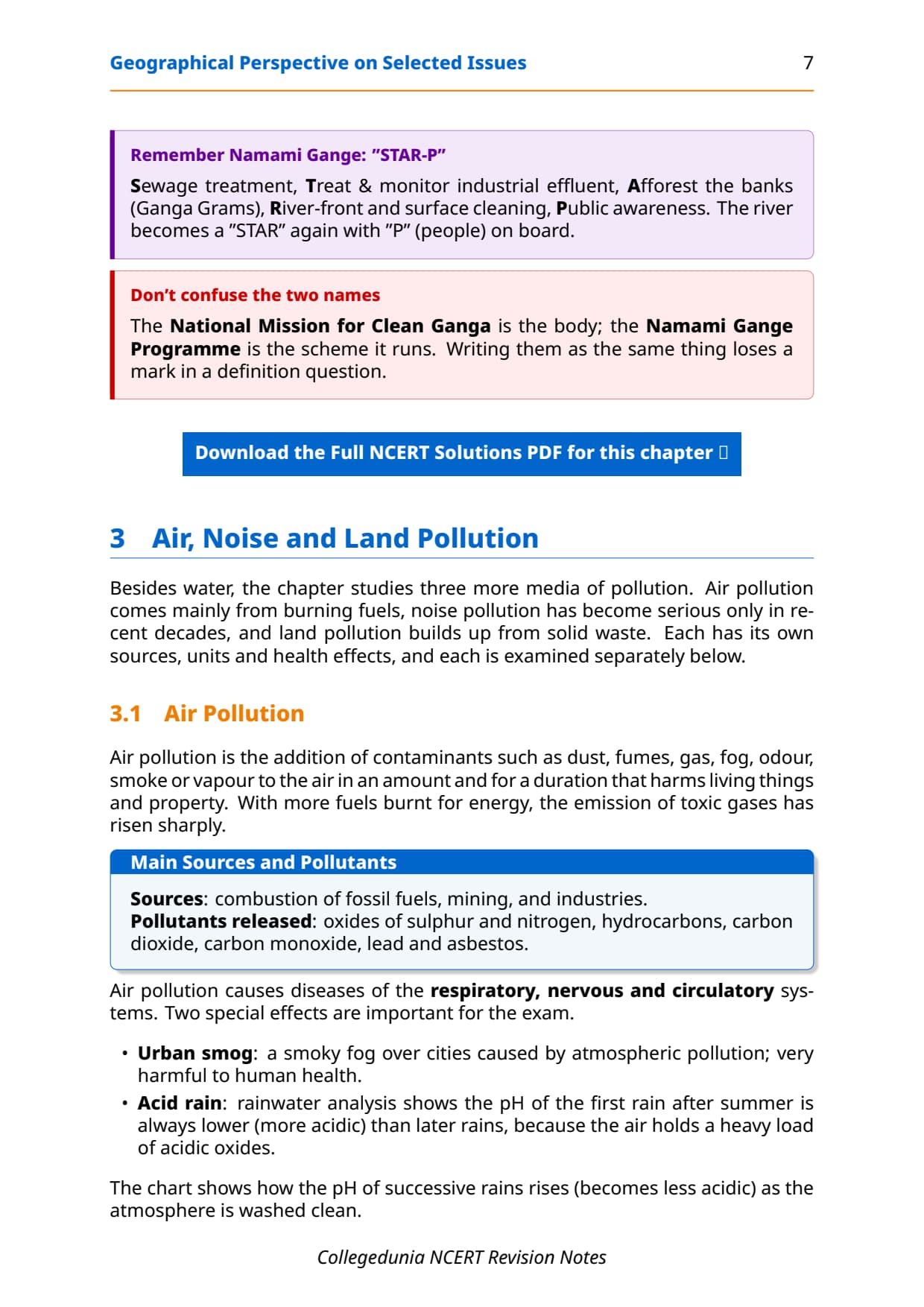
Main sources: fossil fuel combustion, industry and waste disposal, releasing sulphur and nitrogen oxides, carbon monoxide, hydrocarbons and lead. Effects hit the respiratory, nervous and circulatory systems, and smog is the visible result. Acid rain forms when these oxides lower rainwater pH, so the first rain after summer is the most acidic.
Water Pollution
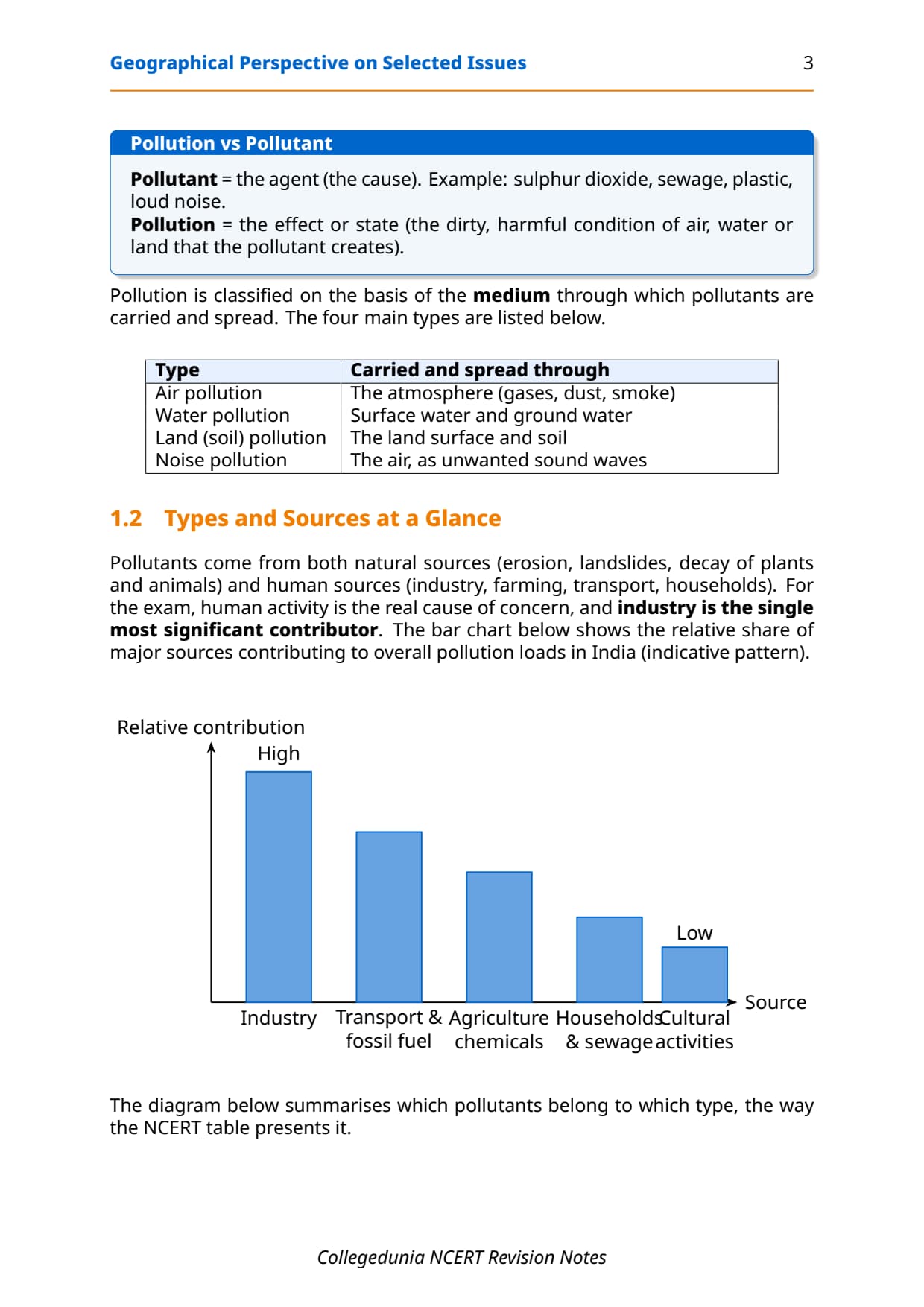
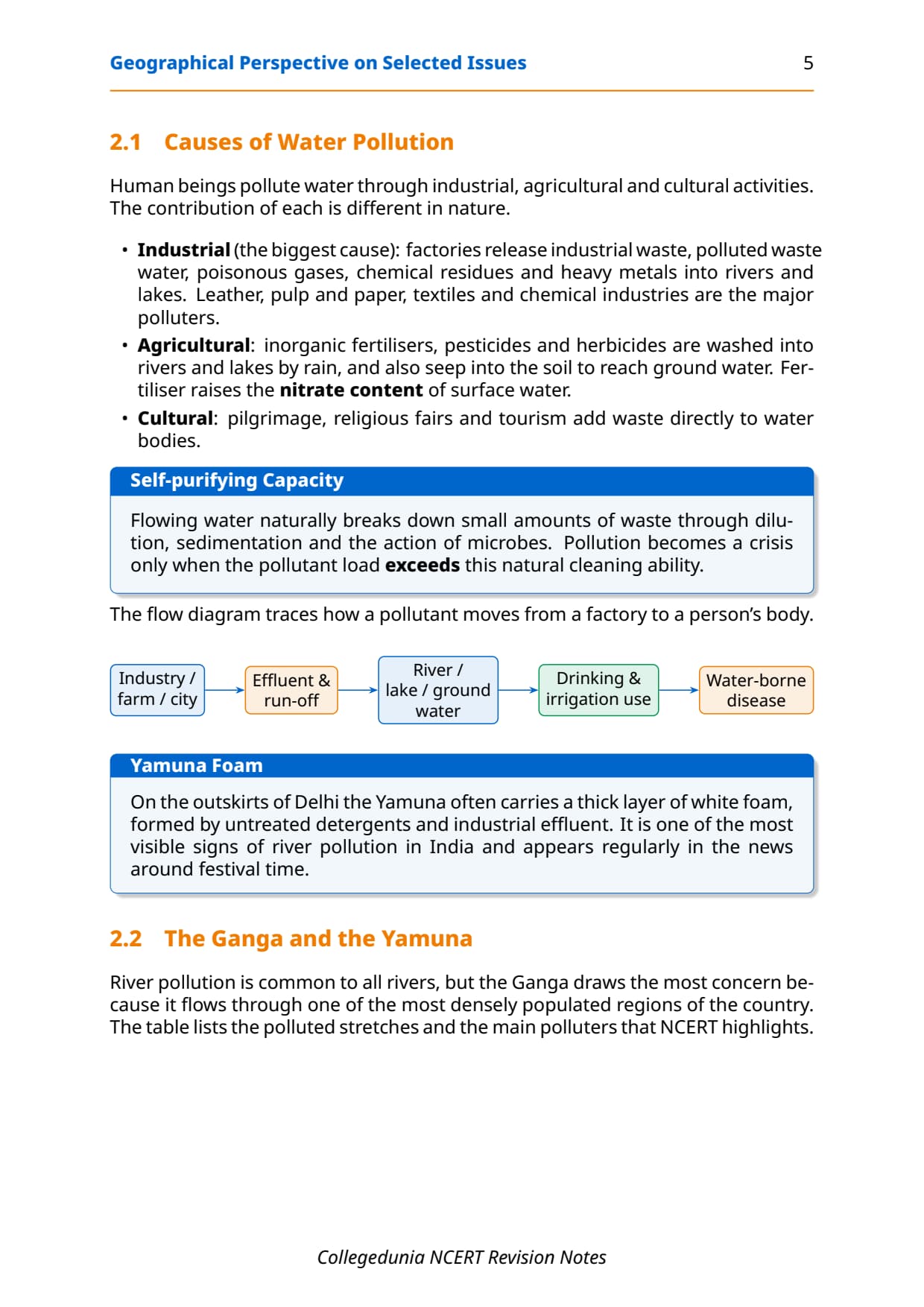
Major polluting industries are leather, paper, textiles and chemicals; farm chemicals wash into rivers and groundwater. The WHO estimates about one-fourth of communicable diseases in India are water-borne. Key pollutants include nitrates, fluoride and heavy metals.
Land Pollution
Land pollution comes from human and animal excreta, industrial and chemical waste and radioactive substances, degrading soil directly.
Noise Pollution
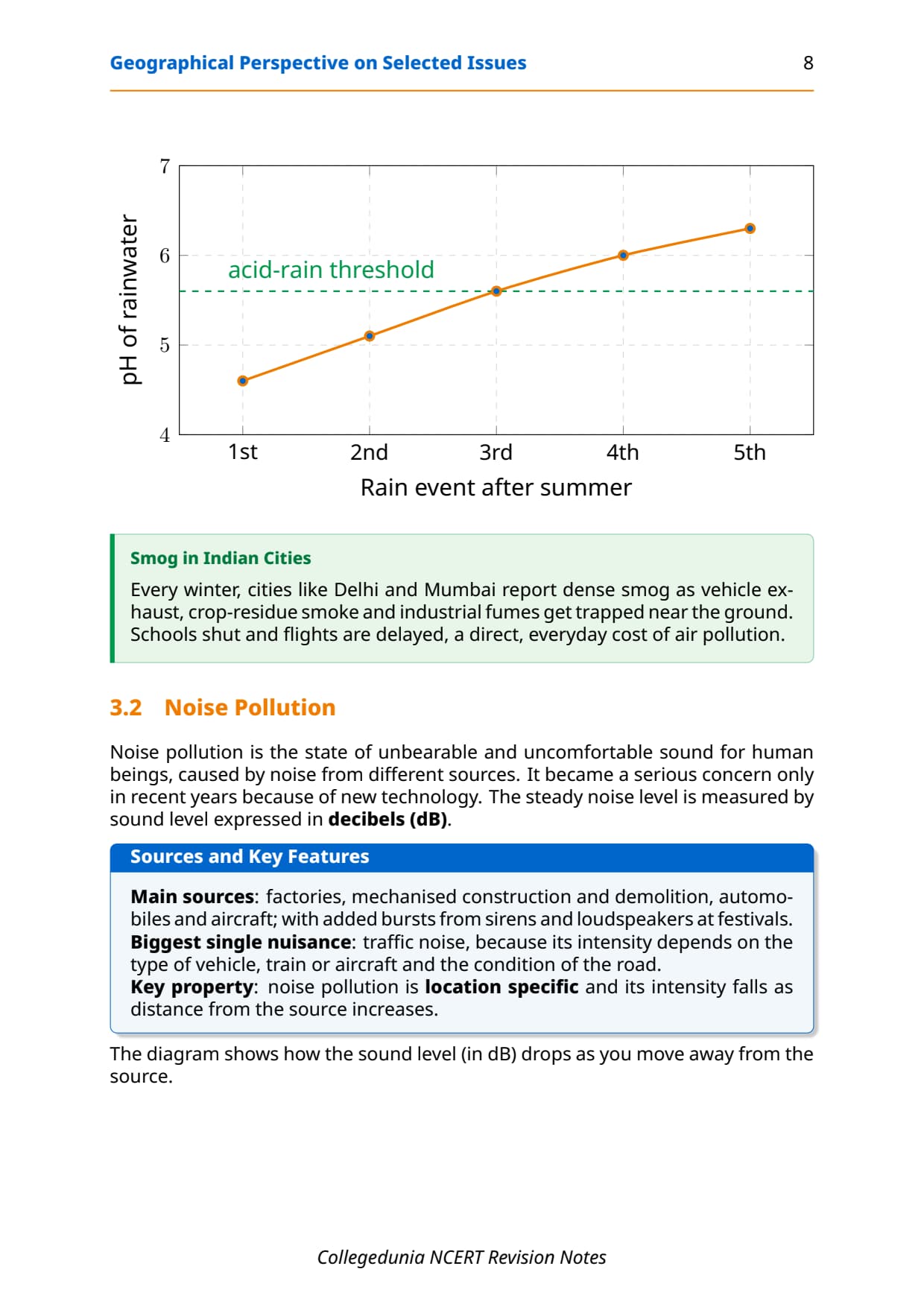
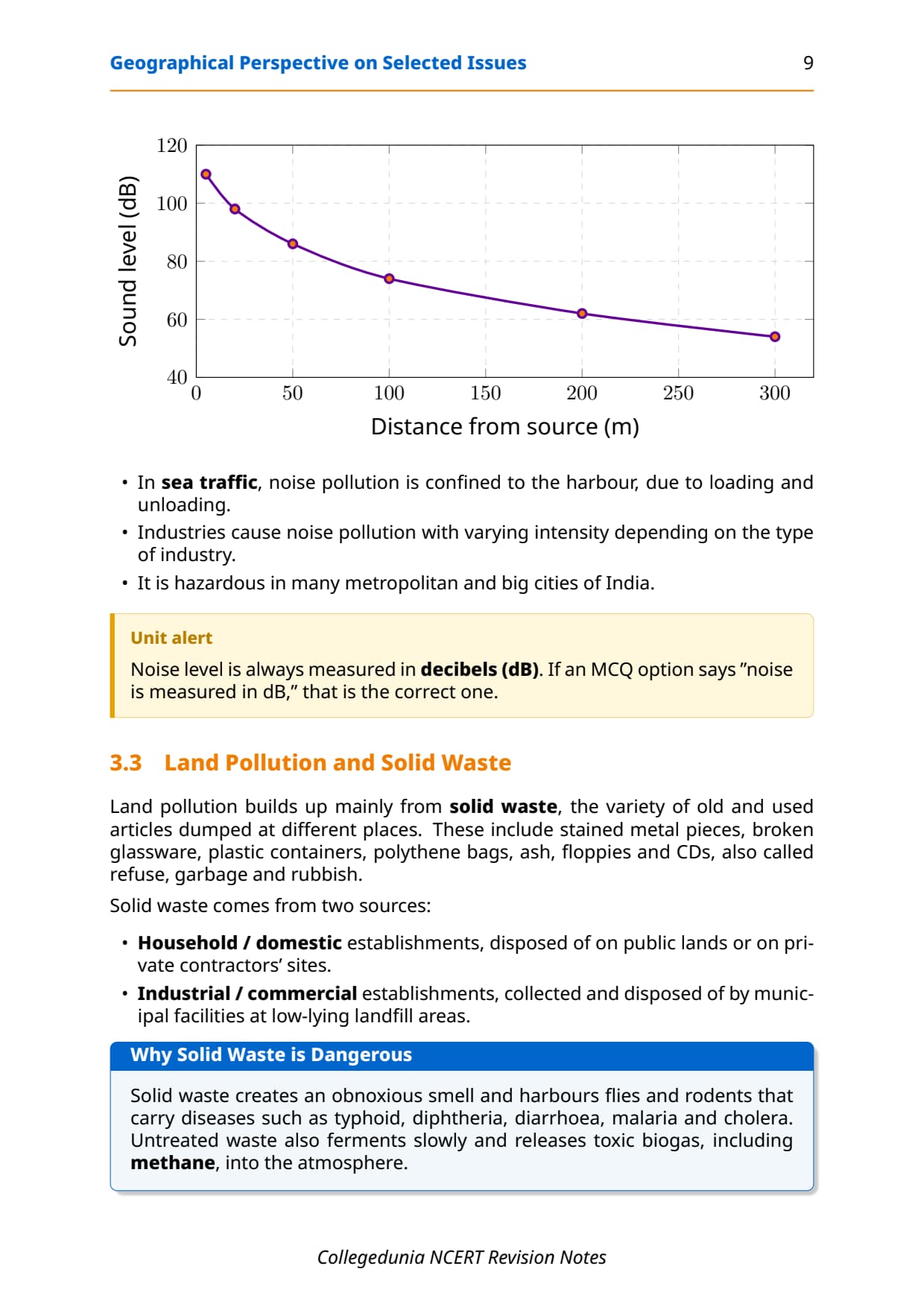
Noise is measured in decibels (dB). The biggest urban source is traffic, and intensity falls with distance. Delhi, Mumbai and Kolkata have the highest levels.
Memory hook: Air, combustion products; Water, industrial and farm runoff; Land, solid waste and chemical residue; Noise, traffic and machinery.
Water Pollution and the Namami Gange Programme
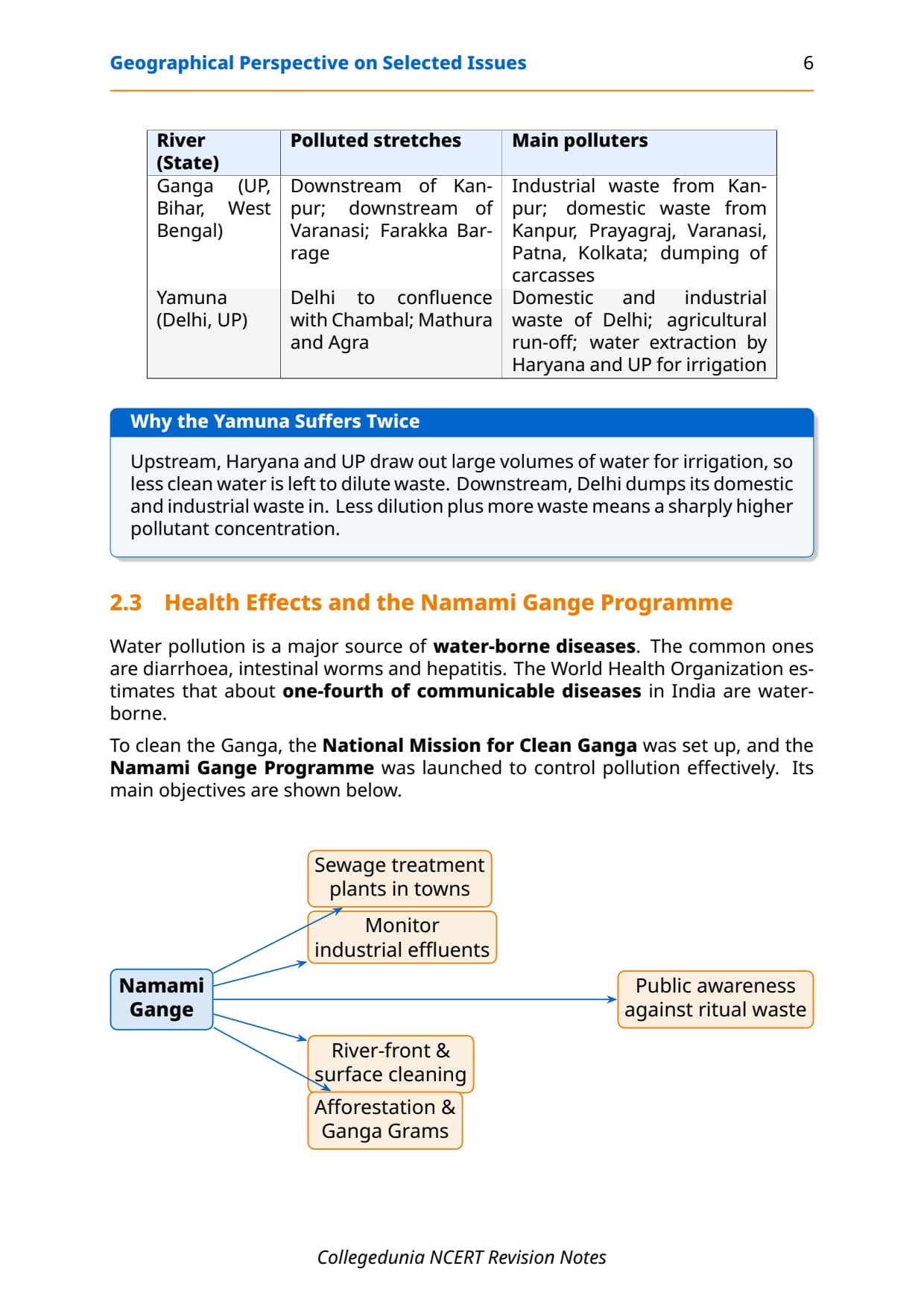
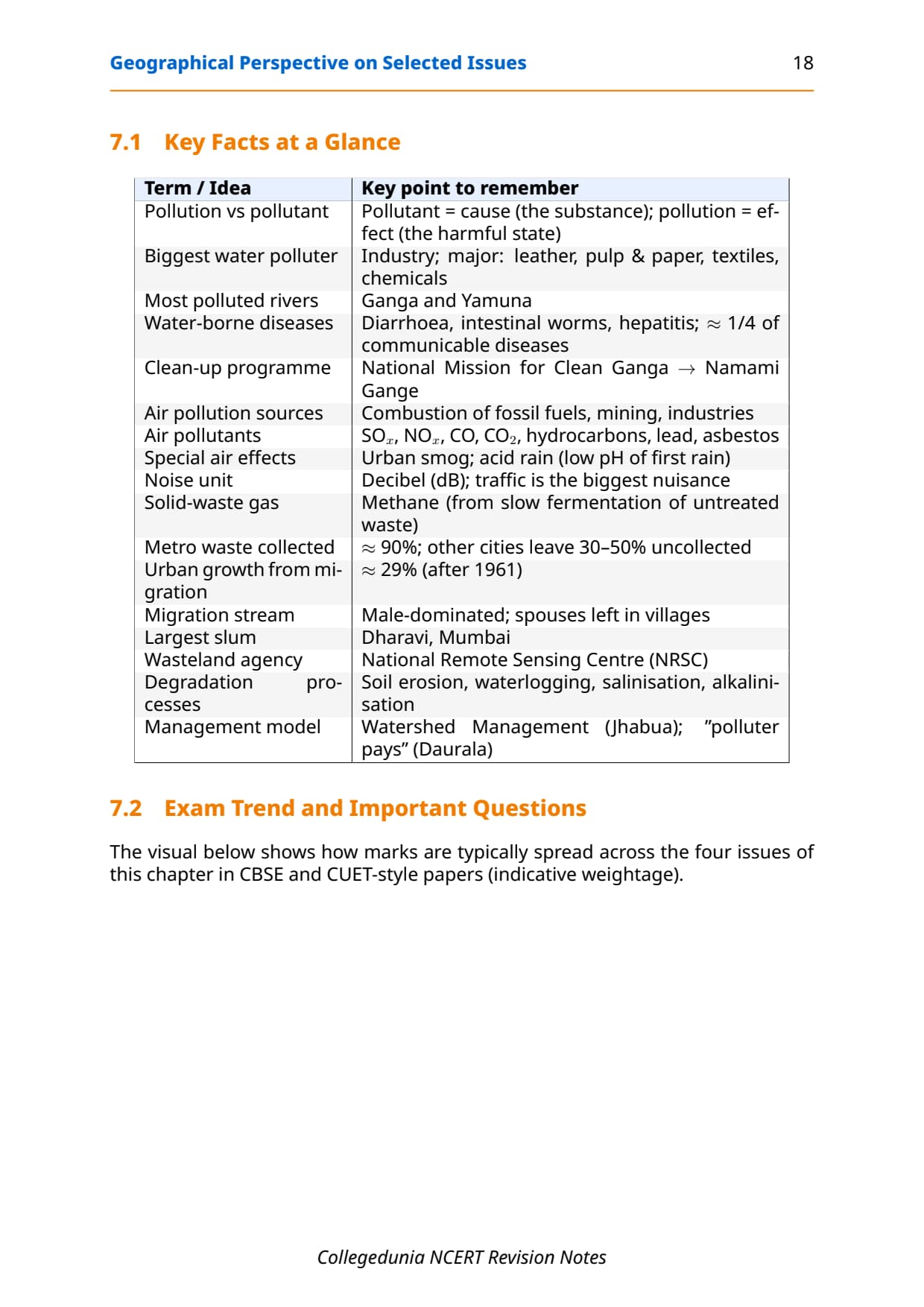
The Ganga and Yamuna are India's most polluted rivers. The Ganga is worst downstream of Kanpur, Varanasi and the Farrakka Barrage; the Yamuna from Delhi to the Chambal confluence, mainly Delhi's waste and Haryana-UP runoff.
Namami Gange Programme: 7 Key Objectives
The seven objectives:
- Sewerage treatment in riverside towns
- Monitoring industrial effluents
- River-front development for ghats and bathing
- Afforestation along the bank
- Cleaning the river surface
- Ganga Grams in Uttarakhand, U.P., Bihar, Jharkhand, West Bengal
- Public awareness to stop adding pollutants
Exam tip: "State any four objectives of the Namami Gange Programme" is a 4-mark question; any four work.
Urban Issues: Waste Disposal and Slum Problem in India
Urban Waste Disposal
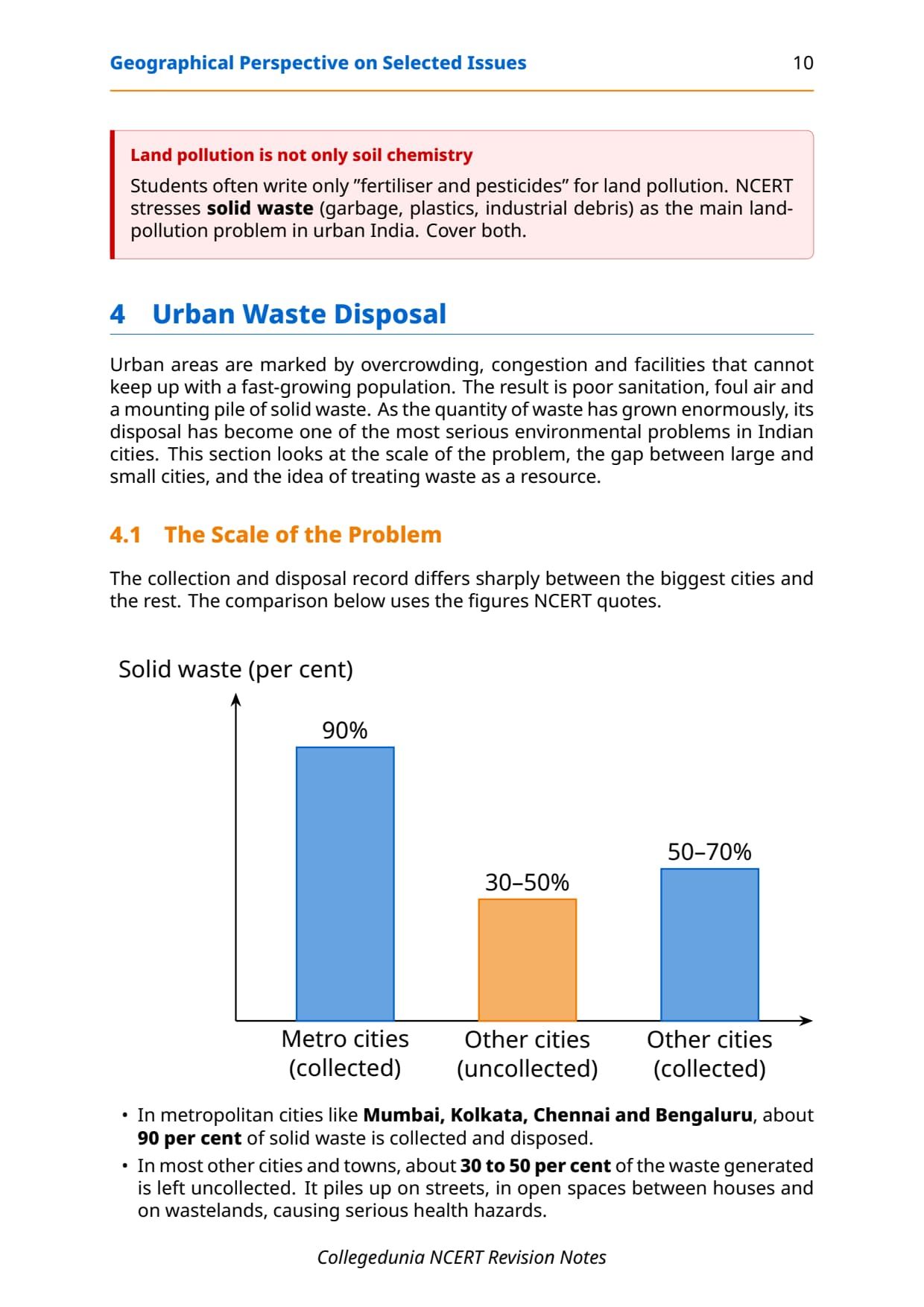
Solid waste comes from households and industry. Metros collect about 90 percent, but most cities collect only 30 to 50 percent; the rest piles up, breeding flies and rodents that spread typhoid, diarrhoea and cholera.
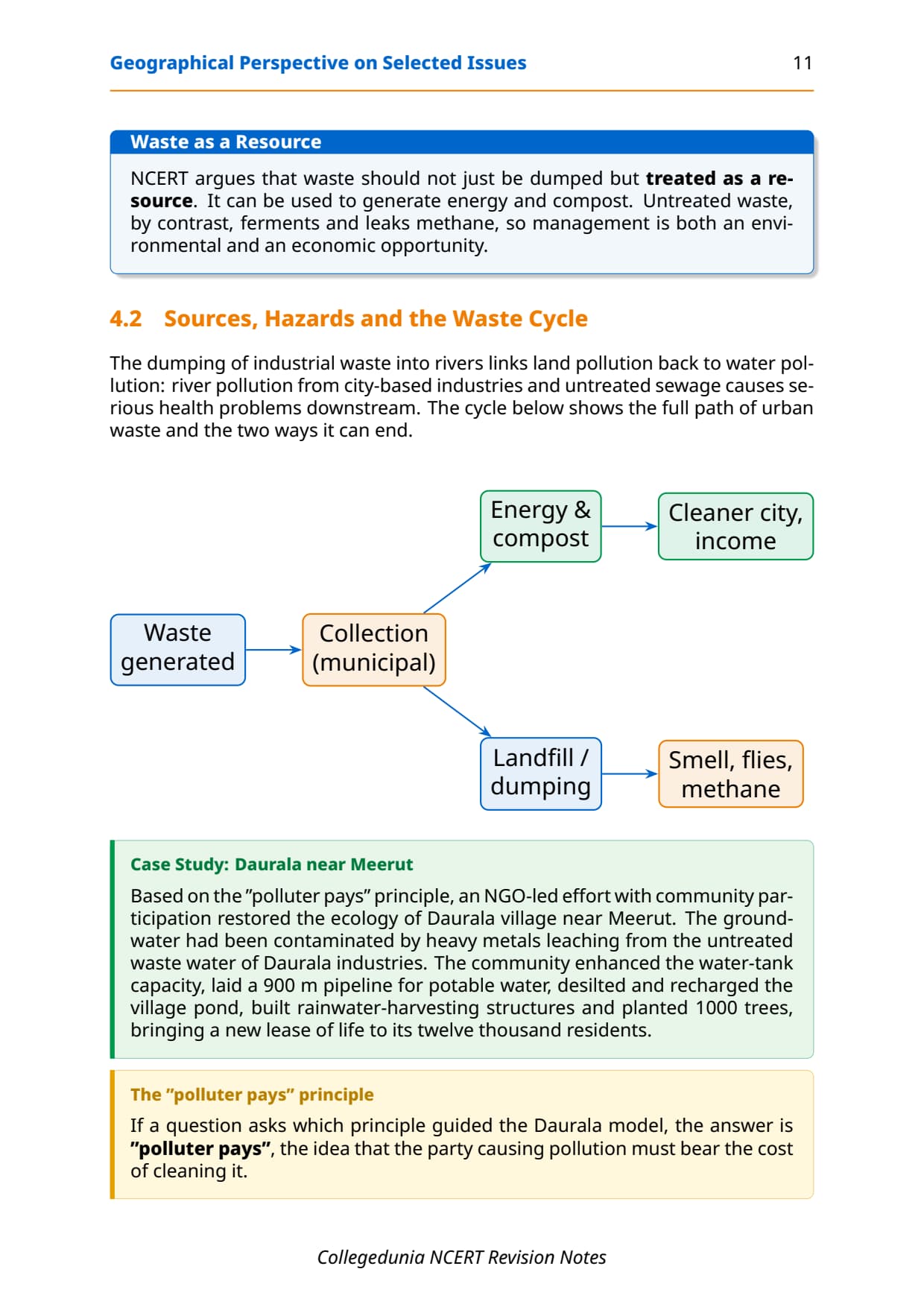
NCERT's Daurala case study (near Meerut): after wastewater contaminated groundwater, an NGO, officials and community built a water pipeline, desilted the pond and planted 1,000 trees.
Slum Problem in India
Slums arise because rural migrants cannot afford housing, settling on flood plains, garbage dumps and steep slopes.
- Physical: dilapidated buildings, overcrowding, no clean water.
- Social and economic: poverty brings drug abuse, crime and exclusion; most work in unorganised sectors.
- Dharavi: Asia's largest slum, still producing ceramics, leather and garments.
- Swachh Bharat Mission: the urban renewal response.
Key NCERT figure: in 2011 India was about 69 percent rural, yet urban slums keep growing.
Rural-Urban Migration: Push and Pull Factors
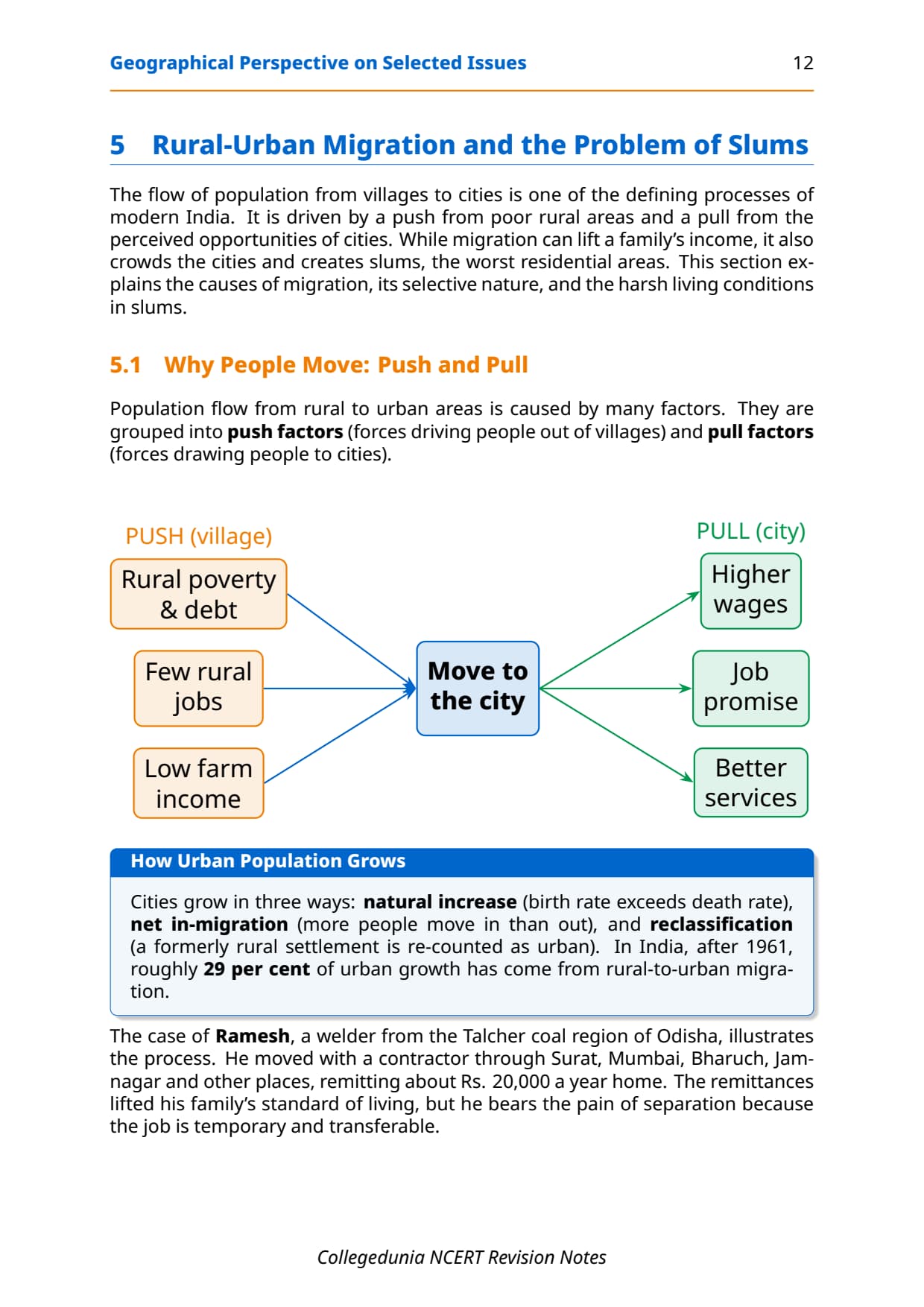
Migration is driven by factors that push people out of villages and pull them to cities, illustrated by NCERT's case study of Ramesh, an Odisha welder.
Push factors (reasons people leave villages)
- Low job opportunities and wages
- Poverty, farm debt and land subdivision (Ramesh: three brothers, three acres)
- Poor access to education and healthcare
Pull factors (reasons people come to cities)
- High labour demand in construction, factories and services
- Better wages, schools, hospitals and infrastructure
- Demonstration effect of successful migrants
The migration stream pattern
The stream is male-dominated, with wives left in villages to care for family because urban jobs are often temporary. After 1961, about 60 percent of urban growth came from natural increase and about 29 percent from migration.
CBSE exam angle: "Explain push-pull factors of rural-urban migration" is a 4-mark question: two push, two pull, plus the male-dominated stream.
Land Degradation and Watershed Management
Land degradation is the decline in land's productive capacity through soil erosion, waterlogging, salinisation and alkalinisation. The NRSC classifies wastelands into two groups.
Natural-process wastelands
- Gullied or ravined land, desertic or coastal sands
- Barren rocky areas, steep slopes, glacial areas
Human-induced (or combined) wastelands
- Waterlogged, marshy, saline and alkaline land
- Land with or without scrub; degraded shifting-cultivation areas
- Degraded forest and pasture; mining and industrial wastelands
NCERT confirms human-made processes contribute more to wastelands than natural ones.
Jhabua Case Study (Madhya Pradesh)
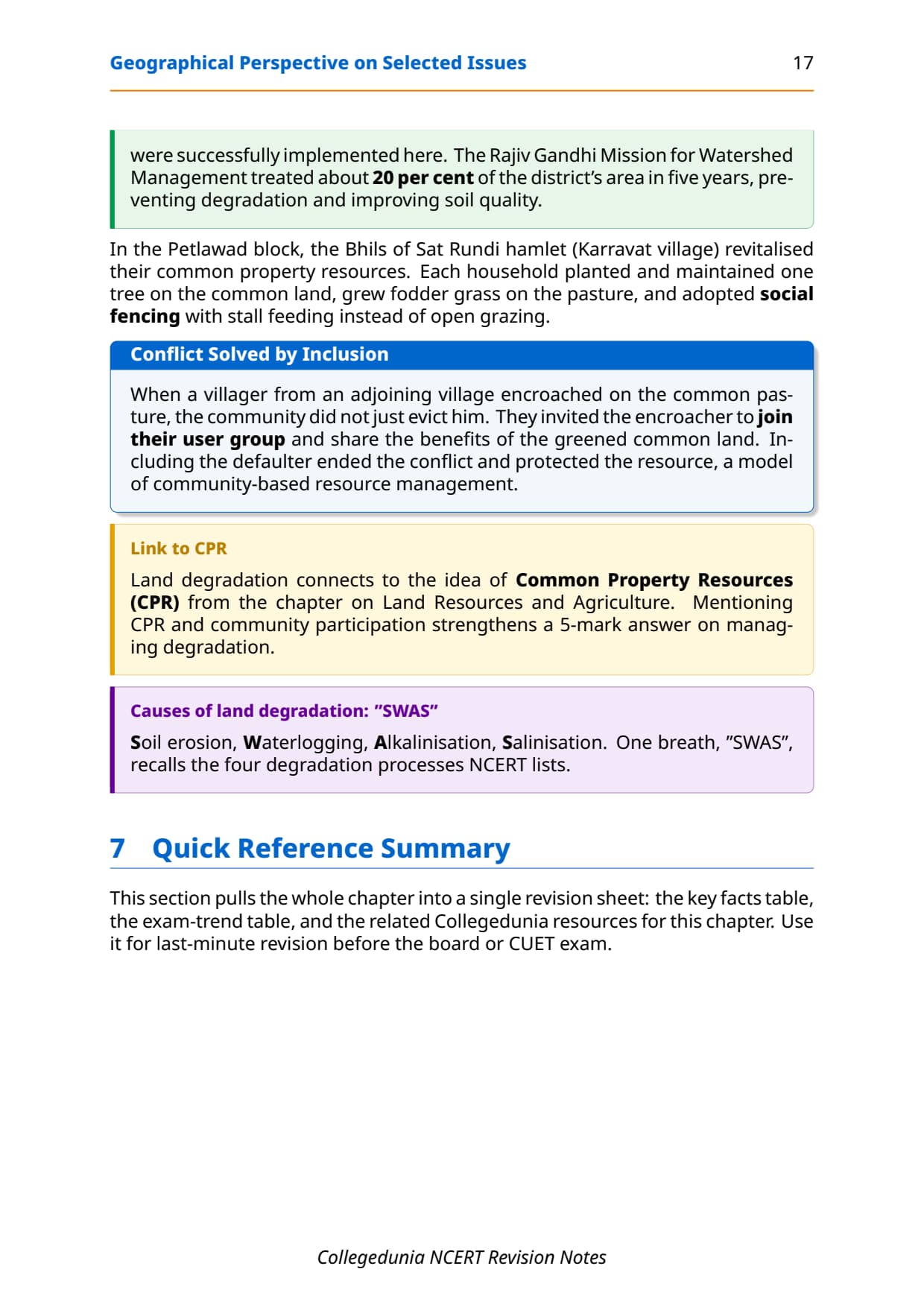
In Jhabua, a tribal (Bhil) district of Madhya Pradesh, the Rajiv Gandhi Mission for Watershed Management treated 20 percent of the area in five years. The Petlawad block is a success story:
- Each household kept one tree on common land, plus fodder grass on social-fenced pastures.
- An encroachment dispute resolved by adding the defaulter to the group.
- Result: greener land, better soil.
The principle: link land, water and vegetation, improving livelihoods through community participation.
Common Mistakes Students Make in This Chapter
Repeat-offender mistakes CBSE examiners flag each year:
- Pollution vs pollutant: pollution is the state of contamination; a pollutant is the substance causing it (Exercise Q 2(i)).
- Acid rain: caused by air pollution (sulphur and nitrogen oxides), not classified under water pollution.
- Noise: always mention it is measured in decibels (dB), or a 3-mark definition is incomplete.
- Ganga vs Yamuna sources: Ganga, cities like Kanpur, Varanasi, Kolkata; Yamuna, Delhi's domestic waste plus Haryana-UP runoff. Do not swap.
- Slum cause: link slums to migration and unaffordable housing, not just poor living conditions.
Previous Year Question Trends from Chapter 9
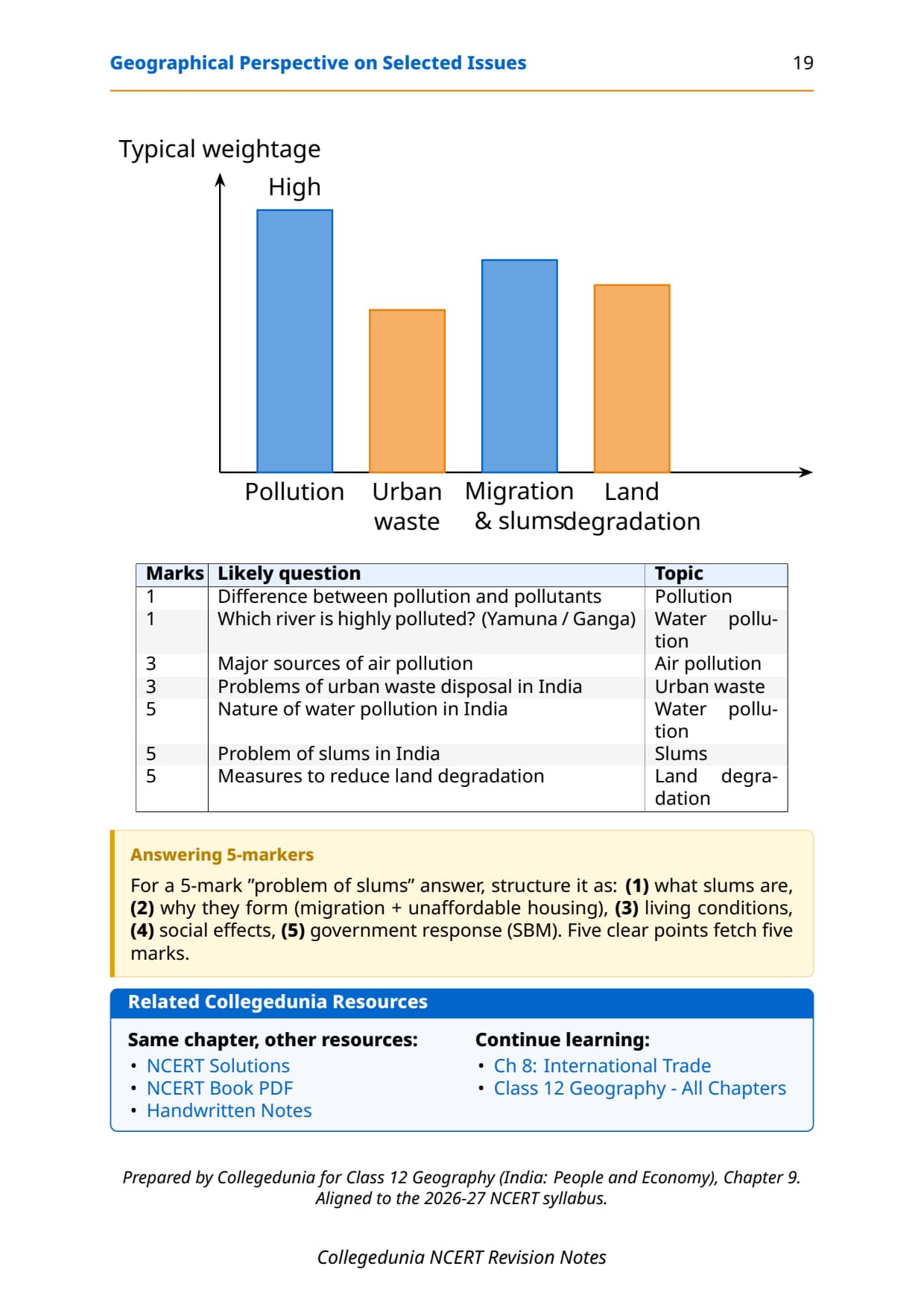
The table below maps recent CBSE question types.
| Year | Question asked | Marks | Notes section to revise |
|---|---|---|---|
| 2025 | Describe the Namami Gange Programme + state causes of water pollution | 6 + 3 | Water Pollution + Namami Gange section |
| 2024 | Distinguish between pollution and pollutants + explain push-pull migration factors | 3 + 4 | Key Definitions + Rural-Urban Migration section |
| 2023 | Explain problems of slums in India with Dharavi example | 6 | Urban Issues section |
| 2022 | Describe measures for reduction of land degradation + Jhabua case | 6 | Land Degradation section |
| 2021 | State sources of air pollution + effects on human health | 4 + 3 | Environmental Pollution section |
The chapter carries 9 to 12 marks per year, one of the higher-weightage chapters of the book.
Other Resources for Class 12 Geography Chapter 9
Pair these notes with the resources below.
| Resource | What it covers | Open |
|---|---|---|
| Notes | Concept-first revision notes covering all five issue areas, key definitions, Namami Gange objectives and common mistakes. | You are here |
| NCERT Solutions | Step-by-step answers to all MCQ, 30-word and 150-word exercise questions with Expert's Solution alternatives. | Class 12 Geography Chapter 9 NCERT Solutions |
| Handwritten Notes | Topper's handwritten revision pages for last-minute board exam practice. | Class 12 Geography Chapter 9 Handwritten Notes |
| NCERT Book PDF | Official NCERT India: People and Economy Chapter 9 textbook in PDF form. | Class 12 Geography Chapter 9 NCERT Book PDF |
| Subject Hub | All chapters of Class 12 Geography with every resource in one place. | Class 12 Geography Subject Hub |
All Chapters Notes for Class 12 Geography India: People and Economy
Related Links: Notes for the other chapters of Class 12 Geography India: People and Economy.
| Chapter | Topic | Notes link |
|---|---|---|
| Chapter 1 | Population Distribution, Density, Growth and Composition | Class 12 Geography Population Notes |
| Chapter 2 | Human Settlements | Class 12 Geography Human Settlements Notes |
| Chapter 3 | Land Resources and Agriculture | Class 12 Geography Land Resources Notes |
| Chapter 4 | Water Resources | Class 12 Geography Water Resources Notes |
| Chapter 5 | Mineral and Energy Resources | Class 12 Geography Mineral and Energy Resources Notes |
| Chapter 6 | Planning and Sustainable Development in Indian Context | Class 12 Geography Planning and Sustainable Development Notes |
| Chapter 7 | Transport and Communication | Class 12 Geography Transport and Communication Notes |
| Chapter 8 | International Trade | Class 12 Geography International Trade Notes |
| Chapter 9 | Geographical Perspective on Selected Issues and Problems | You are here |
NCERT Notes Class 12 Geography Chapter 9 Geographical Perspective on Selected Issues and Problems FAQs
Ques. What are the four types of environmental pollution covered in Chapter 9 of Class 12 Geography?
Ans. Chapter 9 of NCERT Class 12 India: People and Economy covers four types of environmental pollution classified by the medium through which pollutants travel: air pollution (from fossil fuel combustion and industrial processes), water pollution (from industrial effluents, agricultural chemicals and cultural activities), land pollution (from improper waste disposal and chemical residues) and noise pollution (from traffic, factories, aircraft and construction). Each type has its own table of sources and pollutants in the NCERT chapter, and CBSE asks students to distinguish between them in the 1-mark and 3-mark slots.
Ques. What is the Namami Gange Programme and what are its main objectives?
Ans. The Namami Gange Programme is the Union Government's flagship initiative to clean the Ganga river by controlling pollution effectively. The NCERT lists seven main objectives: developing sewerage treatment systems in towns, monitoring industrial effluents, developing river fronts, afforestation along the river banks to increase biodiversity, cleaning the river surface, developing Ganga Grams in Uttarakhand, Uttar Pradesh, Bihar, Jharkhand and West Bengal, and creating public awareness to stop adding pollutants even through rituals. CBSE regularly asks for any four of these objectives in a 4-mark question format.
Ques. What are the push and pull factors of rural-urban migration in India?
Ans. Push factors are the conditions that force people out of rural areas: low wages, limited job opportunities in villages, land fragmentation, poverty and debt. Pull factors are the attractions of urban areas: higher demand for labour, better wages, access to schools and hospitals and the demonstration effect of seeing successful migrants return from cities. The NCERT case study of Ramesh, a welder from Odisha, illustrates both: abject poverty and land shortage at home (push) combined with perceived job opportunities at Ludhiana and Surat (pull). The migration stream in India is predominantly male, with wives staying in villages to care for children and elderly family members.
Ques. How does the NCERT define the slum problem in India for Class 12 Geography?
Ans. The NCERT defines slums as residential areas of least choice, characterised by dilapidated housing, poor hygiene, overcrowding, lack of drinking water, lighting and toilet facilities, and open defecation. Slums form because rural migrants who come to cities for livelihood cannot afford proper housing due to high land costs and rents, and end up on environmentally degraded or incompatible land. Dharavi in Mumbai is the landmark NCERT example. Most slum residents work in low-paid, unorganised sectors and are vulnerable to disease, malnutrition and social exclusion. The Swachh Bharat Mission (SBM) is the government's urban renewal response to improve conditions in urban slums.
Ques. What is the difference between pollution and pollutants in Class 12 Geography Chapter 9?
Ans. Pollution is the overall state of contamination of a medium (air, water, land) caused by the release of harmful substances or energy from human activities. A pollutant is the specific substance or energy form that causes the pollution - for example, sulphur dioxide is a pollutant that contributes to air pollution, and nitrates from fertilisers are pollutants that contribute to water pollution. This distinction is Exercise Question 2(i) of the NCERT chapter and is worth 3 marks in the board paper; students must define both terms separately and clearly.
Ques. What is land degradation and how is it classified by the NRSC?
Ans. Land degradation is a temporary or permanent decline in the productive capacity of land, caused by processes like soil erosion, waterlogging, salinisation and alkalinisation. The National Remote Sensing Centre (NRSC) classifies degraded land (wasteland) using remote sensing into two broad categories: land degraded by natural processes (gullied land, desert sands, barren rocky areas, steep slopes, glacial areas) and land degraded by human activities or a combination of natural and human factors (waterlogged and marshy land, saline and alkaline land, degraded forests, mining wastelands). The NCERT states that human-induced processes are more important contributors to wasteland formation than natural processes.
Ques. What is the Jhabua watershed management case study about?
Ans. The Jhabua case study in Madhya Pradesh shows how a Government-NGO-community partnership successfully reversed land degradation in one of India's most backward tribal districts. The Rajiv Gandhi Mission for Watershed Management (Ministry of Rural Development) treated 20 percent of Jhabua's total area in five years. In the Petlawad block, the Bhil tribal community planted one tree per household on common land, planted fodder grass on pastures, enforced social-fencing for two years and resolved an encroachment dispute by including the defaulter in the user group. This case illustrates the watershed management principle: linking land, water and vegetation management while empowering local communities to take ownership of natural resources.
Ques. How are the Ganga and Yamuna rivers polluted differently?
Ans. According to NCERT Table 9.2, the Ganga's main pollution comes from industrial cities like Kanpur, Prayagraj, Varanasi, Patna and Kolkata that discharge both industrial waste and domestic sewage; the worst stretches are downstream of Kanpur, downstream of Varanasi and near the Farrakka Barrage. The Yamuna's main pollution is concentrated in the Delhi to Chambal stretch and around Mathura and Agra; the chief causes are Delhi's domestic waste dumped into the river, extraction of water by Haryana and Uttar Pradesh for irrigation, and agricultural runoff containing high levels of micro-pollutants. For board exams, students should name at least two specific polluted stretches and two main polluter types for each river.
Ques. What is urban waste disposal and why is it a problem in India?
Ans. Urban waste disposal is the collection and disposal of solid waste generated by households and industrial or commercial establishments. It is a major problem in India because only metropolitan cities like Mumbai, Kolkata, Chennai and Bengaluru collect around 90 percent of their solid waste; in most other cities and towns, only 30 to 50 percent of waste is collected and the rest accumulates on streets, open spaces and wastelands. Uncollected waste creates health hazards by harbouring flies and rodents that carry typhoid, diphtheria, diarrhoea, malaria and cholera. Industrial waste dumped in rivers adds to water pollution downstream. The NCERT recommends treating waste as a resource for energy and compost generation rather than discarding it.
Ques. Is this chapter important for CUET and UPSC preparation?
Ans. Yes. For CUET Geography, Chapter 9 is part of the Class 12 NCERT syllabus that CUET draws directly from, and environmental issues, urban problems and land degradation are frequently tested in the domain section. For UPSC Preliminary and Mains Geography optional, the same themes of environmental pollution, slums, rural-urban migration and watershed management appear as sub-topics under Human Geography and Environmental Geography. Students preparing for UPSC should supplement these Class 12 notes with additional data from government reports (NRSC, NITI Aayog) and current affairs on Namami Gange and Swachh Bharat Mission updates.
Ques. Is the Class 12 Geography syllabus for these notes changing in 2026-27?
Ans. No major changes for 2026-27. Chapter 9 of NCERT India: People and Economy remains part of the CBSE Class 12 Geography syllabus for the current cycle. The Namami Gange Programme section and the Jhabua case study are both retained in the 2026-27 edition of the textbook (reprinted 2026-27), and the CBSE marking scheme continues to reward specific NCERT examples and precise definitions in answers. These notes are aligned to the 2026-27 NCERT reprint and the latest CBSE sample paper released for the 2026 boards.



Comments