




The NCERT Solutions for Class 12 Geography (India: People and Economy) Chapter 2 Human Settlements cover all 3 exercise questions, in line with the 2026-27 CBSE syllabus. Every answer is in plain English and follows the textbook's order: rural settlement types, the urban definition, functional classification of towns, and the factors that shape where people live.
- 3 NCERT exercise questions solved with plain prose and bullets, plus an Expert's Solution per question with exam strategy.
- Covers the four rural settlement types, the Census definition of a town, functional classification of Indian cities, and why cities become multi-functional.
- Aligned with the 2026-27 CBSE Class 12 Geography syllabus and CUET Geography patterns.
Every answer here is curated by Geography subject experts, mapped to the 2026-27 NCERT textbook, and refined against the last five years of CBSE board papers.
Student Feedback: What 9,400 students told us about this chapter
68% of students rated telling apart the four rural settlement types the trickiest part of Chapter 2, and most mixed up semi-clustered and hamleted settlements in long answers. Toppers found that naming one Indian region per type (Gujarat plain for semi-clustered, Chhattisgarh for hamleted) added 1 to 2 marks per long-answer.
Source: 2026-27 Class 12 Geography student poll, 9,400 CBSE students across 13 states.
What the NCERT Solutions for Class 12 Geography Chapter 2 Cover
The chapter answers one question: how and why do people live where they do? The textbook builds the answer in four blocks, which these solutions follow.
- Rural vs urban settlements: their economic and social differences, and how cities act as growth nodes linked to villages through transport and trade.
- Four types of rural settlements: clustered, semi-clustered, hamleted and dispersed, each shaped by terrain, water, caste and security, with named Indian regions.
- Urban settlements and the Census definition: the three-part definition (population, density, occupation) and the difference between statutory and Census towns.
- Functional classification of towns: administrative, industrial, transport, commercial, educational, garrison, religious, tourist and mining towns, with named examples.
Source: Lucky Education on YouTube
Exercise-wise Breakdown: Chapter 2 NCERT Solutions
Chapter 2 carries 3 end-of-chapter exercise questions mixing MCQs, 30-word short answers and 150-word long answers. The table below maps each question to its topic, answer style and typical marks.
| Question | Topic covered | Answer style | Typical marks |
|---|---|---|---|
| Q 2.1 | MCQ set: city not on a river bank; Census town definition criteria; environment with dispersed rural settlements | One correct option per sub-part with a one-line reason | 1 mark each (3 sub-parts) |
| Q 2.2 | Define garrison towns and their function; factors for village location in desert regions | Short answer, about 30 words per sub-part, plain prose or bullets | 2-3 marks each |
| Q 2.3 | Features of four types of rural settlements and factors responsible; can a town be single-function, and why cities become multi-functional | Long answer, about 150 words per sub-part, sub-headings and named examples | 5-6 marks each |
The two sub-parts of Q 2.3 carry the heaviest marks. Naming all four rural types with a regional example each, and making the multi-functional argument with a specific city (Mumbai, Delhi, Varanasi), scores full marks.
Rural Settlements in India: Four Types and Their Drivers
Every rural settlement type reduces to one question: what mix of terrain, water, society and security forced people to live this way?
Clustered (Nucleated) Settlements
A clustered settlement is a compact village where houses sit side by side along lanes, separated from farmland and pasture. The layout is usually geometric: rectangular, radial or linear.
- Where: Indo-Gangetic plain, Tamil Nadu, Kerala, Punjab, Haryana; also Bundelkhand and Rajasthan, where security and water scarcity force clustering.
- Why: Flat, fertile, well-watered land allows dense farming; collective defence and shared water reinforce the compact shape.
Semi-Clustered (Fragmented) Settlements
A semi-clustered settlement arises when a section of the community lives a little away from the main cluster. The dominant land-owning group sits at the core; lower-strata households settle on the outer flanks.
- Where: Gujarat plain and parts of Rajasthan.
- Why: Caste-based segregation pulls sub-groups to the edges without fully breaking the settlement apart.
Hamleted Settlements
A hamleted settlement is a village split into several small clusters, each called a panna, para, palli, nagla or dhani, but all sharing one name.
- Where: Middle and lower Ganga plain, Chhattisgarh and lower Himalayan valleys.
- Why: Streams cut the land into patches; ethnic and caste divisions reinforce the split into named sub-clusters.
Dispersed (Isolated) Settlements
A dispersed settlement consists of isolated huts or tiny clusters scattered over remote jungle, hills or grassland. Extreme fragmentation of the terrain prevents any clustering.
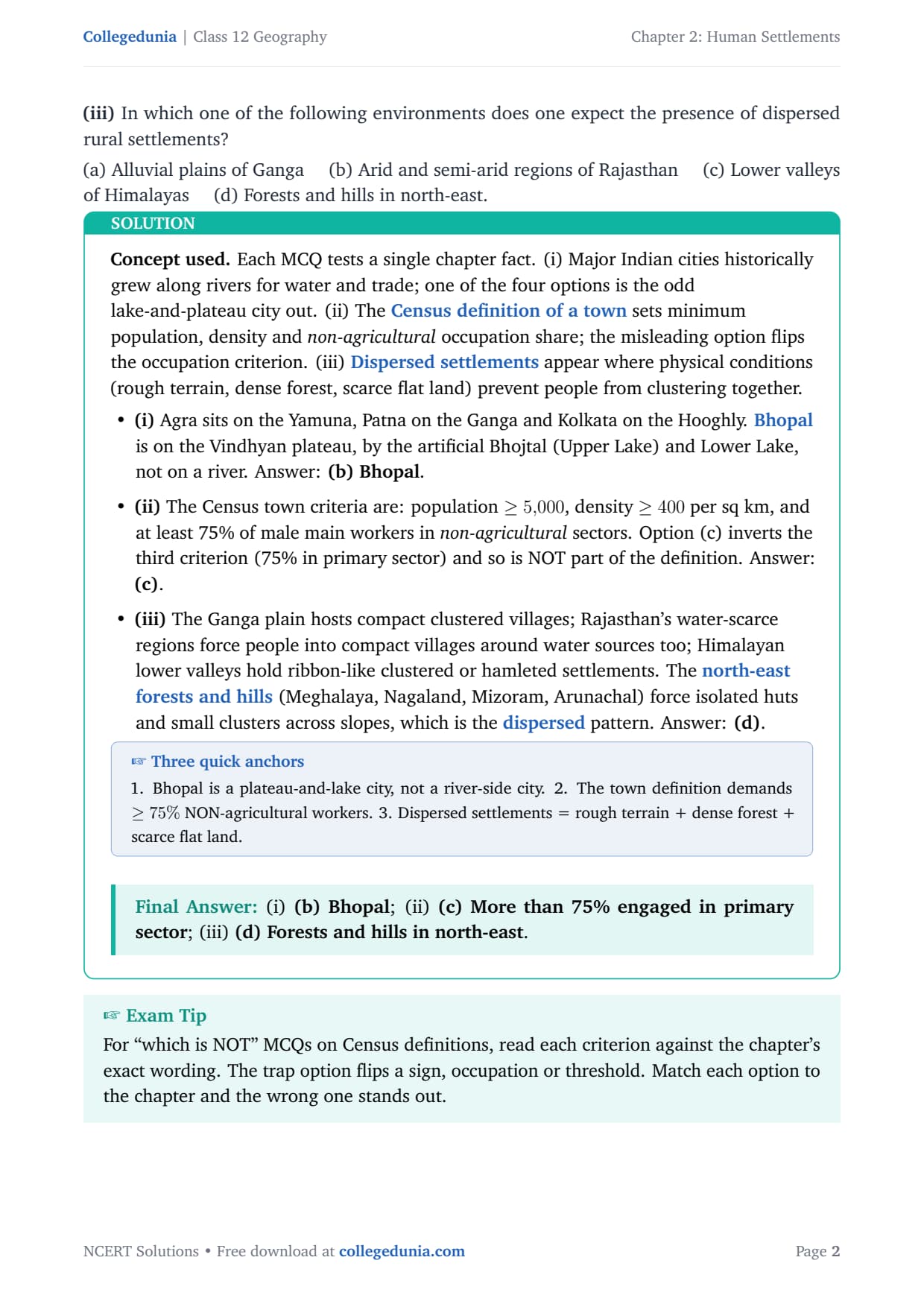
- Where: Meghalaya, Uttarakhand, Himachal Pradesh, parts of Kerala, and the north-east forests (Arunachal, Nagaland, Mizoram).
- Why: Rugged terrain, dense forest and little flat land make a compact village impossible; each family occupies the nearest usable patch.
Tip: For Q 2.3(i), name all four types, give one feature and one named Indian region for each. Doing this reliably earns full marks even with simple prose.
Urban Settlements: Census Definition and Functional Classes
Urban settlements are compact, larger and engaged in non-agricultural and administrative work. The chapter gives the Census of India 1991 definition, which drives the Q 2.1 MCQ.
The Census Definition of a Town (Three Criteria)
A place is urban if it meets all three conditions below:
| Criterion | Threshold | Why it matters for MCQs |
|---|---|---|
| Minimum population | 5,000 persons | Eliminates very small hamlets and villages from the urban category |
| Population density | At least 400 persons per sq km | Ensures the settlement is physically compact, not just large in area |
| Male main workers in non-agricultural pursuits | At least 75% | The criterion MCQs most often flip; the correct threshold is NON-agricultural, not primary sector |
Statutory towns also need a municipality, corporation, cantonment board or notified town area committee. The Q 2.1(ii) MCQ turns on the third criterion: option (c) says "75% in primary sector", which inverts the definition and is NOT part of it.
Functional Classification of Indian Towns
Indian towns are classified by their dominant function. CBSE tests this with named examples, so use the table below as a checklist.
| Town type | Defining function | Named Indian examples |
|---|---|---|
| Administrative towns | Seat of government at state, district or divisional level | Chandigarh, Bhopal, Gandhinagar, New Delhi |
| Industrial towns | Manufacturing and processing dominate the economy | Bhilai, Durgapur, Jamshedpur, Bhiwandi, Ludhiana |
| Transport towns | Junction, port or railway hub | Mughal Sarai (now Pt. Deen Dayal Upadhyaya), Itarsi, Kandla |
| Commercial towns | Trade and market functions dominate | Saharanpur, Satna, Surat |
| Mining towns | Built around mineral extraction | Raniganj, Jharia, Digboi, Singrauli, Ankleshwar |
| Garrison cantonment towns | Military base; primary function is housing and supporting army units | Ambala, Jalandhar, Mhow, Babina, Udhampur |
| Educational towns | Major campus or university centre | Roorkee, Varanasi (BHU), Aligarh, Pilani, Prayagraj |
| Religious and cultural towns | Place of pilgrimage or cultural significance | Varanasi, Mathura, Amritsar, Madurai, Puri, Tirupati, Haridwar, Ujjain |
| Tourist towns | Leisure and tourism draw visitors | Nainital, Mussoorie, Shimla, Pachmarhi, Jodhpur, Jaisalmer, Ooty, Mount Abu |
Cities are not static. As they grow they become multi-functional, with industry, business, administration, transport and culture intertwined. Mumbai, Delhi, Kolkata and Bengaluru are the textbook examples.
Rural vs Urban Settlements: Key Differences at a Glance
CBSE regularly asks students to distinguish rural and urban settlements, as a 3-mark table or a long-answer opener. The three differences the chapter makes explicit are the ones the examiner rewards.
| Feature | Rural settlements | Urban settlements |
|---|---|---|
| Economic base | Land-based primary activities (farming, fishing, forestry) | Secondary (manufacturing) and tertiary (services) activities |
| Role in the network | Produce food and raw materials; depend on cities for goods and services | Act as nodes of economic growth; process raw materials and provide services to rural hinterlands |
| Social character | Less mobile; intimate social relations; traditional outlook | High mobility; complex and fast-paced life; formal social relations |
The two-way link works through transport and communication: villages send food and raw materials, cities send goods and services back. The chapter calls this the rural-urban continuum.
Common Mistakes Students Make in Chapter 2 Answers
The five repeat-offender mistakes in Chapter 2 board answers:
- Mixing up hamleted and dispersed: hamleted means one village in a few named sub-clusters sharing a name; dispersed means truly isolated huts that do not cluster.
- Inverting the town definition: the criterion is 75% of male main workers in NON-agricultural work, not "primary sector". This is exactly what Q 2.1(ii) tests.
- Saying Bhopal is on a river: Q 2.1(i) asks which city is NOT on a river. Bhopal is on the Vindhyan plateau with artificial lakes, unlike Agra, Patna and Kolkata.
- Listing town types without named examples: 1 mark per named example, so always name Ambala, Mhow, Babina, and so on.
- Using numbered steps: Geography answers use plain prose and bullets, not "Step 1, Step 2".
Previous Year Question Trends from Chapter 2
Chapter 2 questions are easy to predict because the CBSE pattern has been consistent for five years. The table below maps the question types across recent board papers.
| Year | Question type asked | Marks |
|---|---|---|
| 2025 | Describe any four types of rural settlements in India with examples | 5 |
| 2024 | What is a garrison town? Name two examples; Census definition MCQ on town criteria | 2 + 1 |
| 2023 | Why do cities become multi-functional? Explain with examples from India | 5 |
| 2022 | Distinguish between clustered and dispersed rural settlements; name two religious towns | 3 + 1 |
| 2021 | Census definition of an urban settlement; factors for desert village location | 2 + 2 |
Also Check: The full set of CBSE board questions for this chapter is in the PDF above, updated for 2026-27.
Other Resources for Class 12 Geography Chapter 2
Pair this with the matching revision notes, handwritten notes and the official NCERT book chapter, all linked below.
| Resource | What it covers | Open |
|---|---|---|
| NCERT Solutions | Plain-English answers to all 3 exercise questions, with Expert's Solution alternatives for each. | You are here |
| Notes | Concept-first revision notes covering the four rural types, Census definition, functional classification and rural-urban differences. | Class 12 Geography Chapter 2 Notes |
| Handwritten Notes | A topper's genuine handwritten revision pages for last-minute board practice. | Class 12 Geography Chapter 2 Handwritten Notes |
| NCERT Book PDF | Official NCERT India: People and Economy Chapter 2 textbook in PDF form. | Class 12 Geography Chapter 2 NCERT Book PDF |
| Subject Hub | All chapters of Class 12 Geography with every resource in one place. | Class 12 Geography Subject Hub |
India: People and Economy - All Chapters NCERT Solutions
Related Links: Use the table below for the NCERT Solutions of the other Class 12 Geography (IPE) chapters, each with the same plain-English answers, PDF and FAQ.
| Chapter | Topic | NCERT Solutions link |
|---|---|---|
| Chapter 1 | Population: Distribution, Density, Growth and Composition | NCERT Solutions for Class 12 Geography Chapter 1 IPE |
| Chapter 2 | Human Settlements | You are here |
| Chapter 3 | Land Resources and Agriculture | NCERT Solutions for Class 12 Geography Chapter 3 IPE |
| Chapter 4 | Water Resources | NCERT Solutions for Class 12 Geography Chapter 4 IPE |
| Chapter 5 | Mineral and Energy Resources | NCERT Solutions for Class 12 Geography Chapter 5 IPE |
| Chapter 6 | Planning and Sustainable Development in Indian Context | NCERT Solutions for Class 12 Geography Chapter 6 IPE |
| Chapter 7 | Transport and Communication | NCERT Solutions for Class 12 Geography Chapter 7 IPE |
| Chapter 8 | International Trade | NCERT Solutions for Class 12 Geography Chapter 8 IPE |
| Chapter 9 | Geographical Perspective on Selected Issues and Problems | NCERT Solutions for Class 12 Geography Chapter 9 IPE |
NCERT Solutions for Class 12 Geography Chapter 2: Step-by-Step Answers
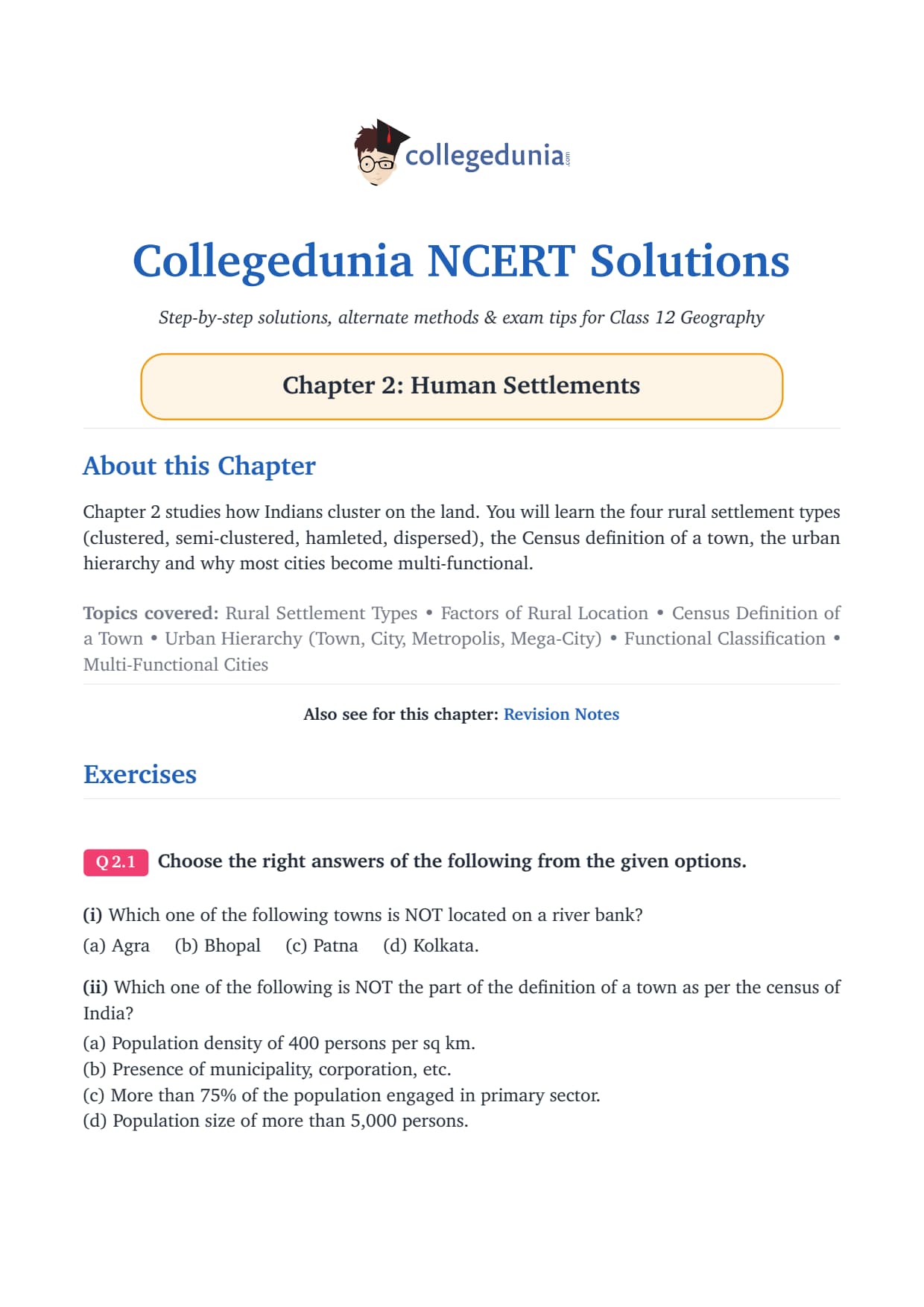
Choose the right answers of the following from the given options.
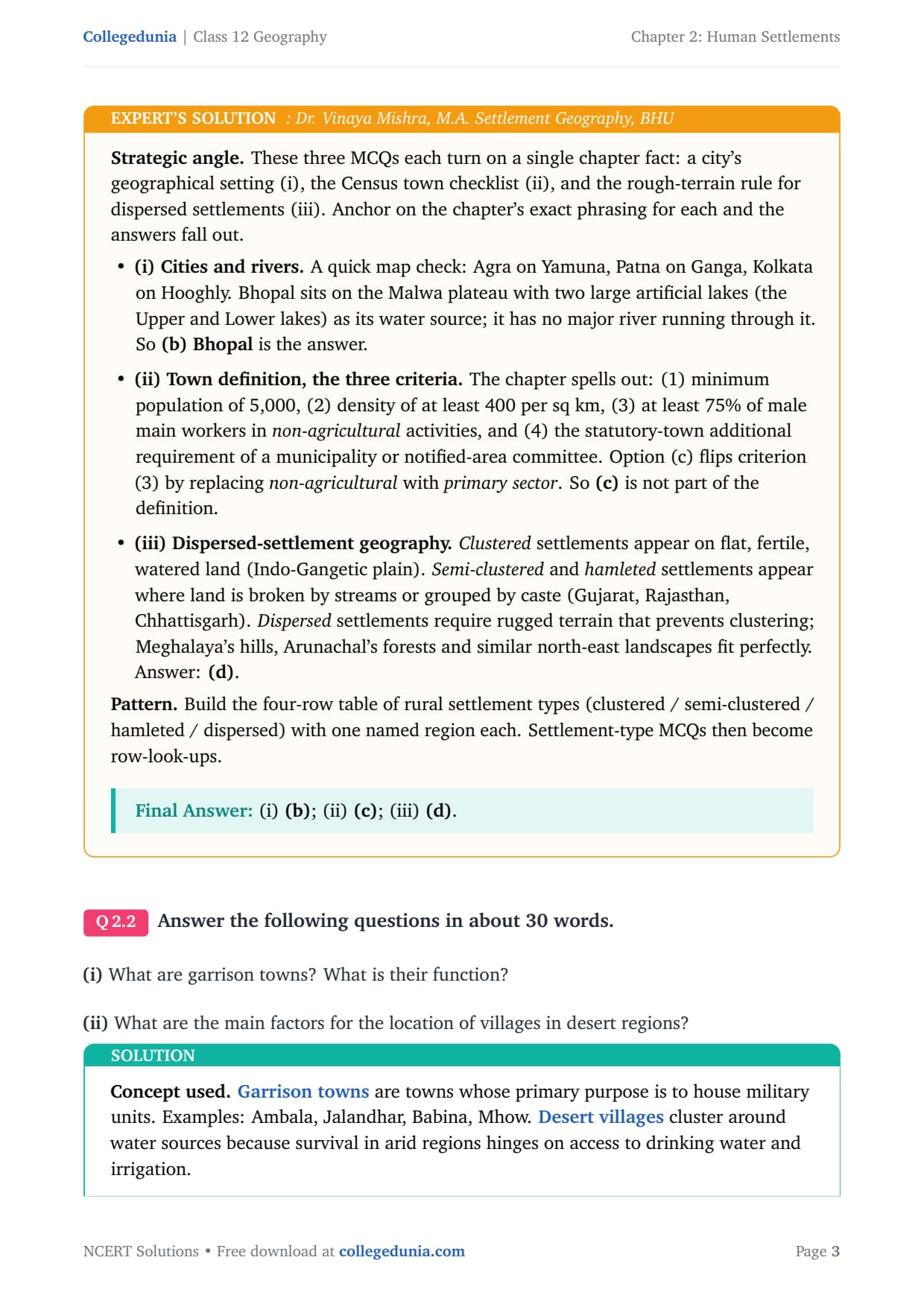
Answer the following questions in about 30 words.
(i) What are garrison towns? What is their function?
(ii) What are the main factors for the location of villages in desert regions?
Answer the following questions in about 150 words.
(i) Discuss the features of different types of rural settlements. What are the factors responsible for the settlement patterns in different physical environments?
(ii) Can one imagine the presence of only one-function town? Why do the cities become multi-functional?
NCERT Solutions Class 12 Geography Chapter 2 Human Settlements FAQs
Ques. How many questions are there in NCERT Class 12 Geography Chapter 2 Human Settlements?
Ans. There are 3 end-of-chapter exercise questions in NCERT Class 12 India: People and Economy Chapter 2 Human Settlements. Question 1 is an MCQ set with 3 sub-parts. Question 2 is a short-answer set with 2 sub-parts (about 30 words each). Question 3 is a long-answer set with 2 sub-parts (about 150 words each). All 3 questions are solved with full plain-English answers and an Expert's Solution in our human settlements class 12 ncert solutions PDF.
Ques. What are the four types of rural settlements in India?
Ans. The four types of rural settlements in India are clustered (nucleated), semi-clustered (fragmented), hamleted and dispersed (isolated). Clustered settlements are compact villages common in the Indo-Gangetic plain. Semi-clustered settlements show a dominant core with outer hamlets separated by caste; found in Gujarat and Rajasthan. Hamleted settlements are single villages split into named sub-clusters (panna, para, palli) by streams or ethnicity; found in Chhattisgarh and lower Himalayan valleys. Dispersed settlements are isolated huts on remote hills and in forests; found in Meghalaya, Uttarakhand and north-east India.
Ques. What is the Census definition of a town in India?
Ans. According to the Census of India 1991, an urban settlement is defined as a place with a municipality, corporation, cantonment board or notified town area committee, and a minimum population of 5,000 persons, a density of at least 400 persons per sq km, and at least 75% of male main workers engaged in non-agricultural pursuits. The third criterion (non-agricultural, not primary sector) is the one most often flipped in MCQs and is the key fact in Q 2.1(ii) of the chapter exercise.
Ques. Which city in India is NOT located on a river bank - Agra, Bhopal, Patna or Kolkata?
Ans. Bhopal is not located on a river bank. Agra is on the Yamuna, Patna is on the Ganga and Kolkata is on the Hooghly. Bhopal is situated on the Vindhyan plateau and gets its name partly from the Bhojtal (Upper Lake), which is an artificial lake, not a river. This is the answer to Q 2.1(i) of the Chapter 2 exercise and is a common 1-mark board question.
Ques. What is a garrison town? Give two examples from India.
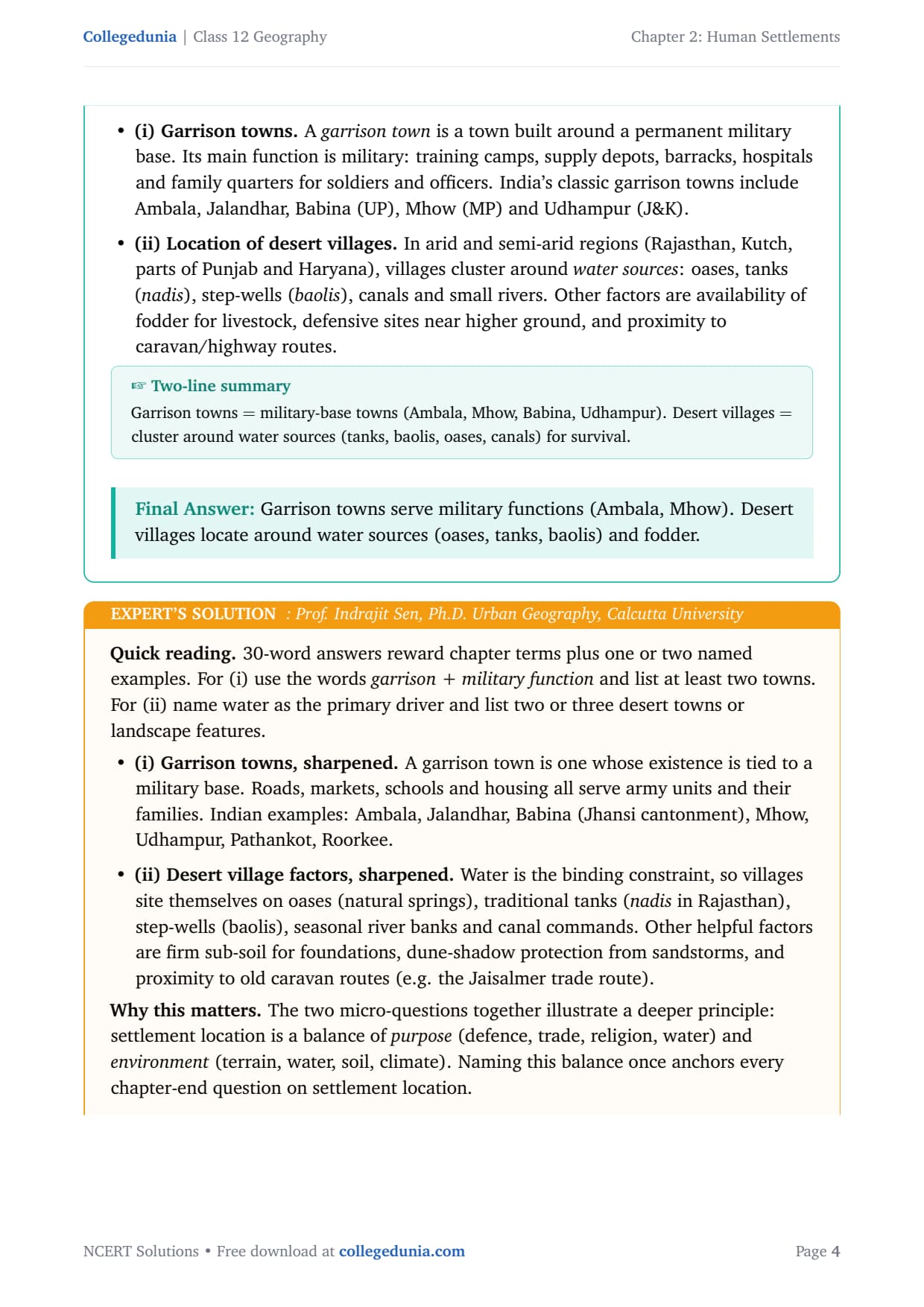
Ans. A garrison town is a town that grew around a permanent military base and whose primary function is housing, training and supporting army units and their families. All the key infrastructure in a garrison town - roads, hospitals, schools, markets and housing - is oriented towards military needs. The civilian population lives in a separate area called the civil lines or cantonment extension. Indian examples include Ambala (Haryana), Jalandhar (Punjab), Mhow (Madhya Pradesh), Babina (Uttar Pradesh) and Udhampur (Jammu and Kashmir).
Ques. Why do villages in desert regions cluster around water sources?
Ans. In arid and semi-arid regions like Rajasthan, Kutch and parts of Punjab and Haryana, water is the binding constraint for survival. Villages locate around oases (natural springs), traditional tanks called nadis, step-wells called baolis, canal commands and seasonal river banks because without a reliable water source no permanent settlement is possible. Other location factors include availability of fodder for livestock, firm sub-soil for building foundations, protection from sandstorms on the leeward side of dunes, and proximity to old caravan routes that provided trade and security.
Ques. Why do cities become multi-functional?
Ans. Cities become multi-functional because population growth automatically generates demand for a wide range of services beyond the original founding purpose. A mining camp needs schools, hospitals, banks and government offices for its workers' families. A temple town like Varanasi develops a complete economy of priests, scholars, weavers, boatmen, restaurants and tourist services. As a city grows it crosses administrative thresholds (district headquarters, state capital, metropolitan corporation) and acquires more official functions. Industries cluster because workers are available; services follow industry; culture follows people. Modern Indian cities like Mumbai, Delhi, Kolkata and Bengaluru serve administrative, industrial, commercial, educational, recreational and cultural roles simultaneously, which is why pure single-function towns are extremely rare in India.
Ques. What is the difference between hamleted and dispersed settlements?
Ans. A hamleted settlement is a single village that has been split into a few physically separate clusters (called panna, para, palli, nagla or dhani) on the same overall land mass. All clusters share a common village name and are linked by social ties. A dispersed settlement, by contrast, consists of truly isolated individual huts or very small clusters of a few huts in remote jungles or on steep hillsides, with no shared name or central cluster at all. Hamleted settlements are caused by stream dissection, ethnic separation or caste segregation. Dispersed settlements are caused by extreme terrain fragmentation that makes any clustering physically impossible.
Ques. What are the main factors that determine the type of rural settlement in India?
Ans. The main factors determining rural settlement types in India are: physical factors (nature of terrain, altitude, climate and availability of water), cultural and ethnic factors (social structure, caste, religion and community ties), and security factors (the need for defence against theft and robbery). In flat, fertile, well-watered plains, clustered settlements form because dense farming and collective security are both possible. In areas with broken terrain or strong caste divisions, semi-clustered or hamleted patterns appear. In rugged mountain forests and remote hills, dispersed settlements are the only option because flat habitable land is too scarce to allow clustering.
Ques. Name the types of towns based on functional classification in the NCERT Chapter 2.
Ans. The NCERT chapter classifies Indian towns into the following functional types: administrative towns (Chandigarh, Bhopal), industrial towns (Bhilai, Jamshedpur, Ludhiana), transport towns (Mughal Sarai, Itarsi, Kandla), commercial towns (Surat, Saharanpur), mining towns (Raniganj, Jharia, Digboi, Singrauli), garrison or cantonment towns (Ambala, Mhow, Babina, Udhampur), educational towns (Roorkee, Aligarh, Pilani), religious and cultural towns (Varanasi, Mathura, Amritsar, Madurai, Tirupati, Haridwar), and tourist towns (Nainital, Shimla, Mussoorie, Jaisalmer, Ooty). As cities grow they typically combine several of these functions and become multi-functional.
Ques. Is the Class 12 Geography syllabus changing for 2026-27?
Ans. No major changes have been made to Class 12 Geography for 2026-27. The chapter structure of India: People and Economy is unchanged for the current cycle, and the CBSE marking scheme continues to reward named examples and structured paragraph answers. Our human settlements class 12 ncert solutions for the 2026-27 cycle are fully aligned with the unchanged textbook and the latest CBSE sample paper released for the 2026 boards. The four rural settlement types, the Census definition of a town, and the functional classification of Indian towns are all preserved as-is for 2026-27.



Comments