



Inside the Class 6 Social Science Chapter 13 file you will find the Swami Vivekananda quotation, the Anu and Kabir story, the six money terms the chapter defines, and the carpenter Rajesh who turns wood worth 600 rupees into a chair worth 1,000 rupees. This is the full printed chapter from Exploring Society: India and Beyond for the 2026-27 session, with nothing shortened or reworded.
- 12-page official file: Chapter 13 runs from printed page 183 to printed page 194 of the Class 6 textbook.
- Covers the two section heads Types of Economic Activities and The Importance of Non-Economic Activities.
- Carries 3 LET'S EXPLORE boxes, 3 THINK ABOUT IT boxes, 6 glossary terms, the community participation box and 4 end questions.

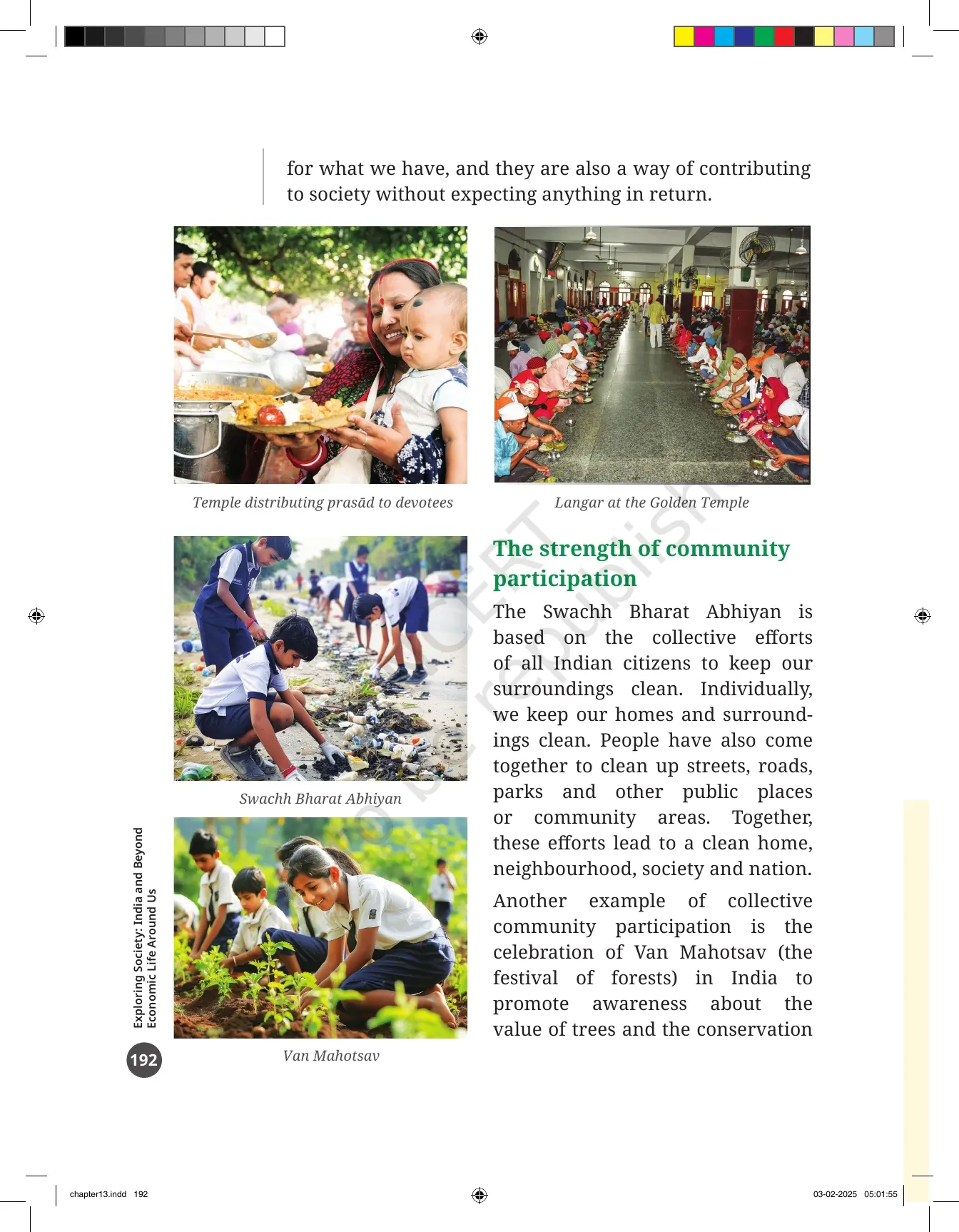
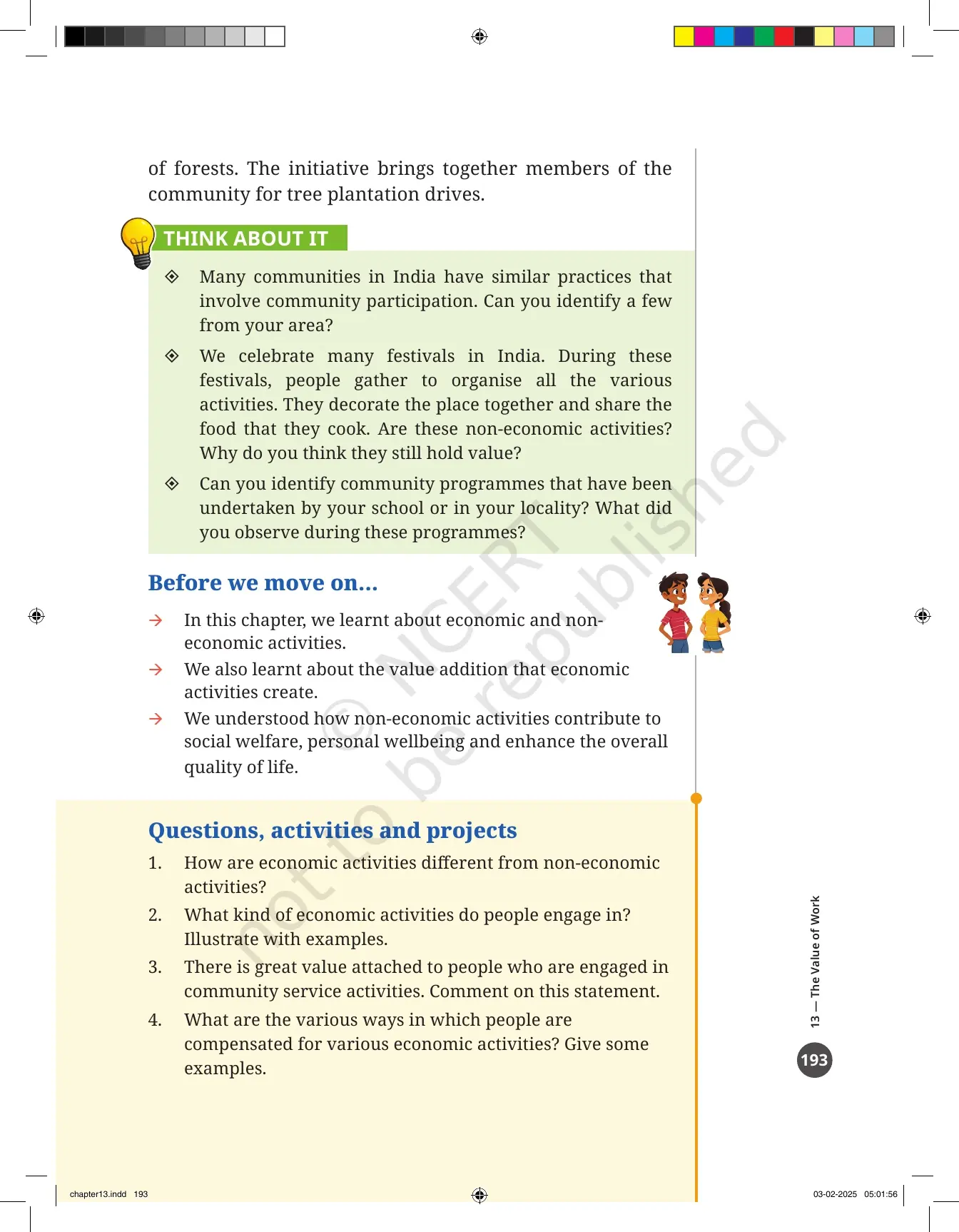

This is the unedited NCERT chapter file for the 2026-27 print run, checked page by page against the official Exploring Society: India and Beyond release before it was put on this page.
Student Feedback
What 12,910 students told us about The Value of Work chapter, in a Collegedunia poll taken during the 2026-27 session.
- 68% of students could not explain value addition without redoing the carpenter sum first.
- Most-confused pair: wage and salary, mixed up by about 6 in 10 students surveyed.
- Students reported that writing the six glossary terms on one card cleared most of the chapter in a single sitting.
Source: 2026-27 Class 6 Social Science student poll. Sample of 12,910 students from CBSE schools across 19 states.
What the Value of Work Class 6 PDF Contains, Page by Page
The file is the printed chapter in full, not a summary sheet. It opens with the Swami Vivekananda quotation on printed page 183 and closes with the Noodles page on printed page 194. Use the table below to jump straight to the part you need.
| Section in the PDF | Printed pages | What is on these pages |
|---|---|---|
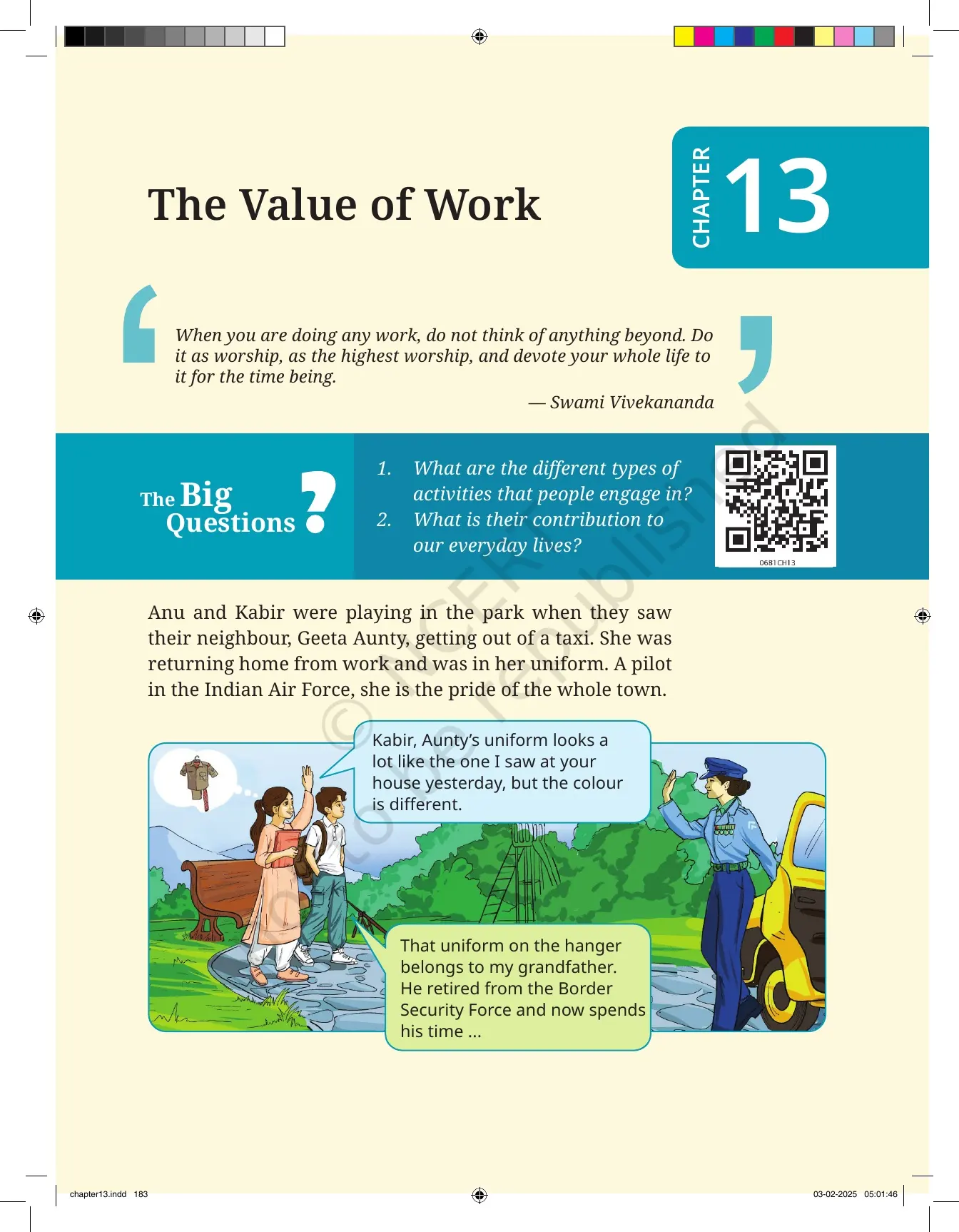
| Chapter opener | 183 | The Swami Vivekananda quotation, the two Big Questions, Geeta Aunty the Air Force pilot and the start of the Anu and Kabir story |
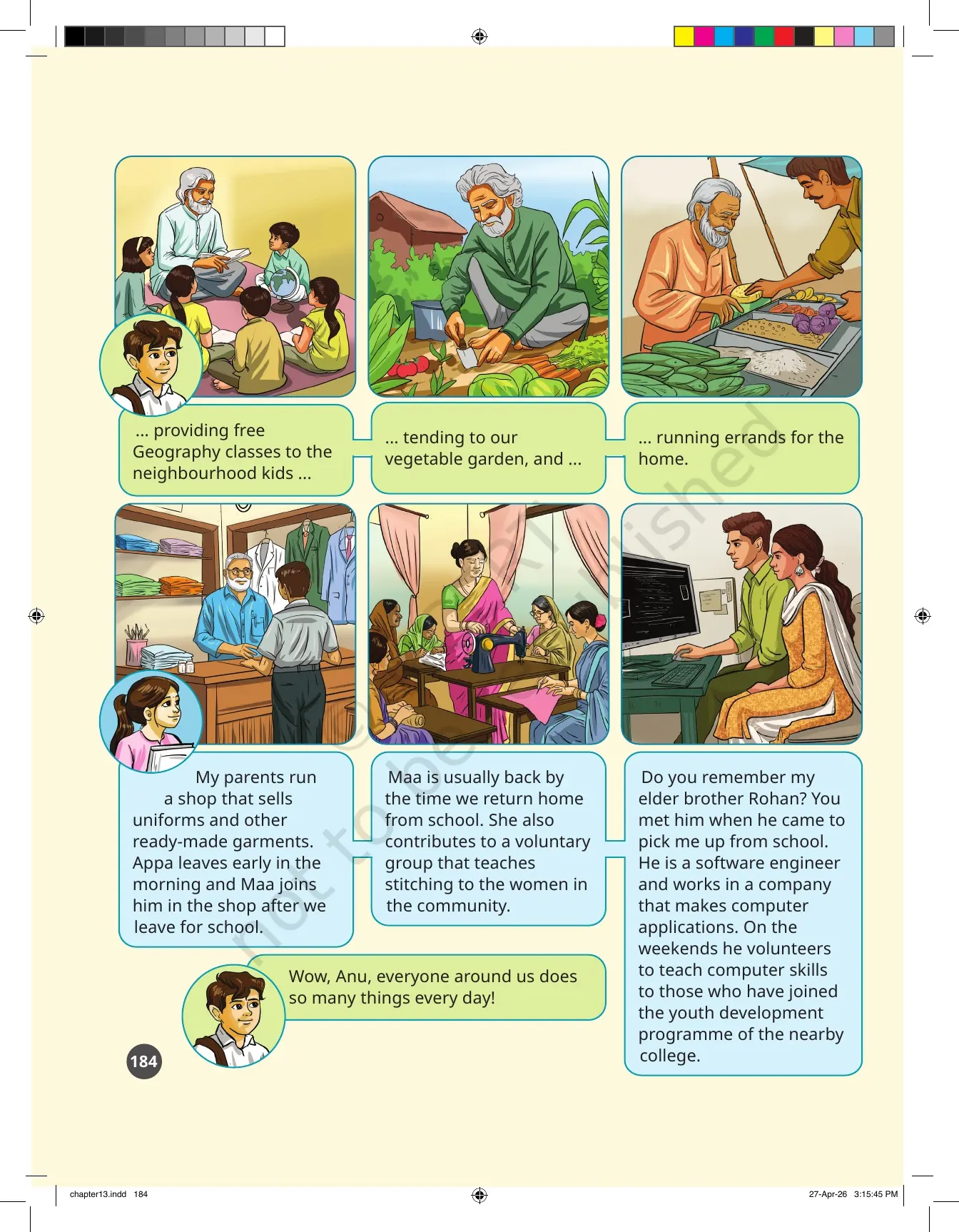
| The illustrated story | 184 | Kabir's grandfather, Anu's parents and their uniform shop, Anu's mother and her stitching group, and Rohan the software engineer |
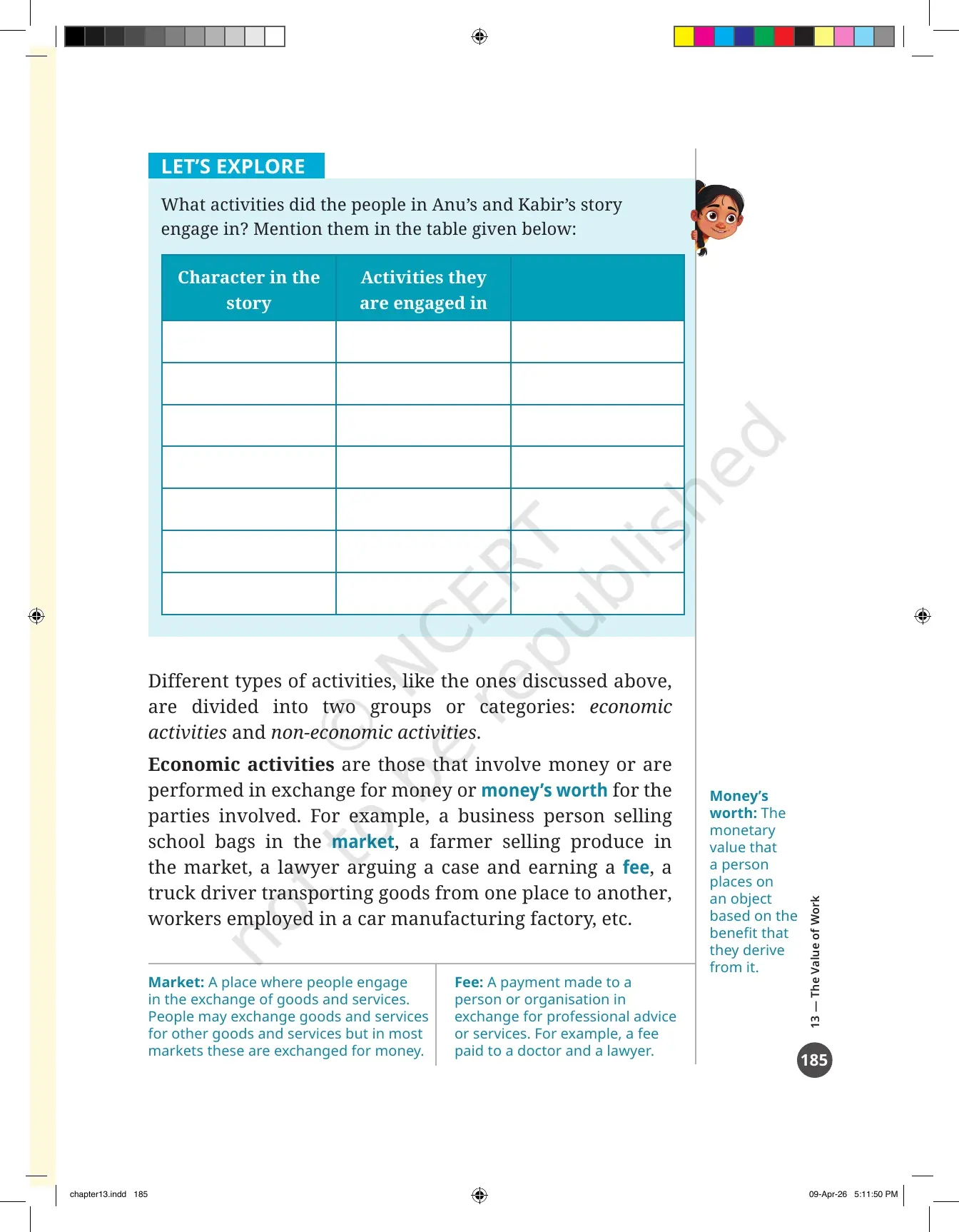
| The two categories | 185 | The first LET'S EXPLORE table, the meaning of economic activities with five examples, and the Money's worth, Market and Fee glossary boxes |
| Non-economic activities | 186 | What non-economic activities are, the four feelings behind them, and the captioned photographs of both kinds of work |
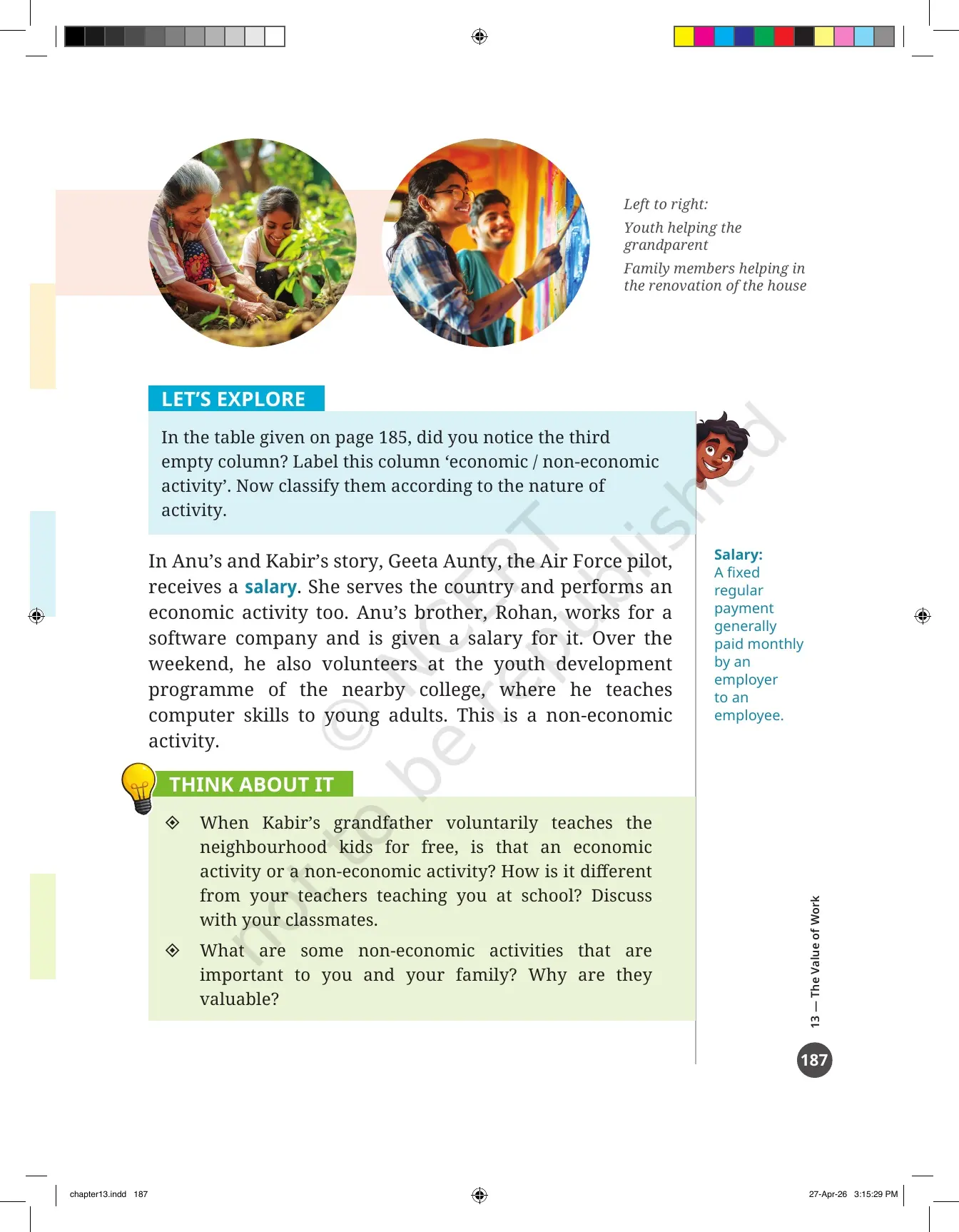
| Salary and the first THINK ABOUT IT | 187 | The second LET'S EXPLORE box, Geeta Aunty and Rohan doing both kinds of activity, the Salary glossary and the first THINK ABOUT IT box |
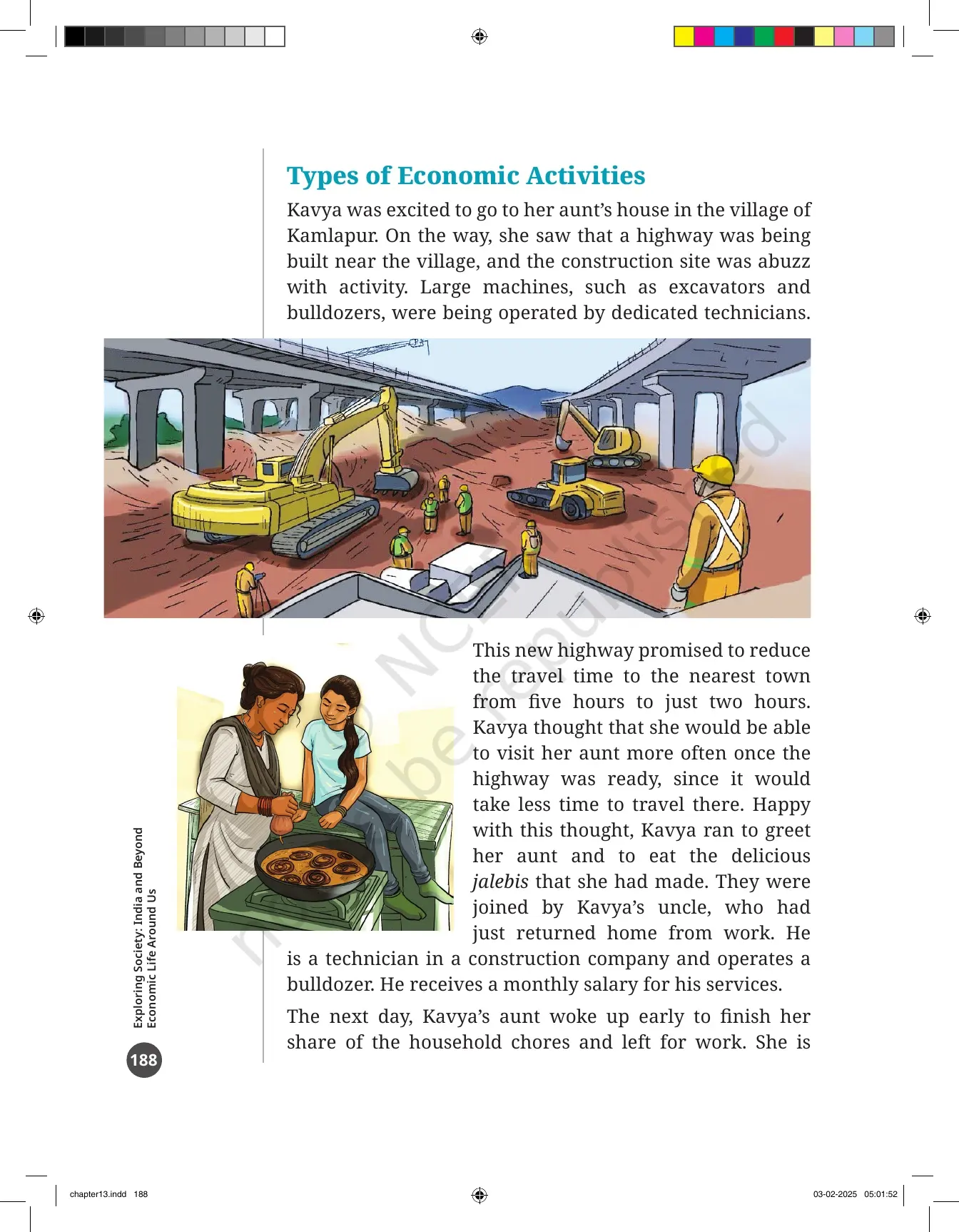
| Types of Economic Activities begins | 188 | Kavya's trip to Kamlapur, the highway under construction, and her uncle the bulldozer technician on a monthly salary |
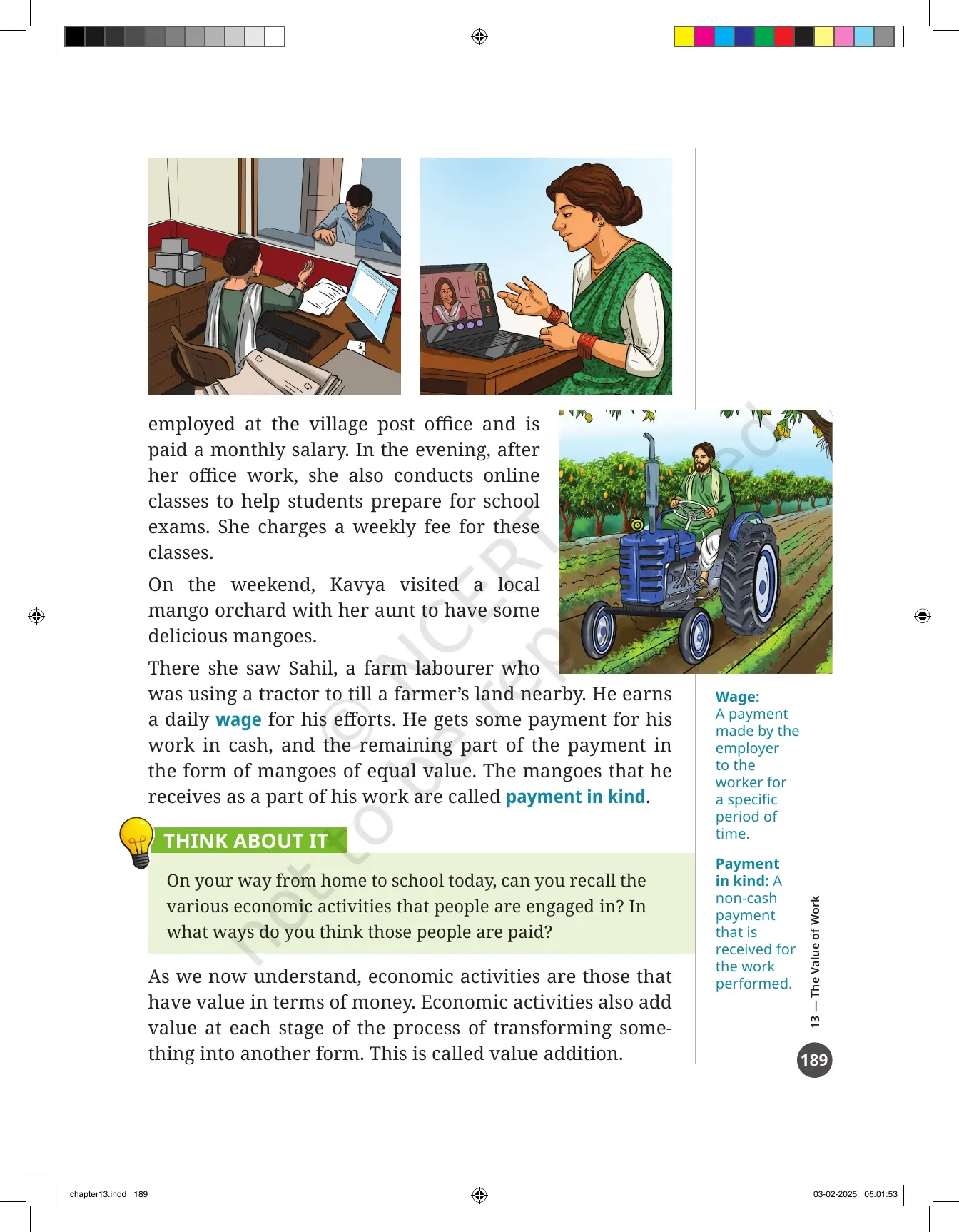
| Wage and payment in kind | 189 | Kavya's aunt at the post office and her evening classes, Sahil the farm labourer, the Wage and Payment in kind glossary and the second THINK ABOUT IT box |
| Value addition | 190 | Rajesh the carpenter, the wood bought for 600 rupees, the chair sold for 1,000 rupees and what the remaining 400 rupees stands for |
| The tick table and sevā | 191 | The third LET'S EXPLORE table with nine rows, the section head on non-economic activities, and sevā with the langar example |
| Community participation | 192 | Photographs of prasād at a temple, the langar at the Golden Temple, Swachh Bharat Abhiyan and Van Mahotsav, plus the community participation box |
| Recap and questions | 193 | The rest of Van Mahotsav, the third THINK ABOUT IT box, the 'Before we move on' recap and all 4 end questions |
| Noodles | 194 | A blank Notes and Doodles page for your own rough work |
Also Check:
The Value of Work Chapter Overview Explained
Source: Magnet Brains on YouTube
The Swami Vivekananda Quotation and the Two Big Questions on Page 183
This chapter opens with a line from Swami Vivekananda, not with a definition. Two Big Questions are printed beside it. Both are answered inside the chapter, so learning them first gives you a map of the whole file.
- What he said: when you are doing any work, do not think of anything beyond. Do it as worship, as the highest worship, and devote your whole life to it for the time being.
- Big Question 1: what are the different types of activities that people engage in? Answered by the economic and non-economic split on printed pages 185 to 187.
- Big Question 2: what is their contribution to our everyday lives? Answered by the value addition pages and the section on non-economic activities.
The quotation is the reason the chapter is called The Value of Work rather than Types of Work. Vivekananda is talking about attitude, not about pay, which is exactly the point the chapter makes when it says unpaid work still creates value.
The Anu and Kabir Story: Every Character and the Work They Do
Printed pages 183 and 184 are an illustrated conversation between two children. It looks like decoration, but the first LET'S EXPLORE box asks you to fill a table from it. Note every character and every activity as you read.
| Character in the story | Activities they are engaged in | Economic or non-economic |
|---|---|---|
| Geeta Aunty | A pilot in the Indian Air Force, returning home in uniform | Economic, she receives a salary |
| Kabir's grandfather | Retired from the Border Security Force. Gives free Geography classes to the neighbourhood kids, tends the vegetable garden and runs errands for the home | Non-economic, no payment is taken |
| Anu's father, Appa | Runs a shop that sells uniforms and ready-made garments, leaving early in the morning | Economic |
| Anu's mother, Maa | Joins the shop after the children leave for school. She also teaches stitching in a voluntary group for women in the community | Both, the shop is economic and the stitching group is non-economic |
| Rohan, Anu's elder brother | A software engineer in a company that makes computer applications. On weekends he teaches computer skills at a college youth development programme | Both, for the same reason |
Three of these people do both kinds of activity in the same week. That is the trick in this table, and it is why the chapter puts the story before the definitions instead of after them.
Economic Activities Explained with the Five Examples the Chapter Gives
This is the definition the rest of the chapter is built on. Learn it in the book's own words, because the phrase money's worth inside it is doing real work and is defined separately in the margin.
Economic activities are those that involve money or are performed in exchange for money or money's worth for the parties involved. The chapter then lists five examples, and every one of them is a safe answer in an exam.
- A business person selling school bags in the market.
- A farmer selling produce in the market.
- A lawyer arguing a case and earning a fee.
- A truck driver transporting goods from one place to another.
- Workers employed in a car manufacturing factory.
Notice that the list mixes selling, serving and being employed. Students who only write about shopkeepers lose the mark for range, so pick one seller, one professional and one employed worker when a question asks for examples.
Non-Economic Activities and the Four Feelings Behind Them
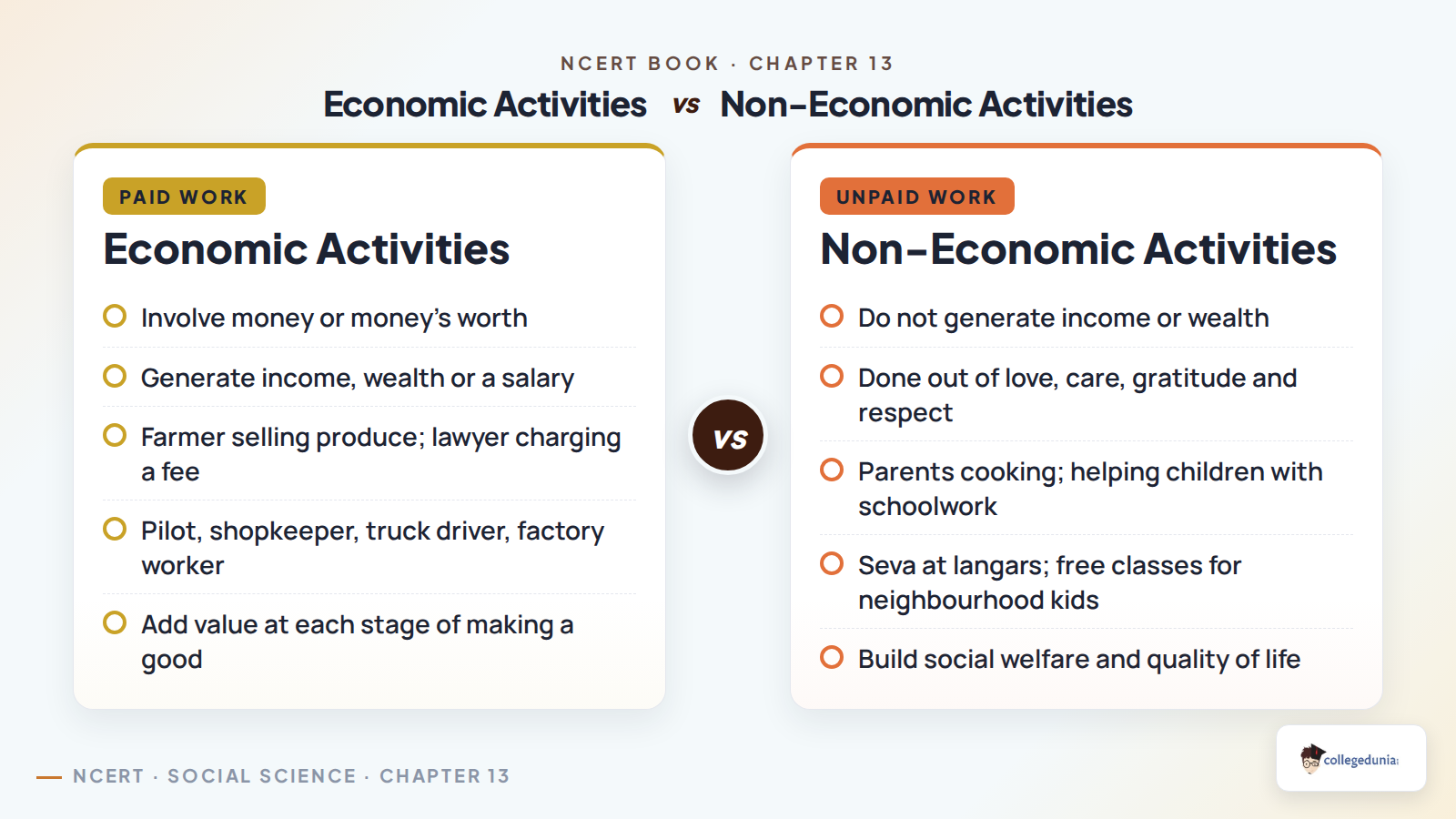
The second category is defined on printed page 186. The definition has two halves, and most students write only the first half. Write both, because the second half is what makes the answer complete.
- First half: non-economic activities do not generate income or wealth.
- Second half: they are done out of feelings like gratitude, love, care and respect.
The examples printed alongside are worth learning as a set, because the captioned photographs on pages 186 and 187 repeat them.
- Parents cooking food for the family.
- Parents helping their children with schoolwork.
- Youth taking care of the grandparents.
- Family members helping in the renovation of the house.
The photographs in this chapter are captioned but not numbered. There is no Fig. 13.1 anywhere in the file, so a question can only ask you to describe a picture, never to name it by number.
Every Money Term in the Value of Work Chapter: Market, Fee, Salary, Wage and Payment in Kind
Six terms are defined in the margins and the small boxes of this chapter. They carry more one-mark questions than any other part of the file. Learn them together, because three of them are ways of getting paid and are easy to swap by mistake.
| Term | Printed page | What the chapter says it means |
|---|---|---|
| Money's worth | 185 | The monetary value that a person places on an object based on the benefit that they derive from it |
| Market | 185 | A place where people engage in the exchange of goods and services. People may exchange goods and services for other goods and services, but in most markets these are exchanged for money |
| Fee | 185 | A payment made to a person or organisation in exchange for professional advice or services, for example a fee paid to a doctor or a lawyer |
| Salary | 187 | A fixed regular payment, generally paid monthly, by an employer to an employee |
| Wage | 189 | A payment made by the employer to the worker for a specific period of time |
| Payment in kind | 189 | A non-cash payment that is received for the work performed |
The safest way to keep salary and wage apart is to attach each one to its person in the chapter. Kavya's uncle and aunt draw a monthly salary. Sahil the farm labourer earns a daily wage. Quote the person and the examiner can see you have read the chapter.
Kavya's Kamlapur Story: The Four Ways of Getting Paid
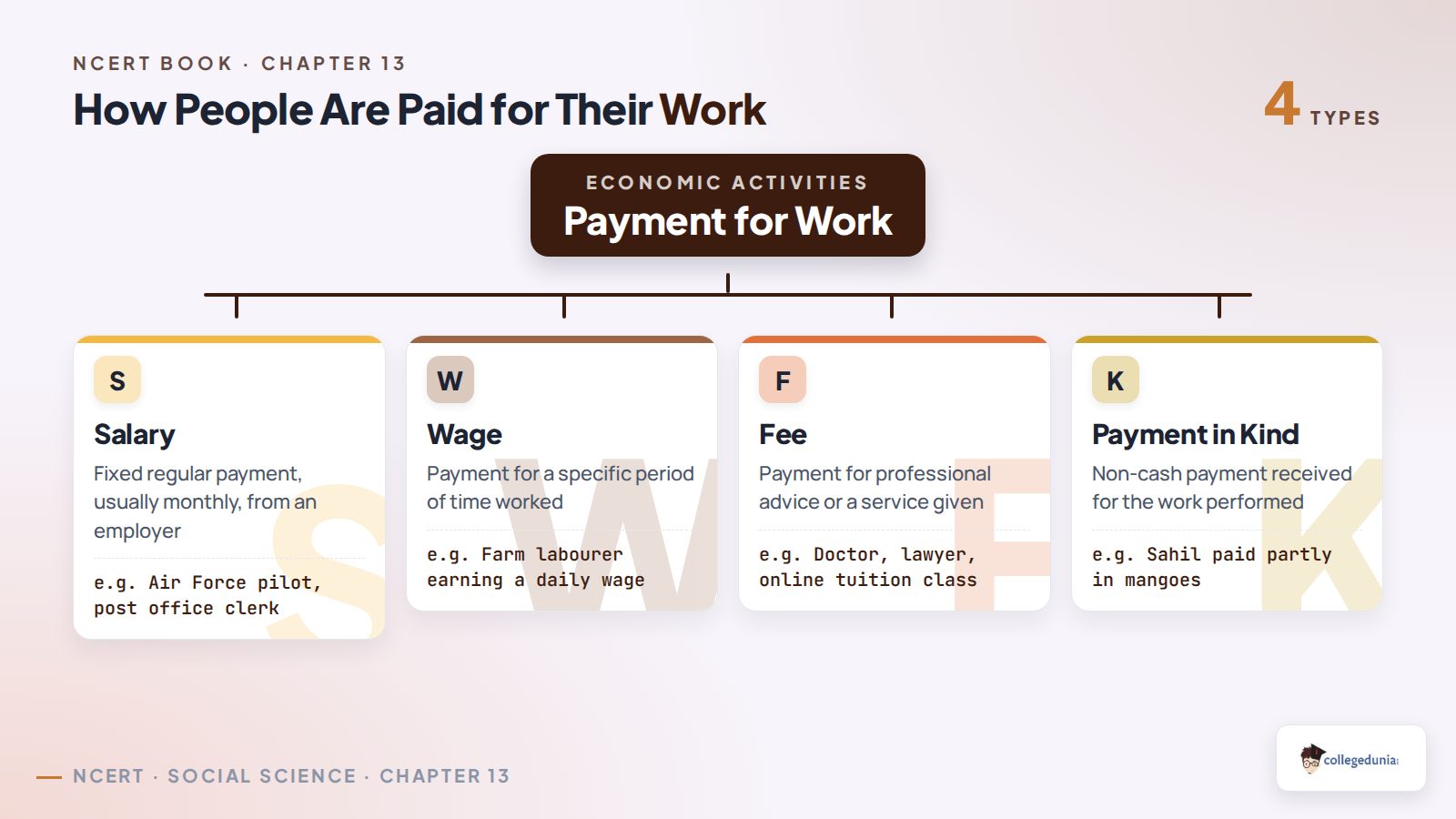
The section head Types of Economic Activities starts on printed page 188 with a second story. Kavya goes to her aunt's house in the village of Kamlapur and meets four working people in two days. Each one is paid differently, and that is the whole purpose of the story.
| Person | Work they do | How they are paid |
|---|---|---|
| Kavya's uncle | A technician in a construction company who operates a bulldozer | Monthly salary |
| Kavya's aunt | Employed at the village post office | Monthly salary |
| Kavya's aunt, in the evening | Conducts online classes to help students prepare for school exams | Weekly fee |
| Sahil | A farm labourer using a tractor to till a farmer's land | Daily wage, partly in cash and partly in mangoes of equal value, which is payment in kind |
Two details from this story turn up in questions often. The highway being built near the village was set to cut the travel time to the nearest town from five hours to just two hours. The machines at the site are named too: excavators and bulldozers, operated by technicians.
Kavya's aunt is the most useful person in the chapter, because one person shows two kinds of payment. She takes a salary from the post office and a fee from her evening classes. End question 4 asks exactly this, so keep her name ready.
Value Addition Explained with Rajesh the Carpenter and the 400 Rupee Gap
Printed page 190 carries the only sum in the chapter, and our student poll found it is the part most students cannot repeat. It is three short steps. Copy them in order and the idea of value addition becomes easy to write in one line.
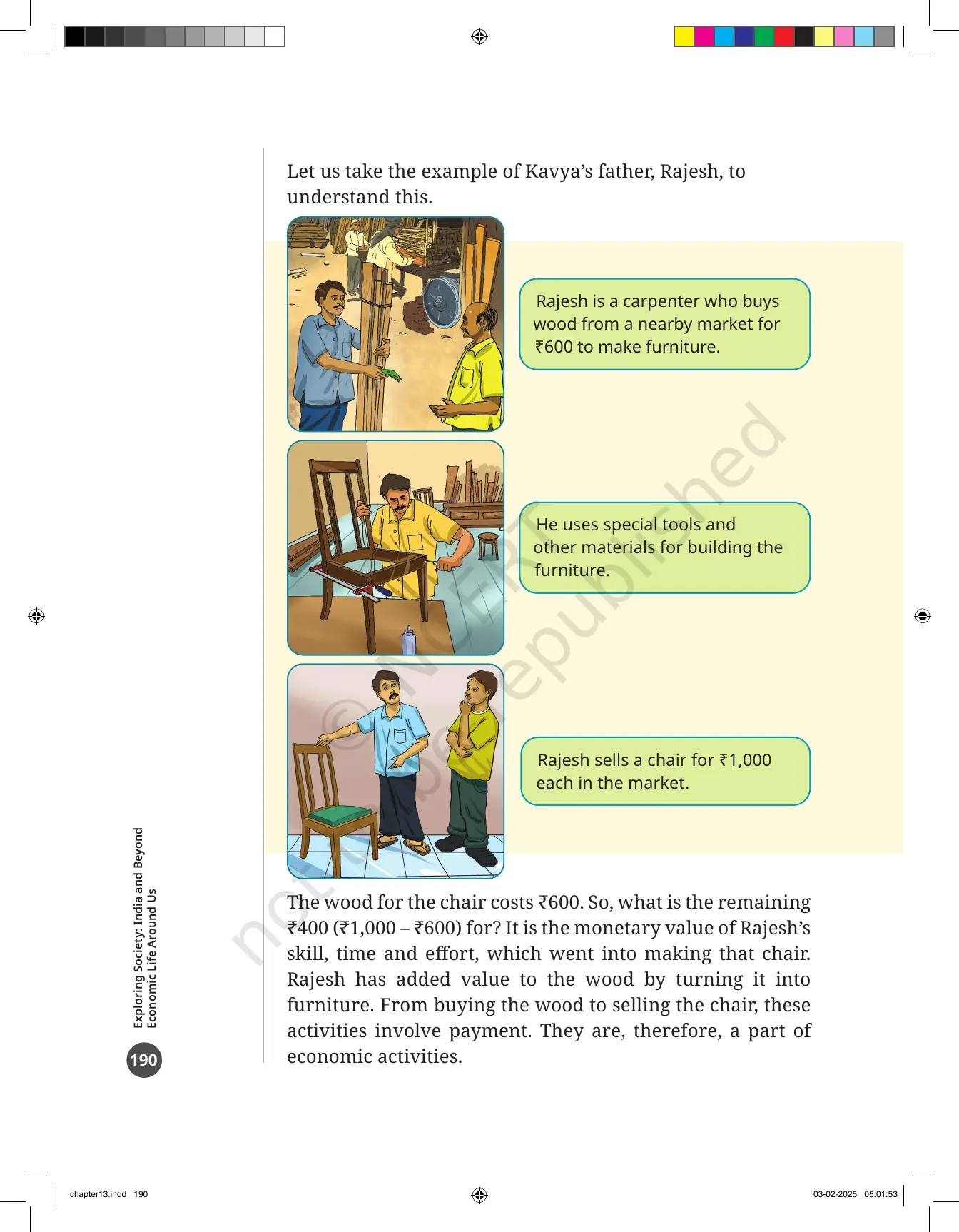
- Rajesh buys wood from a nearby market for 600 rupees to make furniture.
- He uses special tools and other materials for building the furniture.
- He sells a chair for 1,000 rupees each in the market.
The chapter then asks what the remaining 400 rupees is for, and answers it in one sentence. It is the monetary value of Rajesh's skill, time and effort, which went into making that chair. Rajesh has added value to the wood by turning it into furniture.
The book's own definition sits just above the example. Economic activities add value at each stage of the process of transforming something into another form, and this is called value addition. Learn that sentence and then use the chair to prove it.
Sevā, Langar and Why Non-Economic Work Still Has Value
The second section head, The Importance of Non-Economic Activities, begins on printed page 191 with one line you should quote. While non-economic activities may not involve money, the value they generate is important in our lives.
- Sevā: the chapter defines it simply as selfless service.
- Where we see it: in temples, gurudwaras, mosques and churches.
- The named example: langars, or community kitchens, at gurudwaras that serve food to every visitor for free.
- What it does: these practices foster a sense of satisfaction and gratitude for what we have.
- The closing idea: they are a way of contributing to society without expecting anything in return.
Two photographs sit beside this text. One shows a temple distributing prasād to devotees and the other shows the langar at the Golden Temple. Naming the Golden Temple in your answer shows you read the caption and not just the paragraph.
Swachh Bharat Abhiyan and Van Mahotsav: The Community Participation Box
Printed pages 192 and 193 carry a box titled The strength of community participation. It gives two national examples, and both are the kind of thing a five-mark question asks you to describe.
| Example | What the chapter says about it |
|---|---|
| Swachh Bharat Abhiyan | Based on the collective efforts of all Indian citizens to keep our surroundings clean. Individually we keep our homes clean, and people have also come together to clean up streets, roads, parks and other public places. Together these efforts lead to a clean home, neighbourhood, society and nation |
| Van Mahotsav | The festival of forests, celebrated in India to promote awareness about the value of trees and the conservation of forests. The initiative brings community members together for tree plantation drives |
Write the translation when you name the second one. Van Mahotsav means the festival of forests, and the chapter prints that meaning in brackets, so the examiner is looking for it.
The Three LET'S EXPLORE Tables and How to Fill Them
All three activity boxes in this chapter ask you to build a table rather than write a paragraph. They are also linked: the second one adds a column to the first. Do them in order.
- LET'S EXPLORE 1, printed page 185. A two-column table of character in the story against activities they are engaged in, filled from the Anu and Kabir story. Our table above already gives you every row.
- LET'S EXPLORE 2, printed page 187. Go back to the same table and label the third empty column 'economic / non-economic activity', then classify each row by the nature of the activity.
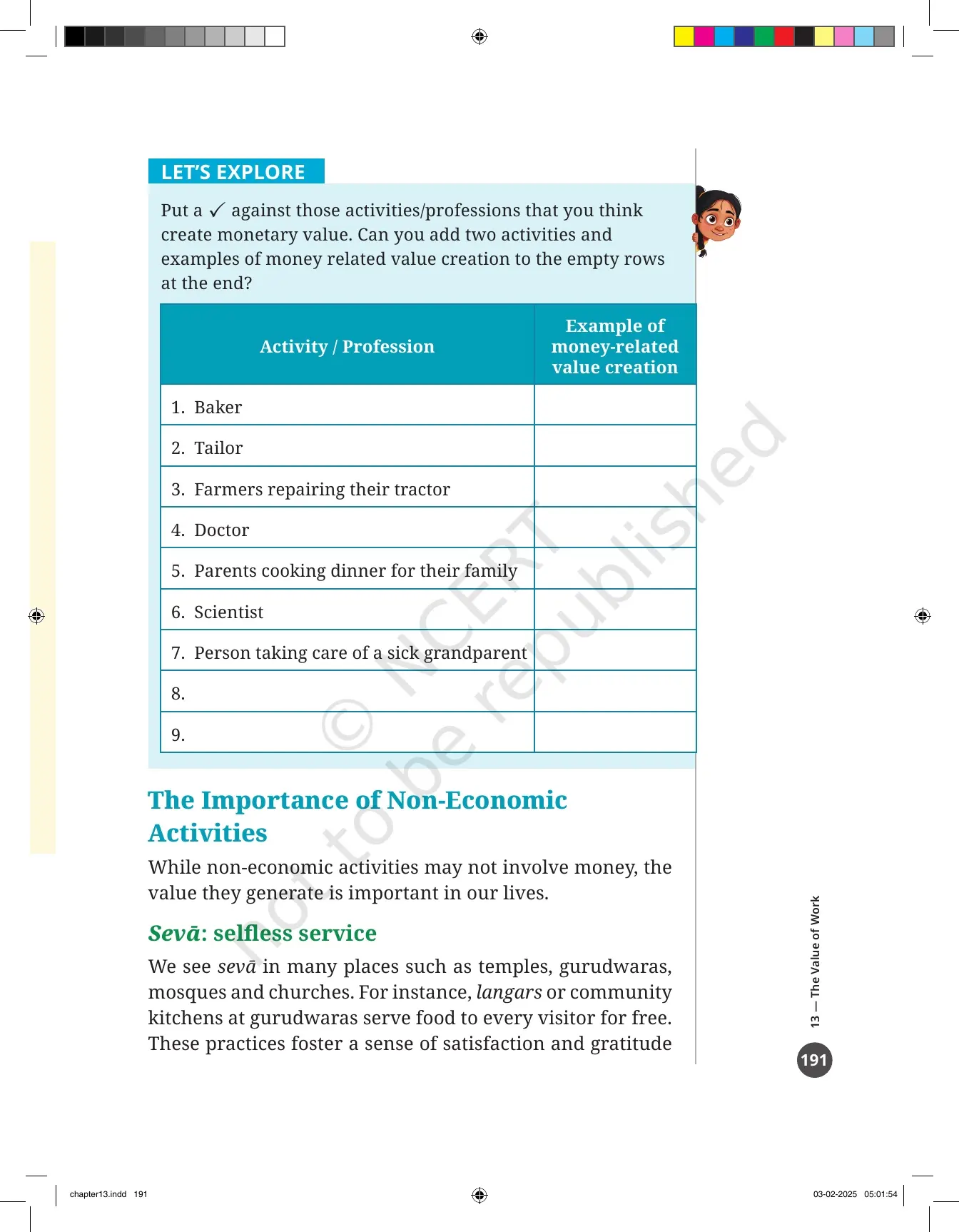
- LET'S EXPLORE 3, printed page 191. Tick the activities and professions that create monetary value, then add two more of your own in the blank rows.
The third box lists seven items with two blank rows after them. Five of the seven create monetary value and two do not, which is the point of the exercise.
| Activity or profession in the box | Creates monetary value? |
|---|---|
| 1. Baker | Yes, bread is baked and sold |
| 2. Tailor | Yes, cloth is stitched for a charge |
| 3. Farmers repairing their tractor | Yes, the repair keeps the farm earning |
| 4. Doctor | Yes, treatment is given for a fee |
| 5. Parents cooking dinner for their family | No, this is non-economic and is done out of love and care |
| 6. Scientist | Yes, research is paid work |
| 7. Person taking care of a sick grandparent | No, this is non-economic and is done out of care and respect |
Every Activity Box and Special Page Inside the Value of Work PDF
This chapter has no numbered figures, so the boxes carry the load instead. Six activity boxes, six glossary terms and three special pages make up the rest. The checklist below is the fastest way to make sure you have not skipped one.
| Box, feature or special page | Printed page | What it shows or asks |
|---|---|---|
| The opening quotation | 183 | Swami Vivekananda on doing work as the highest worship |
| The Big Questions | 183 | Two questions on the types of activities people do and what those activities contribute |
| The Anu and Kabir story | 183 to 184 | An illustrated conversation covering Geeta Aunty, Kabir's grandfather, Anu's parents and Rohan |
| LET'S EXPLORE 1 | 185 | A table of characters in the story against the activities they are engaged in |
| Money's worth, Market and Fee | 185 | Three glossary definitions printed in the margin and in side boxes |
| LET'S EXPLORE 2 | 187 | Adding the economic or non-economic column to the first table |
| Salary glossary | 187 | A fixed regular payment, generally paid monthly, by an employer to an employee |
| THINK ABOUT IT 1 | 187 | Whether the grandfather's free teaching is economic, how it differs from school teaching, and which non-economic activities matter to your family |
| Kavya's Kamlapur story | 188 to 189 | The highway site, the uncle on a salary, the aunt with a salary and a fee, and Sahil on a daily wage |
| Wage and Payment in kind glossary | 189 | Two definitions printed in the margin beside Sahil's paragraph |
| THINK ABOUT IT 2 | 189 | Recalling the economic activities you pass on the way to school and how those people are paid |
| The Rajesh value addition example | 190 | Wood bought for 600 rupees, a chair sold for 1,000 rupees, and the 400 rupee gap explained |
| LET'S EXPLORE 3 | 191 | A tick table of seven activities that may or may not create monetary value, with two blank rows |
| The strength of community participation | 192 to 193 | Swachh Bharat Abhiyan and Van Mahotsav as examples of collective effort |
| THINK ABOUT IT 3 | 193 | Community practices in your area, whether festival preparation is non-economic, and community programmes run by your school |
| Before we move on ... | 193 | A three-point recap of the whole chapter |
| Noodles | 194 | A page for Notes and Doodles, which is what the chapter says the word stands for |
Questions, Activities and Projects at the End of the Value of Work Chapter
Printed page 193 carries 4 numbered items. There is no true or false set and no multiple-choice set in this chapter. All four are written answers, and three of them ask for examples, so keep the two stories handy.
- How are economic activities different from non-economic activities? Give both definitions and then contrast them on payment and on motive: money or money's worth against gratitude, love, care and respect.
- What kind of economic activities do people engage in? Illustrate with examples. Use the five examples from printed page 185, then add the Kamlapur people for range.
- Comment on the value attached to people in community service. Use sevā, the langar, Swachh Bharat Abhiyan and Van Mahotsav, and close with the line about contributing without expecting anything in return.
- What are the various ways in which people are compensated? Name all four: salary, wage, fee and payment in kind. Attach a person to each one from the Kamlapur story.
Before the questions, the 'Before we move on ...' box on printed page 193 gives a three-point recap that works as a ready-made summary answer.
- The chapter taught economic and non-economic activities.
- It taught the value addition that economic activities create.
- Non-economic activities contribute to social welfare and personal wellbeing and enhance the overall quality of life.
Common Mistakes Students Make in the Value of Work Chapter
- Swapping salary and wage. A salary is fixed and generally monthly. A wage is paid for a specific period of time, like Sahil's daily wage.
- Calling unpaid work worthless. The chapter says the opposite: non-economic activities do not generate income, but the value they generate is important.
- Writing that the chair is worth 400 rupees. The chair sells for 1,000 rupees. The 400 rupees is the added value of skill, time and effort.
- Forgetting that one person can do both. Rohan, Anu's mother and Kavya's aunt each do a paid job and an unpaid or separately paid activity.
- Giving only the first half of the non-economic definition. Always add the four feelings: gratitude, love, care and respect.
- Mixing up fee and payment in kind. A fee is money for professional service. Payment in kind is a non-cash payment, like Sahil's mangoes.
- Looking for figure numbers. This chapter has no numbered figures, only captioned photographs, so describe them instead of naming them.
Related Links:
How to Read the Class 6 Value of Work PDF in One Sitting
This is a 12-page chapter with no figures to copy, one small sum and only 4 end items. One focused sitting of about 30 minutes is enough. Keep a rough sheet beside you for the glossary card and the carpenter steps.
- Minutes 0 to 5: read printed pages 183 and 184, then write the Vivekananda quotation, the two Big Questions and the five characters from the story.
- Minutes 5 to 11: read printed pages 185 and 186 and write both definitions in full, with the five economic examples and the four feelings.
- Minutes 11 to 15: read printed page 187 and add the economic or non-economic column to your character table.
- Minutes 15 to 21: read printed pages 188 and 189 and make the four-way payment table: salary, salary, fee, wage with payment in kind.
- Minutes 21 to 25: read printed page 190 and redo the carpenter sum on your own sheet without looking.
- Minutes 25 to 30: read printed pages 191 to 193 and note sevā, the langar, Swachh Bharat Abhiyan, Van Mahotsav and the three recap points.
Come back the next day for the four end items. The question that makes the chapter stick is number 4, on the ways people are compensated, because it forces you to hold all six glossary terms at once. That second pass turns a chapter you have read into a chapter you can answer.
More The Value of Work Class 6 Resources
The book PDF gives you the printed chapter. These pages give you the answers, the revision layer and the last-day recap for the same chapter.
| Resource | What it gives you |
|---|---|
| The Value of Work Class 6 NCERT Solutions | Step-by-step answers to all 4 end items and every activity box, including the filled character table and the ways people are compensated |
| The Value of Work Class 6 Revision Notes | Both definitions, the six glossary terms, the Kamlapur payment table and the carpenter value addition sum in one short read |
| The Value of Work Class 6 Handwritten Notes | A topper's handwritten pages with the economic against non-economic split and the salary, wage, fee and payment in kind terms drawn out in colour-coded boxes |
| The Value of Work Class 6 NCERT Book PDF | This page. The official 2026-27 chapter file, printed pages 183 to 194 of Exploring Society: India and Beyond |
NCERT Book PDF for Class 6 Social Science: All 14 Chapters
Exploring Society: India and Beyond runs to 14 chapters across five themes. Download the ones your school has taught, or take the full set in one go.
| Chapter | Resource |
|---|---|
| Chapter 1 | Locating Places on the Earth NCERT Book PDF |
| Chapter 2 | Oceans and Continents NCERT Book PDF |
| Chapter 3 | Landforms and Life NCERT Book PDF |
| Chapter 4 | Timeline and Sources of History NCERT Book PDF |
| Chapter 5 | India, That Is Bharat NCERT Book PDF |
| Chapter 6 | The Beginnings of Indian Civilisation NCERT Book PDF |
| Chapter 7 | India's Cultural Roots NCERT Book PDF |
| Chapter 8 | Unity in Diversity, or 'Many in the One' NCERT Book PDF |
| Chapter 9 | Family and Community NCERT Book PDF |
| Chapter 10 | Grassroots Democracy Part 1: Governance NCERT Book PDF |
| Chapter 11 | Grassroots Democracy Part 2: Local Government in Rural Areas NCERT Book PDF |
| Chapter 12 | Grassroots Democracy Part 3: Local Government in Urban Areas NCERT Book PDF |
| Chapter 13 | The Value of Work NCERT Book PDF (this page) |
| Chapter 14 | Economic Activities Around Us NCERT Book PDF |
The Value of Work Class 6 Social Science NCERT Book PDF FAQs
Common Questions on the Class 6 Social Science Chapter 13 File
Ques. Where can I download the NCERT Class 6 Social Science Chapter 13 The Value of Work PDF?
Ans. You can download it directly from this page. It is the official NCERT chapter file for the 2026-27 print of Exploring Society: India and Beyond, and it is free.
Ques. How many pages is The Value of Work chapter PDF?
Ans. The file runs to 12 pages. It covers printed pages 183 to 194 of the textbook, from the Swami Vivekananda quotation to the Noodles page at the end.
Ques. What are economic activities?
Ans. Economic activities are those that involve money or are performed in exchange for money or money's worth for the parties involved. The chapter gives five examples: a business person selling school bags, a farmer selling produce, a lawyer arguing a case for a fee, a truck driver transporting goods, and workers employed in a car manufacturing factory.
Ques. What are non-economic activities?
Ans. Non-economic activities are those that do not generate income or wealth but are done out of feelings like gratitude, love, care and respect. The chapter names parents cooking food, parents helping children with schoolwork, youth taking care of grandparents, and family members helping in the renovation of the house.
Ques. What is value addition in Class 6 Social Science Chapter 13?
Ans. Economic activities add value at each stage of the process of transforming something into another form, and this is called value addition. Rajesh the carpenter buys wood for 600 rupees and sells a chair for 1,000 rupees. The remaining 400 rupees is the monetary value of his skill, time and effort.
Ques. What is the difference between a salary and a wage?
Ans. A salary is a fixed regular payment, generally paid monthly, by an employer to an employee. A wage is a payment made by the employer to the worker for a specific period of time. Kavya's uncle and aunt draw a monthly salary. Sahil the farm labourer earns a daily wage.
Ques. What is payment in kind?
Ans. Payment in kind is a non-cash payment that is received for the work performed. In the chapter, Sahil gets part of his daily wage in cash and the remaining part in mangoes of equal value. Those mangoes are his payment in kind.
Ques. What is a fee, and how is it different from a salary?
Ans. A fee is a payment made to a person or organisation in exchange for professional advice or services, for example a fee paid to a doctor or a lawyer. A salary is fixed and comes regularly from an employer. Kavya's aunt shows both: a monthly salary from the post office and a weekly fee from her evening online classes.
Ques. What is a market, according to the chapter?
Ans. A market is a place where people engage in the exchange of goods and services. People may exchange goods and services for other goods and services, but in most markets these are exchanged for money.
Ques. What does money's worth mean?
Ans. Money's worth is the monetary value that a person places on an object based on the benefit that they derive from it. It appears inside the definition of economic activities on printed page 185.
Ques. What is sevā in The Value of Work chapter?
Ans. Sevā is selfless service. The chapter says we see it in temples, gurudwaras, mosques and churches, and gives langars, or community kitchens at gurudwaras, that serve food to every visitor for free as the main example.
Ques. Why are Swachh Bharat Abhiyan and Van Mahotsav mentioned?
Ans. They are the two examples in the box on the strength of community participation. Swachh Bharat Abhiyan is based on the collective efforts of all Indian citizens to keep our surroundings clean. Van Mahotsav, the festival of forests, promotes awareness about the value of trees and brings the community together for tree plantation drives.
Ques. Who is quoted at the start of The Value of Work chapter?
Ans. Swami Vivekananda. He said that when you are doing any work, do not think of anything beyond, but do it as worship, as the highest worship, and devote your whole life to it for the time being.
Ques. Who are Anu and Kabir in the chapter?
Ans. They are the two children in the illustrated story on printed pages 183 and 184. They see Geeta Aunty, an Indian Air Force pilot, and go on to talk about Kabir's grandfather, who retired from the Border Security Force, Anu's parents and their uniform shop, and Anu's elder brother Rohan, a software engineer.
Ques. Who is Kavya and what does her story teach?
Ans. Kavya visits her aunt in the village of Kamlapur on printed pages 188 and 189. Her story shows four ways of being paid: her uncle the bulldozer technician and her aunt at the post office draw a monthly salary, her aunt charges a weekly fee for evening online classes, and Sahil the farm labourer earns a daily wage with part of it as payment in kind.
Ques. Are there any numbered figures in Class 6 Social Science Chapter 13?
Ans. No. This chapter carries captioned photographs and illustrations but no numbered figures, so a question can ask you to describe a picture but never to name it by a figure number.
Ques. How many questions are there at the end of The Value of Work chapter?
Ans. Printed page 193 carries 4 numbered items. There is no true or false set in this chapter. They ask how economic and non-economic activities differ, what kinds of economic activities people do, why community service is valued, and the various ways people are compensated for economic activities.
Ques. Do I need the NCERT Solutions if I already have the book PDF?
Ans. The book PDF carries the questions but not the answers. Use the The Value of Work Class 6 NCERT Solutions to check all 4 end items and every activity box.



Comments