




The NCERT Solutions for Class 12 Geography (India: People and Economy) Chapter 9 Geographical Perspective on Selected Issues and Problems cover all 3 textbook exercise questions in line with the 2026-27 CBSE syllabus, written in plain English across the four themes: environmental pollution, urban waste, slums and land degradation.
- 3 NCERT exercise questions solved with plain prose and bullets, plus an Expert's Solution per question that adds exam strategy and UPSC angles.
- Covers all four issues: water pollution, air pollution and acid rain, urban waste and slums, and land degradation with watershed case studies.
- Aligned to the 2026-27 CBSE Class 12 Geography syllabus and CUET Geography patterns.
Every answer in this Collegedunia compilation is curated by geography subject experts, mapped to the 2026-27 NCERT textbook and refined against the last five years of CBSE board papers.
Student Feedback: What 9,840 students told us about this chapter
68% of Class 12 students rated Chapter 9 the most practical chapter in India: People and Economy. Toppers reported that using the cause-scale-effect-response scaffold and naming one government programme (Namami Gange, PMAY-Urban, IWMP) per answer added 2 to 3 marks.
Source: 2026-27 Class 12 Geography student poll. Sample of 9,840 students from CBSE schools across 14 states.
What the NCERT Solutions for Class 12 Geography Chapter 9 Cover
This chapter asks what environmental and social problems rapid development creates in India, and how the government responds. NCERT splits the answer across four thematic issues:
- Environmental pollution: water, air, land and noise pollution and government responses like the Namami Gange Programme.
- Urban waste disposal: how Indian cities generate and manage solid waste, and why the system breaks down at scale (Ghazipur, Deonar).
- Slums and urban poverty: why slums grow, what residents face, and schemes like PMAY-Urban and Swachh Bharat Mission.
- Land degradation: soil erosion, salinisation, waterlogging, mining wastelands and watershed management, with the Jhabua (Madhya Pradesh) case study.
Source: Next Toppers - 12th Humanities on YouTube
Exercise-wise Breakdown: Chapter 9 NCERT Solutions
Chapter 9 carries 3 exercise questions mixing MCQs, 30-word short answers and 150-word long answers. The table maps each to its topic, answer style and typical marks.
| Question | Topic covered | Answer style | Typical marks |
|---|---|---|---|
| Q1 | MCQs on highly polluted river, water-borne disease, cause of acid rain, push-pull factors | 4 MCQs, one answer each with short reasoning | 4 marks |
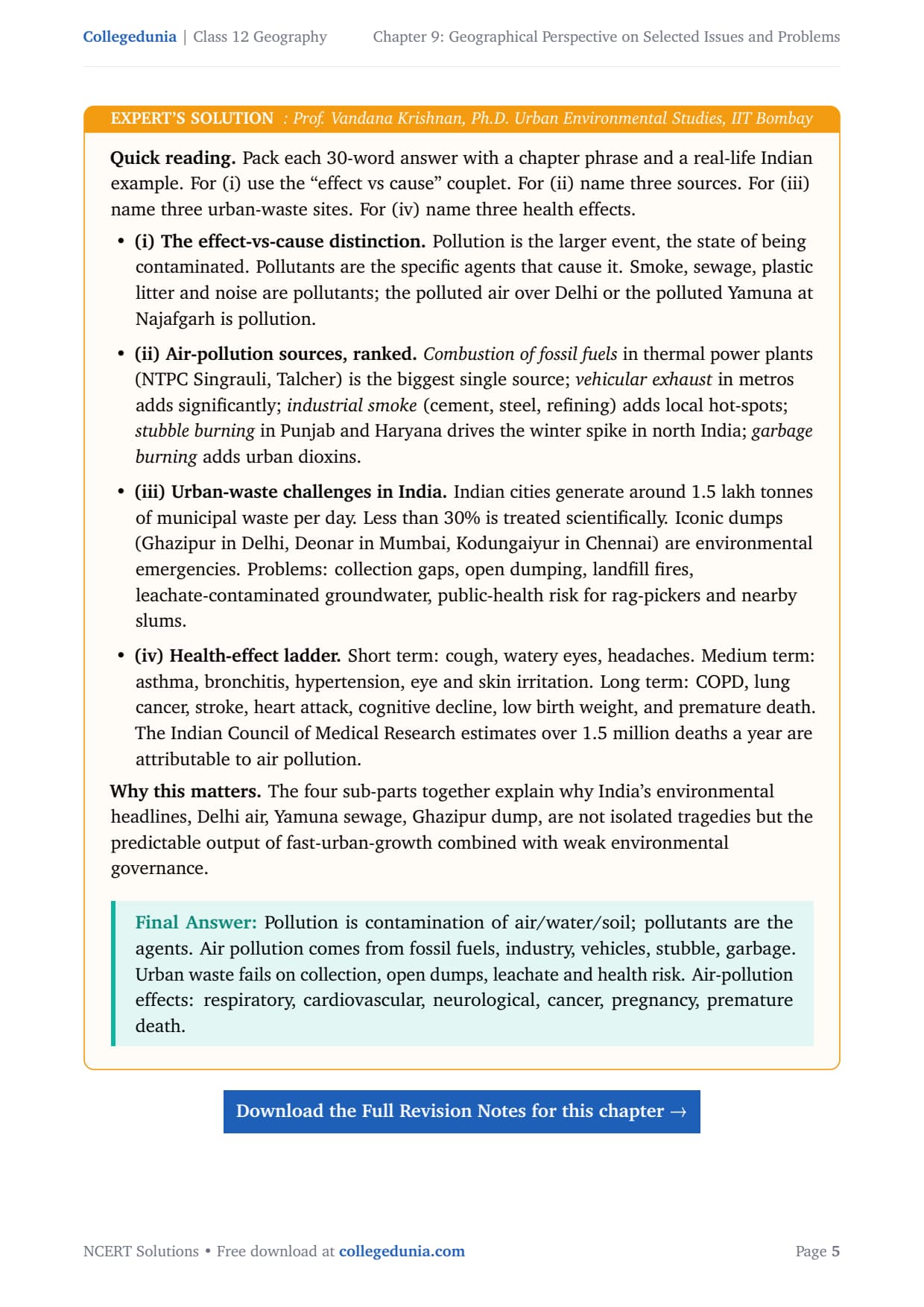
| Q2 | 30-word short answers: pollution vs pollutants, major air-pollution sources, urban waste problems, air-pollution health effects | Plain prose, one or two sentences per sub-part | 8 marks |
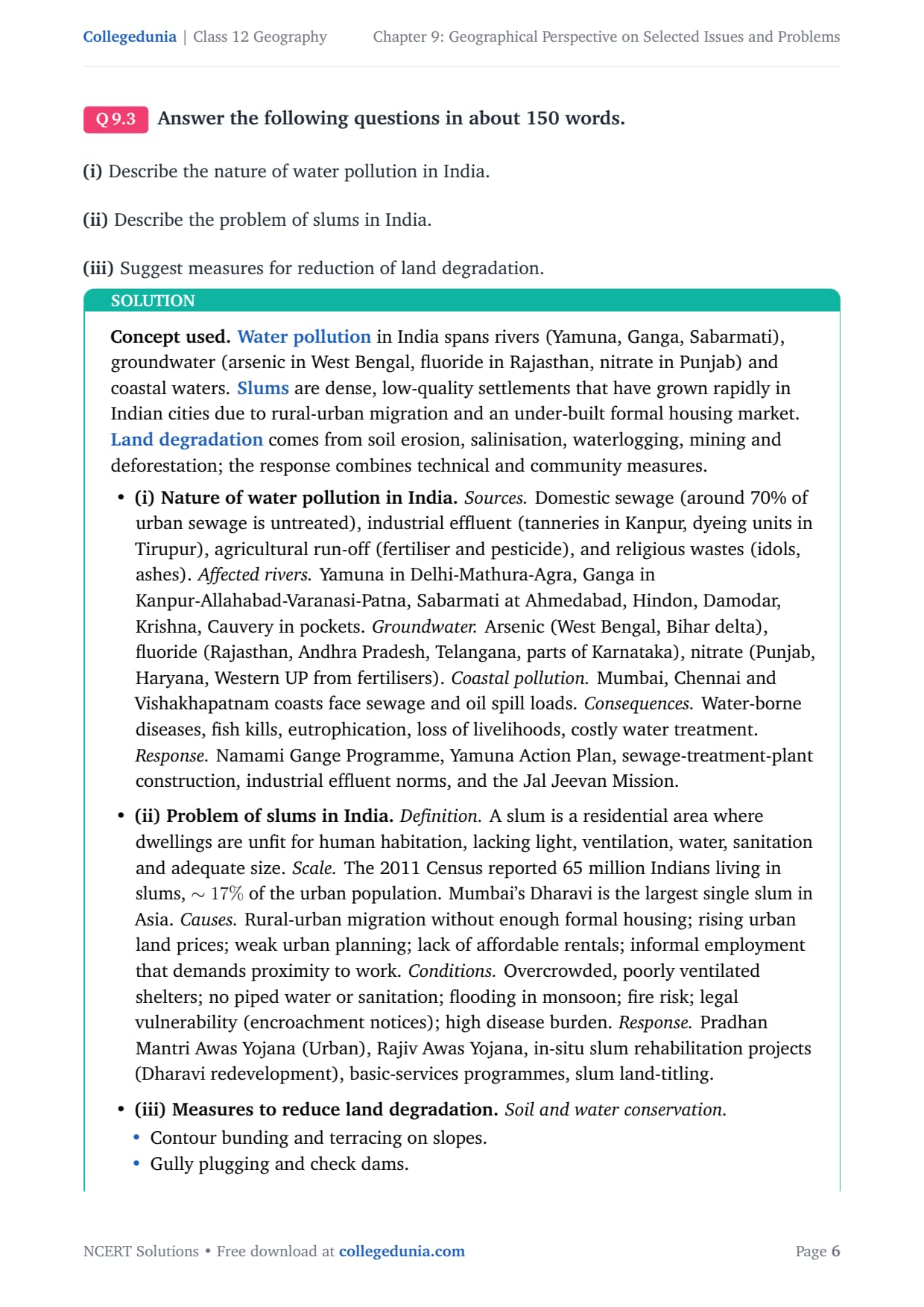
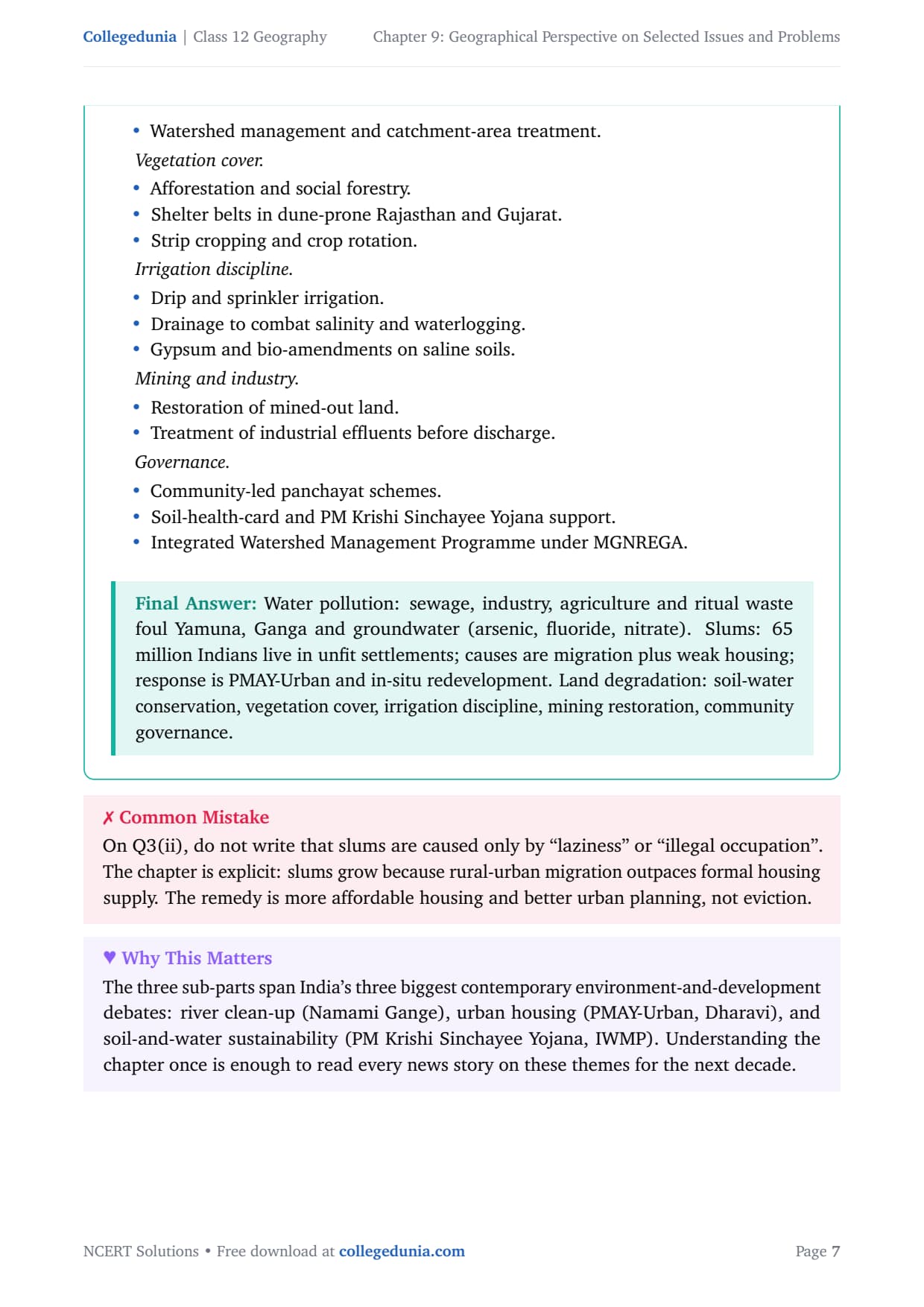
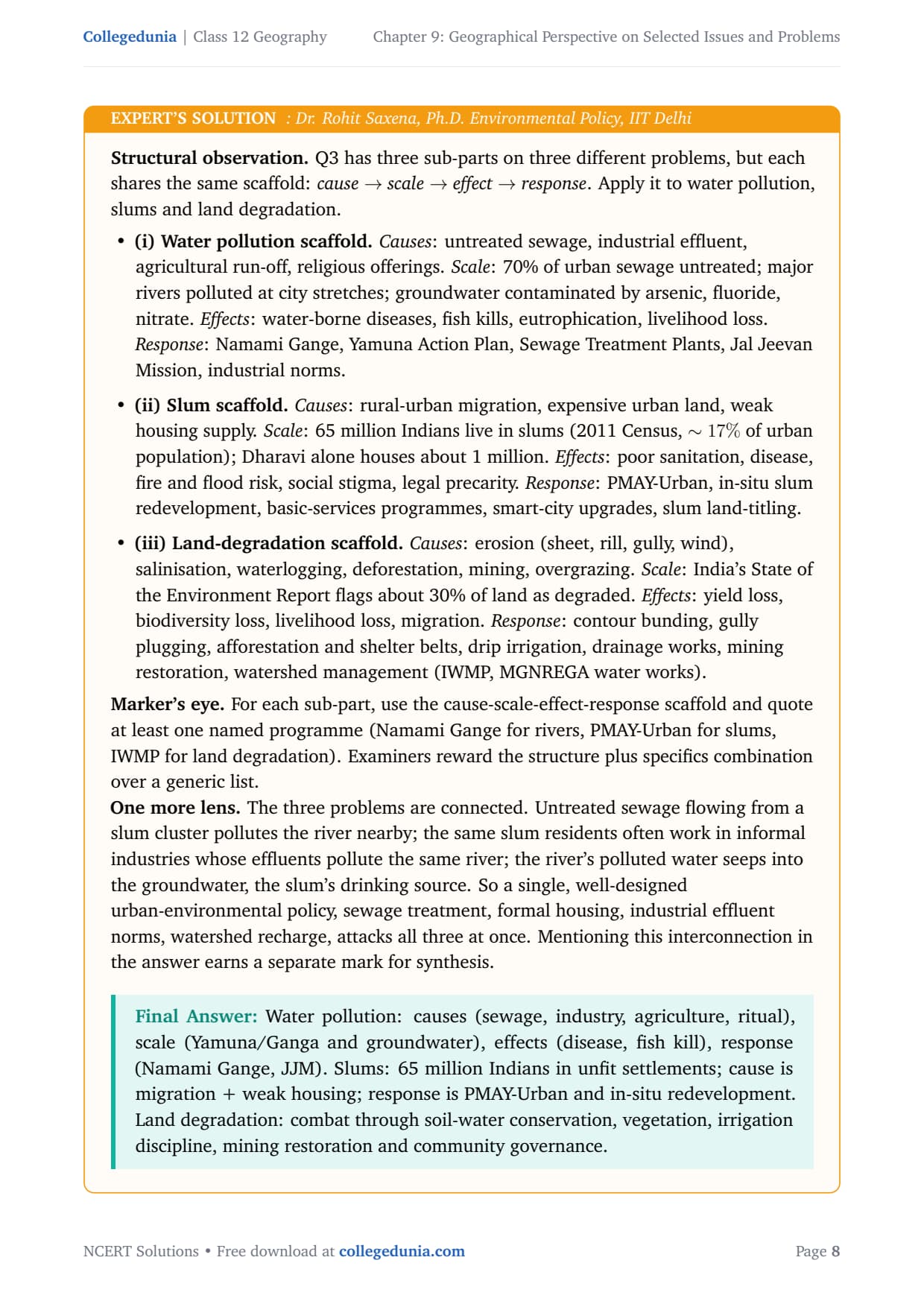
| Q3 | 150-word essays: nature of water pollution in India; the problem of slums; measures to reduce land degradation | Cause-scale-effect-response scaffold per sub-part | 15 marks |
Q3 carries the bulk of the marks: use the cause-scale-effect-response scaffold and name one programme per sub-part. Q2 needs the precise pollution-versus-pollutants distinction and three named air-pollution sources.
Environmental Pollution in India: Water, Air, Land and Noise
Environmental pollution is the release of harmful substances and energy from human activities into the environment. NCERT classifies it into four types by the medium pollutants travel through: water, air, land and noise.
Water Pollution in India
Water becomes polluted when suspended particles, dissolved solids and organic matter cross a threshold and its self-purifying capacity breaks down. Main sources: industrial effluent (tanneries, paper, textiles, chemicals discharging heavy metals and oxygen-depleting waste); domestic sewage (about 70% of urban sewage reaches rivers untreated, from Kanpur, Prayagraj, Varanasi, Patna and Delhi into the Ganga and Yamuna); agricultural run-off (fertiliser nitrates and pesticide residues); and cultural activities (religious fairs, idol immersion). The Yamuna at Delhi is one of India's most polluted stretches. The government response is the Namami Gange Programme and National Mission for Clean Ganga.
Air, Land and Noise Pollution
Air pollution is the addition of dust, fumes, smoke or gas to the atmosphere in harmful quantities. Combustion of fossil fuels in power plants and vehicles is the largest source, with industrial emissions, stubble burning in Punjab and Haryana and open garbage burning adding seasonal loads. Acid rain forms when sulphur dioxide (SO2) and nitrogen oxides (NOx) from burning coal and diesel dissolve in rainwater. Land pollution comes from industrial waste, pesticides and mining; noise pollution is any sound above the tolerance level (aircraft, automobiles, industry). NCERT Table 9.1 summarises all four types with their pollutants and sources.
Urban Waste, Slums and the Geography of Poverty
India's cities generate huge quantities of solid waste daily, but collection and scientific treatment remain seriously inadequate. Most waste ends up in open landfills grown into mountains (Ghazipur, Deonar, Kodungaiyur), where fires release toxic smoke and leachate contaminates groundwater.
The Problem of Slums in India
Slums are residential areas where dwellings are unfit for human habitation, lacking light, ventilation, water, sanitation and space. The 2011 Census counted 65 million Indians in slums, about 17% of the urban population; Mumbai's Dharavi is Asia's largest. NCERT traces slums to push and pull factors of migration: people pushed out by drought and landlessness are pulled to cities for work but cannot afford formal housing. Conditions include overcrowding, no sanitation, flooding and fire risk, causing high disease burden and school dropout. Government response: PMAY-Urban, Rajiv Awas Yojana, Swachh Bharat Mission-Urban and in-situ rehabilitation.
Push and pull factors together explain rural-to-urban migration, and migration explains slum growth. This is the chapter's clearest cause-effect chain and the most tested MCQ, Q1(iv).
Land Degradation and Watershed Management
Land degradation is a decline in the productive capacity of land through natural processes (wind and water erosion, landslides) and human activities (overgrazing, deforestation, waterlogging, salinisation, mining); the textbook notes man-made wastelands exceed naturally-caused ones. Measures include contour bunding, gully plugging and check dams, afforestation and shelter belts, drip irrigation, gypsum treatment of saline soils, and community governance through the Integrated Watershed Management Programme.
The Jhabua District Case Study
Jhabua in western Madhya Pradesh is a tribal-dominated (Bhil) district with severe land and forest degradation. NCERT uses it to show how watershed management reverses degradation through community participation: the Rajiv Gandhi Mission for Watershed Management treated 20% of Jhabua's area in five years, and in Petlawad block Bhil communities planted trees, set up social-fencing and stopped open grazing without enforcement. Name the district, programme and three community actions for full marks.
Common Mistakes Students Make in Chapter 9 Answers
The five repeat-offender mistakes in Chapter 9 answers:
- Confusing pollution and pollutants: pollution is the state of contamination; pollutants are the substances causing it. Write "pollution is the effect, pollutants are the cause".
- Attributing acid rain to water or land pollution: it is caused by air pollution (SO2 and NOx). This is what MCQ Q1(iii) tests.
- Mixing up push and pull factors: push factors drive people out of the village; pull factors attract them to the city. Push-pull explains migration, not slums directly.
- Generic 150-word answers without named programmes: name one programme per sub-part (Namami Gange, PMAY-Urban, IWMP) or lose 1-2 marks each.
- Forgetting Jhabua case study details: name the district, Bhil community, Petlawad block, Rajiv Gandhi Mission and social-fencing.
Previous Year Question Trends from Chapter 9
Chapter 9 questions are predictable: the CBSE pattern over the last five years has been stable, as the table shows.
| Year | Question type asked | Marks |
|---|---|---|
| 2025 | Describe the nature of water pollution in India with two named rivers + mention any two government programmes | 5 |
| 2024 | Distinguish between pollution and pollutants (30 words) + MCQ on water-borne disease | 2 + 1 |
| 2023 | Describe the problem of slums in India and suggest any two government measures | 5 |
| 2022 | Suggest measures for reduction of land degradation (150 words) + MCQ on acid rain cause | 5 + 1 |
| 2021 | What are push and pull factors of migration? + Explain urban waste disposal problems (30 words) | 2 + 2 |
Also Check: The full Chapter 9 questions and answers set ships with the downloadable PDF above, updated for 2026-27.
Other Resources for Class 12 Geography Chapter 9
Pair this NCERT Solutions PDF with the matching notes, handwritten notes and NCERT book chapter below.
| Resource | What it covers | Open |
|---|---|---|
| NCERT Solutions | Step-by-step answers to all 3 exercise questions, with Expert's Solution alternatives. | You are here |
| Notes | Concept-first revision notes covering pollution types, slums, land degradation and the Jhabua case study. | Class 12 Geography Chapter 9 Notes |
| Handwritten Notes | Topper's handwritten revision pages for last-minute board exam practice. | Class 12 Geography Chapter 9 Handwritten Notes |
| NCERT Book PDF | Official NCERT India: People and Economy Chapter 9 textbook in PDF form. | Class 12 Geography Chapter 9 NCERT Book PDF |
| Subject Hub | All chapters of Class 12 Geography with every resource in one place. | Class 12 Geography Subject Hub |
India: People and Economy - All Chapters NCERT Solutions
Related Links: Navigate to the NCERT Solutions for the other chapters of Class 12 India: People and Economy below.
| Chapter | Topic | NCERT Solutions link |
|---|---|---|
| Chapter 1 | Population Distribution, Density, Growth and Composition | NCERT Solutions for Class 12 Geography Chapter 1 Population |
| Chapter 2 | Human Settlements | NCERT Solutions for Class 12 Geography Chapter 2 Human Settlements |
| Chapter 3 | Land Resources and Agriculture | NCERT Solutions for Class 12 Geography Chapter 3 Land Resources and Agriculture |
| Chapter 4 | Water Resources | NCERT Solutions for Class 12 Geography Chapter 4 Water Resources |
| Chapter 5 | Mineral and Energy Resources | NCERT Solutions for Class 12 Geography Chapter 5 Mineral and Energy Resources |
| Chapter 6 | Planning and Sustainable Development | NCERT Solutions for Class 12 Geography Chapter 6 Planning and Sustainable Development |
| Chapter 7 | Transport and Communication | NCERT Solutions for Class 12 Geography Chapter 7 Transport and Communication |
| Chapter 8 | International Trade | NCERT Solutions for Class 12 Geography Chapter 8 International Trade |
| Chapter 9 | Geographical Perspective on Selected Issues and Problems | You are here |
All NCERT Solutions for Class 12 Geography Chapter 9 with Step-by-Step Answers
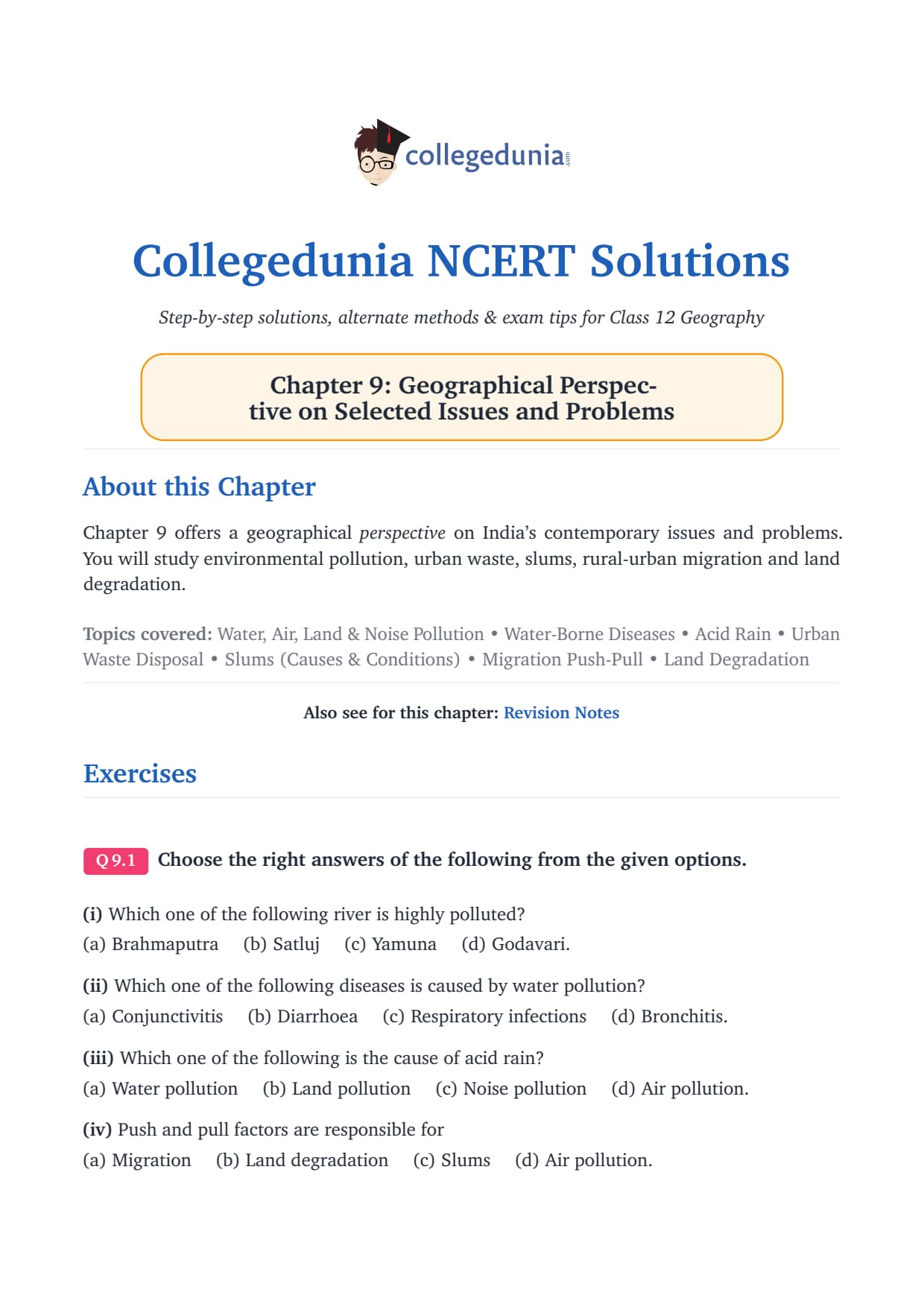
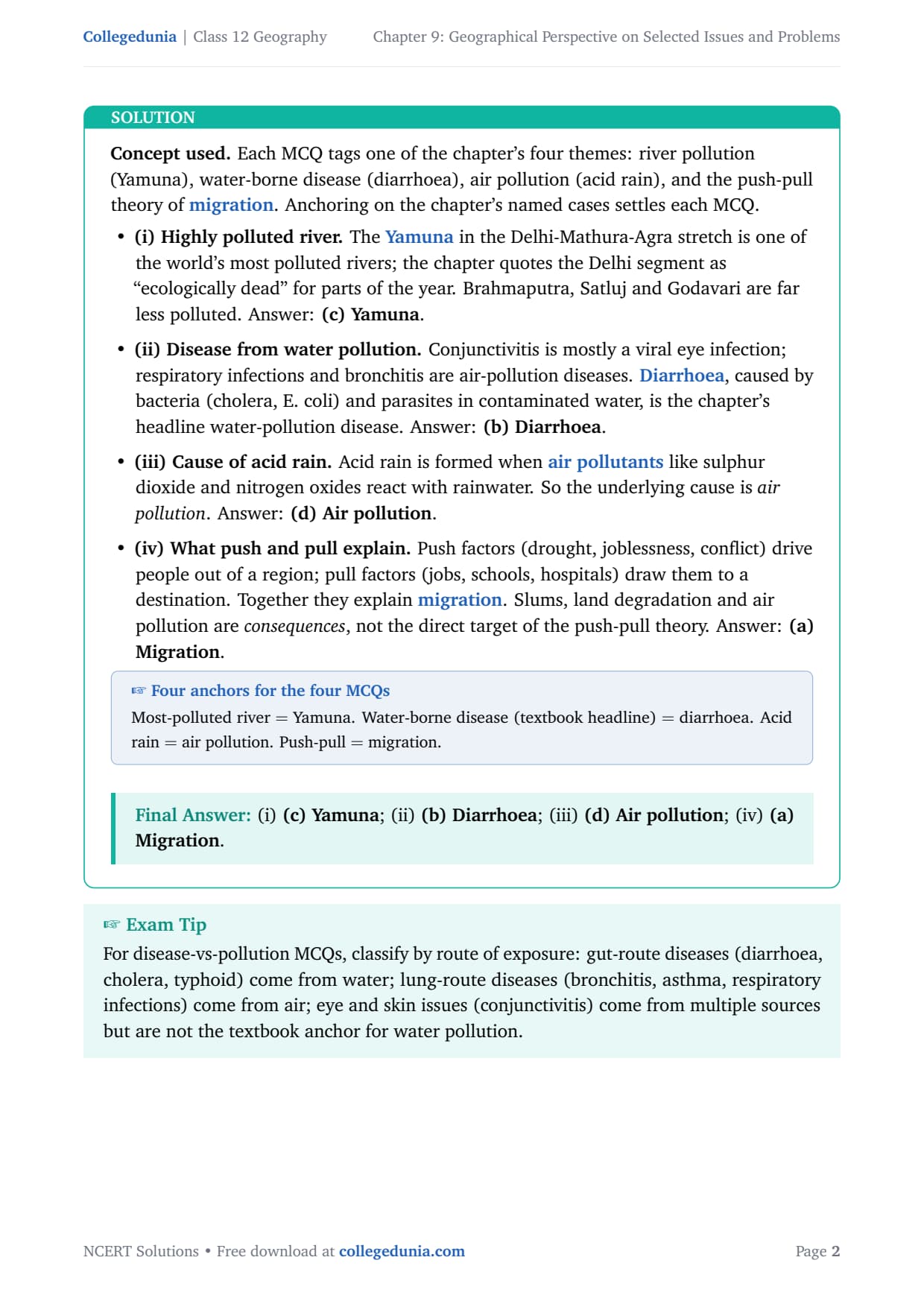
Choose the right answers of the following from the given options.
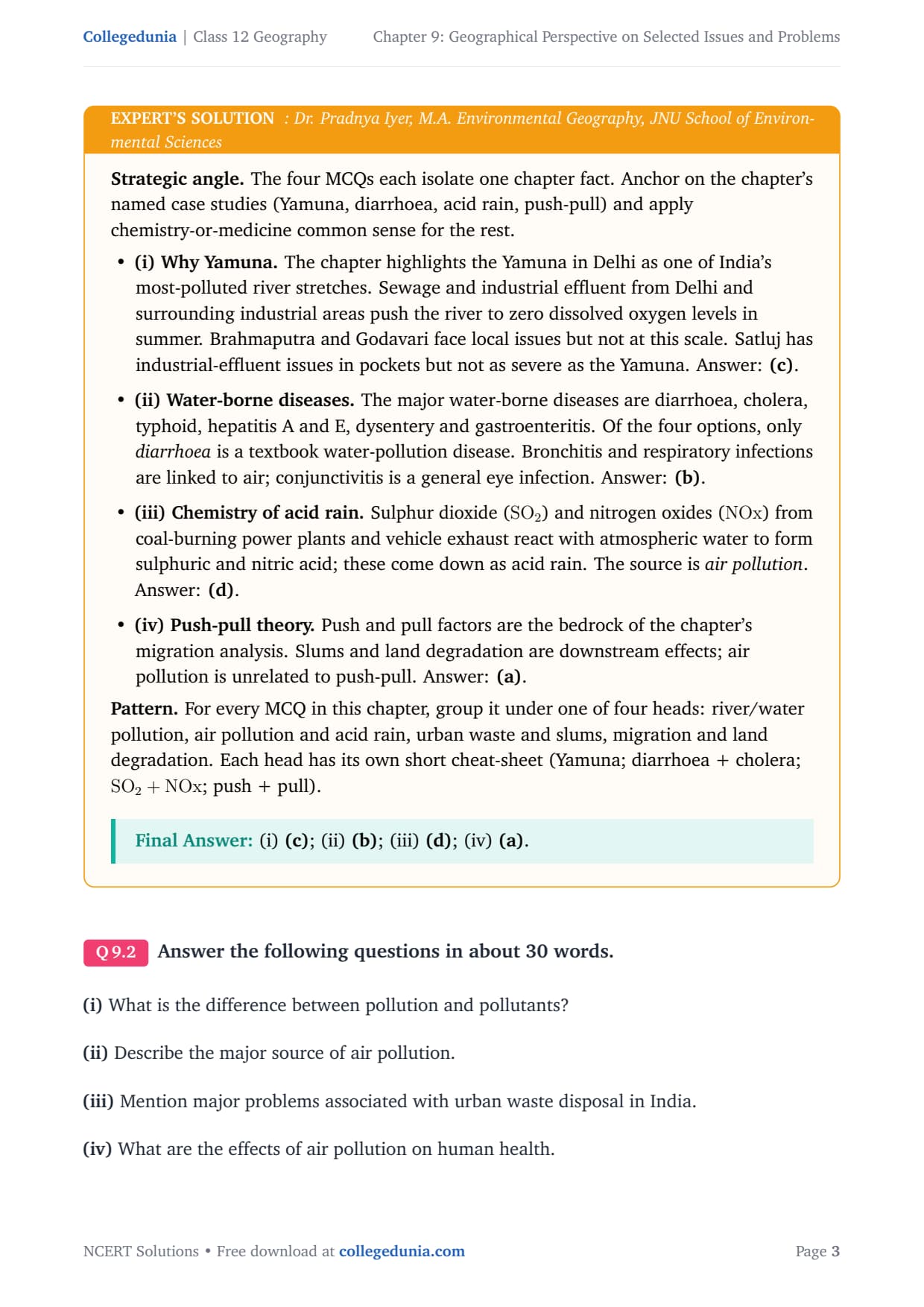
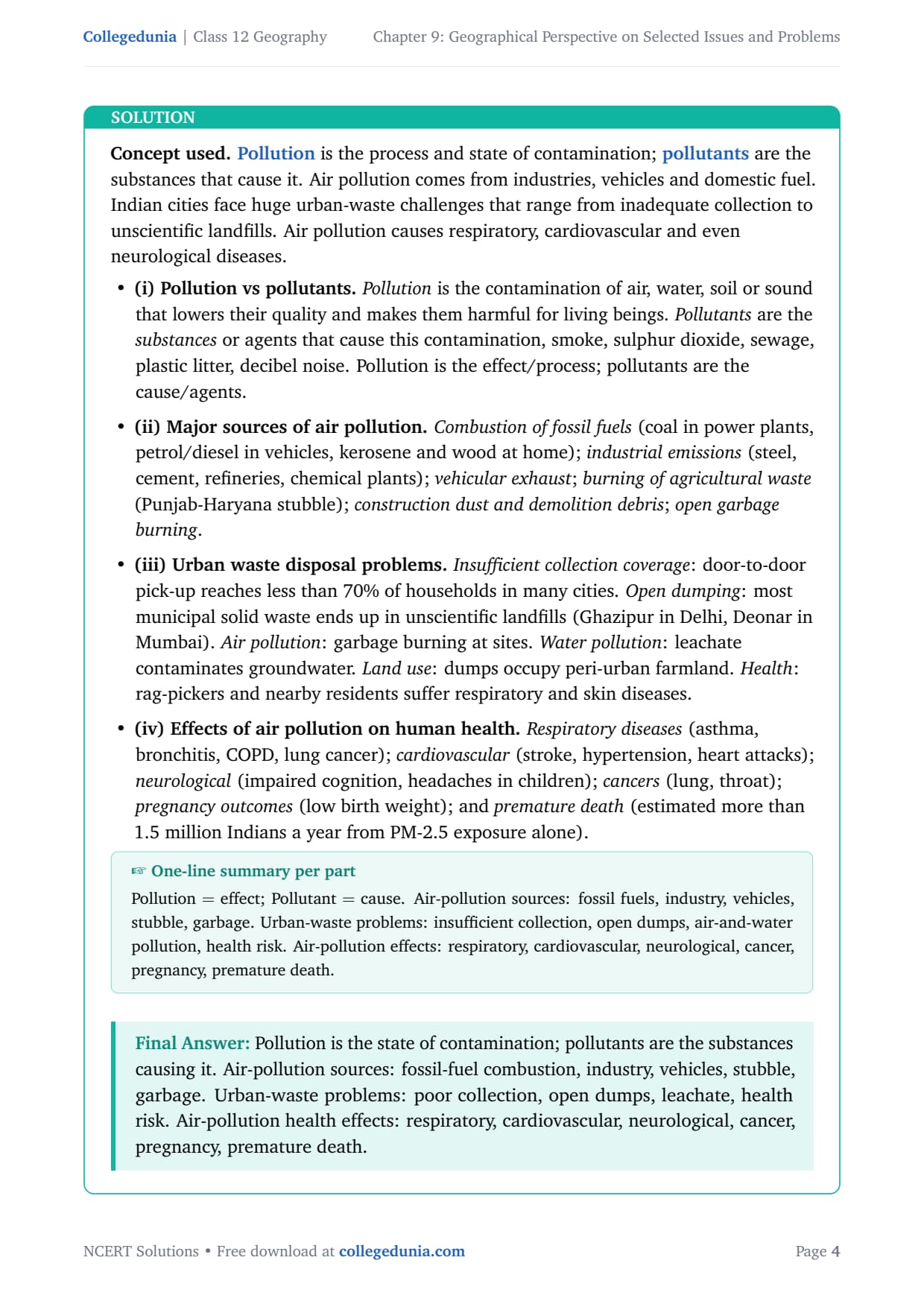
Answer the following questions in about 30 words.
Answer the following questions in about 150 words.
NCERT Solutions Class 12 Geography Chapter 9 Geographical Perspective on Selected Issues and Problems FAQs
Ques. How many questions are there in NCERT Class 12 Geography Chapter 9 Geographical Perspective on Selected Issues and Problems?
Ans. There are 3 end-of-chapter exercise questions in NCERT Class 12 Geography Chapter 9. Question 1 has 4 MCQ sub-parts, Question 2 has 4 short-answer sub-parts of about 30 words each, and Question 3 has 3 long-answer sub-parts of about 150 words each. All 3 questions are solved in full in our geographical perspective on selected issues and problems class 12 ncert solutions PDF, with Expert's Solutions that add exam strategy and UPSC links.
Ques. Which is the most highly polluted river in India according to NCERT Class 12 Geography?
Ans. The NCERT Class 12 Geography textbook identifies the Yamuna river, particularly in the Delhi-Mathura-Agra stretch, as one of India's most highly polluted rivers. Industrial effluent, domestic sewage and agricultural run-off push the dissolved oxygen levels in the Yamuna to near-zero in summer months in Delhi, making it ecologically dead for parts of the year. This is directly tested as MCQ Q1(i) in the chapter exercise and the answer is (c) Yamuna.
Ques. What is the difference between pollution and pollutants in Class 12 Geography?
Ans. Pollution is the contamination of air, water, soil or the sound environment that lowers quality and harms living beings - it is the state or process. Pollutants are the specific substances or agents that cause this contamination, such as smoke, sulphur dioxide, sewage, plastic waste, heavy metals and excessive noise - they are the cause or agents. In one line: pollution is the effect, pollutants are the cause. This distinction is the most-asked 30-word definition from Chapter 9 in CBSE Class 12 Geography board papers.
Ques. Why is acid rain caused by air pollution and not water pollution?
Ans. Acid rain forms when sulphur dioxide (SO2) and nitrogen oxides (NOx) - released by the combustion of coal, diesel and petrol in power plants and vehicles - react with water vapour in the atmosphere to form sulphuric acid and nitric acid. These acids then come down as rain, hence the name acid rain. The source of the problem is air pollution, specifically the air pollutants SO2 and NOx. Water pollution refers to contamination of water bodies, not the atmospheric process that creates acid rain. This is what MCQ Q1(iii) in Chapter 9 tests.
Ques. What are push and pull factors of rural-to-urban migration in Class 12 Geography?
Ans. Push factors are conditions in rural areas that force people to leave: drought, poverty, landlessness, unemployment, lack of education and healthcare facilities, and social discrimination. Pull factors are attractions in cities that draw people towards them: better employment opportunities, higher wages, schools, hospitals, and a perceived higher quality of life. Push and pull factors together explain rural-to-urban migration in India, which in turn explains the growth of slums in cities when formal housing cannot keep up with the influx of migrants.
Ques. What is the Namami Gange Programme and how does it help reduce water pollution?
Ans. The Namami Gange Programme is a flagship initiative launched by the Government of India to clean and conserve the Ganga river. It combines construction of sewage treatment plants, effluent treatment plants for industries, river-front development, afforestation along the riverbank, and enforcement of industrial discharge norms. It replaced the earlier Ganga Action Plans and is the main government response to reducing water pollution in the Ganga river basin. Students should mention Namami Gange when answering the Q3(i) 150-word answer on the nature of water pollution in India.
Ques. What are the main problems associated with urban waste disposal in India?
Ans. Indian cities generate roughly 1.5 lakh tonnes of municipal solid waste per day but treat less than 30% of it scientifically. The main problems are: insufficient door-to-door collection coverage; open dumping in unscientific landfills that overflow (Ghazipur in Delhi, Deonar in Mumbai); landfill fires that release toxic smoke; leachate from dumps that contaminates groundwater; land use conflicts between growing dumps and peri-urban farming; and severe health risks for rag-pickers and residents near dump sites.
Ques. What is the Jhabua case study in Chapter 9 about?
Ans. Jhabua is a district in western Madhya Pradesh, one of India's five most backward districts, with a high concentration of Bhil tribal population. The textbook uses it as a case study in successful watershed management and community-led land-degradation reversal. Under the Rajiv Gandhi Mission for Watershed Management, funded by the Ministry of Rural Development, 20% of Jhabua's total area was treated in five years. In Petlawad block, Bhil communities planted trees on common property, established social-fencing of pastures, stopped open grazing and shifted to stall-feeding of cattle - all driven by community initiative rather than top-down enforcement.
Ques. What measures can reduce land degradation in India?
Ans. Land degradation can be reduced through technical, vegetative and institutional measures. Technical: contour bunding, terracing, gully plugging, check dams for soil-water conservation; drainage and gypsum treatment for saline or waterlogged soils; mining-land restoration. Vegetative: afforestation and social forestry; shelter belts in arid areas; strip cropping and crop rotation. Institutional: the Integrated Watershed Management Programme (IWMP) under MGNREGA, Pradhan Mantri Krishi Sinchayee Yojana, Soil Health Card scheme and community-led panchayat schemes. The Jhabua case study shows community participation alone can reverse severe degradation without compulsion.
Ques. Is the Class 12 Geography Chapter 9 Geographical Perspective syllabus changing for 2026-27?
Ans. No major reductions affect Chapter 9 for 2026-27. The NCERT India: People and Economy textbook chapter on Geographical Perspective on Selected Issues and Problems remains in the 2026-27 CBSE Class 12 Geography syllabus with all four issues intact: water pollution, air pollution, slums and land degradation. Our geographical perspective on selected issues and problems class 12 ncert solutions for 2026-27 are aligned to the current textbook and the latest CBSE sample paper released for the 2026 boards.
Ques. How does Chapter 9 Geography help in CUET and UPSC preparation?
Ans. For CUET Geography, Chapter 9 topics such as water pollution (Yamuna, Ganga), types of pollution and land degradation appear as application-type questions that test understanding of cause-effect relationships, not just fact recall. For UPSC, the chapter's data on water pollution, slums and land degradation connects directly to General Studies Paper 1 topics on India's physical and human geography, and to General Studies Paper 3 topics on environment and disaster management. The Namami Gange Programme and Swachh Bharat Mission are also asked in GS Paper 2 on governance and social justice.



Comments