Senior Psychology Editor, 8 Yrs | Updated 3+ months ago
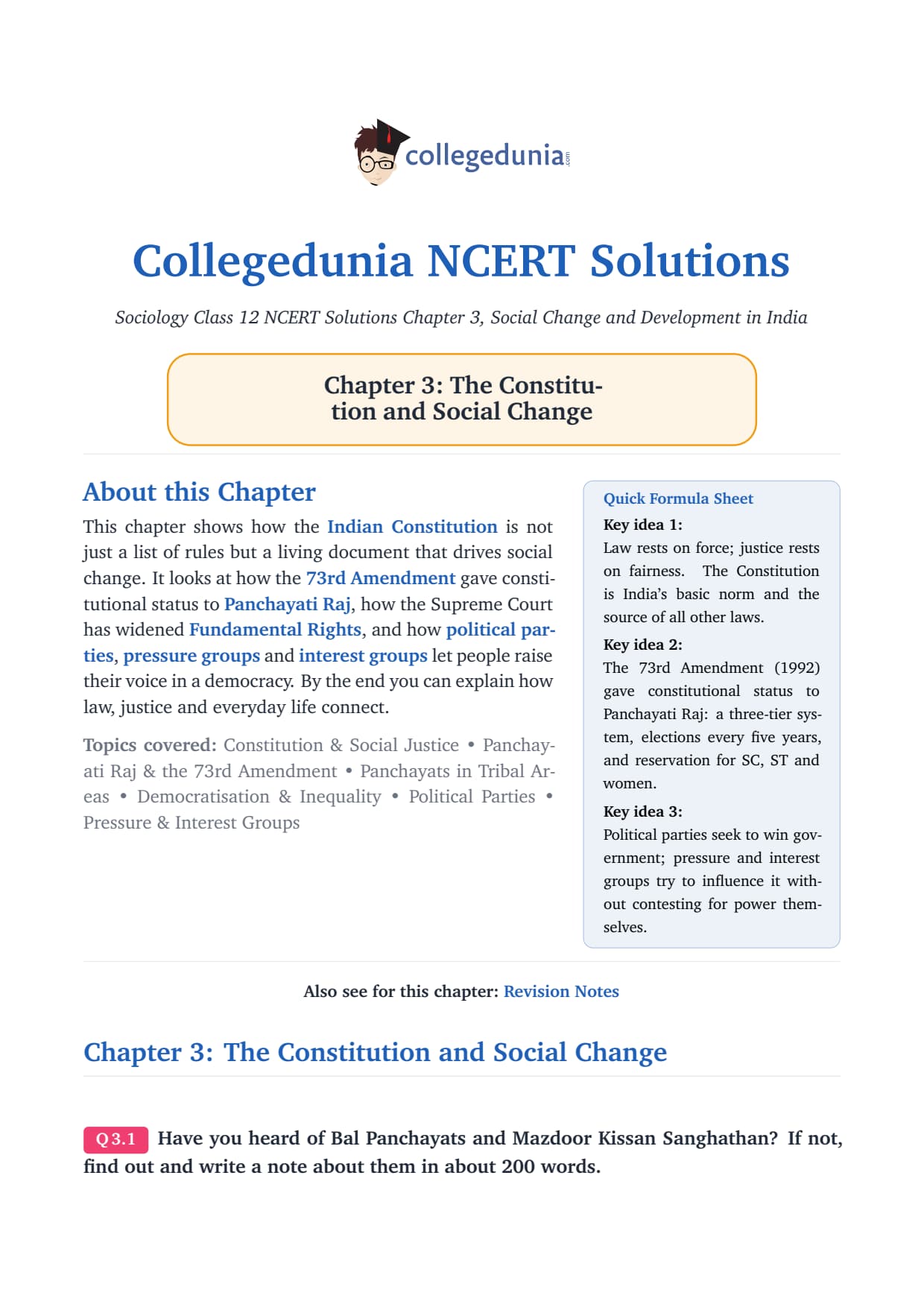
The NCERT Solutions for Class 12 Sociology Chapter 3 The Constitution and Social Change answer every textbook question on how the Indian Constitution works as a tool of reform, set to the latest 2026-27 CBSE syllabus. Each answer explains panchayats and the 73rd Amendment, political parties, pressure groups and interest groups, and the way the Constitution touches everyday life. These solutions help students write full board answers and revise fast.
Covers all 6 exercise questions from Social Change and Development in India Chapter 3, with full point-wise answers.
This Class 12 Sociology chapter usually carries 5 to 6 marks per board paper.
Pairs with the Notes, Handwritten Notes and NCERT Book PDF linked lower on this page.
Every solution for Class 12 Sociology Chapter 3 in this Collegedunia compilation is written by subject experts from the official NCERT Social Change and Development in India textbook, and checked against the last five years of CBSE board papers.
Student Feedback: In a Collegedunia poll of 8,420 Class 12 Sociology students taken before the 2026 boards, 71% of students rated the difference between pressure groups and interest groups as the part of The Constitution and Social Change they most wanted a model answer for. Most students said a clear two-line tag for each group made the answer easy to recall.
Source: 2026-27 Class 12 Sociology student poll. Sample of 8,420 students from CBSE schools across 12 states.
What the Constitution and Social Change Class 12 Chapter Is About
The Constitution and Social Change is the third chapter of Social Change and Development in India. It looks at how the Indian Constitution acts as a tool of social reform, not just a legal rulebook. The chapter shows that law both enables change, such as ending untouchability, and constrains it, by setting limits on State power. That double role runs through every answer in the chapter.
The chapter answers three big questions that students must keep in mind:
How does law change society? Through Fundamental Rights, Directive Principles and amendments.
Who gives villages a voice? The Panchayati Raj system and the 73rd Amendment.
Who carries demands to the State? Political parties, pressure groups and interest groups.
So the chapter is really about the link between the Constitution and everyday social life. A student who sorts each fact under "rights", "panchayats" or "groups" first can connect almost any question in The Constitution and Social Change class 12 back to one of them, which makes revision much faster.
The Constitution as a Living Tool of Social Change
The chapter starts with the idea that the Constitution is a living document. It was adopted in 1950, yet it can be amended, so it keeps pace with new social needs. This is the framing examiners look for, so students should learn it as a clear set of points rather than a story.
Enables change: it abolishes untouchability and grants equality, so it pushes social reform forward.
Constrains power: it limits what the State can do, so it protects citizens from misuse of authority.
Two tools:Fundamental Rights (Part III) and the Directive Principles (Part IV) carry this work.
The point examiners reward is that the Constitution both enables and limits social change at the same time. Whenever a question asks how the Constitution touches everyday life, the safe answer pairs an enabling example, such as the right to equality, with a constraining one, such as limits on State power. The image below sorts the Constitution's two main tools for fast revision.
Panchayats and the 73rd Amendment
A large part of the chapter deals with how the Constitution gives villages a real voice. The 73rd Amendment is the single most-asked topic here, so students should know what it did and why it matters. The list below keeps the key facts together.
73rd Amendment (1992): made Panchayati Raj a constitutional system across rural India.
Three tiers: Gram Panchayat at the village, Panchayat Samiti at the block, and Zila Parishad at the district.
Gram Sabha: the whole village adult body, which keeps the panchayat answerable.
Reservation: seats are reserved for women, Scheduled Castes and Scheduled Tribes, which widens who can lead.
The honest exam point is that the 73rd Amendment brought a voice to the people in the villages, but elite capture can still weaken it. A balanced answer praises the reform for reserving seats and creating the Gram Sabha, then notes that local landlords or dominant groups sometimes control decisions. Showing both sides is what lifts a "discuss" answer to full marks.
Parties, Pressure Groups and Interest Groups
The chapter closes with the bodies that carry citizens' demands to the State. Telling parties, pressure groups and interest groups apart is a long-answer favourite, so students should learn them as a clean comparison. The table below sorts the three for quick revision.
Body
Key idea to recall
Political party
Contests elections to capture power and run the government, such as the Congress or BJP.
Pressure group
Pushes demands on the State but does not contest elections, such as a trade union.
Interest group
Protects a shared interest of its members, such as a farmers' or teachers' body.
A key insight for the exam is that only a political party seeks to capture office; the other two only influence it. Pressure groups and interest groups overlap a lot, but the clean line is that a party wants to govern while a group only wants the government to listen. The image below lays out all three side by side.
The Constitution and Social Change Class 12 Exercise-wise Coverage
The chapter exercise has 6 questions. The table maps each one to its topic so students can plan revision and find the right NCERT answer fast. The full point-wise solution for each sits in the question set lower on this page.
Question
Topic it tests
Q 1
Note on Bal Panchayats and Mazdoor Kissan Sanghathan (grassroot bodies)
Q 2
How the 73rd Amendment gave villages a voice (discuss)
Q 3
Essay on how the Constitution touches people's everyday life
Q 4
Significance of political parties in a democracy
Q 5
How pressure groups are formed
Q 6
Role of interest groups in a democratic system
Questions 2, 3 and 4 are the most-asked long answers, so students preparing The Constitution and Social Change class 12 important questions should learn those three first. The group items, Q5 and Q6, are quick marks once the basic definitions are clear.
Students who want the offline copy can save the class 12 sociology chapter 3 pdf from the download card above and tick off each question as they finish it.
The Constitution and Social Change Important Questions and Previous Year Trends
CBSE sets a steady mix of short and long answers from this chapter. Knowing the pattern helps students decide how much to write. The chapter is a regular source of a 4-mark or 6-mark question, which is why a focused list of The Constitution and Social Change important questions saves a lot of revision time.
Long answer (5 to 6 marks): the 73rd Amendment and village democracy, or how the Constitution touches everyday life.
Short answer (4 marks): the significance of political parties, or how pressure groups are formed.
Concept-based: the difference between pressure groups and interest groups.
Example-based: Bal Panchayats and the Mazdoor Kissan Sanghathan as grassroot bodies.
For quick recall before the exam, students often practise the class 12 sociology chapter 3 important questions and a list of The Constitution and Social Change class 12 questions and answers. The most repeated items are the 73rd Amendment and the three kinds of groups, so keep those answer points ready in your own words.
Working through the ncert solutions class 12 sociology chapter 3 set twice, once open-book and once from memory, fixes the names and the group definitions well before the board exam.
Common Mistakes Students Make in This Chapter
A few errors cost marks every year in this chapter. Most come from mixing up the three kinds of groups or forgetting the limits of panchayat reform. Avoiding them is the fastest way to lift a score.
Calling a pressure group a political party - a group does not contest elections, a party does.
Forgetting that the 73rd Amendment can be weakened by elite capture of the Gram Sabha.
Treating the Constitution as only a rulebook - it also enables social reform like ending untouchability.
Mixing up Fundamental Rights (Part III, justiciable) with Directive Principles (Part IV, not enforceable).
Writing a one-sided "discuss" answer - always show both the gain and the limit.
Students who fix these five points usually move from average to high marks on the long answers. The exam rewards a balanced view, so always show both the reform side and its limit before you judge the Constitution's role.
The Constitution and Social Change PDF Download Formats and Languages
The solutions are free to download in more than one format, so students can pick what suits their device and revision style. The download card at the top of the page carries each option for this chapter.
Normal and HD PDF: the class 12 sociology chapter 3 pdf comes in a normal size for quick downloads and an HD version for clear printing.
English medium: all 6 answers are written in simple English for the CBSE board paper.
Question-only set: a print-and-practise sheet of The Constitution and Social Change extra questions for self-testing.
Whole-book pack: the solutions sit in one set that runs through every Social Change and Development in India chapter, so you can revise in one place.
Many students search for class 12 sociology chapter 3 answers on their phone the night before a test, so a saved PDF means you can revise even without internet. Keep both the question set and the solved version handy for a full self-check.
How These Solutions Pair with the Notes and Book PDF
These NCERT Solutions answer the back-exercise questions. To revise the full chapter, students should use them alongside the other resources for the same chapter, all linked in the table below.
Tip: read the Notes first, then attempt these solutions on your own, and only then check the model answers here. That order builds memory faster than copying answers straight away.
All NCERT Solutions for Class 12 Sociology
The table links the NCERT Solutions for every chapter in both Class 12 Sociology books, so students can move across the course in one click. The Constitution and Social Change is highlighted.
All NCERT Solutions for The Constitution and Social Change with Step-by-Step Solutions
Below are all 6 NCERT exercise questions for this chapter, exactly as they appear in the textbook. Tap Check Solution for the model answer or Expert Solution for the topper-style approach.
Q 3.1
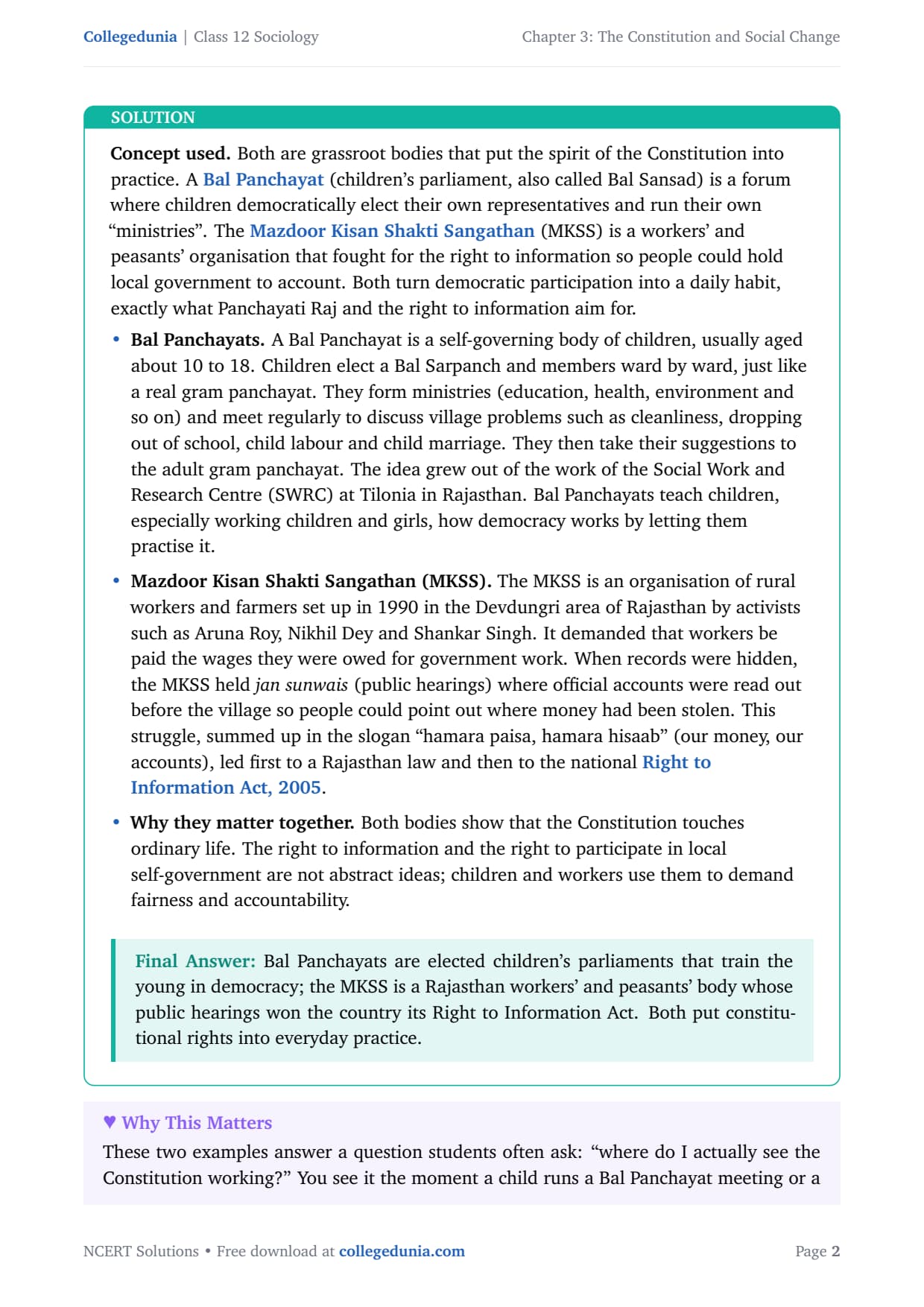
Have you heard of Bal Panchayats and Mazdoor Kissan Sanghathan? If not, find out and write a note about them in about 200 words.
Concept used. Both are grassroot bodies that put the spirit of the
Constitution into practice. A Bal Panchayat (children's parliament,
also called Bal Sansad) is a forum where children democratically elect their
own representatives and run their own ``ministries''. The Mazdoor
Kisan Shakti Sangathan (MKSS) is a workers' and peasants' organisation that
fought for the right to information so people could hold local government to
account. Both turn democratic participation into a daily habit, exactly what
Panchayati Raj and the right to information aim for.
Bal Panchayats. A Bal Panchayat is a self-governing body of
children, usually aged about 10 to 18. Children elect a Bal Sarpanch
and members ward by ward, just like a real gram panchayat. They form
ministries (education, health, environment and so on) and meet
regularly to discuss village problems such as cleanliness, dropping
out of school, child labour and child marriage. They then take their
suggestions to the adult gram panchayat. The idea grew out of the work
of the Social Work and Research Centre (SWRC) at Tilonia in Rajasthan.
Bal Panchayats teach children, especially working children and girls,
how democracy works by letting them practise it.
Mazdoor Kisan Shakti Sangathan (MKSS). The MKSS is an
organisation of rural workers and farmers set up in 1990 in the
Devdungri area of Rajasthan by activists such as Aruna Roy, Nikhil Dey
and Shankar Singh. It demanded that workers be paid the wages they were
owed for government work. When records were hidden, the MKSS held
jan sunwais (public hearings) where official accounts were read
out before the village so people could point out where money had been
stolen. This struggle, summed up in the slogan ``hamara paisa, hamara
hisaab'' (our money, our accounts), led first to a Rajasthan law and
then to the national Right to Information Act, 2005.
Why they matter together. Both bodies show that the
Constitution touches ordinary life. The right to information and the
right to participate in local self-government are not abstract ideas;
children and workers use them to demand fairness and accountability.
Bal Panchayats are elected children's parliaments that train the
young in democracy; the MKSS is a Rajasthan workers' and peasants' body whose
public hearings won the country its Right to Information Act. Both put
constitutional rights into everyday practice.
AB
Ananya Banerjee
M.A Sociology, Delhi School of Economics
Verified Expert
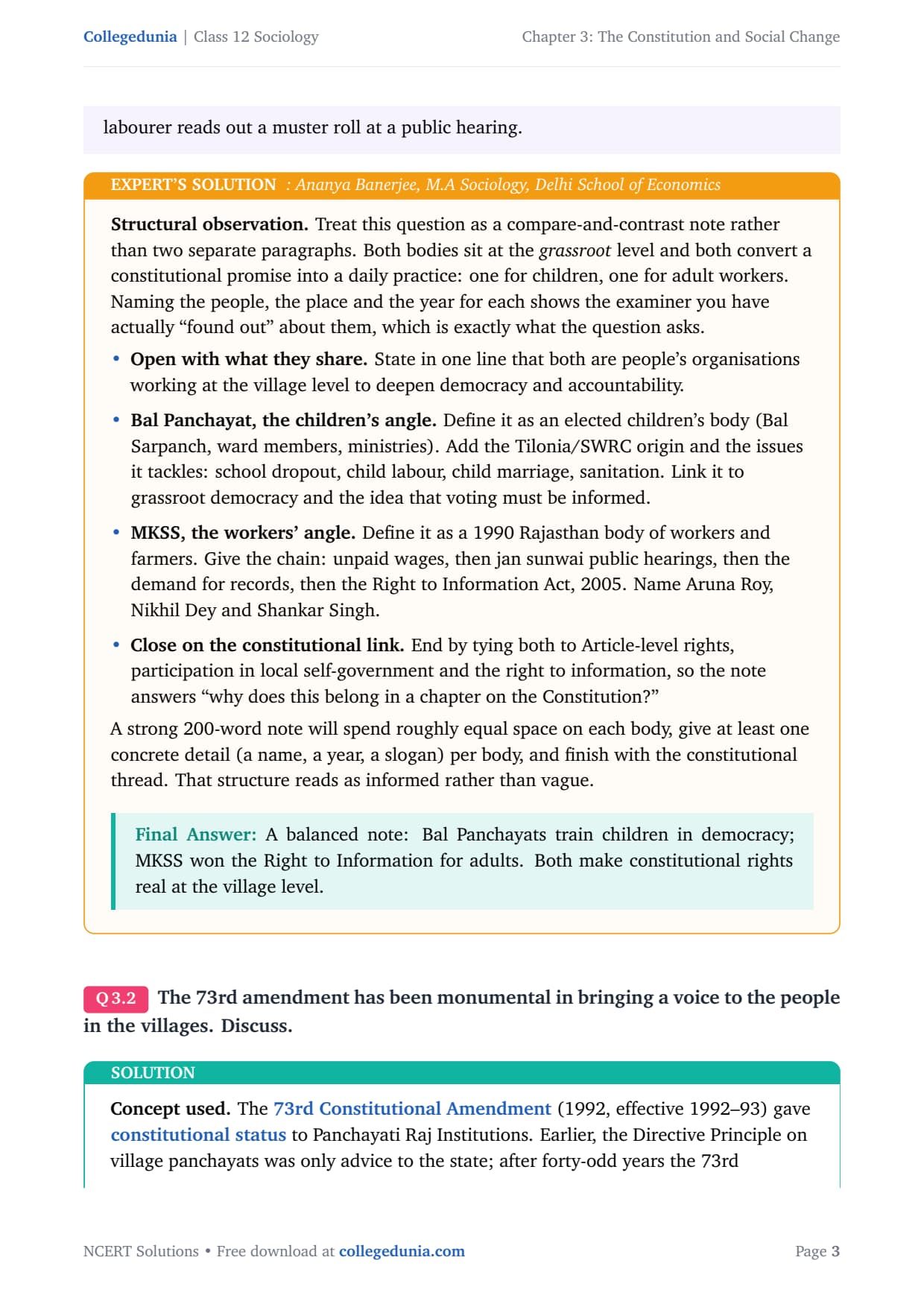
Structural observation. Treat this question as a compare-and-contrast
note rather than two separate paragraphs. Both bodies sit at the
grassroot level and both convert a constitutional promise into a daily
practice: one for children, one for adult workers. Naming the people, the
place and the year for each shows the examiner you have actually ``found out''
about them, which is exactly what the question asks.
Open with what they share. State in one line that both are
people's organisations working at the village level to deepen
democracy and accountability.
Bal Panchayat, the children's angle. Define it as an elected
children's body (Bal Sarpanch, ward members, ministries). Add the
Tilonia/SWRC origin and the issues it tackles: school dropout, child
labour, child marriage, sanitation. Link it to grassroot democracy and
the idea that voting must be informed.
MKSS, the workers' angle. Define it as a 1990 Rajasthan body
of workers and farmers. Give the chain: unpaid wages, then jan sunwai
public hearings, then the demand for records, then the Right to
Information Act, 2005. Name Aruna Roy, Nikhil Dey and Shankar Singh.
Close on the constitutional link. End by tying both to
Article-level rights, participation in local self-government and the
right to information, so the note answers ``why does this belong in a
chapter on the Constitution?''
A strong 200-word note will spend roughly equal space on each body, give at
least one concrete detail (a name, a year, a slogan) per body, and finish with
the constitutional thread. That structure reads as informed rather than vague.
A balanced note: Bal Panchayats train children in democracy; MKSS
won the Right to Information for adults. Both make constitutional rights real
at the village level.
Q 3.2
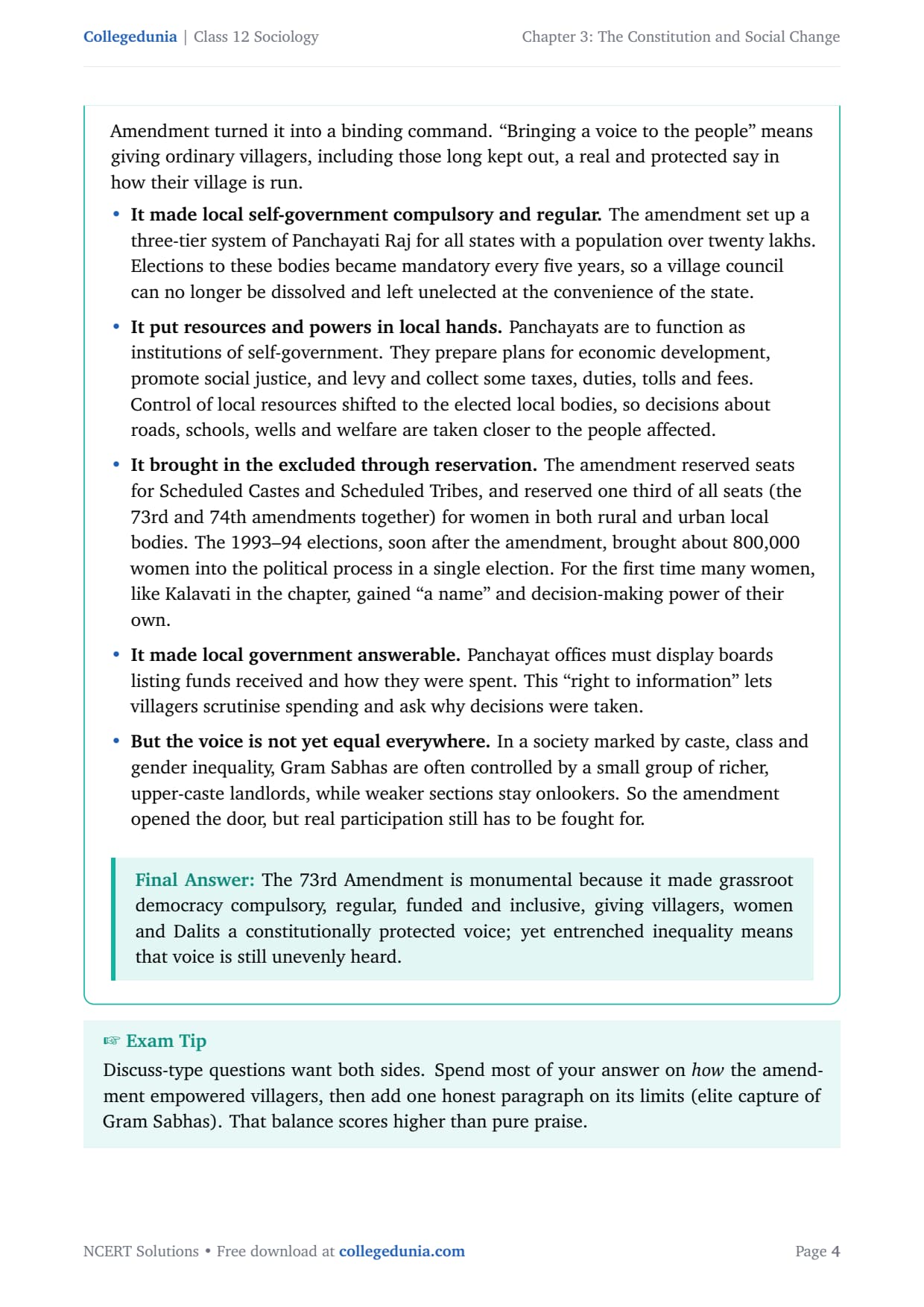
The 73rd amendment has been monumental in bringing a voice to the people in the villages. Discuss.
Concept used. The 73rd Constitutional Amendment (1992,
effective 1992–93) gave constitutional status to Panchayati Raj
Institutions. Earlier, the Directive Principle on village panchayats was only
advice to the state; after forty-odd years the 73rd Amendment turned it into a
binding command. ``Bringing a voice to the people'' means giving ordinary
villagers, including those long kept out, a real and protected say in how their
village is run.
It made local self-government compulsory and regular. The
amendment set up a three-tier system of Panchayati Raj for all states
with a population over twenty lakhs. Elections to these bodies became
mandatory every five years, so a village council can no longer be
dissolved and left unelected at the convenience of the state.
It put resources and powers in local hands. Panchayats are to
function as institutions of self-government. They prepare plans for
economic development, promote social justice, and levy and collect some
taxes, duties, tolls and fees. Control of local resources shifted to the
elected local bodies, so decisions about roads, schools, wells and
welfare are taken closer to the people affected.
It brought in the excluded through reservation. The amendment
reserved seats for Scheduled Castes and Scheduled Tribes, and reserved
one third of all seats (the 73rd and 74th amendments together) for
women in both rural and urban local bodies. The 1993–94 elections,
soon after the amendment, brought about 800,000 women into the
political process in a single election. For the first time many women,
like Kalavati in the chapter, gained ``a name'' and decision-making
power of their own.
It made local government answerable. Panchayat offices must
display boards listing funds received and how they were spent. This
``right to information'' lets villagers scrutinise spending and ask why
decisions were taken.
But the voice is not yet equal everywhere. In a society marked
by caste, class and gender inequality, Gram Sabhas are often controlled
by a small group of richer, upper-caste landlords, while weaker sections
stay onlookers. So the amendment opened the door, but real
participation still has to be fought for.
The 73rd Amendment is monumental because it made grassroot democracy
compulsory, regular, funded and inclusive, giving villagers, women and Dalits a
constitutionally protected voice; yet entrenched inequality means that voice is
still unevenly heard.
AI
Arjun Iyer
Ph.D Political Sociology, Jawaharlal Nehru University
Verified Expert
Strategic angle. The word ``monumental'' is the hinge of this
question. Build the answer around one claim: the amendment changed Panchayati
Raj from optional advice into an enforceable right. Everything you list then
becomes evidence for that claim, which keeps a long ``discuss'' answer tightly
argued instead of a loose list of facts.
Set the baseline. Note that before 1992 panchayats rested only
on a Directive Principle, which the state could ignore. This makes the
``before'' clear so the ``after'' looks genuinely new.
Give the three pillars. Group the changes into permanence
(compulsory five-yearly elections, three-tier structure), power
(planning, social justice, taxes, control of local resources) and
inclusion (reservation for SC, ST and one third for women).
Humanise it. Use a single example from the chapter, Kalavati
the Dalit panchayat member who said ``she has a name'', and the 800,000
women of 1993–94, to show what ``a voice'' means in lived terms.
Qualify it. Close with elite capture of the Gram Sabha and the
exclusion of much of the tribal north-east from the amendment, so your
verdict is informed, not one-sided.
A top answer reads as an argument: ``monumental, yes, because it made
participation a right; incomplete, because inequality still filters who is
actually heard.'' That single sentence could open or close the answer.
One more move lifts the answer from good to excellent. Examiners reward
students who can connect the amendment to the wider theme of the chapter, that
the Constitution is a living document and can extend the meaning of social
justice over time. The 73rd Amendment is the clearest example of that idea: a
mere Directive Principle, ignored for forty-odd years, finally hardened into a
binding right in 1992. Point this out and you show that you understand not just
the amendment but why it sits in a chapter on the Constitution and social
change. Add one concrete institutional detail, the duty of panchayats to put up
boards listing funds received and spent, to show that accountability, not only
representation, was built in. That detail proves the amendment gave villagers
not just a seat but the information to use it.
Argue that the amendment is monumental because it converted village
democracy from advice into an enforceable, funded, inclusive and accountable
right, then temper the claim with elite capture and tribal exclusion.
Q 3.3
Write an essay on the ways that the Indian Constitution touches peoples' everyday life, drawing upon different examples.
Concept used. The Indian Constitution is India's
basic norm: every other law is made and enforced by authorities the
Constitution sets up, and a hierarchy of courts, led by the Supreme Court,
interprets it. The chapter's central claim is that the Constitution is not just
a referencer of do's and don'ts; it can ``extend the meaning of social
justice''. So it touches everyday life both through the rights it guarantees and
through the way courts and movements keep widening those rights.
Through expanding Fundamental Rights. The short words of
Article 21, the right to life and liberty, have been read by the Supreme
Court to include all that makes a life of quality: livelihood, health,
shelter, education and dignity, not mere ``animal existence''. This has
protected prisoners from torture, freed and rehabilitated bonded
labourers, and guaranteed primary healthcare and primary education.
Through the right to information. In 1993 the Supreme Court
held that the right to information is part of the right to freedom of
speech and expression under Article 19(1)(a). In everyday terms this is
why a villager can demand to see how panchayat funds were spent, the
same right the MKSS fought for.
Through equality at work. The Court read the Directive
Principle of ``equal pay for equal work'' into the Fundamental Right to
Equality under Article 14, bringing relief to plantation and
agricultural labourers. So a worker's wage packet can be shaped by the
Constitution.
Through local self-government. The 73rd Amendment gives every
village a say in roads, schools, wells, child welfare and family
planning, and reserves seats for SC, ST and women. A woman becoming a
Panch, or a Gram Sabha approving a development plan, is the Constitution
at work in the village.
Through everyday participation. Citizens form trade unions,
farmers' unions, industry bodies and women's groups, and they vote,
petition and protest. The right to organise and be heard, and the duty
of the state to listen, both flow from the Constitution.
From the food on a labourer's plate to a woman taking office as a
Panch, from a wage dispute to a request for government records, the
Constitution shapes daily life by guaranteeing rights and by letting courts and
movements keep widening them in the name of social justice.
MN
Meera Nair
M.A Political Science, University of Delhi
Verified Expert
Picture-first. Open the essay with a single ordinary scene, a worker
checking that a panchayat board lists how funds were spent, then say: every part
of that scene is shaped by the Constitution. Starting from life, not from law,
makes the essay feel like it is about people rather than clauses, which is
exactly what the question asks for.
State the thesis. The Constitution touches everyday life in two
ways: by guaranteeing rights and by being a living document that courts
and movements keep widening.
Build right-by-right. Devote one short paragraph each to
Article 21 (life as livelihood, health, shelter, education), Article
19(1)(a) (right to information, 1993), and Article 14 (equal pay for
equal work). Name the Article so the essay reads as informed.
Move to institutions. Show the 73rd Amendment giving villagers,
women and Dalits a say in local decisions, and reservation reshaping who
holds office.
End on agency. Close with citizens themselves: voting, forming
unions, holding public hearings. The Constitution does not just protect
people; it invites them to act.
A strong essay carries one thread throughout: the Constitution is alive because
its meaning keeps growing toward social justice. Repeating that idea lightly at
the start and end frames every example.
Two extra touches separate a top essay from an average one. First, draw out the
difference between law and justice that the chapter opens with: the essence of
law is force, the essence of justice is fairness, and the Constitution matters
in daily life precisely because it is the basic norm from which all fair laws
and authorities flow. Stating this once near the start gives the essay a
sociological spine rather than a civics-textbook tone. Second, name the agents
of change. Rights did not widen on their own; the Supreme Court read livelihood
and information into Articles 21 and 19, and social movements such as the MKSS
pushed those interpretations from below. Showing that courts and movements
together stretch the meaning of rights is the analytical point the chapter is
really after, and it lets the essay end on a forward-looking note: the
Constitution touches everyday life most when ordinary people use it to demand
more justice than they had yesterday.
Frame the essay around a living Constitution: rights (Articles 21, 19,
14) plus institutions (Panchayati Raj, reservation) plus citizen action (unions,
public hearings, movements) together shape daily life and keep widening social
justice.
Q 3.4
What is the significance of political parties in a democracy?
Concept used. A political party is defined in the chapter as
an organisation oriented towards achieving legitimate control of government
through an electoral process: it is set up to win governmental power and then
use that power to pursue a specific programme. Parties are based on a particular
understanding of society and how it ought to be. Their ``significance'' lies in
what they do for democracy that nothing else does in quite the same way.
They are the key actors that contest for power. In a democratic
form of government, political parties are the main bodies that seek to
win control of government through elections, peacefully and by agreed
rules, rather than by force.
They represent the interests of different groups. In a
democratic system the interests of different sections of society are
represented by political parties, who take up their cause. A scattered
group of citizens gets a collective platform through a party.
They turn ideas into programmes. Because each party is based on
a certain understanding of how society ought to be, it offers voters a
programme. Elections then become a choice between visions, not just
between persons.
They give other groups something to influence. Different
interest groups work towards influencing political parties. When a group
feels its interests are ignored, it may push an existing party, form a
pressure group, or even start an alternative party. So parties are the
main channel through which demands enter government.
They link state and society. As Max Weber put it, while classes
belong to the economic order and status groups to the social order,
``parties live in a house of power'' and act in a planned way towards a
goal. Parties are thus the organised bridge between everyday society and
state power.
Political parties matter because they let groups compete for
governmental power peacefully through elections, represent and aggregate
diverse interests, offer voters a programme, and form the main channel through
which society's demands reach the state.
AV
Aditya Verma
M.A Sociology, Tata Institute of Social Sciences
Verified Expert
Strategic angle. A short ``significance'' question is best answered as
a list of distinct functions, each in one crisp line. Four or five sharp points
beat one long paragraph here. Lead with the chapter's definition so every
function clearly belongs to a party and not to a pressure group.
Define first. One line: a party seeks legitimate control of
government through elections in order to pursue a programme.
List the functions. Contesting power peacefully; representing
and aggregating group interests; offering competing visions of society;
serving as the target that interest and pressure groups try to
influence.
Add the Weber line. Quote ``parties live in a house of power''
to show parties are oriented to power in a planned way, which marks them
off from purely social or economic groupings.
Note the limit. Briefly acknowledge that not all interests have
equal access to parties, which is why pressure and interest groups also
exist. This shows nuance.
A high-scoring answer makes each function a separate bullet and ties every one
back to ``power through elections''. That keeps the answer both complete and
disciplined.
To push the answer further, bring in the sociological caution the chapter
raises. Parties claim to represent the interests of different groups, yet not
all groups reach them with equal ease. Some sociologists argue that the concept
of representation underestimates how much dominant groups of class, caste or
gender already shape what parties say and do. So the significance of parties is
real but partial: they are the main democratic route to power, and at the same
time they can mirror the inequalities of the society around them. A student who
states both the function and this qualification shows that significance is being
judged, not just listed. Closing on Weber's idea that ``parties live in a house
of power'' ties the whole answer together: parties exist to win and use power in
a planned way, which is exactly why every other group in a democracy tries to
influence them.
Parties are significant because they peacefully contest for power,
aggregate and represent interests, offer programmatic choices, and act as the
main channel between society and the state, even if unequal access means they
can also reflect existing inequalities.
Q 3.5
How are pressure groups formed?
Concept used. A pressure group is an organised body that
tries to influence government policy in favour of a particular interest, mainly
by lobbying those in power, but without contesting elections to form
the government itself. The chapter explains pressure groups as a response: they
appear when ordinary representation through political parties is felt to be
falling short.
They begin with an unmet interest. People who share a common
economic or social interest, industrialists, workers, farmers, women,
first notice that their concerns are not being taken up adequately by
the existing political parties.
They organise to be heard. When a group feels its interests are
being ignored, it has a choice. It may move to form an alternative
political party, or it may form a pressure group that lobbies with the
government to push its specific demand.
They take a recognisable organisational shape. Pressure groups
usually grow out of existing associations of people with the same
livelihood. Industrialists form bodies such as FICCI and ASSOCHAM;
workers form trade unions such as INTUC and CITU; farmers form
agricultural unions such as the Shetkari Sangathan; agricultural
labourers form their own unions.
They work mainly by lobbying. Once formed, a pressure group
operates primarily by lobbying members of legislative bodies and meeting
ministers, for example the many delegations that meet the Finance
Ministry before the annual Budget, rather than by seeking office.
Sometimes they begin as movements. Where an organisation seeks
a share in power but is denied it through standard means, it may operate
as a movement first and become a recognised pressure group or party
only later.
Pressure groups form when people who share an interest feel that
political parties are not taking up their cause, so they organise, usually
around a common livelihood such as industry, labour or farming, into bodies
that lobby the government rather than contest for power.
RJ
Riya Joshi
M.A Sociology, Jawaharlal Nehru University
Verified Expert
Quick reading. The question asks ``how are they formed'', so structure
the answer as a short sequence: an unmet need, a decision to organise, a
recognisable form, and a chosen method (lobbying). Naming a few real groups
(FICCI, INTUC, Shetkari Sangathan) proves the point and lifts the answer above
mere theory.
Trace the trigger. Start with the felt gap: a shared interest
that existing parties are not representing well.
Show the choice. Such a group can either start a new party or
form a pressure group; pressure groups are the lobbying route.
Give the building blocks. Point out they usually crystallise
around occupation, industry bodies, trade unions, farmers' unions, and
name one or two real examples.
State the method and the limit. They work by lobbying
legislators and ministers, not by contesting elections; and access is
unequal, since dominant groups of class, caste or gender can pressure
the government far more easily than others.
A complete answer makes the contrast with parties explicit and ends on the
inequality of access, which is the chapter's own critical note on pressure
groups.
It is worth being precise about the word ``formed''. A pressure group is rarely
built from scratch; it usually grows out of an existing community of people who
already share a livelihood and therefore share an interest, industrialists,
factory workers, farmers, agricultural labourers. The trigger is political: the
moment they feel that ordinary representation through parties is not delivering,
they convert that shared interest into an organised body that can lobby. So
formation has two ingredients, a pre-existing common interest and a felt gap in
representation. Naming real bodies, FICCI and ASSOCHAM for industry, INTUC and
CITU for labour, the Shetkari Sangathan for farmers, shows the examiner you
understand that these groups are concrete and occupation-based, not abstract.
End on the chapter's caution that some groups can pressure the state far more
easily than others, so the very process of forming a pressure group also
reflects the inequalities of class, caste and gender in society.
They form when a pre-existing community with a shared livelihood feels
its interest is not represented by parties, and organises, usually as an
industry body, trade union or farmers' union, to lobby government rather than
contest elections.
Q 3.6
What is the role of interest groups in a democratic system?
Concept used. An interest group is an organised body that
pursues a specific interest in the political arena, operating primarily by
lobbying the members of legislative bodies. Like pressure groups, it
does not aim to form the government; its ``role'' is the particular function it
plays in keeping a democracy responsive between elections.
They represent specific interests. Interest groups are
organised to pursue specific interests, of industry, labour, farmers, a
profession or a community, in the political arena. They give a focused,
organised voice to a section of society that a broad-based party may
treat as only one concern among many.
They influence political parties. In a democratic system the
interests of different groups are also represented by political parties,
and different interest groups work towards influencing those parties so
that their concerns are taken up in party programmes and government
policy.
They lobby the law-makers. Their main method is lobbying the
members of legislative bodies, putting their case directly to those who
frame and pass laws, so that legislation reflects their interest.
They keep democracy participatory between elections. Voting
happens only once every few years; interest groups let citizens press
their demands continuously. They are one of the channels through which
the everyday concerns of society reach the state.
But their influence is unequal. The chapter cautions that all
groups do not have the same access or the same ability to pressurise the
government. Some argue this underestimates how much dominant groups of
class, caste or gender already control the state. So interest groups
enrich democracy but can also reflect its inequalities.
Interest groups give organised, focused voice to specific sections of
society, influence political parties and lobby legislators so policy reflects
their concerns, and keep democracy participatory between elections, though their
unequal access means dominant groups are heard more easily.
KM
Karan Mehta
Ph.D Sociology, Delhi School of Economics
Verified Expert
Structural observation. Read ``role'' as ``functions plus
limitations''. List what interest groups do for democracy, then add the
chapter's own critical note that access is unequal. That two-part shape, a
positive role and an honest qualification, is what examiners reward in a
12th-grade sociology answer.
Define and distinguish. One line: an interest group pursues a
specific interest by lobbying legislators, without contesting for
government. Mark it off from a party.
List the positive roles. Representing specific interests;
influencing political parties; lobbying law-makers; sustaining
participation between elections.
Add the critical note. Bring in the chapter's caution that
access is unequal and that dominant social groups may already control
the state. This shows analytical maturity.
Close on balance. Conclude that interest groups deepen
democracy by widening participation, yet can mirror its existing
inequalities of class, caste and gender.
A strong answer never stops at ``they lobby''. It states the role, then asks
``whose interest is actually heard?'', which is the sociological angle the
chapter wants you to take.
It also helps to make the difference between an interest group and a pressure
group explicit, since the examiner may read Q5 and Q6 together. Both work by
lobbying and neither contests elections to form the government; the chapter
treats them as closely related ways in which organised interests press their
case in the political arena. Where you can add value is by giving a concrete
example, industrialists in FICCI or ASSOCHAM, workers in INTUC or CITU, farmers
in the Shetkari Sangathan, so the role is shown, not just asserted. Finish with
the chapter's sharpest point: because dominant groups of class, caste and gender
can pressure the government far more easily than others, interest groups widen
participation but do not by themselves make it equal. A worked answer that names
the function, illustrates it, and then weighs its limits reads as genuinely
sociological rather than merely descriptive.
Interest groups represent specific interests, influence parties, lobby
law-makers and sustain participation between elections, deepening democracy
while also reflecting its unequal access.
FAQs on The Constitution and Social Change Class 12 NCERT Solutions
The Constitution and Social Change Class 12 Sociology Common Questions
Ques. Where can I get the class 12 sociology chapter 3 NCERT Solutions PDF?
Ans. You can download the The Constitution and Social Change Class 12 Sociology NCERT Solutions PDF directly from this page. It is free, follows the 2026-27 NCERT, and answers all 6 exercise questions point by point.
Ques. How many questions are there in The Constitution and Social Change class 12 questions and answers?
Ans. The chapter has 6 exercise questions. They cover grassroot bodies, the 73rd Amendment, an essay on the Constitution in everyday life, the role of political parties, and how pressure and interest groups work.
Ques. What did the 73rd Amendment do for villages?
Ans. The 73rd Amendment of 1992 made Panchayati Raj a constitutional system across rural India. It set up a three-tier structure, created the Gram Sabha as a check, and reserved seats for women, Scheduled Castes and Scheduled Tribes, so it gave villages a real voice.
Ques. What is the difference between a pressure group and an interest group?
Ans. A pressure group pushes demands on the State without contesting elections, such as a trade union. An interest group protects a shared interest of its members, such as a farmers' or teachers' body. Both influence the government but neither seeks to capture office, which is what a political party does.
Ques. How does the Indian Constitution touch everyday life?
Ans. The Constitution shapes daily life through Fundamental Rights and Directive Principles. It grants equality, abolishes untouchability, protects free speech and guides State policy on wages and education, so it both enables social reform and limits the power of the State.
Ques. Is class 12 sociology chapter 3 easy to score in the board exam?
Ans. Yes. It is a high-scoring chapter if you keep the three kinds of groups straight and remember the 73rd Amendment. Practise the short definitions and keep a balanced "discuss" answer ready for the long question on village democracy.








Comments