Senior Psychology Editor, 8 Yrs | Updated 3+ months ago
The NCERT Solutions for Class 12 Sociology Chapter 7 Mass Media and Communications answer every textbook question on how print, radio and television have changed in India, set to the latest 2026-27 CBSE syllabus. Each answer traces the growth of the newspaper, the survival of radio, and the rise of private satellite television, then shows students how to add a reasoned opinion. These solutions help students write full board answers and revise fast.
Covers all 3 exercise questions from Social Change and Development in India Chapter 7, with full point-wise answers.
This Class 12 Sociology chapter usually carries 5 to 6 marks per board paper.
Pairs with the Notes, Handwritten Notes and NCERT Book PDF linked lower on this page.
Student Feedback: In a Collegedunia poll of 7,920 Class 12 Sociology students taken before the 2026 boards, 71% of students rated the question on the Indian language newspaper revolution as the one they most wanted a model answer for. Most students said one clear statistic, like the jump in vernacular circulation, made the whole answer easy to recall.
Source: 2026-27 Class 12 Sociology student poll. Sample of 7,920 students from CBSE schools across 12 states.
Every solution for Class 12 Sociology Chapter 7 in this Collegedunia compilation is written by subject experts from the official NCERT Social Change and Development in India textbook, and checked against the last five years of CBSE board papers.
What the Mass Media and Communications Class 12 Chapter Is About
Mass Media and Communications is the seventh chapter of Social Change and Development in India. It looks at how the tools that reach millions at once, print, radio and television, grew and changed in India. The chapter does not treat the media as fixed. It shows how the State, the market and technology together pushed each medium to change, so an answer that names all three usually scores well.
The chapter answers three big questions that students must keep in mind:
What is mass media? Channels like newspapers, radio and television that carry one message to a huge, scattered public.
Who controlled it? The State guided radio and television for development after 1947, then liberalisation in the 1990s opened the door to private and global players.
How did each medium change? Print boomed through the Indian language press, radio survived through FM, and television exploded into many private channels.
So the chapter is really about the link between state policy, the market and everyday media use. A student who sorts each fact under "print", "radio" or "television" first can connect almost any question in mass media and communications class 12 back to one of them, which makes revision much faster.
Key Terms in Mass Media and Communications Class 12
Before the questions, students should fix the vocabulary the chapter keeps using. The glossary below gathers the words examiners expect in a full answer. Learn them as a short list, not as a story, so they are quick to recall in the exam.
Mass media: forms like TV, newspapers, radio and the internet that reach a mass public at once.
Liberalisation: the 1990s policy that opened Indian media to private and foreign players.
Infotainment: a mix of information and entertainment used to keep people watching and reading.
Vernacular press: newspapers printed in Indian languages, the engine of the print boom.
The point examiners reward is that each of these terms ties back to one shift, the move from a state-guided media to a market-driven one. Whenever a question asks you to explain a change, name the term first, then give the chapter's own example. The image below sorts the key terms for fast revision.
State-Controlled Media versus Private and Global Media
A large part of the chapter turns on one change, the move from media run by the State to media run by private and global firms. This is the single most useful frame for the whole chapter, so students should know both sides well. The list below keeps the key contrasts together.
Before 1991: Doordarshan and All India Radio were run by the State, mainly for nation building and development.
After 1991: liberalisation let private satellite channels enter, driven by profit and large viewership.
From one voice to many: a single national channel gave way to many regional and global channels.
From slow to fast: planned, slow growth became fast expansion funded by advertising.
The honest exam point is that liberalisation did not simply add channels; it changed who controlled the media and why. A balanced answer notes the development role of state media, then shows how the market reshaped choice, language and reach. The image below sets the two phases side by side.
Mass Media and Communications Class 12 Exercise-wise Coverage
The chapter exercise has 3 questions. The table maps each one to its topic so students can plan revision and find the right NCERT answer fast. The full point-wise solution for each sits in the question set lower on this page.
Question
Topic it tests
Q1
Changes in the newspaper industry and your own opinion on them
Q2
Whether radio is dying out and the potential of FM stations
Q3
Changes in the medium of television since the 1990s
Tip: every question here asks you to "trace changes" or "discuss", so each answer needs a clear description first and a reasoned opinion second. Keep the two halves separate in your answer sheet.
Important Questions from Mass Media and Communications
Beyond the back exercise, a few patterns repeat in board papers. Students should keep ready answers for these so no version of the question catches them off guard.
The Indian language newspaper revolution: why vernacular papers grew when many expected print to fall.
The role of the State in early Indian media: how radio and television served development goals after 1947.
Community radio: the example of a small grassroots station and what it does for a local community.
Infotainment and advertisers: how the need for advertising money changed news content.
These four ideas cover most of the marks in this chapter. A student who can write five clear points on each is ready for any board question on mass media and communications class 12.
Common Mistakes Students Make in This Chapter
This is a high-scoring chapter, but small slips cost marks. The list below flags the errors examiners see most often, so students can avoid them.
Giving only a description: the questions also ask for an opinion, so a one-sided answer loses marks.
Mixing up the timeline: remember state media came first, then liberalisation opened the field after 1991.
Forgetting examples: a vague answer without the vernacular press or community radio looks thin.
Treating media as only entertainment: the chapter stresses the development and democratic roles too.
The safe habit is to write the change, add one named example, then close with a short reasoned view. That order answers exactly what the NCERT questions ask for.
How to Download the Mass Media and Communications Class 12 Solutions PDF
Students often want these answers offline for revision. The solutions on this page are available in two handy forms so you can pick what suits your study style.
Solved set: the full point-wise answers to all 3 exercise questions, ready to read and revise.
Question-only set: a print-and-practise sheet of mass media and communications extra questions for self-testing.
Whole-book pack: the solutions sit in one set that runs through every Social Change and Development in India chapter, so you can revise in one place.
Many students search for class 12 sociology chapter 7 answers on their phone the night before a test, so a saved PDF means you can revise even without internet. Keep both the question set and the solved version handy for a full self-check.
How These Solutions Pair with the Notes and Book PDF
These NCERT Solutions answer the back-exercise questions. To revise the full chapter, students should use them alongside the other resources for the same chapter, all linked in the table below.
Tip: read the Notes first, then attempt these solutions on your own, and only then check the model answers here. That order builds memory faster than copying answers straight away.
All NCERT Solutions for Class 12 Sociology
The table links the NCERT Solutions for every chapter in both Class 12 Sociology books, so students can move across the course in one click. Mass Media and Communications is highlighted.
All NCERT Solutions for Mass Media and Communications with Step-by-Step Solutions
Below are all 3 NCERT exercise questions for this chapter, exactly as they appear in the textbook. Tap Check Solution for the model answer or Expert Solution for the topper-style approach.
Q 7.1
Trace out the changes that have been occurring in the newspaper
industry. What is your opinion on these changes?
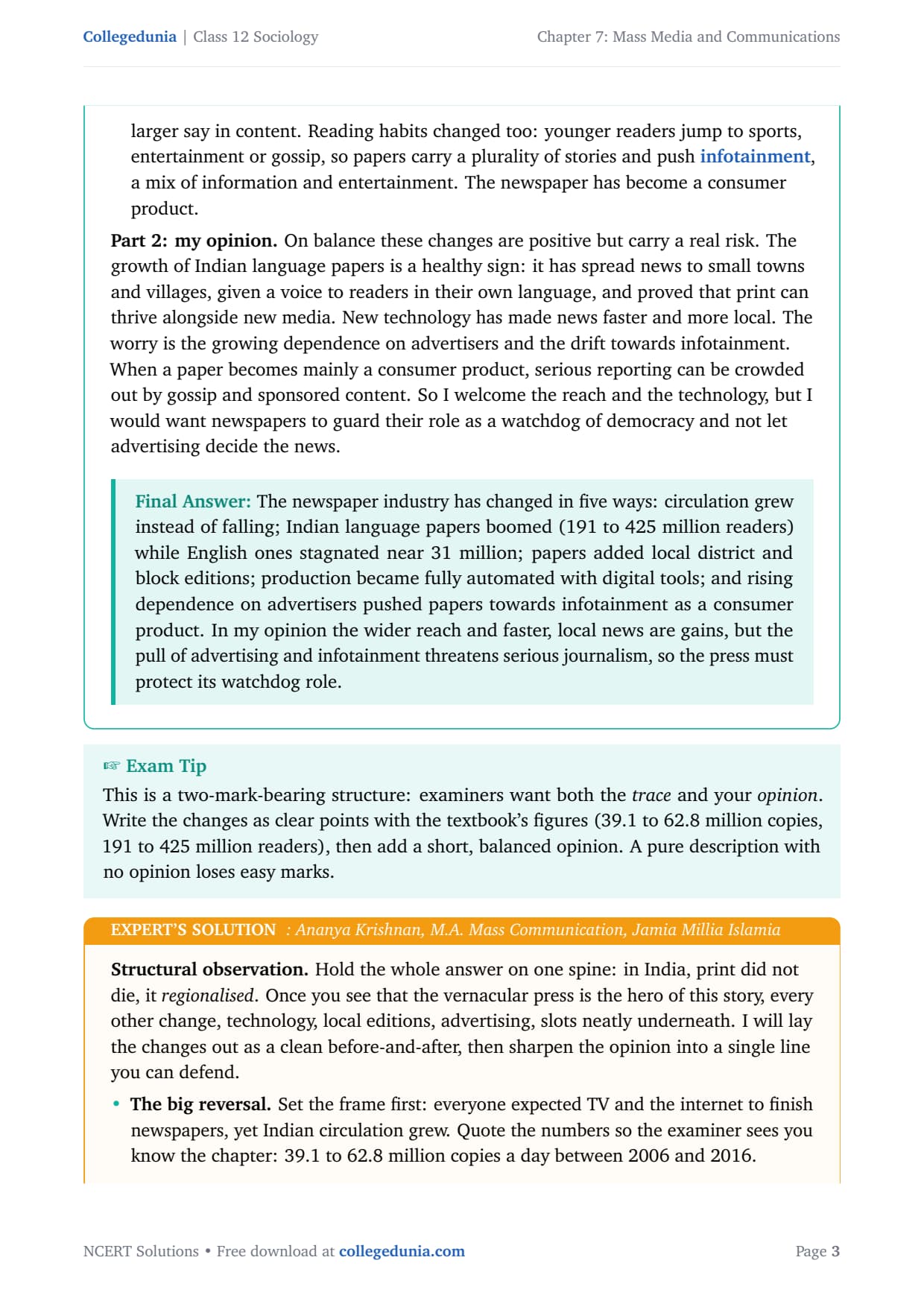
Concept used. The print media means newspapers and magazines.
This is a two-part question: first trace (describe in order) the changes
in the newspaper industry, then give a reasoned opinion of your own. The
chapter shows that, unlike what many feared, the spread of television and the
internet did not kill the newspaper in India. Instead, circulation grew,
especially for Indian language (vernacular) newspapers, and the way
newspapers are produced and what they contain both changed. The answer below
stays close to the textbook's examples, then closes with a balanced opinion so
you can practise arguing a view.
The starting point
Newspapers were central to the social reform and freedom movements. After
independence the press saw itself as a partner in nation building, taking up
development issues and giving voice to the widest section of people. The changes
below build on that base.
Part 1: tracing the changes.
Circulation grew instead of falling. Many feared that
television and the internet would sideline print, but in India newspaper
circulation actually grew. Print publications saw average daily
circulation rise from 39.1 million copies in 2006 to 62.8 million in
2016. The rise in the number of literate people migrating to cities is a
major reason.
The Indian language newspaper revolution. The biggest change has
been the explosive growth of vernacular newspapers, with Hindi, Telugu
and Kannada recording the highest growth. Indian language dailies as a
whole grew from 191 million people to 425 million people by 2019, while
the readership of English dailies stagnated at around 31 million. The top
Hindi dailies, Dainik Jagran and Dainik Bhaskar, lead the field.
Catering to local needs. Vernacular papers meet needs that city
English papers do not. Papers like Malayala Manorama and
Eenadu launched local news with district and block editions;
Dina Thanthi used simple, colloquial Tamil. The Eenadu
story, linking up with rural causes like the anti-arrack movement, shows
how a paper reached the countryside.
New production technology. From the late 1980s and 1990s,
newspaper production became fully automatic, from reporter's desk to final
page proof, using networked PCs (LANs) and news-making software. A
reporter's old tools, the shorthand notebook, pen, typewriter and
telephone, gave way to a digital recorder, laptop, mobile or satellite
phone, modem and dish. This sped up news and let papers run many local
editions from limited print centres.
Dependence on advertisers and the rise of infotainment. To
compete with electronic media, English papers cut prices and brought out
editions from multiple centres. Falling prices made papers depend more on
advertisers, who then have a larger say in content. Reading
habits changed too: younger people jump to sports, entertainment or
gossip, so papers carry a plurality of stories and push
infotainment, a mix of information and entertainment. The
newspaper has become a consumer product.
Part 2: my opinion. On balance these changes are positive but carry a
real risk. The growth of Indian language papers is a healthy sign: it has spread
news to small towns and villages, given a voice to people in their own language,
and proved that print can thrive alongside new media. New technology has made
news faster and more local. The worry is the growing dependence on advertisers
and the drift towards infotainment. When a paper becomes mainly a consumer
product, serious reporting can be crowded out by gossip and sponsored content.
So I welcome the reach and the technology, but I would want newspapers to guard
their role as a watchdog of democracy and not let advertising decide the news.
The newspaper industry has changed in five ways: circulation grew
instead of falling; Indian language papers boomed (191 to 425 million people)
while English ones stagnated near 31 million; papers added local district and
block editions; production became fully automated with digital tools; and rising
dependence on advertisers pushed papers towards infotainment as a consumer
product. In my opinion the wider reach and faster, local news are gains, but the
pull of advertising and infotainment threatens serious journalism, so the press
must protect its watchdog role.
AK
Ananya Krishnan
M.A. Mass Communication, Jamia Millia Islamia
Verified Expert
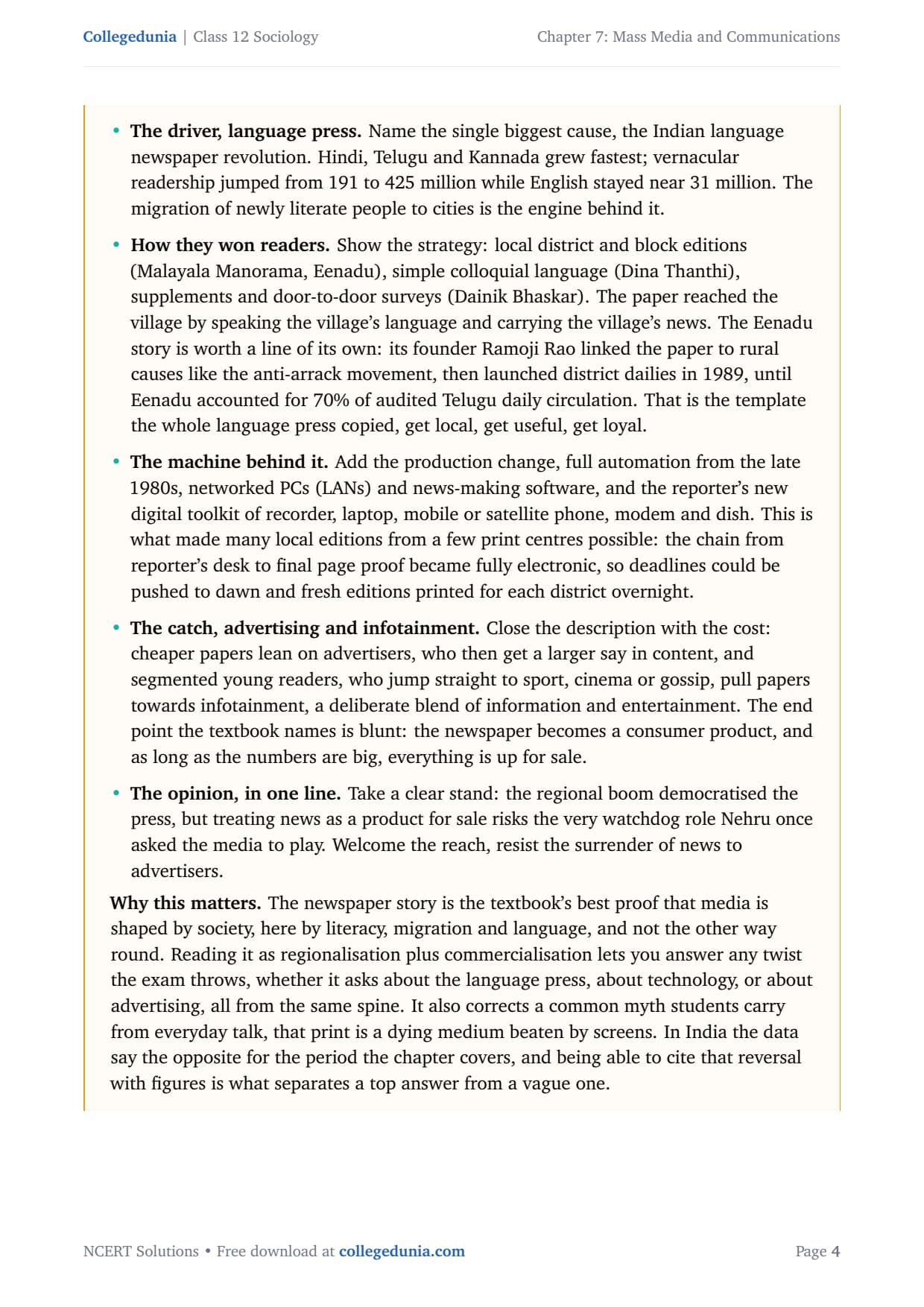
Structural observation. Hold the whole answer on one spine: in India,
print did not die, it regionalised. Once you see that the vernacular press
is the hero of this story, every other change, technology, local editions,
advertising, slots neatly underneath. I will lay the changes out as a clean
before-and-after, then sharpen the opinion into a single line you can defend.
The big reversal. Set the frame first: everyone expected TV and
the internet to finish newspapers, yet Indian circulation grew. Quote the
numbers so the examiner sees you know the chapter: 39.1 to 62.8 million
copies a day between 2006 and 2016.
The driver, language press. Name the single biggest cause, the
Indian language newspaper revolution. Hindi, Telugu and Kannada grew
fastest; vernacular readership jumped from 191 to 425 million while
English stayed near 31 million. The migration of newly literate people to
cities is the engine behind it.
How they won people. Show the strategy: local district and block
editions (Malayala Manorama, Eenadu), simple colloquial language (Dina
Thanthi), supplements and door-to-door surveys (Dainik Bhaskar). The
paper reached the village by speaking the village's language and carrying
the village's news. The Eenadu story is worth a line of its own: its
founder Ramoji Rao linked the paper to rural causes like the anti-arrack
movement, then launched district dailies in 1989, until Eenadu accounted
for 70% of audited Telugu daily circulation. That is the template the
whole language press copied, get local, get useful, get loyal.
The machine behind it. Add the production change, full
automation from the late 1980s, networked PCs (LANs) and news-making
software, and the reporter's new digital toolkit of recorder, laptop,
mobile or satellite phone, modem and dish. This is what made many local
editions from a few print centres possible: the chain from reporter's desk
to final page proof became fully electronic, so deadlines could be pushed
to dawn and fresh editions printed for each district overnight.
The catch, advertising and infotainment. Close the description
with the cost: cheaper papers lean on advertisers, who then get a larger
say in content, and segmented young people, who jump straight to sport,
cinema or gossip, pull papers towards infotainment, a deliberate blend of
information and entertainment. The end point the textbook names is blunt:
the newspaper becomes a consumer product, and as long as the numbers are
big, everything is up for sale.
The opinion, in one line. Take a clear stand: the regional boom
democratised the press, but treating news as a product for sale risks the
very watchdog role Nehru once asked the media to play. Welcome the reach,
resist the surrender of news to advertisers.
Why this matters. The newspaper story is the textbook's best proof that
media is shaped by society, here by literacy, migration and language, and not the
other way round. Reading it as regionalisation plus commercialisation lets you
answer any twist the exam throws, whether it asks about the language press, about
technology, or about advertising, all from the same spine. It also corrects a
common myth students carry from everyday talk, that print is a dying medium beaten
by screens. In India the data say the opposite for the period the chapter covers,
and being able to cite that reversal with figures is what separates a top answer
from a vague one.
Tracing the changes: Indian print regionalised rather than died, with
vernacular readership rising from 191 to 425 million (English near 31 million),
won through local editions, simple language and marketing, made possible by full
automation, but increasingly tied to advertisers and infotainment. My opinion:
the regional boom is a democratic gain, yet turning news into a consumer product
endangers serious journalism, so the press must keep its watchdog role.
Q 7.2
Is radio as a medium of mass communication dying out? Discuss the
potential that FM stations have in post-liberalisation India.
Concept used.Radio is one of the oldest forms of mass media in
India, run for decades mainly by the state through All India Radio
(AIR). The question has two parts: first decide whether radio is dying
out (you must take a view and support it), then discuss the
potential of FM stations after liberalisation, the policy
since the 1990s that let private players enter. The textbook's evidence points to
one clear answer: radio is not dying; private FM has given it a fresh boost.
Read the question as ``no, and here is why''.
The phrasing invites you to disagree. Argue clearly that radio is not
dying out, back it with AIR's huge reach and the arrival of FM, then spend the
rest of the answer on FM's potential.
Part 1: is radio dying out? No.
AIR's reach is enormous. Radio is far from dead. AIR operates a
three-tiered service, national, regional and local, to cover India's
geographic, linguistic and cultural diversity. It has grown to 480
stations and 681 transmitters covering 99% of the population over 92% of
the country's area.
A mass public already exists. In 2000, around 110 million
households, about two-thirds of all Indian households, were listening to
radio in 24 languages and 146 dialects, and more than a third of them
were rural. The transistor revolution of the 1960s, which made sets mobile
and cheap, first put radio within reach of ordinary people.
FM gave radio a fresh boost. The arrival of privately owned FM
radio stations in 2002 boosted entertainment programming over radio. Far
from fading, radio gained a new, lively, urban-focused life through FM. So
the medium is changing form, not dying.
Part 2: the potential of FM stations in post-liberalisation India.
Entertainment and a young urban public. Private FM channels
are popular among young urban professionals and students. Because they are
not allowed to broadcast political news bulletins, many specialise in
particular kinds of popular music to hold their listeners; one channel's
slogan is ``All hits all day!''. Big media houses run them, such as Radio
Mirchi (Times of India group), Red FM (Living Media) and Radio City (Star
Network).
Growing demand for local news and culture. The demand for local
news is growing, and the number of homes listening to FM has reinforced
the worldwide trend of big networks being replaced by local
radio. FM is well placed to serve specific local cultures and tastes.
Community radio at the grassroots. The chapter's example of
Raghav Mahato's village FM station in Bihar shows the potential vividly.
Run cheaply out of a small repair shop, it plays film songs and
broadcasts public-interest messages on HIV and polio, local news and
alerts on missing children to villagers within a 20 km radius. It shows
how FM can cater to local cultures and serve real community needs.
Room to grow further. The textbook says the potential for FM is
``enormous''. Further privatisation of radio stations and the emergence of
community-owned radio stations would lead to the growth of radio
and meet the rising demand for local content.
No, radio is not dying out. AIR reaches 99% of the population through
480 stations, and around two-thirds of Indian households were already radio
listeners in 2000. Private FM, allowed from 2002, has revived radio with
entertainment for young urban listeners (Radio Mirchi, Red FM, Radio City). The
potential of FM is enormous: it can serve growing demand for local news and
culture, support community radio like Raghav Mahato's village station in Bihar,
and grow further through more privatisation and community-owned stations.
DM
Devansh Mehta
M.A. Sociology, University of Hyderabad
Verified Expert
Strategic angle. Split the answer into two halves and give each its own
weight. Half one is a quick, evidence-backed ``no, radio is not dying''. Half two,
the bigger half, is FM's potential, which I would group into three buckets:
entertainment, the local turn, and community radio. Buckets stop you from rambling
and let the examiner tick each point.
Settle the ``dying'' question fast. One line plus one statistic:
radio is alive, AIR covers 99% of people through 480 stations, and
two-thirds of households listened in 2000. Then pivot to FM, which gave
radio a second wind in 2002.
Bucket one, entertainment reach. FM caught the young urban
public with non-stop popular music, since by rule it cannot air its own
political news bulletins, which is why so many channels specialise in
``particular kinds'' of popular music with slogans like ``All hits all
day!''. Drop the corporate names, Radio Mirchi (Times of India group), Red
FM (Living Media) and Radio City (Star Network), to show it is a serious
commercial sector backed by media conglomerates, not a hobby.
Bucket two, the local turn. Tie FM to the global shift from big
networks to local radio and to India's rising demand for local news. FM's
strength is being close to a place and its tastes. The chapter even notes
that the number of homes listening to FM in India has reinforced this
worldwide trend of networks being replaced by local radio, so FM is riding
a structural change, not a passing fashion.
Bucket three, community radio. Use Raghav Mahato's Bihar station
as your clinching example: cheap kit run out of a thatched-roof electronics
shop, film songs, and genuinely useful messages on HIV, polio and missing
children for villagers within a 20 km radius, broadcast for up to 12 hours
a day. This is FM's social potential made concrete, and it shows the
ingenuity of a village youth meeting the need to cater to local cultures.
End on the runway ahead. Quote the chapter's own word,
``enormous'', and name the two engines of further growth, more
privatisation of radio stations and the emergence of community-owned
stations, both of which would meet the growing demand for local news.
Why this matters. Radio is the textbook's clearest case of an ``old''
medium reinventing itself under liberalisation. Showing that it survived by going
local and private, rather than dying against TV and the internet, proves you
understand the chapter's core idea: media forms are reshaped by their economic and
political context, not simply replaced by newer technology. It is also a useful
contrast with the print answer: there the market mainly meant advertising, here it
meant a whole new tier of stations and voices, so liberalisation does not act the
same way on every medium, and a strong answer notices that.
Radio is not dying. AIR reaches 99% of the population and two-thirds of
households listened in 2000; private FM from 2002 revived it. FM's potential in
post-liberalisation India is enormous across three fronts: entertainment for young
urban listeners (Radio Mirchi, Red FM, Radio City), the worldwide shift to local
radio amid rising demand for local news, and grassroots community radio like
Raghav Mahato's Bihar station, with further growth promised by more privatisation
and community-owned stations.
Q 7.3
Trace the changes that have been happening in the medium of television.
Discuss.
Concept used.Television in India moved from a single
state-controlled service to a crowded private satellite market. The command words
are trace (set out the changes in order) and discuss (add some
comment and weigh up the effects). The clearest way to trace television is to walk
through three phases: its early state-led, development-focused years; its
commercialisation in the 1980s; and the explosion of private satellite channels
after liberalisation in the 1990s.
Why television began
Television was introduced experimentally in India as early as 1959 to promote
rural development. The SITE experiment (1975 to 1976) beamed
instructional programmes directly to community sets in rural areas of six states.
The medium began as a tool of development, not entertainment.
Phase 1: state-led, development television.
Television started experimentally in 1959 to promote rural development.
The SITE experiment (1975 to 1976) broadcast directly to about 2,400
community TV sets in rural areas of six states for four hours daily.
Doordarshan set up stations in Delhi, Mumbai, Srinagar and
Amritsar by 1975, with Kolkata, Chennai and Jalandhar added within a year.
Each centre mixed news, children's, women's and farmers' programmes with
entertainment.
Phase 2: commercialisation in the 1980s.
As programmes were allowed to carry advertisements, the target public
shifted towards the urban consuming class and entertainment programmes
grew. Colour broadcasting arrived with the 1982 Asian Games in Delhi.
Indigenous soap operas like Hum Log (1984 to 85) and
Buniyaad (1986 to 87), and the epics Ramayana (1987 to 88)
and Mahabharata (1988 to 90), were hugely popular and pulled in
large advertising revenue, marking the commercialisation of Doordarshan.
Hum Log also used the entertainment-education strategy,
slipping social messages on gender equality and small families into a
drama.
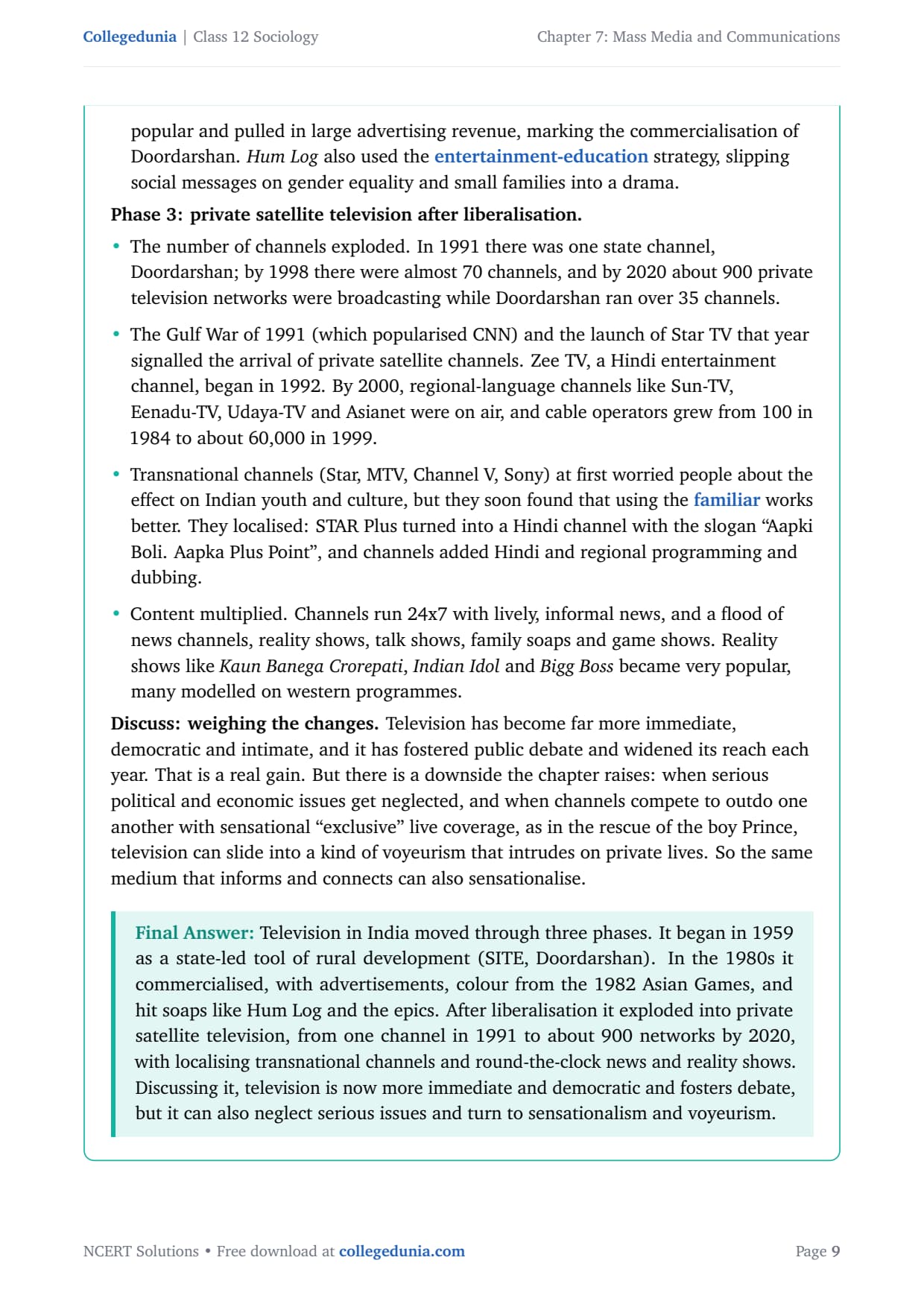
Phase 3: private satellite television after liberalisation.
The number of channels exploded. In 1991 there was one state channel,
Doordarshan; by 1998 there were almost 70 channels, and by 2020 about 900
private television networks were broadcasting while Doordarshan ran over 35
channels.
The Gulf War of 1991 (which popularised CNN) and the launch of Star TV
that year signalled the arrival of private satellite channels. Zee TV, a
Hindi entertainment channel, began in 1992. By 2000, regional-language
channels like Sun-TV, Eenadu-TV, Udaya-TV and Asianet were on air, and
cable operators grew from 100 in 1984 to about 60,000 in 1999.
Transnational channels (Star, MTV, Channel V, Sony) at first worried
people about the effect on Indian youth and culture, but they soon found
that using the familiar works better. They localised: STAR Plus
turned into a Hindi channel with the slogan ``Aapki Boli. Aapka Plus
Point'', and channels added Hindi and regional programming and dubbing.
Content multiplied. Channels run 24x7 with lively, informal news, and a
flood of news channels, reality shows, talk shows, family soaps and game
shows. Reality shows like Kaun Banega Crorepati, Indian Idol
and Bigg Boss became very popular, many modelled on western
programmes.
Discuss: weighing the changes. Television has become far more immediate,
democratic and intimate, and it has fostered public debate and widened its reach
each year. That is a real gain. But there is a downside the chapter raises: when
serious political and economic issues get neglected, and when channels compete to
outdo one another with sensational ``exclusive'' live coverage, as in the rescue
of the boy Prince, television can slide into a kind of voyeurism that intrudes on
private lives. So the same medium that informs and connects can also sensationalise.
Television in India moved through three phases. It began in 1959 as a
state-led tool of rural development (SITE, Doordarshan). In the 1980s it
commercialised, with advertisements, colour from the 1982 Asian Games, and hit
soaps like Hum Log and the epics. After liberalisation it exploded into private
satellite television, from one channel in 1991 to about 900 networks by 2020,
with localising transnational channels and round-the-clock news and reality shows.
Discussing it, television is now more immediate and democratic and fosters debate,
but it can also neglect serious issues and turn to sensationalism and voyeurism.
IB
Ishita Banerjee
M.A. Media and Cultural Studies, Jadavpur University
Verified Expert
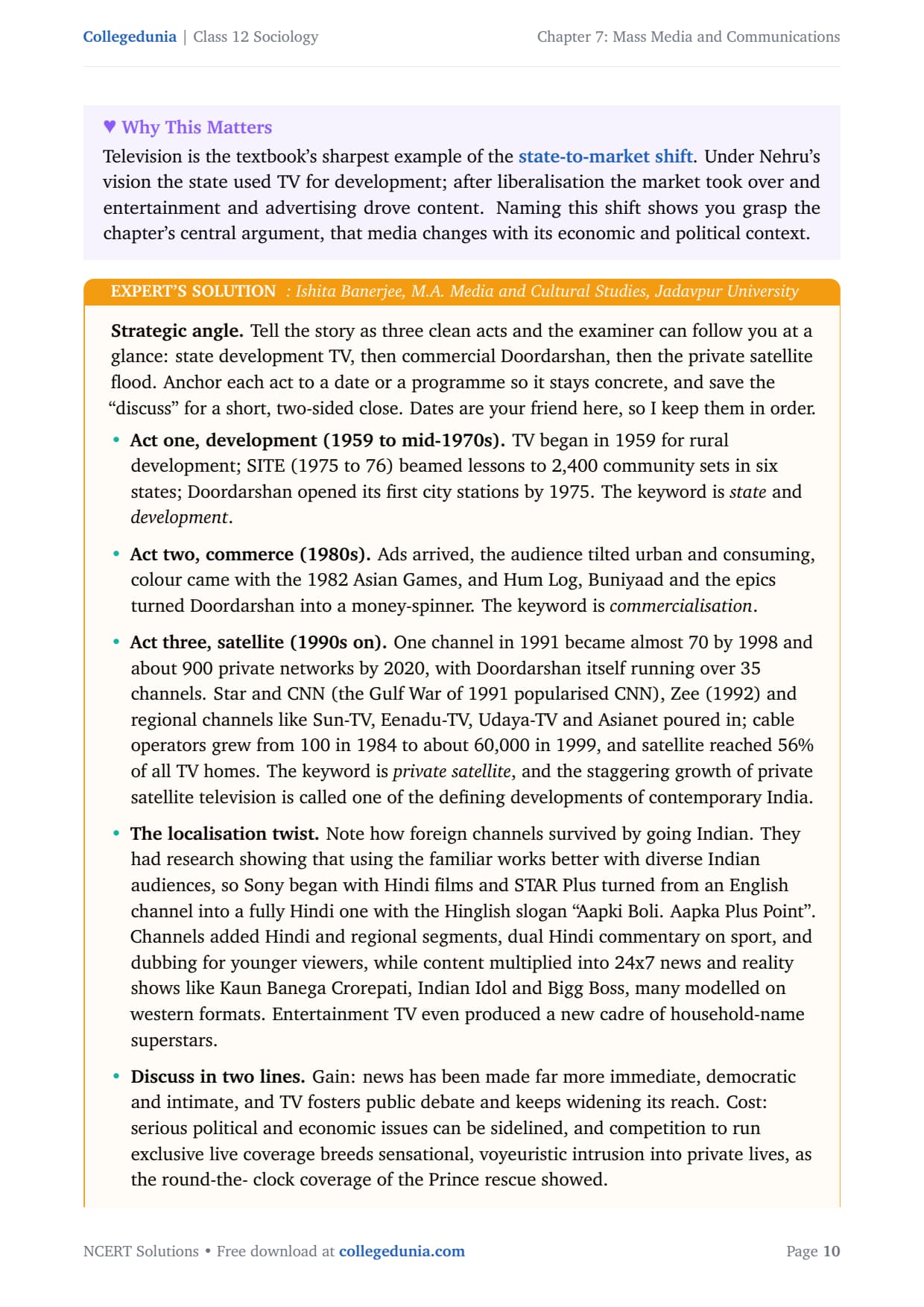
Strategic angle. Tell the story as three clean acts and the examiner can
follow you at a glance: state development TV, then commercial Doordarshan, then the
private satellite flood. Anchor each act to a date or a programme so it stays
concrete, and save the ``discuss'' for a short, two-sided close. Dates are your
friend here, so I keep them in order.
Act one, development (1959 to mid-1970s). TV began in 1959 for
rural development; SITE (1975 to 76) beamed lessons to 2,400 community sets
in six states; Doordarshan opened its first city stations by 1975. The
keyword is state and development.
Act two, commerce (1980s). Ads arrived, the public tilted urban
and consuming, colour came with the 1982 Asian Games, and Hum Log,
Buniyaad and the epics turned Doordarshan into a money-spinner. The keyword
is commercialisation.
Act three, satellite (1990s on). One channel in 1991 became
almost 70 by 1998 and about 900 private networks by 2020, with Doordarshan
itself running over 35 channels. Star and CNN (the Gulf War of 1991
popularised CNN), Zee (1992) and regional channels like Sun-TV, Eenadu-TV,
Udaya-TV and Asianet poured in; cable operators grew from 100 in 1984 to
about 60,000 in 1999, and satellite reached 56% of all TV homes. The
keyword is private satellite, and the staggering growth of private
satellite television is called one of the defining developments of
contemporary India.
The localisation twist. Note how foreign channels survived by
going Indian. They had research showing that using the familiar works
better with diverse Indian publics, so Sony began with Hindi films and
STAR Plus turned from an English channel into a fully Hindi one with the
Hinglish slogan ``Aapki Boli. Aapka Plus Point''. Channels added Hindi and
regional segments, dual Hindi commentary on sport, and dubbing for younger
viewers, while content multiplied into 24x7 news and reality shows like
Kaun Banega Crorepati, Indian Idol and Bigg Boss, many modelled on western
formats. Entertainment TV even produced a new cadre of household-name
superstars.
Discuss in two lines. Gain: news has been made far more
immediate, democratic and intimate, and TV fosters public debate and keeps
widening its reach. Cost: serious political and economic issues can be
sidelined, and competition to run exclusive live coverage breeds
sensational, voyeuristic intrusion into private lives, as the round-the-
clock coverage of the Prince rescue showed.
Why this matters. Television compresses the whole chapter into one
medium: the move from a state-guided, development role to a market-driven,
entertainment one is exactly the dialectic between media and society the chapter
is built on. Telling it as three dated acts lets you trace and discuss in the same
breath, which is what the question rewards. Keep one nuance ready for a higher
mark: the change is not simply ``state bad, market good'' or the reverse. State TV
spread literacy and development messages but offered little choice; private TV
multiplied choice and immediacy but can chase sensation over substance. Showing
both sides is how you turn a list of dates into genuine discussion.
Television passed through three acts: state development TV (1959, SITE,
early Doordarshan); commercial Doordarshan in the 1980s (ads, colour from 1982,
Hum Log and the epics); and a private satellite explosion after 1991 (one channel
to about 900 by 2020, Star and Zee, localised foreign channels, 24x7 news and
reality shows). Discussing it, TV became more immediate and democratic and
fostered debate, but it can neglect serious issues and turn sensational and
voyeuristic.
FAQs on Mass Media and Communications Class 12 NCERT Solutions
Mass Media and Communications Class 12 Sociology Common Questions
Ques. Where can I get the class 12 sociology chapter 7 NCERT Solutions PDF?
Ans. You can download the Mass Media and Communications Class 12 Sociology NCERT Solutions PDF directly from this page. It is free, follows the 2026-27 NCERT, and answers all 3 exercise questions point by point.
Ques. How many questions are there in mass media and communications class 12 questions and answers?
Ans. The chapter has 3 exercise questions. They ask students to trace changes in the newspaper industry, discuss whether radio is dying out, and trace the changes in television, each with a reasoned opinion.
Ques. Why did Indian language newspapers grow instead of falling?
Ans. The vernacular press grew because it reached newly literate people in small towns and villages, ran local district editions, used cheaper modern printing, and met needs that English city papers ignored. This Indian language newspaper revolution is the chapter's best example of print rising in the television age.
Ques. Is radio dying out as a medium in India?
Ans. No. All India Radio still reaches almost the whole country, a huge listening public already exists, and private FM gave radio a fresh boost with music, local news and community radio at the grassroots. The textbook treats radio as an old medium that found a new life after liberalisation.
Ques. How did television change after the 1990s?
Ans. After liberalisation, the single state channel Doordarshan was joined by many private satellite channels in several languages. Television shifted from a development tool to a fast-growing, advertising-funded market with news, entertainment and regional programming that reaches very large numbers of viewers.
Ques. Is class 12 sociology chapter 7 easy to score in the board exam?
Ans. Yes. It is a high-scoring chapter if you keep print, radio and television separate and remember one named example for each. Always add a short reasoned opinion, because every question here asks for your view as well as the facts.








Comments