Sociology Mentor, Ashoka | Updated on - Jul 21, 2026
The NCERT Solutions for Class 12 Sociology Chapter 1 Introducing Indian Society answer every textbook question on what makes sociology a distinct subject, self-reflexivity, common sense versus a sociological view, and the link between personal troubles and social issues, set to the latest 2026-27 CBSE syllabus. Each answer is written in plain points so students can revise fast and write full board answers.
Covers all 13 exercise questions from Indian Society Chapter 1, with point-wise model answers.
This Class 12 Sociology chapter usually carries 4 to 6 marks per board paper.
Pairs with the Notes, Handwritten Notes and NCERT Book PDF linked lower on this page.
Every solution for Class 12 Sociology Chapter 1 in this Collegedunia compilation is written by subject experts from the official NCERT Indian Society textbook, and checked against the last five years of CBSE board papers.
Student Feedback: In a Collegedunia poll of 7,640 Class 12 Sociology students taken before the 2026 boards, 68% of students rated the difference between personal troubles and social issues as the part of this chapter they wanted model answers for. Most students said one clear example, like one person without a job versus mass unemployment, made the idea click at once.
Source: 2026-27 Class 12 Sociology student poll. Sample of 7,640 students from CBSE schools across 12 states.
What the Introducing Indian Society Class 12 Chapter Is About
Introducing Indian Society is the first chapter of Indian Society, and it is unusual: it has no summary boxes and no glossary. Instead it asks students to read it on their own and think for themselves. The chapter sets up the sociological point of view that the rest of the book will use.
The chapter answers a few big questions that students must keep in mind:
What is special about sociology? It studies society itself, links the personal to the social, and turns a critical eye on what we take for granted.
Why must we "unlearn" first? Because we already live in society, our common-sense ideas can block a clear, sociological view.
How did modern India take shape? Colonialism reshaped the economy and society, and out of the response to it grew Indian nationalism.
So the chapter is really about learning to see society in a new way. A student who sorts each idea under "what sociology is", "unlearning common sense" or "colonialism and nationalism" can connect almost any question in Introducing Indian Society class 12 back to one of these threads. That is why revision works best when you label each point before you learn it.
Key Terms This Chapter Builds On
Before the questions, the chapter fixes a short set of ideas. Almost every answer in the exercise leans on one of them, so students should learn these first. The table below keeps each term next to a plain meaning for quick revision.
Term
What it means
Sociology
The systematic study of human society and the relationships within it.
Self-reflexivity
A constant self-questioning of our own ideas, biases and social position.
Sociological imagination
The skill of linking a person's private life to wider public forces.
Common sense
Everyday, taken-for-granted knowledge that sociology tests rather than trusts.
Socialisation
The process by which we learn the norms and values of our society.
A key insight for the exam is that sociology is a way of looking, not just a list of facts. The same event, like one person losing a job, looks personal at first but becomes a social issue once you ask how many others share it and why. An answer that makes this shift scores higher than one that only states a definition.
Why Sociology Is a Distinct Subject
The first exercise question asks why sociology is distinct from all other subjects. This is the most-tested idea in the chapter, so students should learn it as a clear list rather than a story. The point is that sociology studies the very society the student lives in.
Its subject is society itself: other subjects study one slice of life, but sociology studies the whole web of social relationships.
The observer is part of the observed: unlike a scientist outside a test tube, the sociologist studies a society they already belong to.
It demands self-reflexivity: because we are inside society, we must keep questioning our own biases as we study it.
It links the personal and the social: it shows how private lives are shaped by larger social structures.
The honest exam point is that sociology is special because it studies us, by us. The sociologist cannot stand fully outside the subject, so the discipline trains students to be critical of their own taken-for-granted views. This is why self-reflexivity is treated as a core skill, not an optional extra.
Common Sense versus the Sociological Point of View
A regular short answer asks why sociology treats common sense as "partial". Students should know both what common sense is and why a sociological view goes further. The table sorts the contrast for fast recall.
Common sense
Sociological view
Taken for granted
Tested with evidence and questioned, not simply accepted.
Based on what we already "know"
Built on systematic observation and method.
Explains things by individual nature or fate
Explains things by social structures and forces.
Rarely asks where its ideas come from
Always asks how an idea was formed and whose interest it serves.
The key point examiners want is that common sense is "partial" because it explains too little and questions too little. It is useful as a starting point, but it often mistakes a social pattern for a personal failing. Sociology completes the picture by asking why the pattern exists across many people, which is exactly the move common sense skips.
Personal Troubles and Public Issues
The link between personal troubles and social issues, drawn from C. Wright Mills, is the most popular long answer in this chapter. Students should give a clear definition of each and then one shared example. The contrast below is what the examiner is looking for.
Personal troubles: private matters felt by one person within their own life and immediate relations, like a single individual losing one job.
Social issues: public matters that affect large groups and arise from how society is organised, like mass unemployment in a recession.
The bridge: the sociological imagination shows that many private troubles are really public issues in disguise, so the cause lies in society, not just the person.
A balanced answer notes that the same fact can be a private trouble for one person and a public issue for society. When one worker is jobless, it may be a personal trouble; when millions are jobless, the cause sits in the economy and it becomes a social issue. Marks come from giving both definitions and then the shared example that links them.
Why We Must Unlearn Before We Learn Sociology
A sharp exercise question asks why we need to "unlearn" before we can learn sociology. This is a short answer that turns on one idea, so students should state it plainly. The reasons below are what an examiner expects.
We are already members of society: we come to sociology with ready-made ideas about how the world works.
Those ideas can mislead: our common sense and prejudices may be wrong or one-sided, yet they feel obviously true.
Unlearning clears the way: only by setting aside these assumptions can we see society with fresh, critical eyes.
The honest point is that unlearning is needed precisely because we already live in society. Unlike a subject we meet for the first time, here we arrive full of opinions. Sociology asks us to question those opinions first, which is why self-reflexivity and unlearning go hand in hand throughout the chapter.
Colonialism, Nationalism and the Making of Modern India
The chapter closes by linking sociology to history. A regular long answer asks how colonialism shaped modern Indian society and gave rise to nationalism. The table keeps the two threads side by side.
What colonialism did
Why it mattered
Reshaped the economy
Tied India to world markets and changed how people earned a living.
Created new groups and ideas
Brought railways, cities, a press and Western education, which changed society.
Was deeply unequal and exploitative
The gains went to the colonial power, which bred resentment across regions.
Provoked a shared response
The struggle against colonial rule united diverse people into one nation.
One sharp point for this question: nationalism grew out of the very forces colonialism set in motion. The new communications, education and a sense of shared injustice let people across India imagine themselves as one nation. So modern India is best understood as a product of both colonial change and the national response to it, and a good answer names both halves.
Studying Our Own Society: Advantage and Disadvantage
One exercise question asks why studying our own society is both an advantage and a disadvantage. This is a two-part short answer, so students should give one of each. The balance below is what the examiner wants.
The advantage: we already know the society from the inside, so we grasp its customs, language and meaning quickly.
The disadvantage: that very closeness makes us take things for granted, so we may miss what an outsider would notice at once.
The resolution: self-reflexivity lets us use the inside view while still questioning it, getting the best of both.
A balanced answer notes that familiarity is both our strength and our blind spot. Being a member gives easy access, but it can dull our curiosity about practices we never think to question. The sociological habit of stepping back, even from the familiar, is what turns the disadvantage back into an advantage.
The Introducing Indian Society Class 12 Exercise-wise Coverage
The chapter exercise has 13 questions. The table maps each one to its topic so students can plan revision and find the right NCERT answer fast. The full point-wise solution for each sits in the question set lower on this page.
Question
Topic it tests
Q 1
Why sociology is a distinct subject compared with all others
Q 2
Main differences between sociology and other subjects
Q 3
Self-reflexivity and why it matters in sociology
Q 4
The idea of a social map and locating the individual on it
Q 5
Linking personal troubles to social issues, with discussion
Q 6
Why we need to unlearn before we can learn sociology
Q 7
Meaning of common sense and why sociology calls it partial
Q 8
Distinguishing personal troubles from social issues with an example
Q 9
The main themes of the chapters previewed in the book
Q 10
How colonialism shaped modern India and gave rise to nationalism
Q 11
Studying our own society as both an advantage and a disadvantage
Q 12
Looking at India sociologically rather than through common sense
Q 13
How socialisation shapes the viewpoint from which we see society
Questions 1, 5 and 10 are the most-asked long answers, so students preparing Introducing Indian Society class 12 important questions should learn those first. The self-reflexivity and common-sense items (Q3 and Q7) are quick scorers once the sociological point of view is clear in your head.
Students who want the offline copy can save the class 12 sociology chapter 1 pdf from the download card above and tick off each question as they finish it.
Introducing Indian Society Important Questions and Previous Year Trends
CBSE sets a steady mix of short and long answers from this chapter. Knowing the pattern helps students decide how much to write. The chapter is a regular source of one 4-mark or 6-mark question, which is why a focused list of Introducing Indian Society important questions saves a lot of revision time.
Long answer (6 marks): the link between personal troubles and social issues, or how colonialism gave rise to nationalism.
Short answer (4 marks): self-reflexivity, or why sociology treats common sense as partial.
Conceptual: why we must unlearn before learning sociology, and the idea of a social map.
Objective and MCQ: the meaning of sociology, socialisation, self-reflexivity and the sociological imagination.
For quick recall before the exam, students often practise the class 12 sociology chapter 1 mcq set and a list of Introducing Indian Society class 12 important questions. The most repeated items are the troubles-versus-issues link and self-reflexivity, so keep those answer points ready in your own words.
Working through the ncert solutions class 12 sociology chapter 1 set twice, once open-book and once from memory, fixes the terms and ideas well before the board exam.
Common Mistakes Students Make in This Chapter
A few errors cost marks every year in this chapter. Most come from treating sociology as just facts or giving only one side of the troubles-versus-issues link. Avoiding them is the fastest way to lift a score.
Defining sociology as a list of facts, not a critical way of looking at society.
Explaining a personal trouble as a social issue without the linking example, or vice versa.
Calling common sense simply "wrong" - it is partial, a useful but incomplete starting point.
Forgetting self-reflexivity, the habit of questioning our own biases as we study.
Writing about colonialism with no mention of how it gave rise to nationalism.
Students who fix these five points usually move from average to high marks on the long answers. The exam rewards answers that tie a private fact back to society, so always add the "why" behind the example.
Introducing Indian Society PDF Download Formats and Languages
The solutions are free to download in more than one format, so students can pick what suits their device and revision style. The download card at the top of the page carries each option for this chapter.
Normal and HD PDF: the class 12 sociology chapter 1 pdf comes in a normal size for quick downloads and an HD version for clear printing.
English medium: all 13 answers are written in simple English for the CBSE board paper.
Question-only set: a print-and-practise sheet of Introducing Indian Society extra questions for self-testing.
Whole-book pack: the solutions sit in one set that runs through every Indian Society chapter, so you can revise from Chapter 1 onwards in one place.
Many students search for class 12 sociology chapter 1 answers on their phone the night before a test, so a saved PDF means you can revise even without internet. Keep both the question set and the solved version handy for a full self-check.
How the Introducing Indian Society Solutions Pair with Notes and the Book PDF
These NCERT Solutions answer the back-exercise questions. To revise the full chapter, students should use them alongside the other resources for the same chapter, all linked in the table below.
Reading the original NCERT chapter text and its preview of the book
Tip: read the Notes first, then attempt these solutions on your own, and only then check the model answers here. That order builds memory faster than copying answers straight away.
All NCERT Solutions for Class 12 Sociology
The table links the NCERT Solutions for every chapter in both Class 12 Sociology books, so students can move across the course in one click. Introducing Indian Society is highlighted.
All NCERT Solutions for Introducing Indian Society with Step-by-Step Solutions
Below are all 13 NCERT exercise questions for this chapter, exactly as they appear in the textbook. Tap Check Solution for the model answer or Expert Solution for the topper-style approach.
Q 1.1
Why is sociology a distinct subject in comparison with all other subjects?
Concept used. Sociology is the systematic study of human society
and social relationships. What makes it distinct is its starting point:
unlike every other school subject, no student comes to sociology from zero,
because everyone already knows a great deal about society simply from
growing up in it. This prior, untaught knowledge is called
common sense.
No one starts from zero. History, Geography, Psychology or Economics
are learnt because they are taught at school or home. A six year old
is not expected to know them. But even a small child already knows
plenty about society and social relationships, picked up
``naturally'' while growing up. So sociology begins with a learner
who is already full of ideas about its subject.
This prior knowledge is both an advantage and a disadvantage. The
advantage is that students are usually not afraid of sociology and
feel it cannot be very hard. The disadvantage is bigger: to learn
sociology we first have to ``unlearn'' much of what we already
believe about society. The early stage of the subject is mostly
this unlearning.
Common sense is ``partial''. Our everyday knowledge of society comes
from one viewpoint: the social group and environment we are
socialised into. So it is partial in two senses, incomplete (it
shows only a part of social reality) and biased (it tilts towards
the interests of our own group). Sociology replaces this partial
view with a systematic, evidence-based one.
Sociology turns the gaze inward. It can even show us what we look
like to others and teach us to view ourselves ``from the outside'',
something no other subject sets out to do.
Sociology is distinct because its students already carry a stock of
untaught ``common-sense'' knowledge about society; learning the subject
means critically unlearning that partial, biased knowledge and replacing it
with a systematic, self-reflexive understanding.
AI
Ananya Iyer
M.A. Sociology, Delhi School of Economics
Verified Expert
Strategic angle. Frame your answer around a single contrast:
``taught knowledge'' versus ``lived knowledge''. Every other subject deals
in taught knowledge; sociology has to wrestle with the lived knowledge a
student already brings to class. Building the answer on that one axis keeps
it sharp.
Open with the contrast. In Maths or Geography the slate is blank and
the teacher fills it. In sociology the slate is already crowded with
beliefs, so the first job is to clean part of it, not just add to it.
Name the cost of lived knowledge. Because it comes from one social
location, it is partial and biased. I always give a quick example:
a city student and a village student ``know'' very different things
about caste or farming, and each thinks their version is simply
obvious.
Close with what sociology uniquely offers. Self-reflexivity, the
trained habit of turning a critical gaze back on yourself and your
own group. That move, more than any single fact, is what marks the
subject off from the rest.
Why this matters. Examiners reward students who show that
``everyone already knows society'' is exactly the difficulty, not a shortcut.
That insight is the heart of the chapter.
Sociology is unique because it starts from a learner already full of
partial common-sense ideas; its distinct task is to unlearn that bias and
study society systematically and self-reflexively.
Q 1.2
State the main differences between sociology and other subjects.
Concept used. The difference lies in how knowledge of the subject is
acquired and in the attitude the learner must take. Other subjects rest on
taught knowledge; sociology must also deal with prior
common-sense knowledge that every student already holds.
Source of knowledge. Other subjects are learnt only because they are
taught at school, home or elsewhere. Sociology starts with knowledge
that was acquired without any explicit teaching, just by living in
society.
The learner's starting point. In other subjects the student begins
more or less from zero. In sociology no one starts from zero;
everyone already knows something about society.
What learning involves. Other subjects mostly add new information. In
sociology the first task is to ``unlearn'' partial common sense
before fresh understanding can be built.
Attitude to one's own knowledge. Other subjects rarely ask you to
doubt your everyday beliefs. Sociology demands self-reflexivity: you
must turn a critical gaze on yourself and your own social group, slow
to praise and quick to question.
Sociology differs from other subjects in four ways: its knowledge is
acquired untaught (not only through teaching), the student never starts from
zero, learning requires unlearning partial common sense, and it insists on a
self-critical, self-reflexive attitude.
RV
Rohit Verma
M.A. Sociology, Jawaharlal Nehru University
Verified Expert
Structural observation. Notice this is just Question 1 asked the
other way round. If you have understood why sociology is distinct, the
``differences'' are simply that same idea split into clean columns. So I
answer it as a two-column comparison in my head: Other subjects on the left,
Sociology on the right.
Knowledge: taught, on the left; partly untaught and lived, on the
right.
Starting line: from zero, on the left; never from zero, on the right.
Method: add information, on the left; unlearn then rebuild, on the
right.
Stance: trust your knowledge, on the left; question yourself through
self-reflexivity, on the right.
Why this matters. Turning a ``differences'' question into a fixed
left-versus-right grid means you never freeze in the exam. You fill four rows
and you are done.
The core differences: taught versus lived knowledge, a blank versus
a crowded starting point, adding versus unlearning, and trusting versus
critically questioning your own ideas about society.
Q 1.3
What is self-reflexivity? Why is it important in sociology?
Concept used.Self-reflexivity (sometimes just reflexivity)
is the ability to reflect upon yourself, to turn your gaze, which is usually
directed outward at the world, back towards yourself. In sociology this
self-inspection must be critical: quick to criticise and slow to praise
oneself.
What it is. Normally we look outward and judge other people and
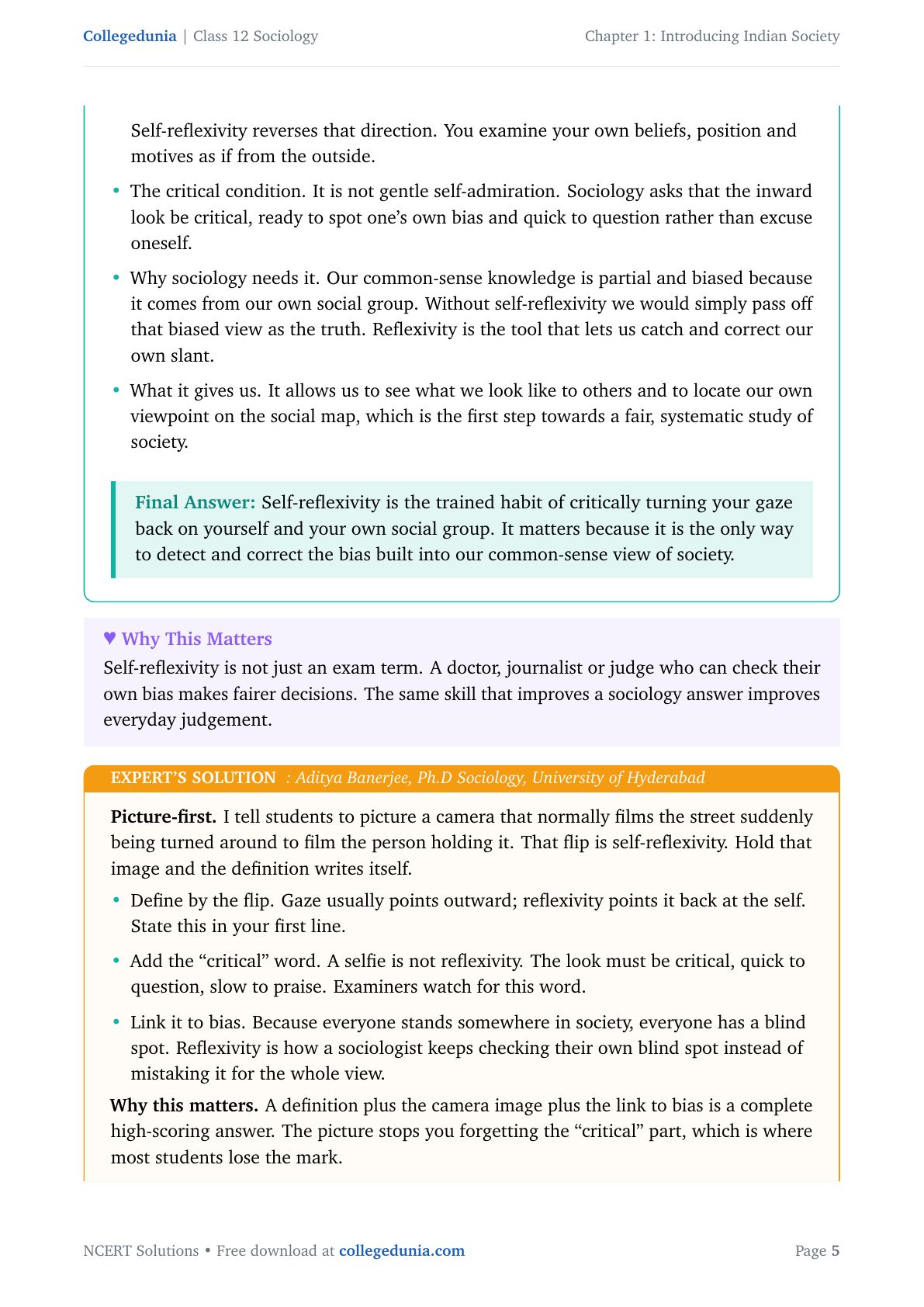
events. Self-reflexivity reverses that direction. You examine your
own beliefs, position and motives as if from the outside.
The critical condition. It is not gentle self-admiration. Sociology
asks that the inward look be critical, ready to spot one's own bias
and quick to question rather than excuse oneself.
Why sociology needs it. Our common-sense knowledge is partial and
biased because it comes from our own social group. Without
self-reflexivity we would simply pass off that biased view as the
truth. Reflexivity is the tool that lets us catch and correct our own
slant.
What it gives us. It allows us to see what we look like to others and
to locate our own viewpoint on the social map, which is the first
step towards a fair, systematic study of society.
Self-reflexivity is the trained habit of critically turning your
gaze back on yourself and your own social group. It matters because it is the
only way to detect and correct the bias built into our common-sense view of
society.
AB
Aditya Banerjee
Ph.D Sociology, University of Hyderabad
Verified Expert
Picture-first. I tell students to picture a camera that normally
films the street suddenly being turned around to film the person holding it.
That flip is self-reflexivity. Hold that image and the definition writes
itself.
Define by the flip. Gaze usually points outward; reflexivity points
it back at the self. State this in your first line.
Add the ``critical'' word. A selfie is not reflexivity. The look must
be critical, quick to question, slow to praise. Examiners watch for
this word.
Link it to bias. Because everyone stands somewhere in society,
everyone has a blind spot. Reflexivity is how a sociologist keeps
checking their own blind spot instead of mistaking it for the whole
view.
Why this matters. A definition plus the camera image plus the link
to bias is a complete high-scoring answer. The picture stops you forgetting
the ``critical'' part, which is where most students lose the mark.
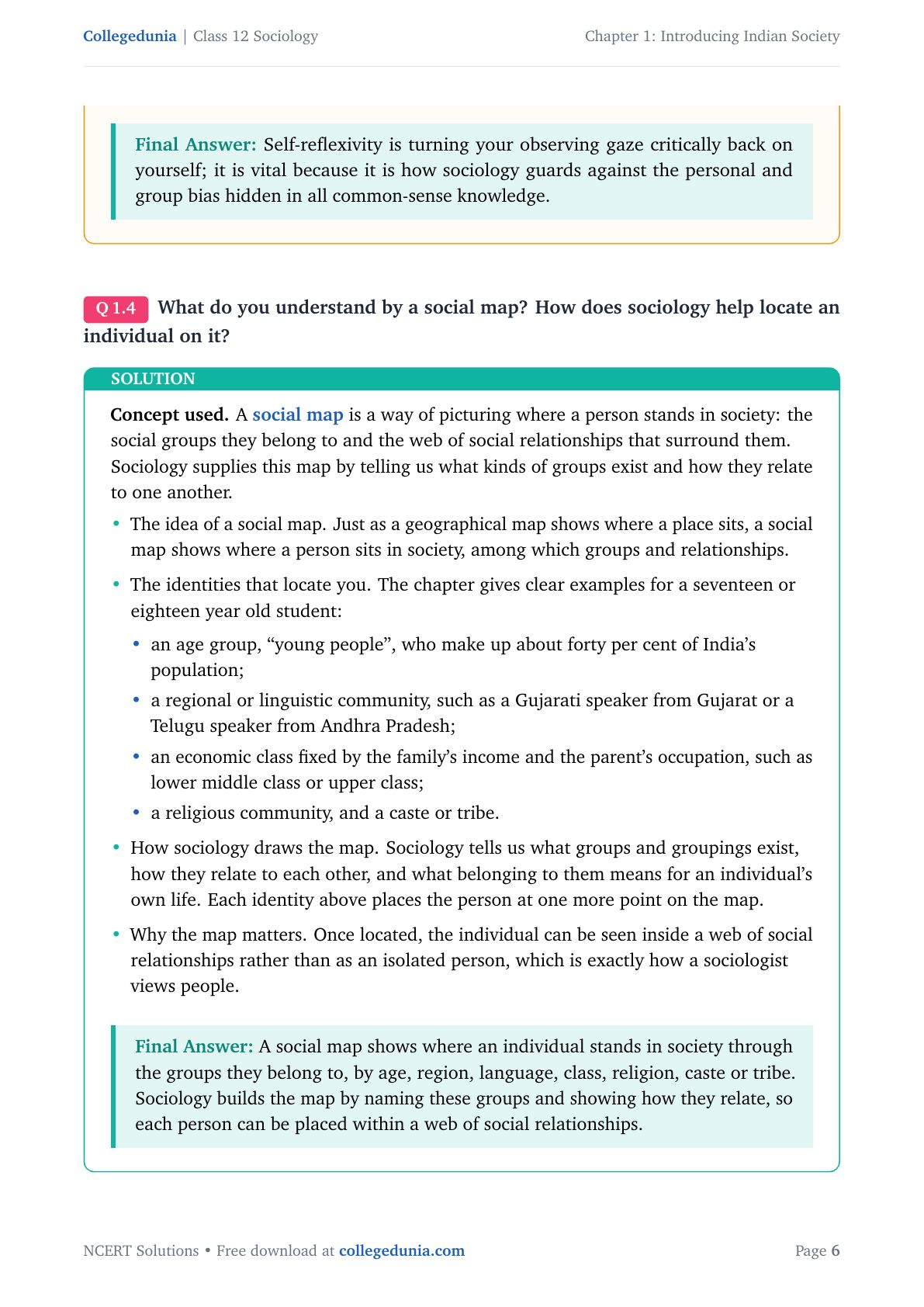
Self-reflexivity is turning your observing gaze critically back on
yourself; it is vital because it is how sociology guards against the personal
and group bias hidden in all common-sense knowledge.
Q 1.4
What do you understand by a social map? How does sociology help locate an individual on it?
Concept used. A social map is a way of picturing where a
person stands in society: the social groups they belong to and the web of
social relationships that surround them. Sociology supplies this map by
telling us what kinds of groups exist and how they relate to one another.
The idea of a social map. Just as a geographical map shows where a
place sits, a social map shows where a person sits in society, among
which groups and relationships.
The identities that locate you. The chapter gives clear examples for
a seventeen or eighteen year old student:
an age group, ``young people'', who make up about forty per
cent of India's population;
a regional or linguistic community, such as a Gujarati
speaker from Gujarat or a Telugu speaker from Andhra Pradesh;
an economic class fixed by the family's income and the
parent's occupation, such as lower middle class or upper
class;
a religious community, and a caste or tribe.
How sociology draws the map. Sociology tells us what groups and
groupings exist, how they relate to each other, and what belonging to
them means for an individual's own life. Each identity above places
the person at one more point on the map.
Why the map matters. Once located, the individual can be seen inside
a web of social relationships rather than as an isolated person, which
is exactly how a sociologist views people.
A social map shows where an individual stands in society through the
groups they belong to, by age, region, language, class, religion, caste or
tribe. Sociology builds the map by naming these groups and showing how they
relate, so each person can be placed within a web of social relationships.
PN
Priya Nair
M.A. Sociology, Indian Statistical Institute Kolkata
Verified Expert
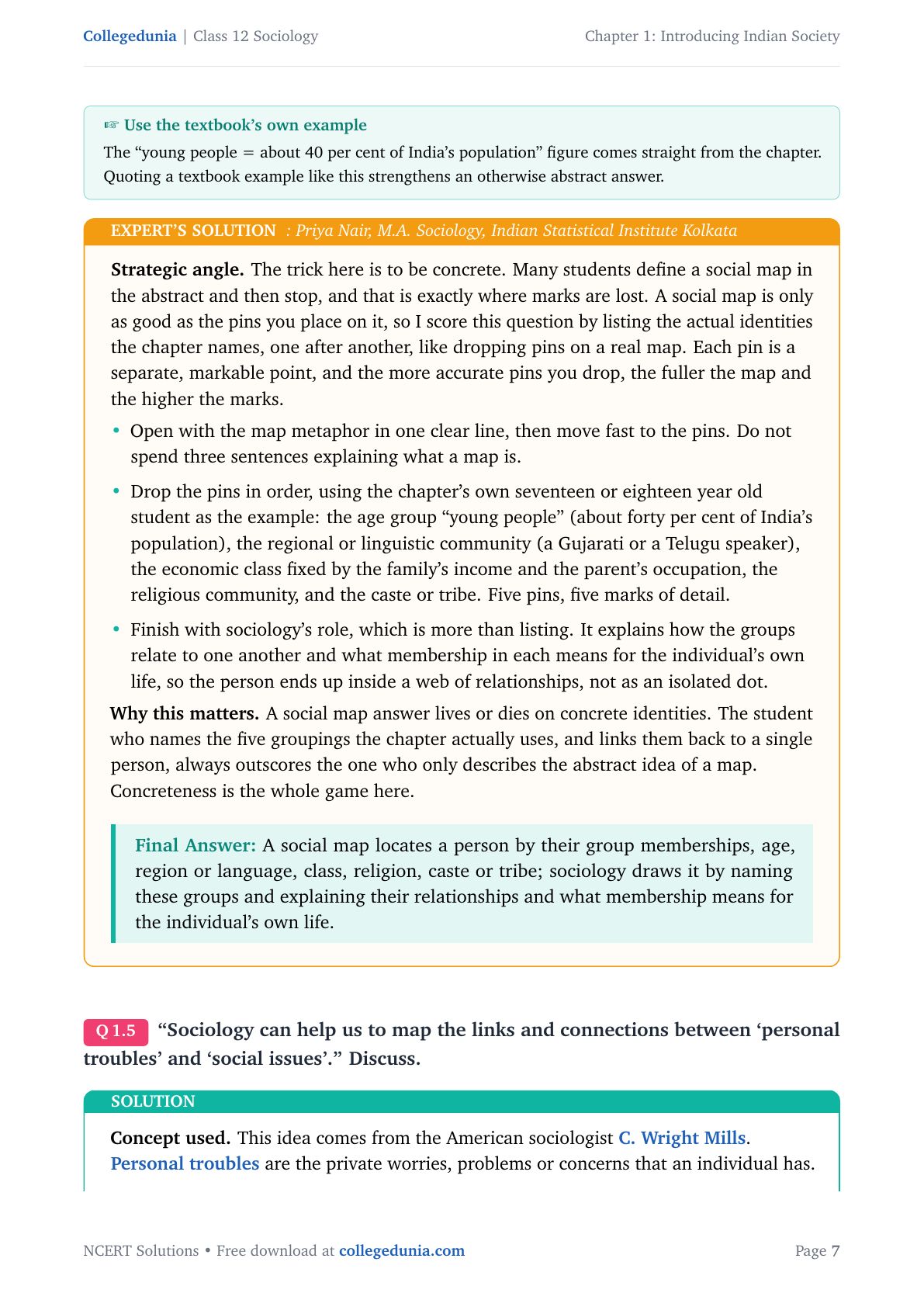
Strategic angle. The trick here is to be concrete. Many students
define a social map in the abstract and then stop, and that is exactly where
marks are lost. A social map is only as good as the pins you place on it, so I
score this question by listing the actual identities the chapter names, one
after another, like dropping pins on a real map. Each pin is a separate,
markable point, and the more accurate pins you drop, the fuller the map and
the higher the marks.
Open with the map metaphor in one clear line, then move fast to the
pins. Do not spend three sentences explaining what a map is.
Drop the pins in order, using the chapter's own seventeen or eighteen
year old student as the example: the age group ``young people'' (about
forty per cent of India's population), the regional or linguistic
community (a Gujarati or a Telugu speaker), the economic class fixed by
the family's income and the parent's occupation, the religious
community, and the caste or tribe. Five pins, five marks of detail.
Finish with sociology's role, which is more than listing. It explains
how the groups relate to one another and what membership in each means
for the individual's own life, so the person ends up inside a web of
relationships, not as an isolated dot.
Why this matters. A social map answer lives or dies on concrete
identities. The student who names the five groupings the chapter actually uses,
and links them back to a single person, always outscores the one who only
describes the abstract idea of a map. Concreteness is the whole game here.
A social map locates a person by their group memberships, age,
region or language, class, religion, caste or tribe; sociology draws it by
naming these groups and explaining their relationships and what membership
means for the individual's own life.
Q 1.5
``Sociology can help us to map the links and connections between `personal troubles' and `social issues'.'' Discuss.
Concept used. This idea comes from the American sociologist
C. Wright Mills. Personal troubles are the private
worries, problems or concerns that an individual has. Social issues
are matters that concern large groups, not the single individuals who make
them up. Sociology's power is to show the link between the two.
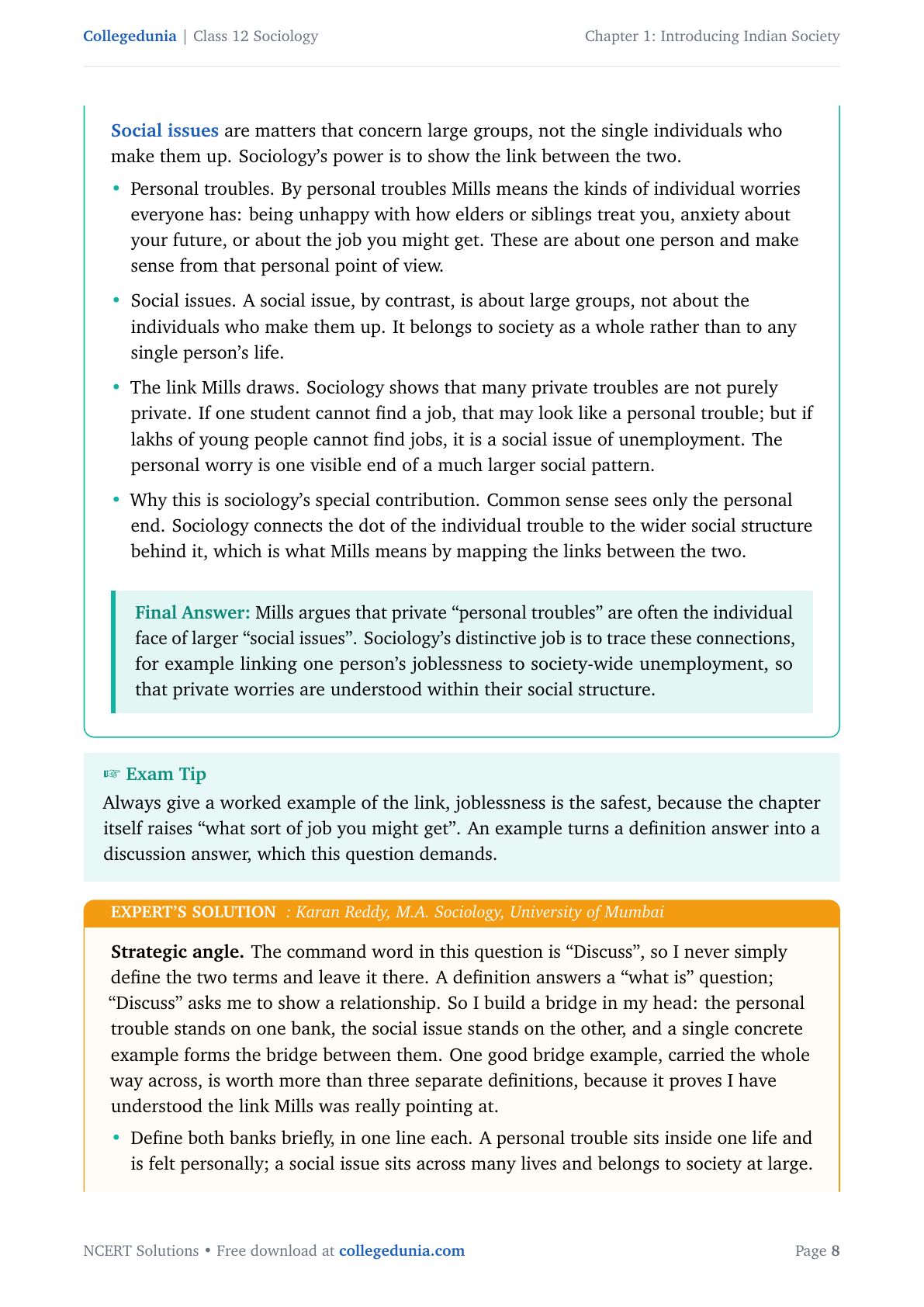
Personal troubles. By personal troubles Mills means the kinds of
individual worries everyone has: being unhappy with how elders or
siblings treat you, anxiety about your future, or about the job you
might get. These are about one person and make sense from that
personal point of view.
Social issues. A social issue, by contrast, is about large groups,
not about the individuals who make them up. It belongs to society as
a whole rather than to any single person's life.
The link Mills draws. Sociology shows that many private troubles are
not purely private. If one student cannot find a job, that may look
like a personal trouble; but if lakhs of young people cannot find
jobs, it is a social issue of unemployment. The personal worry is one
visible end of a much larger social pattern.
Why this is sociology's special contribution. Common sense sees only
the personal end. Sociology connects the dot of the individual trouble
to the wider social structure behind it, which is what Mills means by
mapping the links between the two.
Mills argues that private ``personal troubles'' are often the
individual face of larger ``social issues''. Sociology's distinctive job is to
trace these connections, for example linking one person's joblessness to
society-wide unemployment, so that private worries are understood within
their social structure.
KR
Karan Reddy
M.A. Sociology, University of Mumbai
Verified Expert
Strategic angle. The command word in this question is ``Discuss'', so
I never simply define the two terms and leave it there. A definition answers a
``what is'' question; ``Discuss'' asks me to show a relationship. So I build a
bridge in my head: the personal trouble stands on one bank, the social issue
stands on the other, and a single concrete example forms the bridge between
them. One good bridge example, carried the whole way across, is worth more
than three separate definitions, because it proves I have understood the link
Mills was really pointing at.
Define both banks briefly, in one line each. A personal trouble sits
inside one life and is felt personally; a social issue sits across many
lives and belongs to society at large.
Build the bridge with a single case, kept from the chapter's own
worry about ``what sort of job you might get''. One jobless graduate is
a personal trouble; lakhs of jobless graduates is the social issue of
unemployment, and the single trouble is a symptom of that larger issue.
State the payoff clearly. Sociology's gift is this bridge-building. It
stops us from blaming only the individual for their trouble and makes
us look instead at the social structure that produces so many similar
troubles at once.
Why this matters. The bridge framing answers the ``Discuss'' command
properly and shows the sociological imagination Mills was famous for, the
ability to see a private worry as the visible tip of a public pattern. That
move, not the definitions, is exactly what fetches the top band of marks.
Personal troubles are private; social issues are collective. Mills
and sociology connect them: a single person's trouble, like joblessness, is
usually one instance of a wider social issue, and learning to see that link is
sociology's special strength.
Q 1.6
Why do we need to ``unlearn'' before we can learn sociology?
Concept used. The idea of unlearning is central to this
chapter. Because everyone grows up inside society, we arrive at sociology
carrying a stock of ready-made beliefs, our common sense. Sociology cannot
simply add to this stock; it first has to clear away the partial and biased
parts of it.
We already ``know'' society. Knowledge about society is acquired
without explicit teaching, just by living. So unlike Maths or
Geography, the sociology student does not start with an empty mind but
with one already full of ideas.
This prior knowledge is partial. Our common sense is acquired from a
particular viewpoint, that of the social group we are socialised into.
It is therefore incomplete (it shows only part of social reality) and
biased (it tilts towards our own group's interests).
Why unlearning comes first. If we kept these partial beliefs, we would
mistake one group's view for the whole truth. So the initial stage of
learning sociology consists mainly of unlearning: questioning and
setting aside what we wrongly took to be obvious.
Unlearning is not erasing everything. Our common-sense beliefs are not
always wrong, but they are always partial. Sociology asks us to test
them rather than trust them blindly, and to rebuild a fuller, fairer
picture in their place.
We must unlearn first because we come to sociology already holding
partial, biased common-sense ideas about society. Learning the subject means
critically questioning and clearing those ideas so a systematic, complete
understanding can be built in their place.
VJ
Vivaan Joshi
M.A. Sociology, University of Pune
Verified Expert
Strategic angle. I treat this as a ``why first?'' question. The
examiner wants to know why unlearning has to come before learning, not just
what unlearning is. So I anchor the answer on the ``crowded slate'' image: you
cannot write clearly on a slate that is already covered in scribbles.
Establish the crowded slate. Every student arrives full of
common-sense beliefs about caste, family, money and gender.
Show why the scribbles mislead. They came from one social corner, so
they are partial and biased, yet they feel like plain truth.
Explain the order. You must rub out the misleading parts before fresh,
evidence-based understanding has room to be written. That is why
unlearning is the first stage, not an afterthought.
Why this matters. Getting the sequence right, unlearn then learn, is
the whole point. Students who explain the order, not just the term, stand out.
Unlearning must come first because our minds are already crowded
with partial, biased common sense; clearing the misleading parts is what makes
room for a systematic sociological understanding.
Q 1.7
What is meant by ``common sense'', and why does sociology treat it as ``partial''?
Concept used.Common sense is the untaught, everyday
knowledge about society that we pick up simply by living in it. Sociology
calls this knowledge partial, a word used here in two distinct
senses at once.
What common sense is. It is the knowledge of society we acquire
``naturally'' or ``automatically'' as we grow up, without anyone
formally teaching it. It feels obvious and is rarely questioned.
Its source. Common sense is acquired from a particular viewpoint, the
social group and environment we are socialised into. Our social
context shapes our opinions, beliefs and expectations about society.
First sense of ``partial'': incomplete. Because it comes from one
social position, common sense lets us see only a part of social
reality, never the whole. Here ``partial'' is the opposite of
``whole''.
Second sense of ``partial'': biased. Common sense leans towards the
viewpoints and interests of our own social group. Here ``partial'' is
the opposite of ``impartial''.
The takeaway. These beliefs are not necessarily wrong, but they are
always limited and slanted, which is exactly why sociology insists on
testing them rather than trusting them.
Common sense is the untaught everyday knowledge of society we absorb
while growing up. Sociology calls it ``partial'' in two senses: it is
incomplete, showing only part of social reality, and it is biased, tilted
towards our own group's interests.
AD
Aarav Desai
Ph.D Sociology, Jamia Millia Islamia
Verified Expert
Structural observation. This question has a built-in skeleton, and
spotting it is half the battle. There is one definition to give, and then the
single word ``partial'' has to be split into two distinct senses. I literally
number them in my mind as 1, 2a and 2b so that I never drop a part under exam
pressure. The examiner here is not testing whether you can define common
sense; that is the easy bit. They are testing whether you can hold both senses
of the same word at the same time, which is a subtler skill and where most
marks are won or lost.
Point 1, the definition: common sense is the untaught, lived knowledge
of society that we absorb naturally while growing up and that simply
feels obvious, so we rarely stop to question it.
Point 2a, partial as incomplete: because the knowledge comes from one
social position, it shows only the slice of society visible from where
you happen to stand, never the whole of social reality.
Point 2b, partial as biased: the same knowledge quietly favours your
own social group and its interests, so it is slanted, not neutral or
impartial.
Why this matters. The 1, 2a, 2b skeleton guarantees you cover the
full question every time. Many students define common sense well, then write
only one sense of ``partial'' and walk away thinking they are done, losing an
easy mark on the half they forgot. Naming both senses explicitly is the safest
way to secure the full score.
Common sense is lived, untaught knowledge of society; it is partial
because it is both incomplete (it shows only part of social reality) and biased
(it is slanted towards one's own social group).
Q 1.8
Distinguish between ``personal troubles'' and ``social issues'' with an example.
Concept used. The distinction is drawn by the sociologist
C. Wright Mills. Personal troubles are private worries
that belong to one individual; social issues concern large groups
and lie beyond any single person. Sociology connects the two.
Personal troubles. These are individual worries, problems or concerns,
for example being unhappy with how your family treats you, or anxiety
about your future and the job you might get. They make sense from one
person's point of view.
Social issues. These are about large groups, not about the individuals
who make them up. They belong to society at large, such as widespread
unemployment, communal tension or gender inequality.
The link, with an example. Take a single graduate who cannot find
work. As one person it is a personal trouble. But if lakhs of
graduates cannot find work, it becomes a social issue of unemployment.
The personal worry is one visible instance of the larger social
pattern.
Sociology's role. Common sense sees only the personal trouble.
Sociology shows how it connects to the social issue behind it, so we
look at social structures, not just individuals.
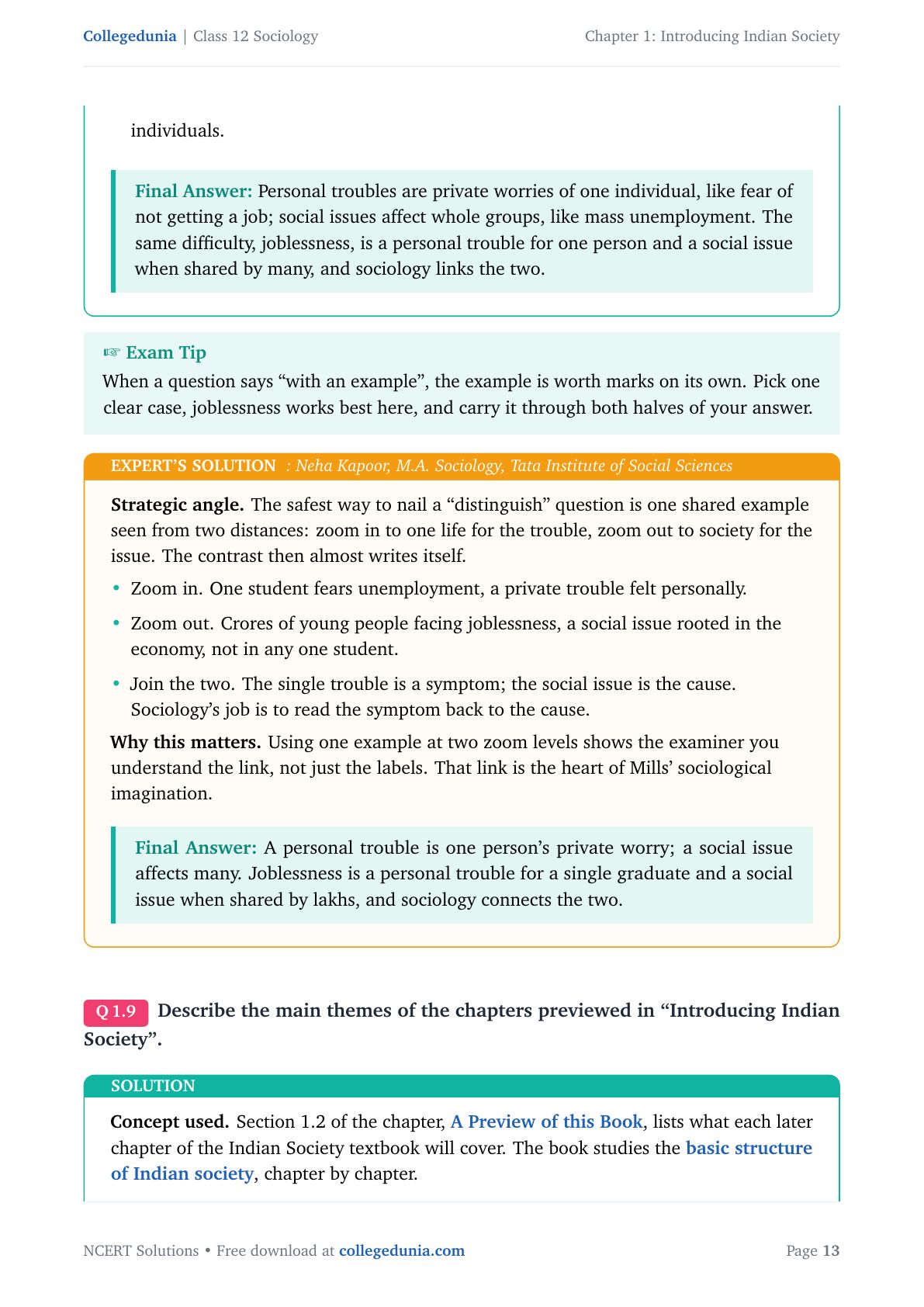
Personal troubles are private worries of one individual, like fear
of not getting a job; social issues affect whole groups, like mass
unemployment. The same difficulty, joblessness, is a personal trouble for one
person and a social issue when shared by many, and sociology links the two.
NK
Neha Kapoor
M.A. Sociology, Tata Institute of Social Sciences
Verified Expert
Strategic angle. The safest way to nail a ``distinguish'' question is
one shared example seen from two distances: zoom in to one life for the
trouble, zoom out to society for the issue. The contrast then almost writes
itself.
Zoom in. One student fears unemployment, a private trouble felt
personally.
Zoom out. Crores of young people facing joblessness, a social issue
rooted in the economy, not in any one student.
Join the two. The single trouble is a symptom; the social issue is the
cause. Sociology's job is to read the symptom back to the cause.
Why this matters. Using one example at two zoom levels shows the
examiner you understand the link, not just the labels. That link is the heart
of Mills' sociological imagination.
A personal trouble is one person's private worry; a social issue
affects many. Joblessness is a personal trouble for a single graduate and a
social issue when shared by lakhs, and sociology connects the two.
Q 1.9
Describe the main themes of the chapters previewed in ``Introducing Indian Society''.
Concept used. Section 1.2 of the chapter, A Preview of this
Book, lists what each later chapter of the Indian Society textbook will
cover. The book studies the basic structure of Indian society,
chapter by chapter.
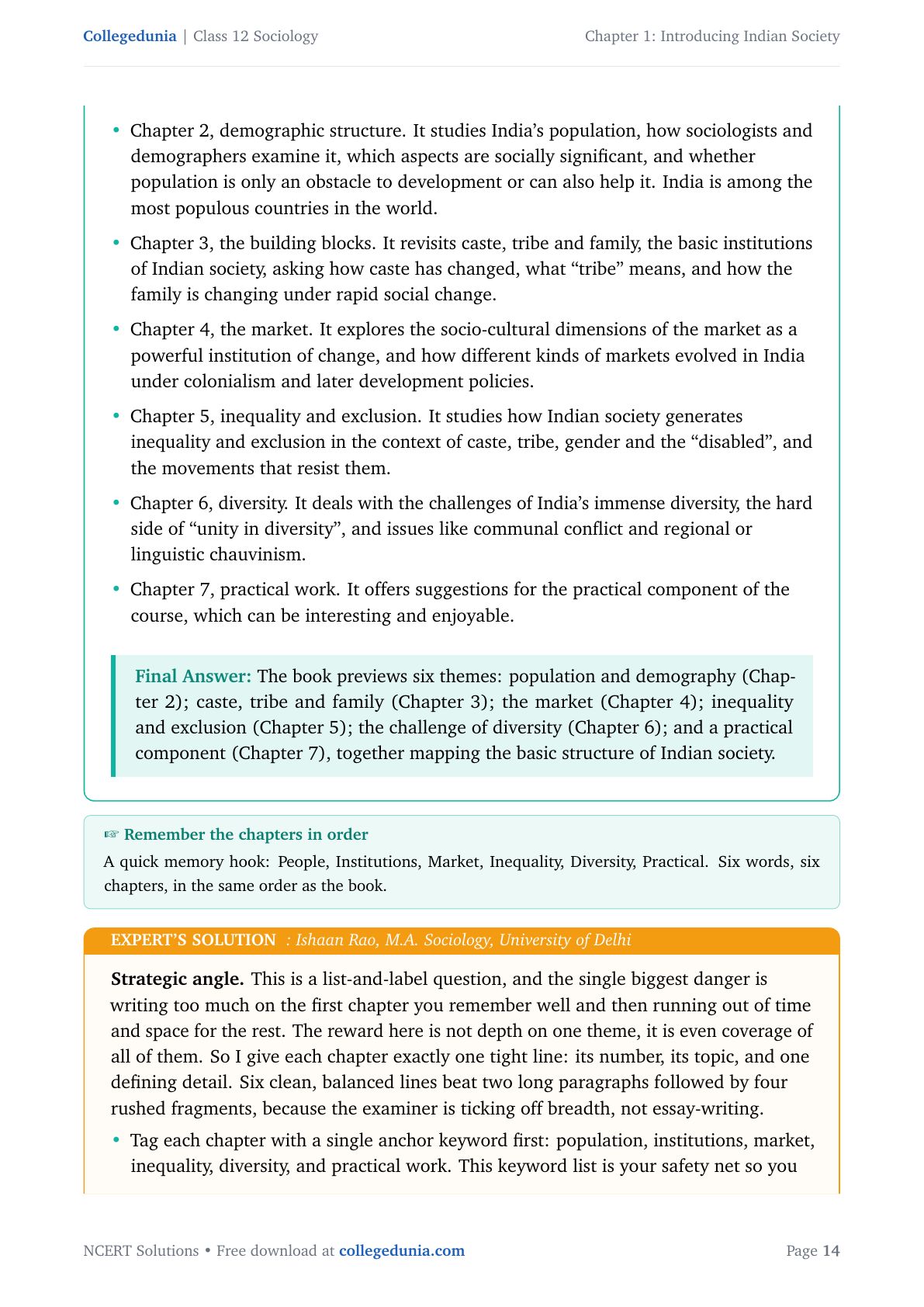
Chapter 2, demographic structure. It studies India's population, how
sociologists and demographers examine it, which aspects are socially
significant, and whether population is only an obstacle to development
or can also help it. India is among the most populous countries in the
world.
Chapter 3, the building blocks. It revisits caste, tribe and family,
the basic institutions of Indian society, asking how caste has changed,
what ``tribe'' means, and how the family is changing under rapid social
change.
Chapter 4, the market. It explores the socio-cultural dimensions of the
market as a powerful institution of change, and how different kinds of
markets evolved in India under colonialism and later development
policies.
Chapter 5, inequality and exclusion. It studies how Indian society
generates inequality and exclusion in the context of caste, tribe,
gender and the ``disabled'', and the movements that resist them.
Chapter 6, diversity. It deals with the challenges of India's immense
diversity, the hard side of ``unity in diversity'', and issues like
communal conflict and regional or linguistic chauvinism.
Chapter 7, practical work. It offers suggestions for the practical
component of the course, which can be interesting and enjoyable.
The book previews six themes: population and demography (Chapter 2);
caste, tribe and family (Chapter 3); the market (Chapter 4); inequality and
exclusion (Chapter 5); the challenge of diversity (Chapter 6); and a practical
component (Chapter 7), together mapping the basic structure of Indian
society.
IR
Ishaan Rao
M.A. Sociology, University of Delhi
Verified Expert
Strategic angle. This is a list-and-label question, and the single
biggest danger is writing too much on the first chapter you remember well and
then running out of time and space for the rest. The reward here is not depth
on one theme, it is even coverage of all of them. So I give each chapter
exactly one tight line: its number, its topic, and one defining detail. Six
clean, balanced lines beat two long paragraphs followed by four rushed
fragments, because the examiner is ticking off breadth, not essay-writing.
Tag each chapter with a single anchor keyword first: population,
institutions, market, inequality, diversity, and practical work. This
keyword list is your safety net so you never forget a chapter.
Add one defining detail to each tag, for example ``caste, tribe and
family'' for institutions, ``caste, tribe, gender and the disabled''
for inequality, or ``unity in diversity'' for diversity. The detail is
what turns a bare list into an answer.
Keep the chapters in book order, Chapter 2 through Chapter 7, so the
answer mirrors the textbook's own sequence and is quick and easy for an
examiner to mark off point by point.
Why this matters. Balanced, even coverage is the actual skill being
tested by a preview question. A student who gives all six chapters roughly
equal weight, each with its keyword and one detail, scores higher than one who
writes a mini-essay on the first chapter and then rushes the remaining five in
a single crowded line.
The six previewed themes are population (Chapter 2); caste, tribe and
family (Chapter 3); the market (Chapter 4); inequality and exclusion
(Chapter 5); diversity (Chapter 6); and practical work (Chapter 7).
Q 1.10
How did colonialism shape modern Indian society and give rise to nationalism?
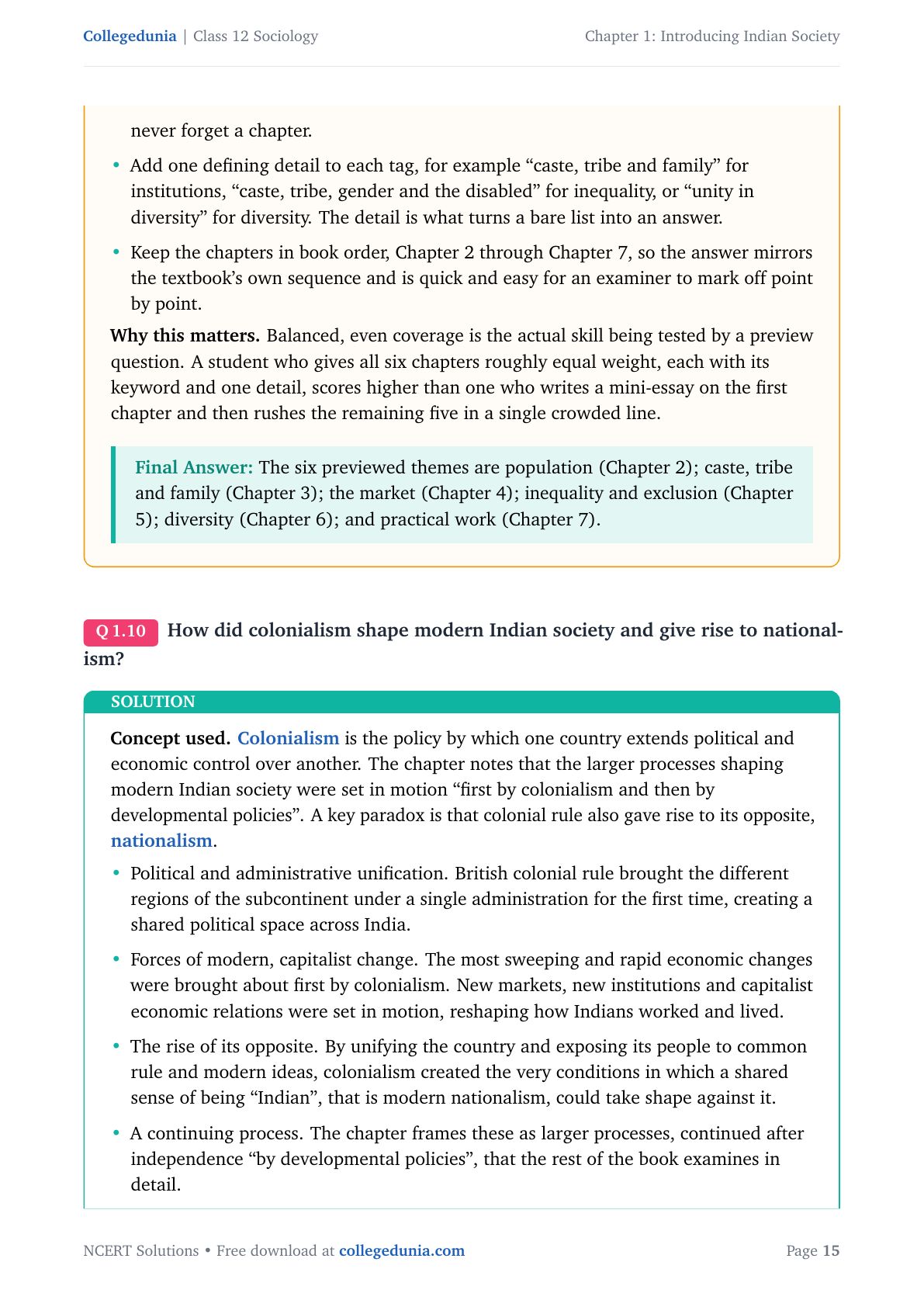
Concept used.Colonialism is the policy by which one
country extends political and economic control over another. The chapter
notes that the larger processes shaping modern Indian society were set in
motion ``first by colonialism and then by developmental policies''. A key
paradox is that colonial rule also gave rise to its opposite,
nationalism.
Political and administrative unification. British colonial rule
brought the different regions of the subcontinent under a single
administration for the first time, creating a shared political space
across India.
Forces of modern, capitalist change. The most sweeping and rapid
economic changes were brought about first by colonialism. New markets,
new institutions and capitalist economic relations were set in motion,
reshaping how Indians worked and lived.
The rise of its opposite. By unifying the country and exposing its
people to common rule and modern ideas, colonialism created the very
conditions in which a shared sense of being ``Indian'', that is modern
nationalism, could take shape against it.
A continuing process. The chapter frames these as larger processes,
continued after independence ``by developmental policies'', that the
rest of the book examines in detail.
Colonialism unified the subcontinent under one administration and
set in motion modern, capitalist economic change. In doing so it created the
shared conditions out of which modern Indian nationalism arose, turning the
country into a single political space that could resist colonial rule
itself.
TM
Tara Mehta
Ph.D Sociology, Jadavpur University
Verified Expert
Strategic angle. The marks here sit in one paradox: colonialism
created modern India and the force that fought it. I open with that paradox so
the examiner sees the main point at once, then unpack the two effects,
unification and economic change, that made it possible.
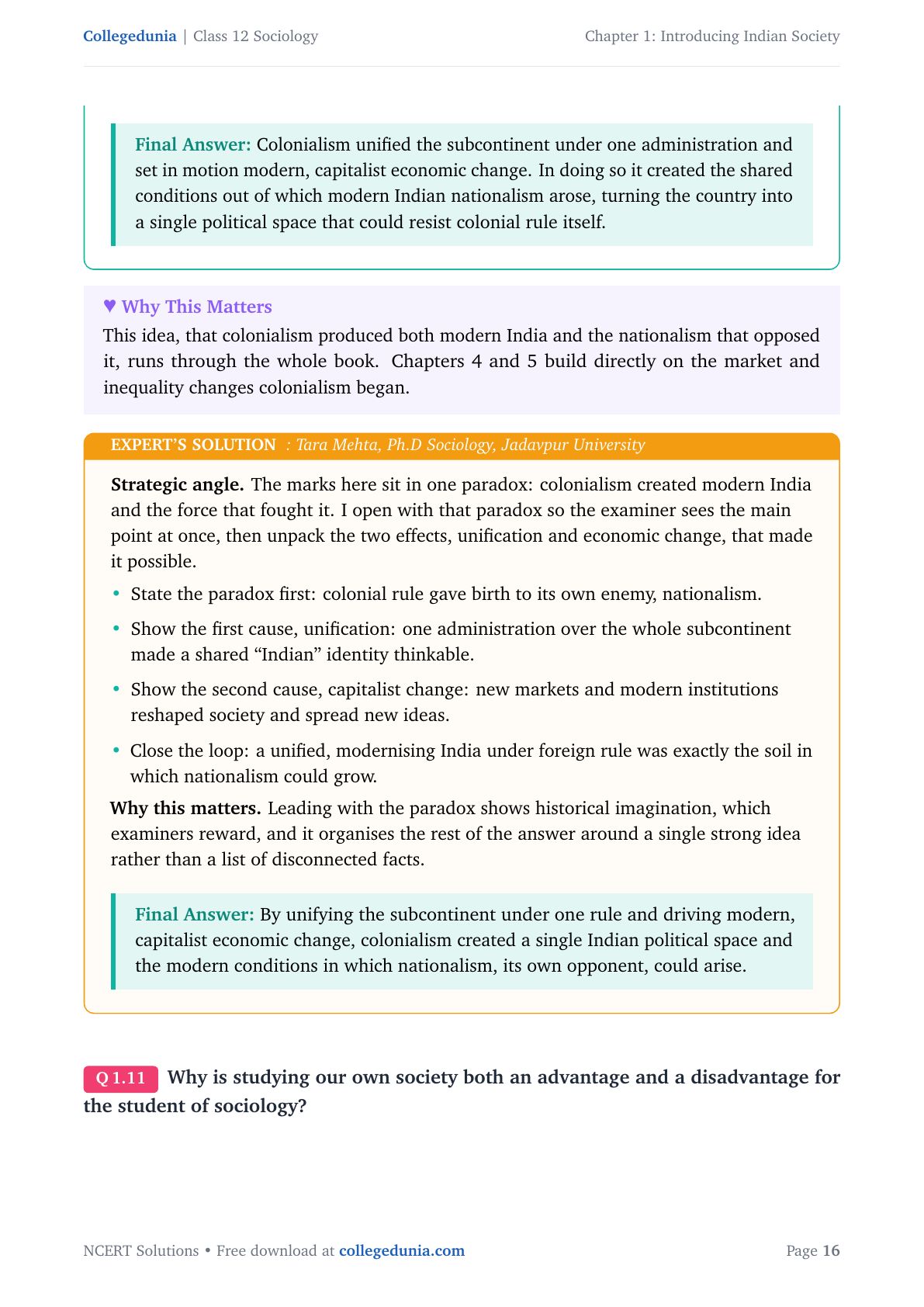
State the paradox first: colonial rule gave birth to its own enemy,
nationalism.
Show the first cause, unification: one administration over the whole
subcontinent made a shared ``Indian'' identity thinkable.
Show the second cause, capitalist change: new markets and modern
institutions reshaped society and spread new ideas.
Close the loop: a unified, modernising India under foreign rule was
exactly the soil in which nationalism could grow.
Why this matters. Leading with the paradox shows historical
imagination, which examiners reward, and it organises the rest of the answer
around a single strong idea rather than a list of disconnected facts.
By unifying the subcontinent under one rule and driving modern,
capitalist economic change, colonialism created a single Indian political
space and the modern conditions in which nationalism, its own opponent, could
arise.
Q 1.11
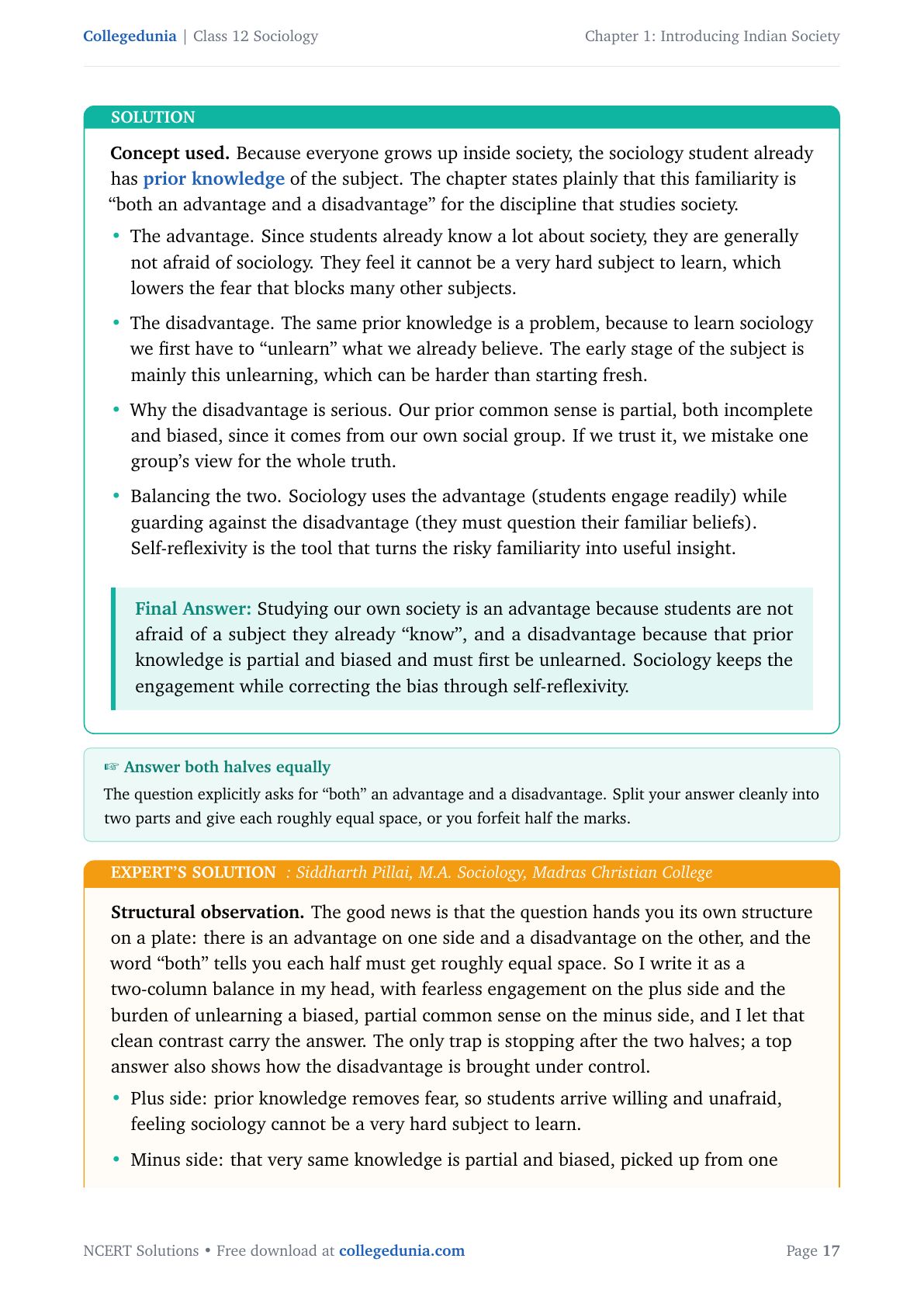
Why is studying our own society both an advantage and a disadvantage for the student of sociology?
Concept used. Because everyone grows up inside society, the sociology
student already has prior knowledge of the subject. The chapter
states plainly that this familiarity is ``both an advantage and a
disadvantage'' for the discipline that studies society.
The advantage. Since students already know a lot about society, they
are generally not afraid of sociology. They feel it cannot be a very
hard subject to learn, which lowers the fear that blocks many other
subjects.
The disadvantage. The same prior knowledge is a problem, because to
learn sociology we first have to ``unlearn'' what we already believe.
The early stage of the subject is mainly this unlearning, which can be
harder than starting fresh.
Why the disadvantage is serious. Our prior common sense is partial,
both incomplete and biased, since it comes from our own social group.
If we trust it, we mistake one group's view for the whole truth.
Balancing the two. Sociology uses the advantage (students engage
readily) while guarding against the disadvantage (they must question
their familiar beliefs). Self-reflexivity is the tool that turns the
risky familiarity into useful insight.
Studying our own society is an advantage because students are not
afraid of a subject they already ``know'', and a disadvantage because that
prior knowledge is partial and biased and must first be unlearned. Sociology
keeps the engagement while correcting the bias through self-reflexivity.
SP
Siddharth Pillai
M.A. Sociology, Madras Christian College
Verified Expert
Structural observation. The good news is that the question hands you
its own structure on a plate: there is an advantage on one side and a
disadvantage on the other, and the word ``both'' tells you each half must get
roughly equal space. So I write it as a two-column balance in my head, with
fearless engagement on the plus side and the burden of unlearning a biased,
partial common sense on the minus side, and I let that clean contrast carry the
answer. The only trap is stopping after the two halves; a top answer also shows
how the disadvantage is brought under control.
Plus side: prior knowledge removes fear, so students arrive willing and
unafraid, feeling sociology cannot be a very hard subject to learn.
Minus side: that very same knowledge is partial and biased, picked up
from one social group, so it must be unlearned before any real,
systematic learning can begin.
Resolve the tension: sociology keeps the willingness it gains from the
advantage and uses self-reflexivity to correct the bias of the
disadvantage, turning what looks like a liability into a genuine
strength.
Why this matters. Showing how the disadvantage is managed, through
self-reflexivity, rather than merely naming it, lifts the answer from purely
descriptive to analytical. That extra step, resolving the tension instead of
just stating it, is exactly what separates a higher-band answer from an
ordinary one.
The advantage is fearless engagement, since students already feel
they know society; the disadvantage is that this prior knowledge is partial and
biased and must be unlearned. Sociology balances the two by keeping the
engagement and correcting the bias through self-reflexivity.
Q 1.12
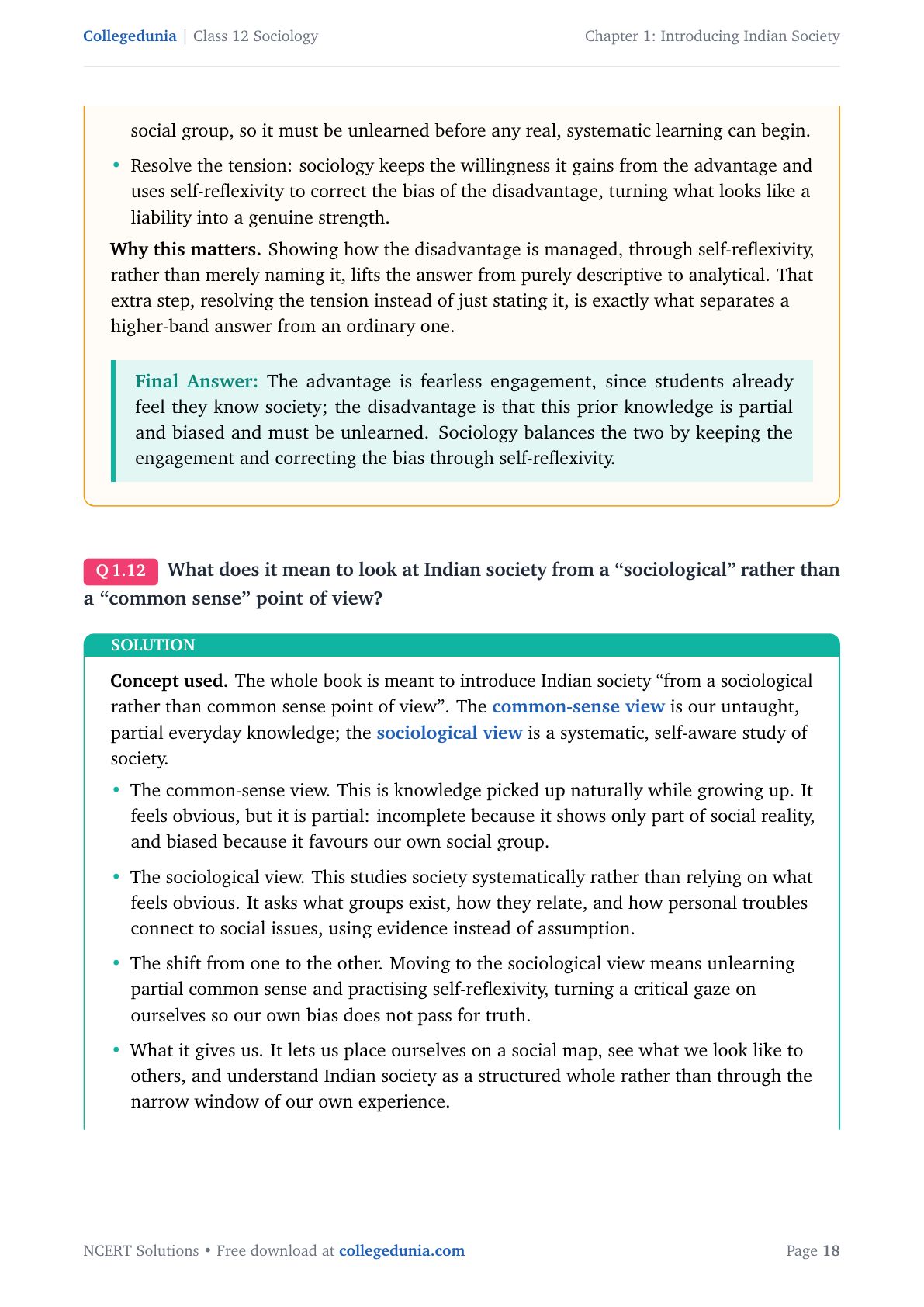
What does it mean to look at Indian society from a ``sociological'' rather than a ``common sense'' point of view?
Concept used. The whole book is meant to introduce Indian society
``from a sociological rather than common sense point of view''. The
common-sense view is our untaught, partial everyday knowledge; the
sociological view is a systematic, self-aware study of society.
The common-sense view. This is knowledge picked up naturally while
growing up. It feels obvious, but it is partial: incomplete because it
shows only part of social reality, and biased because it favours our
own social group.
The sociological view. This studies society systematically rather than
relying on what feels obvious. It asks what groups exist, how they
relate, and how personal troubles connect to social issues, using
evidence instead of assumption.
The shift from one to the other. Moving to the sociological view means
unlearning partial common sense and practising self-reflexivity,
turning a critical gaze on ourselves so our own bias does not pass for
truth.
What it gives us. It lets us place ourselves on a social map, see what
we look like to others, and understand Indian society as a structured
whole rather than through the narrow window of our own experience.
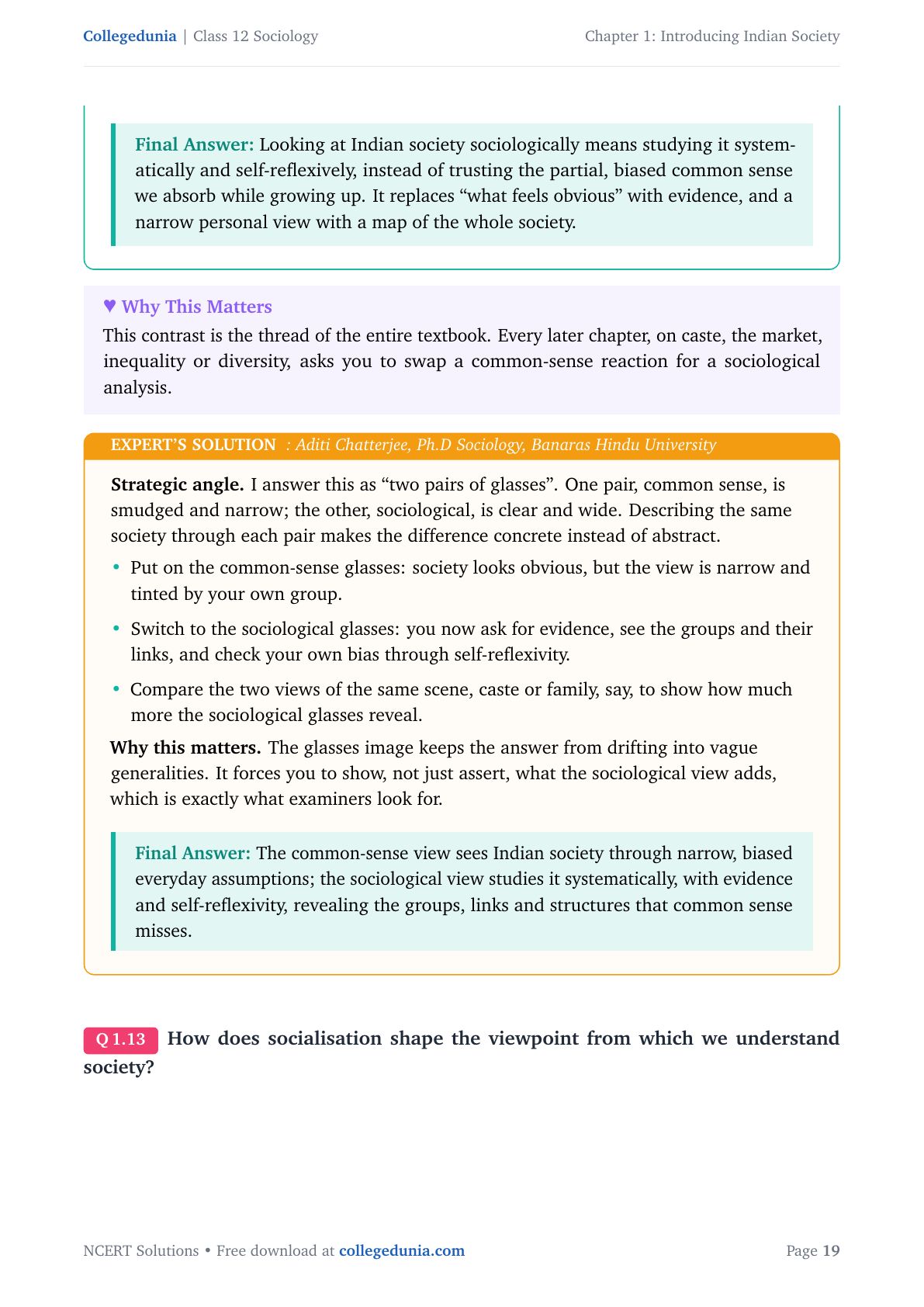
Looking at Indian society sociologically means studying it
systematically and self-reflexively, instead of trusting the partial, biased
common sense we absorb while growing up. It replaces ``what feels obvious''
with evidence, and a narrow personal view with a map of the whole society.
AC
Aditi Chatterjee
Ph.D Sociology, Banaras Hindu University
Verified Expert
Strategic angle. I answer this as ``two pairs of glasses''. One pair,
common sense, is smudged and narrow; the other, sociological, is clear and
wide. Describing the same society through each pair makes the difference
concrete instead of abstract.
Put on the common-sense glasses: society looks obvious, but the view is
narrow and tinted by your own group.
Switch to the sociological glasses: you now ask for evidence, see the
groups and their links, and check your own bias through
self-reflexivity.
Compare the two views of the same scene, caste or family, say, to show
how much more the sociological glasses reveal.
Why this matters. The glasses image keeps the answer from drifting
into vague generalities. It forces you to show, not just assert, what the
sociological view adds, which is exactly what examiners look for.
The common-sense view sees Indian society through narrow, biased
everyday assumptions; the sociological view studies it systematically, with
evidence and self-reflexivity, revealing the groups, links and structures that
common sense misses.
Q 1.13
How does socialisation shape the viewpoint from which we understand society?
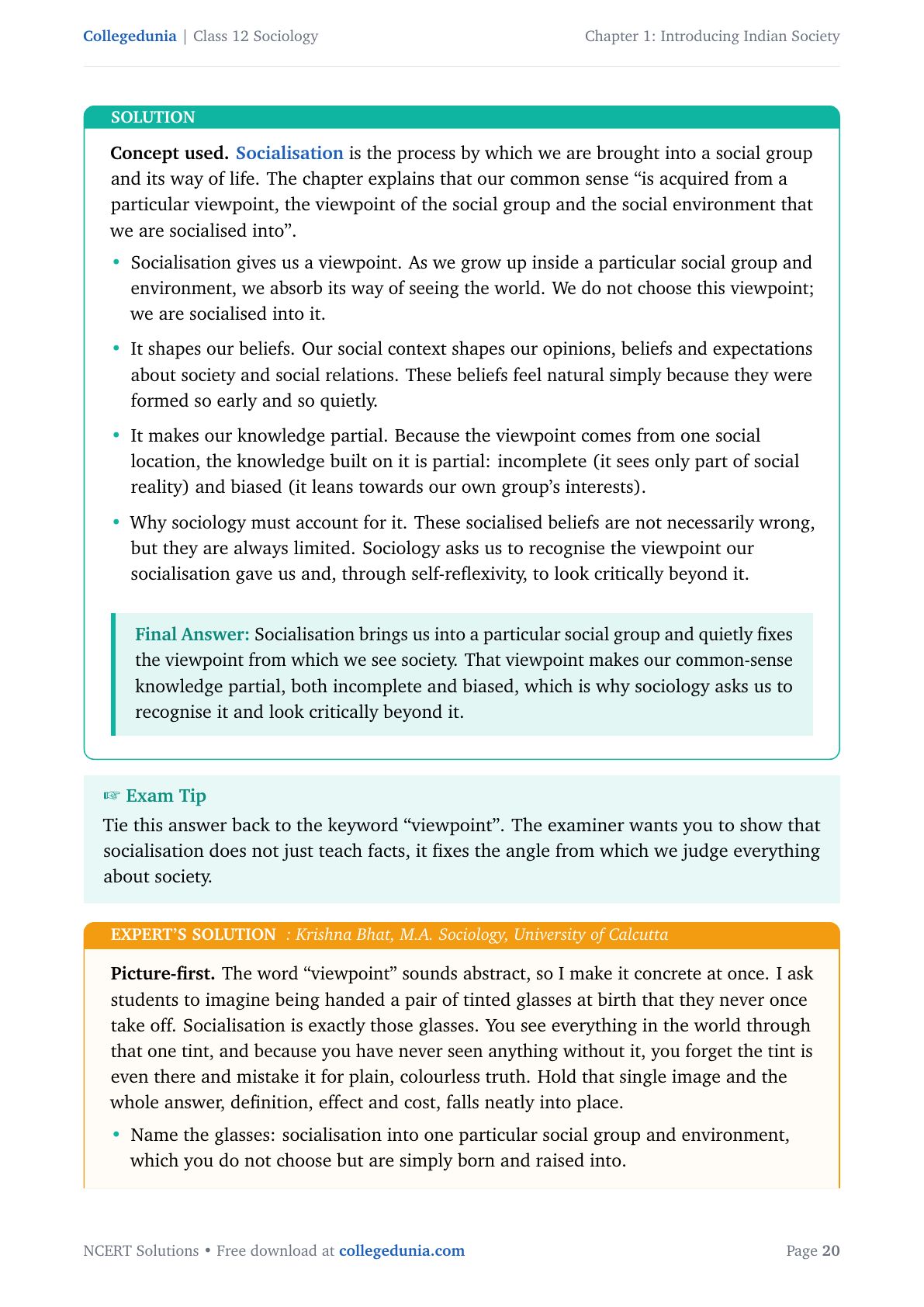
Concept used.Socialisation is the process by which we are
brought into a social group and its way of life. The chapter explains that our
common sense ``is acquired from a particular viewpoint, the viewpoint of the
social group and the social environment that we are socialised into''.
Socialisation gives us a viewpoint. As we grow up inside a particular
social group and environment, we absorb its way of seeing the world. We
do not choose this viewpoint; we are socialised into it.
It shapes our beliefs. Our social context shapes our opinions, beliefs
and expectations about society and social relations. These beliefs feel
natural simply because they were formed so early and so quietly.
It makes our knowledge partial. Because the viewpoint comes from one
social location, the knowledge built on it is partial: incomplete (it
sees only part of social reality) and biased (it leans towards our own
group's interests).
Why sociology must account for it. These socialised beliefs are not
necessarily wrong, but they are always limited. Sociology asks us to
recognise the viewpoint our socialisation gave us and, through
self-reflexivity, to look critically beyond it.
Socialisation brings us into a particular social group and quietly
fixes the viewpoint from which we see society. That viewpoint makes our
common-sense knowledge partial, both incomplete and biased, which is why
sociology asks us to recognise it and look critically beyond it.
KB
Krishna Bhat
M.A. Sociology, University of Calcutta
Verified Expert
Picture-first. The word ``viewpoint'' sounds abstract, so I make it
concrete at once. I ask students to imagine being handed a pair of tinted
glasses at birth that they never once take off. Socialisation is exactly those
glasses. You see everything in the world through that one tint, and because you
have never seen anything without it, you forget the tint is even there and
mistake it for plain, colourless truth. Hold that single image and the whole
answer, definition, effect and cost, falls neatly into place.
Name the glasses: socialisation into one particular social group and
environment, which you do not choose but are simply born and raised
into.
Show the tint at work: it quietly colours your opinions, beliefs and
expectations about society and social relations, all without your ever
noticing it is happening.
Reveal the cost: because the tint comes from one social corner, it
makes your view partial, both incomplete and biased, which is why
sociology asks you to become aware of your own glasses through
self-reflexivity and look critically beyond them.
Why this matters. The glasses image stops the answer from collapsing
into a vague, all-purpose definition of socialisation. It keeps the focus
firmly on ``viewpoint'', the actual word the question turns on, and it makes
the link to bias and self-reflexivity feel natural rather than tacked on, which
is exactly what this question rewards.
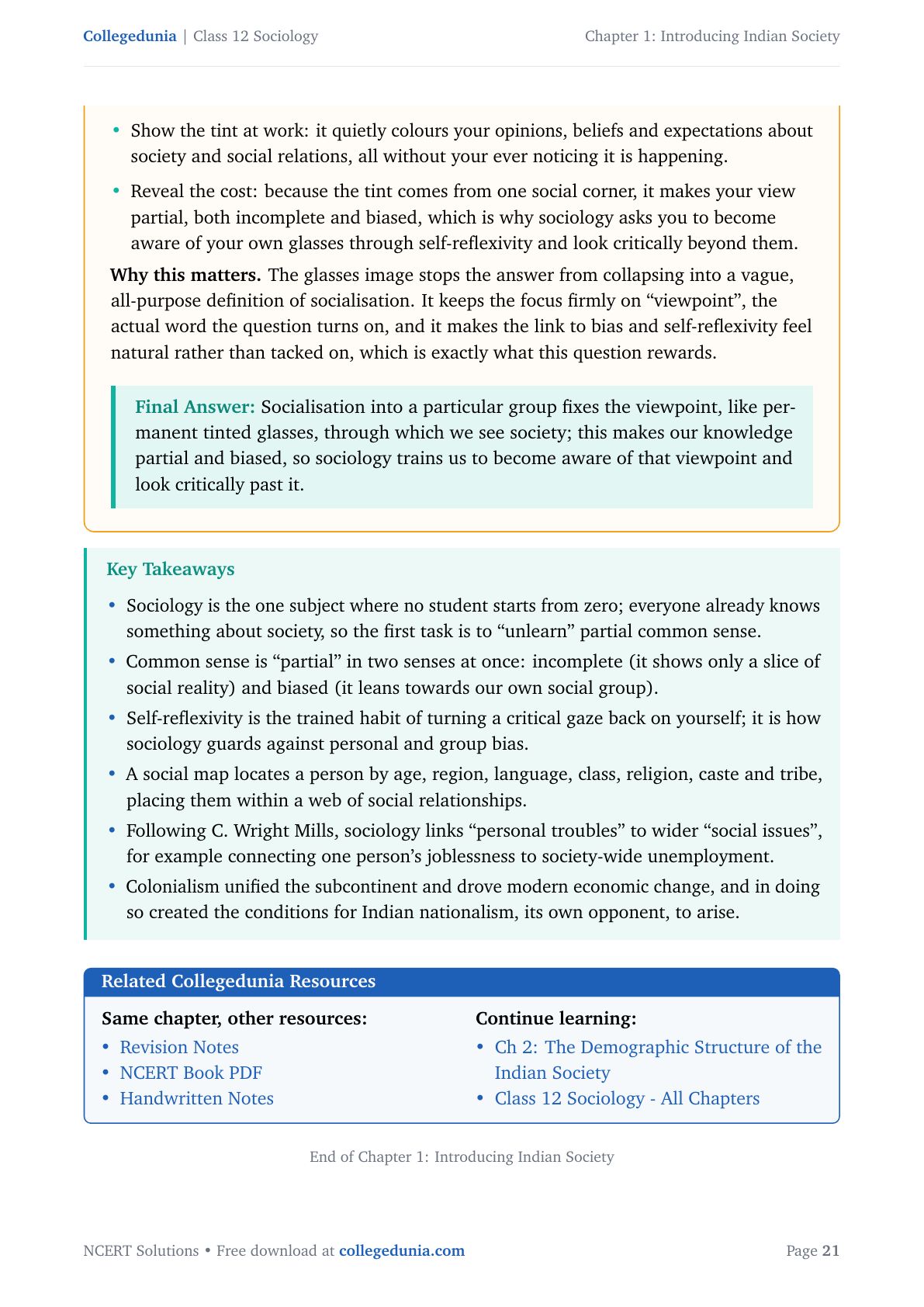
Socialisation into a particular group fixes the viewpoint, like
permanent tinted glasses, through which we see society; this makes our knowledge
partial and biased, so sociology trains us to become aware of that viewpoint and
look critically past it.
FAQs on Introducing Indian Society Class 12 NCERT Solutions
Introducing Indian Society Class 12 Sociology Common Questions
Ques. Where can I get the class 12 sociology chapter 1 NCERT Solutions PDF?
Ans. You can download the Introducing Indian Society Class 12 Sociology NCERT Solutions PDF directly from this page. It is free, follows the 2026-27 NCERT, and answers all 13 exercise questions point by point.
Ques. How many questions are there in Introducing Indian Society class 12 questions and answers?
Ans. The chapter has 13 exercise questions. They cover why sociology is a distinct subject, self-reflexivity, common sense versus a sociological view, personal troubles versus social issues, and how colonialism gave rise to nationalism.
Ques. What is the difference between personal troubles and social issues?
Ans. Personal troubles are private matters felt by one person, like a single individual losing one job. Social issues affect large groups and arise from how society is organised, like mass unemployment. The sociological imagination shows that many private troubles are really public issues in disguise.
Ques. Why does sociology treat common sense as partial?
Ans. Common sense is useful but incomplete. It is taken for granted, rarely tested, and often blames an individual for what is really a social pattern. Sociology completes the picture by asking why the pattern exists across many people, the step common sense skips.
Ques. What is self-reflexivity and why is it important?
Ans. Self-reflexivity is the constant questioning of our own ideas, biases and social position. It matters because the sociologist studies a society they already belong to, so they must keep checking their own assumptions to reach a clear, critical view.
Ques. Is class 12 sociology chapter 1 easy to score in the board exam?
Ans. Yes. It is a high-scoring chapter if you treat sociology as a way of looking and tie every example back to society. Learn self-reflexivity, the common-sense contrast, and the troubles-versus-issues link, and keep your own short example ready for the long answers.








Comments