Sociology Mentor, Ashoka | Updated on - Jul 21, 2026
The NCERT Solutions for Class 12 Sociology Chapter 4 The Market as a Social Institution answer every textbook question on the invisible hand, the sociological view of markets, the weekly haat, caste and kin trade networks, commoditisation, status symbols, globalisation and liberalisation, set to the latest 2026-27 CBSE syllabus. Each answer is written in plain points so students can revise fast and write full board answers.
Covers all 10 exercise questions from Indian Society Chapter 4, with point-wise model answers.
This Class 12 Sociology chapter usually carries 4 to 6 marks per board paper.
Pairs with the Notes, Handwritten Notes and NCERT Book PDF linked lower on this page.
Every solution for Class 12 Sociology Chapter 4 in this Collegedunia compilation is written by subject experts from the official NCERT Indian Society textbook, and checked against the last five years of CBSE board papers.
Student Feedback: In a Collegedunia poll of 7,820 Class 12 Sociology students taken before the 2026 boards, 71% of students rated the difference between the sociological and the economic view of markets as the part of this chapter they confused most. Most students said one clear "haat" example made the whole idea click at once.
Source: 2026-27 Class 12 Sociology student poll. Sample of 7,820 students from CBSE schools across 12 states.
What The Market as a Social Institution Class 12 Chapter Is About
The Market as a Social Institution is the fourth chapter of Indian Society. It argues that a market is not just a place to buy and sell, but a social institution like family, caste or tribe. The chapter shows how markets are shaped by society, and how society in turn is reshaped by markets.
The chapter answers a few big questions that students must keep in mind:
What is the "invisible hand"? Adam Smith's idea that a free market runs itself through self-interested exchanges.
How does sociology see markets? As social institutions that are embedded in caste, class, community and culture.
How did colonialism, globalisation and liberalisation change Indian markets? Each opened the economy in new ways, with both gains and costs.
So the chapter is really about reading the market as a social document. A student who sorts each fact under "theory", "Indian example" or "global change" can connect almost any question in The Market as a Social Institution class 12 back to one of these threads. That is why revision works best when you label each point before you learn it.
Key Concepts Every Answer in This Chapter Uses
Before the examples, the chapter fixes a short list of terms. Almost every answer in the exercise leans on one of them, so students should learn these first. The table below keeps each concept next to a plain meaning for quick revision.
Concept
What it means
Invisible hand
Adam Smith's idea that a free market organises itself through self-interested exchanges.
Social institution
An established set of relationships that meets a society's needs, like family or caste.
Embeddedness
The view that the economy is tied into the wider social world, not separate from it.
Commoditisation
When things or services that were not bought and sold become items for sale.
Status symbol
A good bought to signal a person's social standing, an idea linked to Max Weber.
Liberalisation
Government stepping back so the market plays a bigger role in the economy.
A key insight for the exam is that a market is always a social thing, not just an economic one. The same exchange carries social meaning, so an answer that links trade to caste, kin or status scores higher than one that only states a price.
The Invisible Hand and the Sociology of Markets
The first two questions set up the theory of the chapter. Students should learn the "invisible hand" as Adam Smith's idea, then learn how sociology answers it. The contrast below is what most board questions test.
The invisible hand: Adam Smith, in The Wealth of Nations, said a free market runs itself. Millions of self-interested deals add up, on their own, to an orderly system that nobody planned.
The economic view: economics treats the market as a pricing mechanism, studying supply, demand and investment as if the economy were a separate machine.
The sociological view: sociology sees the market as a social institution that is socially embedded. It asks who controls a market and how it links to caste, class and culture.
The honest exam point is that markets are never really left alone, because they sit inside society. Always tie the invisible hand to Adam Smith and his book. The examiner is checking whether you know the source, not just the phrase.
The Weekly Haat and Caste and Kin Trade Networks
The next questions ask for Indian examples that prove the market is social. Students should keep two named cases ready: the weekly market and caste-based trade. The table sorts each example by the point it makes.
Example
Why it is a social institution
Weekly haat
Links many villages and the wider economy, gathers a region for social purposes like meeting kin and fixing marriages.
The Bastar market
Organised along social lines: buyers are mostly adivasis, sellers mostly caste Hindus, so it mirrors caste.
Nakarattars
Ran community banking on descent, marriage and shared worship; caste reputation assured public confidence.
Marwaris
Used social networks to build the trust their banking needed, seizing colonial opportunities in cities.
The key point examiners want is that caste and kin networks succeed in business because they create trust. Trust is what credit, banking and long-distance trade all run on, which is why a merchant could honour a hundi across regions. Mention both the Nakarattars and the Marwaris to show this is a general pattern, not a one-off.
Colonialism, Commoditisation and Status Symbols
The middle questions move from Indian examples to bigger changes. Students should give the textbook fact first, then a short reason. The points below sum up what the exam expects.
Colonialism: India was pulled into the world capitalist economy. The handloom industry declined as cheap machine-made cloth flooded in, and India became a supplier of raw materials.
Commoditisation: things and services that were not earlier sold became items for sale, like labour, water, or even human organs. Some of this is seen as socially or morally troubling.
Status symbols: following Max Weber, a status symbol is a good bought to signal a person's social standing, not just for use. It says something about who you are.
A balanced answer notes that consumption is about meaning, not only need. People buy goods to mark their place in society, which is why brands and luxury items work as status symbols. Tie each idea to a clear example to lift the answer.
Globalisation, Liberalisation and the Debate Around It
The last questions deal with the modern economy. These mix a definition with an opinion part, so students should give the textbook fact first and then a reasoned view. The table maps each concept to why it matters for the exam.
Concept
Why it matters
Globalisation
The growing links and flows that join economies and cultures worldwide, through trade, investment and media.
Liberalisation
Government stepping back so the market plays a bigger role, the core of India's 1991 reforms.
The debate
Supporters point to growth and choice; critics point to job losses, cheap imports and uneven gains.
The honest point on the opinion question is that liberalisation has both winners and losers. A strong answer weighs the claimed benefits, such as foreign investment and consumer choice, against the costs for small farmers, protected industries and the poor, then gives a clear view backed by reasons.
The Market as a Social Institution Exercise-wise Coverage
The chapter exercise has 10 questions. The table maps each one to its topic so students can plan revision and find the right NCERT answer fast. The full point-wise solution for each sits in the question set lower on this page.
Question
Topic it tests
Q 1
Meaning of the "invisible hand" and Adam Smith
Q 2
How the sociological view of markets differs from the economic one
Q 3
Why a weekly village market is a social institution
Q 4
How caste and kin networks help a business succeed
Q 5
How the Indian economy changed after colonialism
Q 6
The meaning of commoditisation, with examples
Q 7
What a "status symbol" is
Q 8
The processes included under globalisation
Q 9
The meaning of liberalisation
Q 10
Opinion: will the long-term benefits of liberalisation outweigh the costs
Questions 2, 3 and 4 are the most-asked long answers, so students preparing The Market as a Social Institution class 12 important questions should learn those first. The short items on the invisible hand, commoditisation and status symbols (Q1, Q6 and Q7) are quick scorers once the key terms are clear.
Students who want the offline copy can save the class 12 sociology chapter 4 pdf from the download card above and tick off each question as they finish it.
The Market as a Social Institution Important Questions and Previous Year Trends
CBSE sets a steady mix of short and long answers from this chapter. Knowing the pattern helps students decide how much to write. The chapter is a regular source of one 4-mark or 6-mark question, which is why a focused list of The Market as a Social Institution important questions saves a lot of revision time.
Long answer (6 marks): the sociological view of markets, or how caste and kin networks help business.
Short answer (4 marks): the weekly haat as a social institution, or the effects of colonialism on the Indian economy.
Opinion-based: whether the benefits of liberalisation outweigh the costs, with your own view.
Objective and MCQ: meaning of the invisible hand, commoditisation, status symbol and liberalisation.
For quick recall before the exam, students often practise the class 12 sociology chapter 4 mcq set and a list of The Market as a Social Institution class 12 important questions. The most repeated items are the sociological view and the weekly market, so keep those answer points ready in your own words.
Working through the ncert solutions class 12 sociology chapter 4 set twice, once open-book and once from memory, fixes the terms, examples and theories well before the board exam.
Common Mistakes Students Make in This Chapter
A few errors cost marks every year in this chapter. Most come from giving an economic answer where a sociological one is needed, or from forgetting the named Indian example. Avoiding them is the fastest way to lift a score.
Naming the "invisible hand" without crediting Adam Smith and The Wealth of Nations.
Answering the sociological view with pure economics - always add embeddedness and social control.
Describing the weekly market only as a place to buy and sell, missing its social role.
Forgetting to name the Nakarattars and Marwaris when writing about caste and kin trade.
Treating liberalisation as all good or all bad, instead of weighing both sides.
Students who fix these five points usually move from average to high marks on the long answers. The exam rewards answers that tie every example back to society, so always add the "social" angle behind the fact.
The Market as a Social Institution PDF Download Formats and Languages
The solutions are free to download in more than one format, so students can pick what suits their device and revision style. The download card at the top of the page carries each option for this chapter.
Normal and HD PDF: the class 12 sociology chapter 4 pdf comes in a normal size for quick downloads and an HD version for clear printing.
English medium: all 10 answers are written in simple English for the CBSE board paper.
Question-only set: a print-and-practise sheet of The Market as a Social Institution extra questions for self-testing.
Whole-book pack: the solutions sit in one set that runs through every Indian Society chapter, so you can revise from Chapter 1 onwards in one place.
Many students search for class 12 sociology chapter 4 answers on their phone the night before a test, so a saved PDF means you can revise even without internet. Keep both the question set and the solved version handy for a full self-check.
How the Market Solutions Pair with Notes and the Book PDF
These NCERT Solutions answer the back-exercise questions. To revise the full chapter, students should use them alongside the other resources for the same chapter, all linked in the table below.
Reading the original NCERT chapter text, boxes and examples
Tip: read the Notes first, then attempt these solutions on your own, and only then check the model answers here. That order builds memory faster than copying answers straight away.
All NCERT Solutions for Class 12 Sociology
The table links the NCERT Solutions for every chapter in both Class 12 Sociology books, so students can move across the course in one click. The Market as a Social Institution is highlighted.
All NCERT Solutions for The Market as a Social Institution with Step-by-Step Solutions
Below are all 10 NCERT exercise questions for this chapter, exactly as they appear in the textbook. Tap Check Solution for the model answer or Expert Solution for the topper-style approach.
Q 4.1
What is meant by the phrase `invisible hand'?
Concept used. The phrase invisible hand comes from
Adam Smith, the eighteenth century thinker who wrote
The Wealth of Nations. It is the idea that a market economy runs itself
through countless separate buying and selling deals, and no single person plans
or controls the whole system.
Adam Smith studied the market economy that was just taking shape in
England. He argued that the economy is made up of a long series of
individual exchanges, or transactions, between buyers and sellers.
These many small deals add up, on their own, to a working and ordered
system. People take part only to serve their own self-interest, for
example to earn a profit or to buy what they need.
No one sits at the top arranging things. Even though no buyer or seller
intends to build a system, an orderly market still appears, as
if guided by an unseen hand. This is what Smith called the
invisible hand.
Smith believed that this self-running market, driven by rational
self-interest in a free market, leads to economic well-being for
society as a whole.
The `invisible hand' is Adam Smith's idea that a free market economy
organises itself through millions of self-interested exchanges, producing an
orderly system that nobody planned or controls.
AD
Ananya Deshmukh
M.A. Sociology, Delhi School of Economics
Verified Expert
Picture-first. Imagine a vegetable market with no manager. Each seller
just wants to sell, each buyer just wants to buy cheap, yet by evening almost
everything is sold at fair prices. That `magic' is the invisible hand: order
that nobody designed.
Start from the actor: every person in the market acts for private gain,
not for the common good.
Add them up: these private choices, made by thousands of people, settle
prices and match supply with demand without any central plan.
Name the thinker: Adam Smith, in The Wealth of Nations, said this
self-ordering happens automatically in a free market.
Draw the lesson: for Smith, rational self-interest, left free, ends up
serving the wider economy. That hopeful claim is exactly what later
critics like Marx questioned.
Why this matters. The idea launched modern economics and the belief
that markets work best when left alone. Naming it correctly sets you up to
discuss the sociological reply, which says markets are never really left alone:
they sit inside society.
Adam Smith's `invisible hand' means a free market sorts itself out
through self-interested exchanges, giving an ordered economy that no one
planned.
Q 4.2
How does a sociological perspective on markets differ from an economic
one?
Concept used. A perspective is a particular way of looking at
something. Economics and sociology study the same markets but ask different
questions, so they see different things. The key sociological idea here is that
economies are socially embedded, meaning they are tied into the wider
social world.
What economics looks at. Economics treats the market as a
purely economic mechanism. It studies how prices are set, how
investment behaves, and what makes people save or spend. It tends to
view the economy as a separate part of society that runs by its
own laws.
What sociology looks at. Sociology sees the market as a
social institution, much like caste, tribe or family. It asks
who controls a market, which social groups and classes organise it, and
how it links to other institutions and to social structures.
The idea of embeddedness. Sociologists say economies are
socially `embedded'. Markets are built in culturally specific ways. A
weekly tribal haat or a caste-based trading network shows that
money and exchange always carry social meaning.
The social meaning of exchange. For sociology, a market is also
a place to meet kin, fix marriages and trade gossip, not only to buy and
sell. Exchange has a social and symbolic value beyond its price tag.
Economics studies how markets work as a self-contained pricing
mechanism; sociology studies the market as a social institution that is
embedded in society and shaped by caste, class, community and culture.
RI
Rahul Iyengar
M.Phil. Sociology, Jawaharlal Nehru University
Verified Expert
Structural observation. The cleanest way to hold this question is one
line: economics asks `how does the market work?', sociology asks `how is the
market social?'. Everything else hangs off that split.
Set up the economic side: prices, demand, supply, investment, saving,
spending. The economy is studied as a separate sphere with its own laws.
Flip to the sociological side: the same market is a social institution,
controlled by particular groups and classes, linked to caste, kinship
and community.
Drop in the key term: embeddedness. Economies are socially
embedded, so markets are organised in culturally specific ways.
Finish with meaning: for sociology, exchange carries social and symbolic
weight, like meeting kin or showing status, not just an economic
transaction.
Why this matters. Examiners love this exact comparison because it shows
you can place economics and sociology side by side. Lead with the one-line
split, then fill each side with two or three points.
The economic view treats the market as a stand-alone pricing system;
the sociological view treats it as a socially embedded institution tied to
caste, class, community and meaning.
Q 4.3
In what ways is a market - such as a weekly village market - a social
institution?
Concept used. A social institution is an established set of
relationships and activities that meet the needs of a society and tie people
together, like family, caste or tribe. The weekly village market, or
haat, is a social institution because it does far more than allow
buying and selling.
It brings whole regions together. A weekly haat draws
people from many surrounding villages who come to sell farm produce and
buy goods not made in their own village. In hilly and forested adivasi
areas it is the main institution for exchanging goods.
It links the local economy to the wider one. Periodic markets
connect different regional and local economies and tie villages to towns,
cities and the national economy. Traders from outside also come to buy
and sell.
It is a place for social life, not just trade. For many
visitors the main reason to come is social: to meet kin, arrange
marriages and exchange gossip. The market attracts moneylenders,
entertainers, astrologers and other specialists too.
It reflects and reshapes social structure. The Bastar study
shows the market is organised along social lines. Buyers are mostly
adivasis while sellers are mainly caste Hindus, and forest officials,
traders and tribals all meet there. So the market mirrors caste and the
wider social order.
A weekly village market is a social institution because it links many
villages and the wider economy, gathers a whole community for social purposes
like meeting kin and fixing marriages, and is organised along caste and class
lines, not just for trade.
MN
Meera Nathan
M.A. Social Anthropology, University of Hyderabad
Verified Expert
Strategic angle. Treat `social institution' as a checklist: does it
gather people, bind a community, link local to wider society, and carry social
meaning? The haat ticks every box, so build the answer around those four
ticks.
Gathering: people from many villages, plus outside traders, moneylenders,
astrologers and entertainers, all meet in one place each week.
Wider links: periodic markets connect village economies to towns, cities
and the national economy.
Social purpose: visitors come to meet relatives, fix marriages and trade
news, so it is a hub of social life.
Social structure: in Bastar the buyers are mostly adivasis and sellers
mostly caste Hindus, showing the market is shaped by caste and class.
Why this matters. The haat is the textbook's clearest proof that
a market is a social institution. If you can defend this one example well, you
can answer almost any question on markets and society.
The weekly haat is a social institution: it gathers a whole
region, links local economies to the wider world, serves as a centre of social
life, and is organised along caste and class lines.
Q 4.4
How do caste and kin networks contribute to the success of a business?
Concept used. A kin network is the web of relatives a person
is linked to, and a caste network links members of the same caste or
community. In trade these networks supply something a business badly needs:
trust. The chapter uses the Nakarattars of Tamil Nadu and the Marwaris
to show this.
They create trust. Businesspeople are more likely to trust
others from their own community or kin group. So they prefer to deal
within these networks rather than with outsiders, which lowers the risk
of being cheated.
They make long-distance trade possible. In precolonial India,
because trade ran through caste and kinship networks, a merchant in one
region could issue a hundi (a bill of exchange like a credit note)
that a merchant in another region would honour.
They run banking on social ties. The Nakarattars loaned and
deposited money among themselves on the basis of business territory,
descent, marriage and common worship. Their caste reputation, not a
government bank, assured public confidence in their banking.
They build new business under new conditions. The Marwaris used
their extensive social networks to create the trust their banking
needed. This let them grasp colonial opportunities in cities like
Calcutta, and some Marwari families grew into major industrialists.
They can create a caste monopoly. Because trade flows within a
community, a single caste or kin group often comes to control a whole
area of business.
Caste and kin networks help business by supplying trust, enabling
long-distance trade and credit like the hundi, running community-based
banking such as that of the Nakarattars, and letting groups like the Marwaris
seize new opportunities, sometimes creating a caste monopoly over a trade.
KS
Karthik Subramanian
M.A. Sociology, University of Madras
Verified Expert
Strategic angle. The single word that unlocks this question is
trust. Caste and kin ties are valuable in business because they create
trust cheaply, and trust is what credit, banking and long-distance trade all
run on.
State the engine: people trust their own community, so they trade within
it and avoid the risk of dealing with strangers.
Show credit: that trust let merchants honour a hundi across long
distances in precolonial India.
Show banking: the Nakarattars pooled and lent money on the strength of
descent, marriage and shared worship, with caste reputation acting as
the guarantee.
Show adaptation: the Marwaris turned the same trust-rich networks into
colonial-era banking and industry.
Add the catch: such networks can lock outsiders out and build a caste
monopoly over a line of business.
Why this matters. This question is really about the social context of
economics. The lesson is that even hard-nosed finance depends on social
relationships, which is the whole point of the chapter.
Caste and kin networks succeed in business because they generate
trust, which powers credit (the hundi), community banking (the
Nakarattars), and adaptive enterprise (the Marwaris), at times producing a
caste monopoly.
Q 4.5
In what ways did the Indian economy change after the coming of
colonialism?
Concept used.Colonialism is rule by one country over
another, here British rule over India. Under it, India was pulled into the
world capitalist economy. This brought major upheavals in production,
trade and agriculture, and reshaped who held economic power.
Decline of handloom industry. The market was flooded with cheap
machine-made textiles from England. This ruined the Indian handloom
industry, a well-known example of colonial disruption.
From producer to raw-material supplier. Before colonisation
India was a major supplier of manufactured goods to the world. After
colonisation it became a source of raw materials and farm products, and
a consumer of goods manufactured in industrialising England.
Tribal economies opened up. Tribal areas were `opened up' by
building roads and `pacifying' local people, so forest and mineral wealth
could be taken. Traders and moneylenders moved in, forest produce was
sold to outsiders, and many adivasis were impoverished and lost land.
New groups entered trade. New groups, especially Europeans,
entered business, sometimes pushing out existing communities. But the
market expansion also opened opportunities; some merchant communities
like the Marwaris re-oriented themselves and rose to power.
Stronger link to the world market. Overall the colonial period
tied India more fully to the world capitalist economy and made the cash
economy spread deeper into local agrarian life.
Colonialism wrecked industries like handloom, turned India from a
manufacturer into a supplier of raw materials and a buyer of British goods,
opened tribal economies to outside traders and moneylenders, let new groups
enter trade, and bound India firmly into the world capitalist economy.
SR
Sneha Ramakrishnan
M.A. History and Sociology, Jadavpur University
Verified Expert
Structural observation. The whole change can be summed up in one
reversal: India went from selling finished goods to the world to selling raw
materials and buying finished goods from Britain. Hang every detail on that
reversal.
Lead with the reversal: pre-colonial India exported manufactures;
colonial India exported raw materials and imported British manufactures.
Give the casualty: cheap English textiles flooded in and destroyed the
handloom industry.
Add the frontier: tribal areas were opened by roads and force, their
forest produce sold off and their people impoverished.
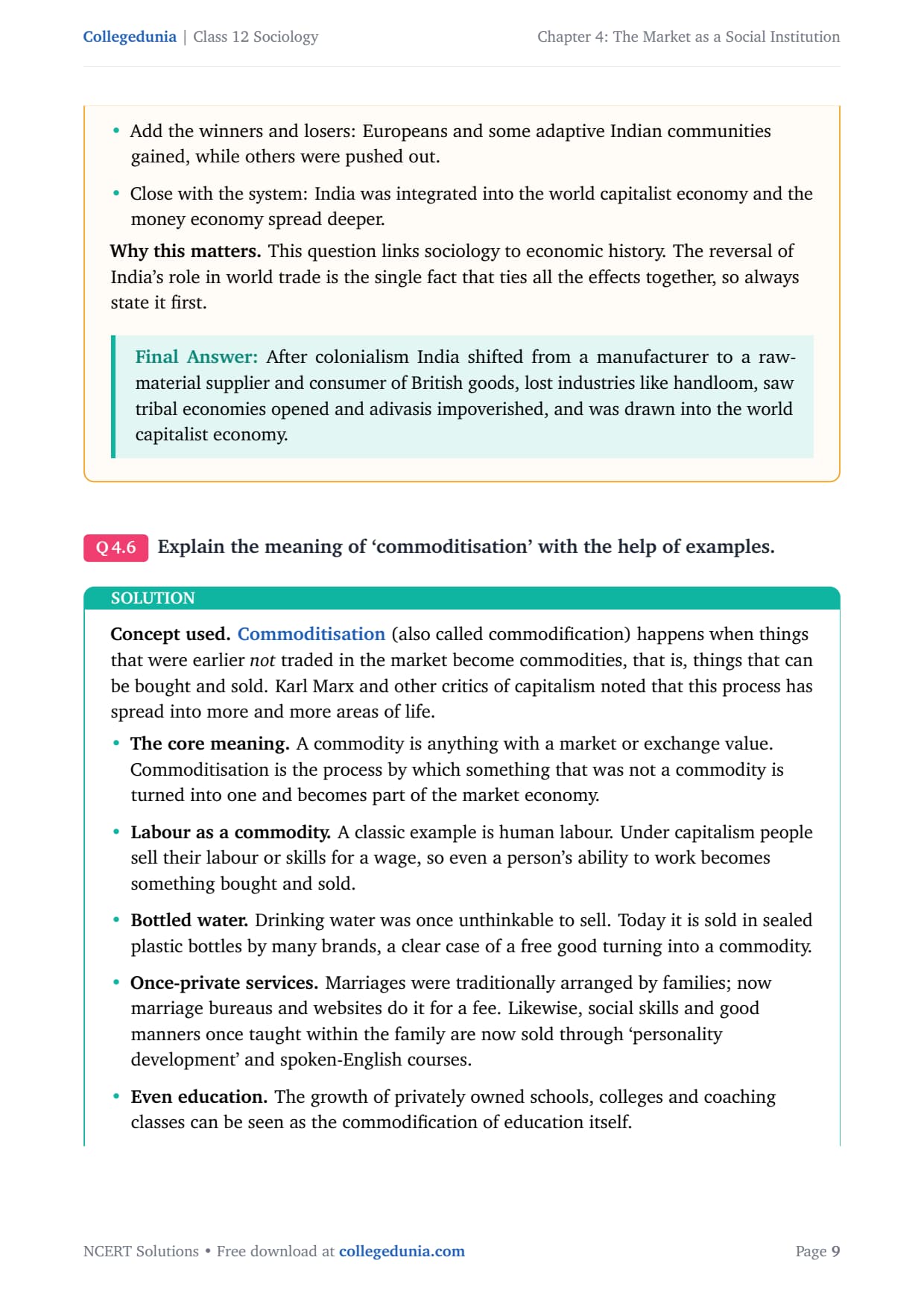
Add the winners and losers: Europeans and some adaptive Indian
communities gained, while others were pushed out.
Close with the system: India was integrated into the world capitalist
economy and the money economy spread deeper.
Why this matters. This question links sociology to economic history.
The reversal of India's role in world trade is the single fact that ties all the
effects together, so always state it first.
After colonialism India shifted from a manufacturer to a raw-material
supplier and consumer of British goods, lost industries like handloom, saw
tribal economies opened and adivasis impoverished, and was drawn into the world
capitalist economy.
Q 4.6
Explain the meaning of `commoditisation' with the help of examples.
Concept used.Commoditisation (also called commodification)
happens when things that were earlier not traded in the market become
commodities, that is, things that can be bought and sold. Karl Marx and other
critics of capitalism noted that this process has spread into more and more
areas of life.
The core meaning. A commodity is anything with a market or
exchange value. Commoditisation is the process by which something that
was not a commodity is turned into one and becomes part of the market
economy.
Labour as a commodity. A classic example is human labour.
Under capitalism people sell their labour or skills for a wage, so even
a person's ability to work becomes something bought and sold.
Bottled water. Drinking water was once unthinkable to sell.
Today it is sold in sealed plastic bottles by many brands, a clear case
of a free good turning into a commodity.
Once-private services. Marriages were traditionally arranged by
families; now marriage bureaus and websites do it for a fee. Likewise,
social skills and good manners once taught within the family are now sold
through `personality development' and spoken-English courses.
Even education. The growth of privately owned schools, colleges
and coaching classes can be seen as the commodification of education
itself.
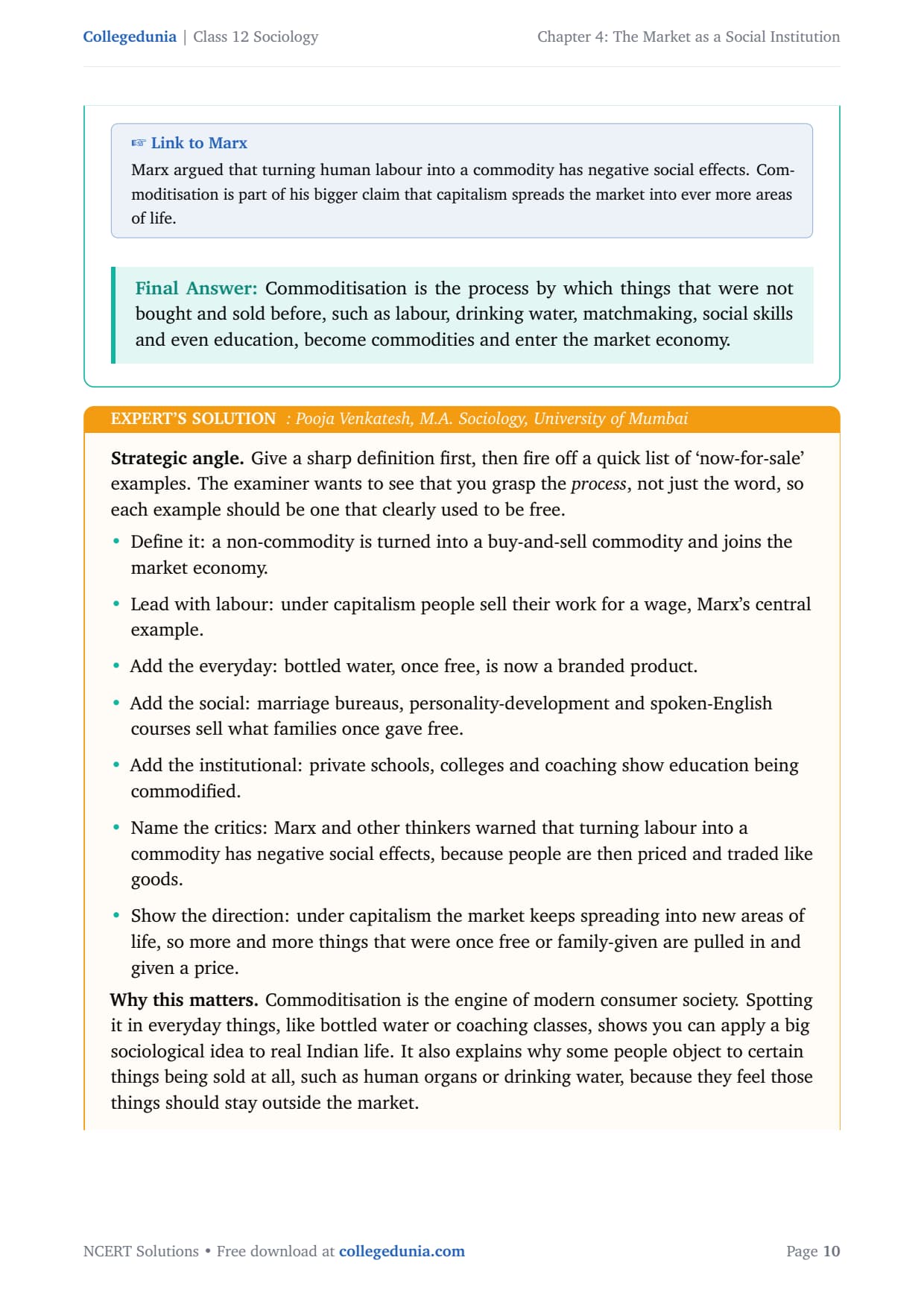
Link to Marx
Marx argued that turning human labour into a commodity has negative social
effects. Commoditisation is part of his bigger claim that capitalism spreads
the market into ever more areas of life.
Commoditisation is the process by which things that were not bought and
sold before, such as labour, drinking water, matchmaking, social skills and even
education, become commodities and enter the market economy.
PV
Pooja Venkatesh
M.A. Sociology, University of Mumbai
Verified Expert
Strategic angle. Give a sharp definition first, then fire off a quick
list of `now-for-sale' examples. The examiner wants to see that you grasp the
process, not just the word, so each example should be one that clearly
used to be free.
Define it: a non-commodity is turned into a buy-and-sell commodity and
joins the market economy.
Lead with labour: under capitalism people sell their work for a wage,
Marx's central example.
Add the everyday: bottled water, once free, is now a branded product.
Add the social: marriage bureaus, personality-development and
spoken-English courses sell what families once gave free.
Add the institutional: private schools, colleges and coaching show
education being commodified.
Name the critics: Marx and other thinkers warned that turning labour
into a commodity has negative social effects, because people are then
priced and traded like goods.
Show the direction: under capitalism the market keeps spreading into new
areas of life, so more and more things that were once free or
family-given are pulled in and given a price.
Why this matters. Commoditisation is the engine of modern consumer
society. Spotting it in everyday things, like bottled water or coaching classes,
shows you can apply a big sociological idea to real Indian life. It also explains
why some people object to certain things being sold at all, such as human organs
or drinking water, because they feel those things should stay outside the market.
Commoditisation turns things once outside the market, labour, water,
matchmaking, manners, education, into goods or services with a price, drawing
more of life into the market economy.
Q 4.7
What is a `status symbol'?
Concept used.Status symbol is a term coined by
Max Weber, a founder of sociology. It describes how the goods people
buy and use are closely linked to their status, or rank, in society.
Goods do not just meet needs; they send a message about who you are.
Goods carry meaning. In modern society, consumption is not only
about economic need. What a person buys and displays signals their
socio-economic standing and cultural tastes to others.
The good becomes a symbol. A status symbol is a good whose main
job is to show off one's place in society. The consumer uses it to
communicate a message about their position.
Indian examples. Among the middle class in India, the brand of
cell phone a person owns, or the model of car they drive, act as markers
of socio-economic status.
Linked to lifestyle. Weber also wrote that status groups are set
apart by their lifestyles. Companies play on this by attaching
symbols of status or culture to their products through advertising.
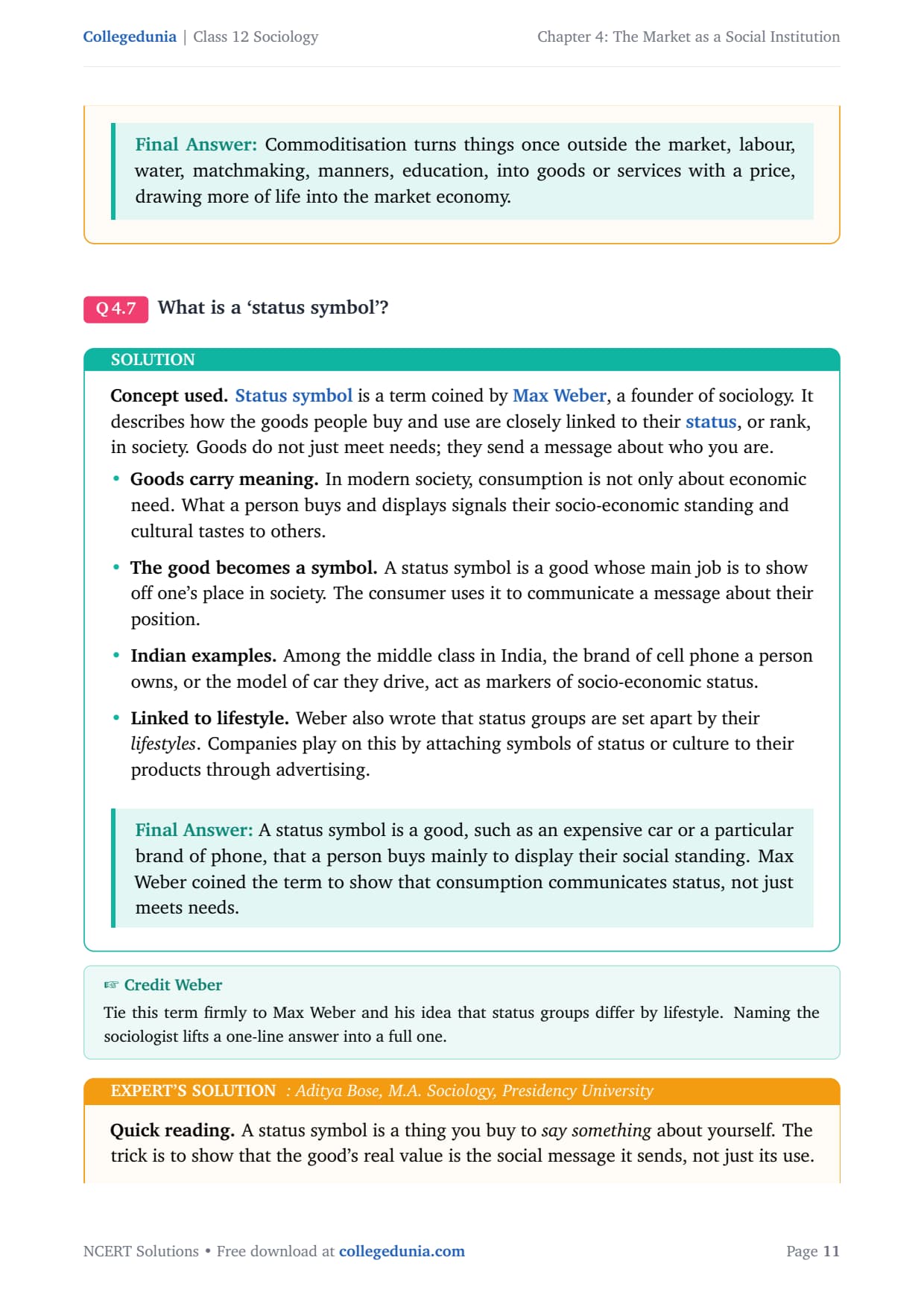
A status symbol is a good, such as an expensive car or a particular
brand of phone, that a person buys mainly to display their social standing.
Max Weber coined the term to show that consumption communicates status, not just
meets needs.
AB
Aditya Bose
M.A. Sociology, Presidency University
Verified Expert
Quick reading. A status symbol is a thing you buy to say
something about yourself. The trick is to show that the good's real value is the
social message it sends, not just its use.
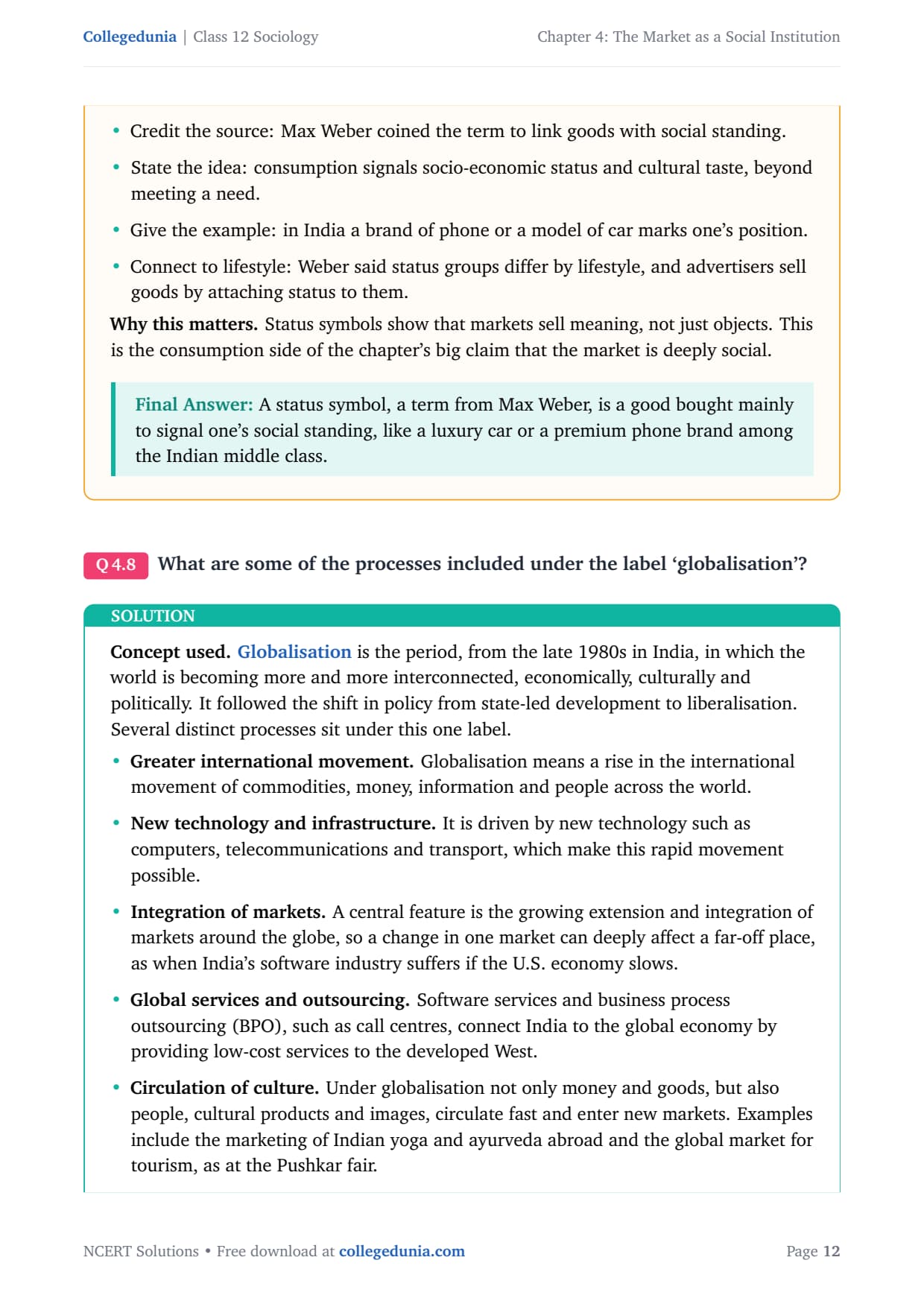
Credit the source: Max Weber coined the term to link goods with social
standing.
State the idea: consumption signals socio-economic status and cultural
taste, beyond meeting a need.
Give the example: in India a brand of phone or a model of car marks one's
position.
Connect to lifestyle: Weber said status groups differ by lifestyle, and
advertisers sell goods by attaching status to them.
Why this matters. Status symbols show that markets sell meaning, not
just objects. This is the consumption side of the chapter's big claim that the
market is deeply social.
A status symbol, a term from Max Weber, is a good bought mainly to
signal one's social standing, like a luxury car or a premium phone brand among
the Indian middle class.
Q 4.8
What are some of the processes included under the label
`globalisation'?
Concept used.Globalisation is the period, from the late
1980s in India, in which the world is becoming more and more interconnected,
economically, culturally and politically. It followed the shift in policy from
state-led development to liberalisation. Several distinct processes sit under
this one label.
Greater international movement. Globalisation means a rise in
the international movement of commodities, money, information and people
across the world.
New technology and infrastructure. It is driven by new
technology such as computers, telecommunications and transport, which
make this rapid movement possible.
Integration of markets. A central feature is the growing
extension and integration of markets around the globe, so a change in one
market can deeply affect a far-off place, as when India's software
industry suffers if the U.S. economy slows.
Global services and outsourcing. Software services and business
process outsourcing (BPO), such as call centres, connect India to the
global economy by providing low-cost services to the developed West.
Circulation of culture. Under globalisation not only money and
goods, but also people, cultural products and images, circulate fast and
enter new markets. Examples include the marketing of Indian yoga and
ayurveda abroad and the global market for tourism, as at the Pushkar
fair.
Globalisation includes the rising international flow of goods, money,
information and people; new technology like computers and telecom; the
integration of world markets; software and BPO services; and the global
circulation of culture, images and tourism.
NK
Nisha Kapoor
M.A. Sociology, Panjab University
Verified Expert
Strategic angle. Sort globalisation into three baskets: what moves
(goods, money, people, culture), what makes it move (technology), and what it
does (integrates markets). That structure stops you from listing random points.
What moves: commodities, money, information, people, and cultural
products and images flow across borders.
What powers it: computers, telecommunications and transport.
What it does: markets around the world become extended and integrated,
so distant economies affect each other.
India's role: software services and BPO, such as call centres, link
India to the global economy by selling low-cost labour and services to
the developed West; yoga, ayurveda and tourism show culture entering
global markets.
Time and trigger: in India this new era began in the late 1980s, after
economic policy shifted from state-led development to liberalisation.
The catch of integration: because markets are now joined up, a slump far
away can hurt India, as the software industry felt after the 9/11 shock
to the U.S. economy.
Why this matters. Breaking globalisation into clear processes lets you
answer follow-up questions on its costs and benefits with confidence, because
you can point to exactly which process you mean. It also shows that globalisation
is not only about money and goods: it moves people, images and even religious and
cultural traditions into new circuits of exchange.
Globalisation bundles together the global movement of goods, money,
information and people, new communication and transport technology, the
integration of world markets, services like BPO, and the worldwide circulation
of culture.
Q 4.9
What is meant by `liberalisation'?
Concept used.Liberalisation is the set of economic policies
India began in the late 1980s, marking a shift from state-led development to a
greater role for the market. Another word for the same direction of change is
marketisation.
Privatisation. Liberalisation includes the privatisation of
public sector enterprises, which means selling government-owned companies
to private companies.
Deregulation. It involves a loosening or removal of government
regulations and controls over capital, labour, trade, wages and prices,
often called deregulation.
Opening to foreign trade and firms. It reduces tariffs and
import duties so foreign goods can be imported more easily, and allows
foreign companies easier access to set up industries in India.
Marketisation. Taken together this is marketisation: using
markets or market-based processes, rather than government rules, to solve
economic, social and political problems. Supporters argue private
industry is more efficient than government-owned industry and so spurs
growth.
Pair it with globalisation
Liberalisation is the policy that opened India up; globalisation is the
process it set off. Keeping the two linked but distinct earns easy marks.
Liberalisation means the economic policy India started in the late
1980s that shifts power from the state to the market, through privatisation,
deregulation and opening up to foreign goods and firms; another name for it is
marketisation.
VA
Vikram Anand
M.A. Economics and Sociology, University of Calcutta
Verified Expert
Quick reading. Liberalisation is government stepping back and the market
stepping forward. Remember it as three moves: privatise, deregulate, open up,
and add its other name, marketisation.
Frame the shift: from state-led development to market-led growth, started
in the late 1980s.
Privatise: sell public sector companies to private owners.
Deregulate: loosen government controls on capital, labour, trade, wages
and prices.
Open up: cut tariffs and import duties and welcome foreign firms, which
together is called marketisation.
Add deregulation: remove or relax government controls over wages, prices,
capital, labour and trade, so the market, not the state, decides more
outcomes.
State the belief behind it: supporters argue private industry is more
efficient than government-owned industry, so marketisation should promote
growth and prosperity.
Why this matters. Liberalisation is the trigger for India's
globalisation. Defining it cleanly sets you up for the harder debate question on
whether its benefits outweigh its costs. Remember that it is a deliberate policy
choice, the state choosing to step back, not a natural or automatic change, which
is why people can argue for or against it.
Liberalisation is India's late-1980s policy of reducing state control
and expanding the market through privatisation, deregulation and openness to
foreign trade and investment, also known as marketisation.
Q 4.10
In your opinion, will the long term benefits of liberalisation exceed
its costs? Give reasons for your answer.
Concept used. This is an opinion question, so it has no single right
answer. A good answer weighs the benefits of liberalisation against
its costs, using points from the chapter, and then takes a clear, well
reasoned stand. The chapter itself stresses that the impact has been
mixed.
The benefits side. Liberalisation has stimulated economic
growth and opened Indian markets to foreign companies. Many foreign
branded goods, not available earlier, are now sold. Rising foreign
investment is meant to help growth and employment, and privatising public
firms is meant to make them more efficient and reduce the government's
burden. Some sectors, like software, information technology and parts of
agriculture such as fish or fruit, gain from access to a global market.
The costs side. The impact has also been negative for many.
Indian farmers now face competition from cheaper imported farm products,
while support prices and subsidies that once protected them are cut, so
many cannot make a decent living. Small manufacturers face global
competition and some cannot survive. Privatisation and closure of public
firms cause job losses and push work into the poorly paid unorganised
sector. Sectors like automobiles, electronics and oilseeds may lose out
to foreign producers.
Weighing the two. Because gains go to some sectors and losses
to others, the question is whether the advantages will, in the long run,
be more than the disadvantages. The textbook notes that many people argue
the net impact on India will be negative.
Taking a stand. A reasoned answer can argue either way. For
example: liberalisation's benefits may exceed its costs in the long run
if growth is shared and weaker sectors and workers are protected
through support prices, safety nets and skilling; without such
protection, the costs to farmers, small producers and unorganised workers
could outweigh the gains. State your view clearly and back it with these
reasons.
There is no fixed answer: liberalisation brings growth, foreign goods,
investment and gains for sectors like IT, but also hurts farmers, small
producers and organised-sector workers. Whether long-term benefits exceed costs
depends on whether the gains are shared and the losers protected; state your
opinion and support it with these points.
TM
Tara Menon
M.A. Development Studies, Tata Institute of Social Sciences
Verified Expert
Strategic angle. For any `in your opinion' question, score comes from
structure: benefits, then costs, then a reasoned verdict. Never lead with the
opinion; earn it by weighing both sides first.
Build the benefits: liberalisation has stimulated economic growth and
opened Indian markets to foreign companies, so many foreign branded goods
not available earlier are now sold. Rising foreign investment is meant to
boost growth and jobs, and privatising public firms is meant to make them
more efficient and ease the government's burden. Sectors like software,
information technology and some agriculture (fish, fruit) gain from access
to a global market.
Build the costs: farmers are exposed to cheaper imported produce while
support prices and subsidies are cut, so many cannot make a decent
living. Small manufacturers are undercut by foreign goods and brands, and
some cannot compete. Privatisation and closure of public firms cause job
losses and push work into the poorly paid, less secure unorganised
sector. Sectors like automobiles, electronics and oilseeds may lose out.
Note the chapter's own view: the impact has been mixed, and many people
argue that the net effect on India will be negative, with costs and
disadvantages outweighing the benefits.
Give a reasoned verdict: argue the benefits can outweigh the costs only
if growth is inclusive and the losers, farmers, small producers and
organised-sector workers, are protected through support prices, safety
nets and skilling; without such protection, the costs may win.
Sign off clearly: whichever side you take, state your opinion in one firm
sentence at the end so the examiner sees you actually answered the
question rather than only listing points.
Why this matters. This is the chapter's big debate, market versus state.
A balanced, evidence-backed opinion shows you can think like a sociologist
instead of just memorising one side. It also trains you for higher marks: opinion
questions reward students who weigh evidence fairly first and only then commit to
a view, rather than picking a side at the start and ignoring the other.
Liberalisation's long-term benefits can exceed its costs only if growth
is shared and weaker sectors are protected; otherwise the harm to farmers, small
producers and unorganised workers may outweigh the gains. Present both sides,
then defend your own reasoned view.
FAQs on The Market as a Social Institution Class 12 NCERT Solutions
The Market as a Social Institution Class 12 Sociology Common Questions
Ques. Where can I get the class 12 sociology chapter 4 NCERT Solutions PDF?
Ans. You can download the The Market as a Social Institution Class 12 Sociology NCERT Solutions PDF directly from this page. It is free, follows the 2026-27 NCERT, and answers all 10 exercise questions point by point.
Ques. How many questions are there in The Market as a Social Institution class 12 questions and answers?
Ans. The chapter has 10 exercise questions. They cover the invisible hand, the sociological view of markets, the weekly haat, caste and kin trade, colonialism, commoditisation, status symbols, globalisation and liberalisation.
Ques. What is the "invisible hand" in simple terms?
Ans. It is Adam Smith's idea, from The Wealth of Nations, that a free market organises itself. Millions of self-interested deals between buyers and sellers add up, on their own, to an orderly system that nobody planned or controls.
Ques. How does the sociological view of markets differ from the economic one?
Ans. Economics studies how the market works as a pricing mechanism. Sociology sees the market as a social institution that is embedded in society and shaped by caste, class, community and culture, asking who controls it and what exchange means socially.
Ques. What is a status symbol in this chapter?
Ans. Following Max Weber, a status symbol is a good bought to signal a person's social standing, not just for its use. It shows that consumption is about meaning and identity, not only need.
Ques. Is class 12 sociology chapter 4 easy to score in the board exam?
Ans. Yes. It is a high-scoring chapter if you keep one clear theory point and one named Indian example ready for each topic. Learn the sociological view, the weekly haat, caste and kin trade, and keep your own view ready for the liberalisation question.








Comments