




NCERT Class 8 Science Chapter 8 Nature of Matter: Elements, Compounds, and Mixtures Notes explain mixtures, air, pure substances, elements, compounds, symbols, formulae, alloys and minerals for the 2026-27 NCERT Curiosity textbook.
- Best for quick revision: covers uniform and non-uniform mixtures, air composition, lime water test, elements and compounds.
- Useful for activity questions: includes black-sheet dust activity, lime water observation and water decomposition idea.
- Free PDF: download the full chapter notes with diagrams, tables and answer frames.
Chapter8NatureofMatter:Elements,Compounds,andMixturesNotes.pdf?page=1&dpi=150)
Chapter8NatureofMatter:Elements,Compounds,andMixturesNotes.pdf?page=2&dpi=150)
Chapter8NatureofMatter:Elements,Compounds,andMixturesNotes.pdf?page=3&dpi=150)
Chapter8NatureofMatter:Elements,Compounds,andMixturesNotes.pdf?page=4&dpi=150)
Chapter8NatureofMatter:Elements,Compounds,andMixturesNotes.pdf?page=5&dpi=150)
Chapter8NatureofMatter:Elements,Compounds,andMixturesNotes.pdf?page=6&dpi=150)
Chapter8NatureofMatter:Elements,Compounds,andMixturesNotes.pdf?page=7&dpi=150)
Chapter8NatureofMatter:Elements,Compounds,andMixturesNotes.pdf?page=8&dpi=150)
Chapter8NatureofMatter:Elements,Compounds,andMixturesNotes.pdf?page=9&dpi=150)
Chapter8NatureofMatter:Elements,Compounds,andMixturesNotes.pdf?page=10&dpi=150)
Chapter8NatureofMatter:Elements,Compounds,andMixturesNotes.pdf?page=11&dpi=150)
Chapter8NatureofMatter:Elements,Compounds,andMixturesNotes.pdf?page=12&dpi=150)
Chapter8NatureofMatter:Elements,Compounds,andMixturesNotes.pdf?page=13&dpi=150)
Chapter8NatureofMatter:Elements,Compounds,andMixturesNotes.pdf?page=14&dpi=150)
Chapter8NatureofMatter:Elements,Compounds,andMixturesNotes.pdf?page=15&dpi=150)
Chapter8NatureofMatter:Elements,Compounds,andMixturesNotes.pdf?page=16&dpi=150)
Chapter8NatureofMatter:Elements,Compounds,andMixturesNotes.pdf?page=17&dpi=150)
Chapter8NatureofMatter:Elements,Compounds,andMixturesNotes.pdf?page=18&dpi=150)
Chapter8NatureofMatter:Elements,Compounds,andMixturesNotes.pdf?page=19&dpi=150)
Chapter8NatureofMatter:Elements,Compounds,andMixturesNotes.pdf?page=20&dpi=150)
Chapter8NatureofMatter:Elements,Compounds,andMixturesNotes.pdf?page=21&dpi=150)
Chapter8NatureofMatter:Elements,Compounds,andMixturesNotes.pdf?page=22&dpi=150)
Chapter8NatureofMatter:Elements,Compounds,andMixturesNotes_flat_MobileCard.pdf?page=1&dpi=150)
Chapter8NatureofMatter:Elements,Compounds,andMixturesNotes_flat_MobileCard.pdf?page=2&dpi=150)
Chapter8NatureofMatter:Elements,Compounds,andMixturesNotes_flat_MobileCard.pdf?page=3&dpi=150)
Chapter8NatureofMatter:Elements,Compounds,andMixturesNotes_flat_MobileCard.pdf?page=4&dpi=150)
Chapter8NatureofMatter:Elements,Compounds,andMixturesNotes_flat_MobileCard.pdf?page=5&dpi=150)
Chapter8NatureofMatter:Elements,Compounds,andMixturesNotes_flat_MobileCard.pdf?page=6&dpi=150)
Chapter8NatureofMatter:Elements,Compounds,andMixturesNotes_flat_MobileCard.pdf?page=7&dpi=150)
Chapter8NatureofMatter:Elements,Compounds,andMixturesNotes_flat_MobileCard.pdf?page=8&dpi=150)
Chapter8NatureofMatter:Elements,Compounds,andMixturesNotes_flat_MobileCard.pdf?page=9&dpi=150)
Chapter8NatureofMatter:Elements,Compounds,andMixturesNotes_flat_MobileCard.pdf?page=10&dpi=150)
Chapter8NatureofMatter:Elements,Compounds,andMixturesNotes_flat_MobileCard.pdf?page=11&dpi=150)
Chapter8NatureofMatter:Elements,Compounds,andMixturesNotes_flat_MobileCard.pdf?page=12&dpi=150)
Chapter8NatureofMatter:Elements,Compounds,andMixturesNotes_flat_MobileCard.pdf?page=13&dpi=150)
Chapter8NatureofMatter:Elements,Compounds,andMixturesNotes_flat_MobileCard.pdf?page=14&dpi=150)
Chapter8NatureofMatter:Elements,Compounds,andMixturesNotes_flat_MobileCard.pdf?page=15&dpi=150)
Chapter8NatureofMatter:Elements,Compounds,andMixturesNotes_flat_MobileCard.pdf?page=16&dpi=150)
Chapter8NatureofMatter:Elements,Compounds,andMixturesNotes_flat_MobileCard.pdf?page=17&dpi=150)
Chapter8NatureofMatter:Elements,Compounds,andMixturesNotes_flat_MobileCard.pdf?page=18&dpi=150)
Chapter8NatureofMatter:Elements,Compounds,andMixturesNotes_flat_MobileCard.pdf?page=19&dpi=150)
Chapter8NatureofMatter:Elements,Compounds,andMixturesNotes_flat_MobileCard.pdf?page=20&dpi=150)
Chapter8NatureofMatter:Elements,Compounds,andMixturesNotes_flat_MobileCard.pdf?page=21&dpi=150)
Chapter8NatureofMatter:Elements,Compounds,andMixturesNotes_flat_MobileCard.pdf?page=22&dpi=150)
Chapter8NatureofMatter:Elements,Compounds,andMixturesNotes_flat_MobileCard.pdf?page=23&dpi=150)
Chapter8NatureofMatter:Elements,Compounds,andMixturesNotes_flat_MobileCard.pdf?page=24&dpi=150)
Chapter8NatureofMatter:Elements,Compounds,andMixturesNotes_flat_MobileCard.pdf?page=25&dpi=150)
Chapter8NatureofMatter:Elements,Compounds,andMixturesNotes_flat_MobileCard.pdf?page=26&dpi=150)
Chapter8NatureofMatter:Elements,Compounds,andMixturesNotes_flat_MobileCard.pdf?page=27&dpi=150)
Chapter8NatureofMatter:Elements,Compounds,andMixturesNotes_flat_MobileCard.pdf?page=28&dpi=150)
Chapter8NatureofMatter:Elements,Compounds,andMixturesNotes_flat_MobileCard.pdf?page=29&dpi=150)
Chapter8NatureofMatter:Elements,Compounds,andMixturesNotes_flat_MobileCard.pdf?page=30&dpi=150)
Chapter8NatureofMatter:Elements,Compounds,andMixturesNotes_flat_MobileCard.pdf?page=31&dpi=150)
Student Feedback: Students usually revise this chapter faster when they first divide matter into mixtures and pure substances, then split pure substances into elements and compounds.
Nature of Matter Elements Compounds and Mixtures Notes Overview
Class 8 Science Chapter 8 explains how substances around us are classified. It begins with mixtures such as poha, sprout salad, sugar water and air, then moves to pure substances, elements and compounds.
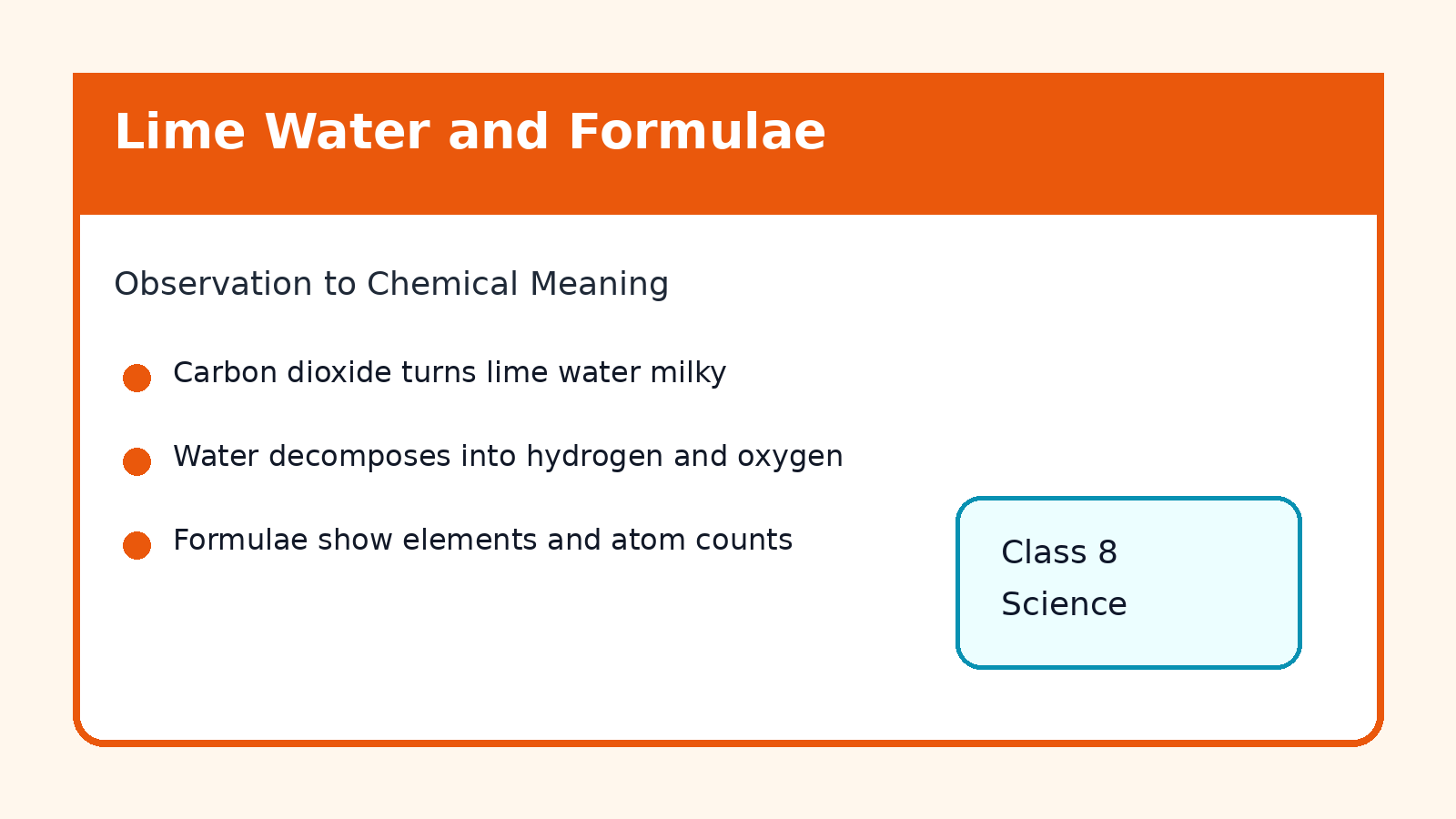
The chapter also links classroom activities to chemical ideas. Lime water turning milky shows carbon dioxide in air, while decomposition of water shows that water is a compound made of hydrogen and oxygen.
Nature of Matter Elements Compounds and Mixtures Video Lesson
Source: Magnet Brains on YouTube
Mixtures and Air in Class 8 Science Chapter 8
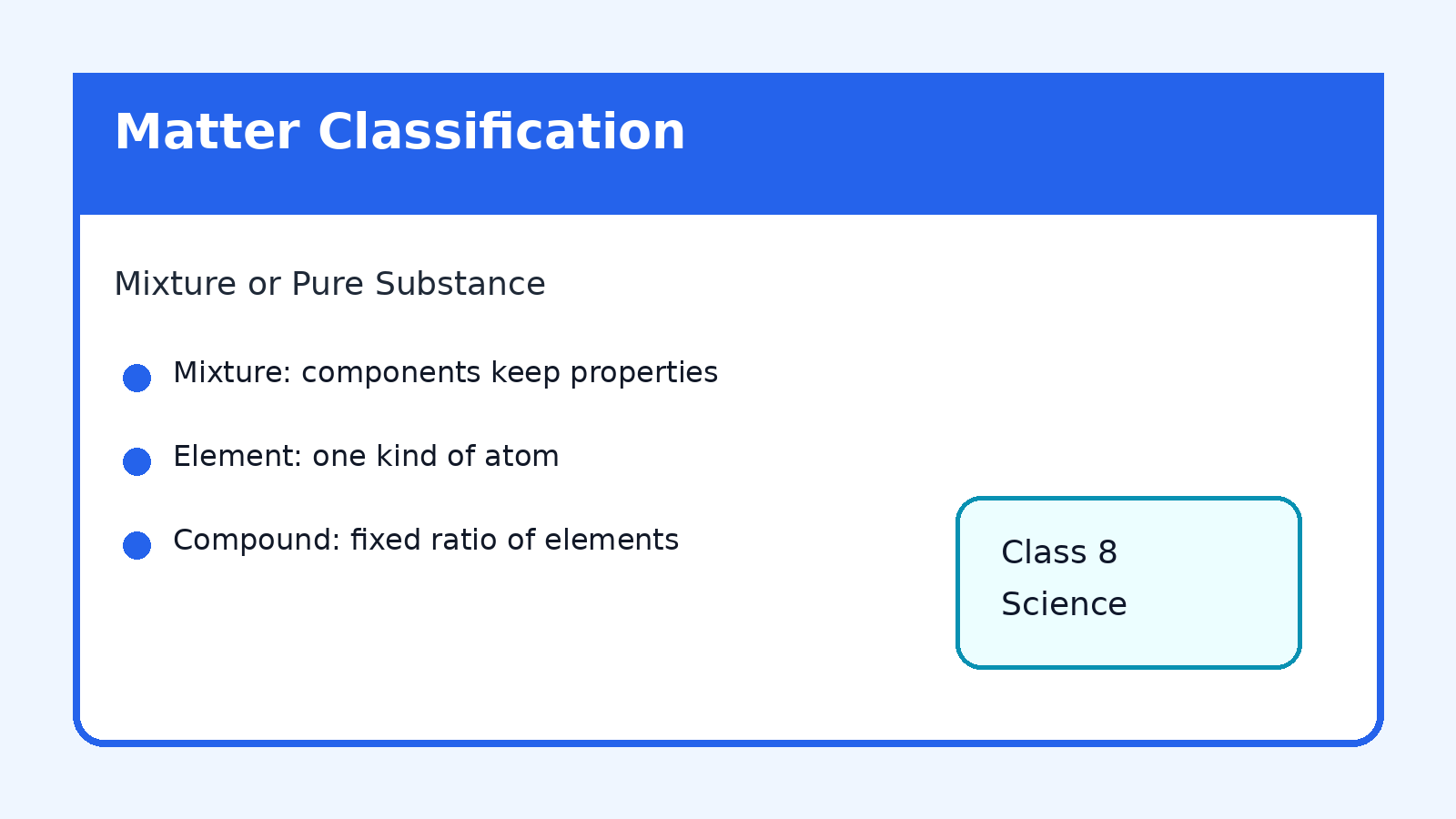
A mixture contains two or more components. In a mixture, each component keeps its own properties. Sprout salad is non-uniform because its components are visible, while sugar water is uniform because the dissolved sugar is evenly spread.
| Example | Category | Reason |
|---|---|---|
| Air | Uniform mixture | Gases are evenly mixed |
| Sprout salad | Non-uniform mixture | Components can be seen separately |
| Sugar water | Uniform mixture | Sugar particles are evenly distributed |
| Dust in air | Pollutant particles | Dust is suspended but not an essential part of air |
Pure Substances Elements and Compounds
A pure substance has a definite composition. Pure substances are of two types: elements and compounds. An element has only one kind of atom, while a compound has two or more elements chemically combined in a fixed ratio.
- Element: oxygen, hydrogen, iron and copper are examples.
- Compound: water, carbon dioxide, common salt and sugar are examples.
- Mixture: air, soil, lemonade, steel and brass are examples.
Symbols Formulae Alloys and Minerals
Element symbols and compound formulae make chemical writing shorter. H stands for hydrogen, O stands for oxygen, Fe stands for iron and Cu stands for copper. The formula H2O shows that water contains hydrogen and oxygen in a fixed ratio.
Alloys such as stainless steel, brass and bronze are uniform mixtures of metals or metals with a small amount of another element. Minerals are naturally occurring substances that can be sources of useful materials.
Nature of Matter Related Resources
| Resource | Link |
|---|---|
| NCERT Solutions | Class 8 Science Chapter 8 NCERT Solutions |
| NCERT Book PDF | Class 8 Science Chapter 8 NCERT Book PDF |
| Handwritten Notes | Class 8 Science Chapter 8 Handwritten Notes |
Class 8 Science Curiosity Notes for All Chapters
| Chapter | Notes |
|---|---|
| Chapter 5 | Exploring Forces Notes |
| Chapter 6 | Pressure Winds Storms and Cyclones Notes |
| Chapter 7 | Particulate Nature of Matter Notes |
| Chapter 8 | Nature of Matter Elements Compounds and Mixtures Notes |
Student Doubts on Class 8 Science Chapter 8
Nature of Matter Elements Compounds and Mixtures Class 8 Notes FAQs
Ques. What is a mixture in Class 8 Science Chapter 8?
Ans. A mixture contains two or more components that are together without chemical reaction. Each component keeps its own properties.
Ques. Is air an element, compound or mixture?
Ans. Air is a uniform mixture of gases such as nitrogen, oxygen, argon, carbon dioxide and water vapour.
Ques. What is the difference between an element and a compound?
Ans. An element contains one kind of atom. A compound contains two or more elements chemically combined in a fixed ratio.
Ques. Why does lime water turn milky in air?
Ans. Carbon dioxide in air reacts with calcium hydroxide in lime water to form insoluble calcium carbonate, which makes the liquid milky.



Comments