




NEET PG 2025 Question Paper PDF is available for download here. NBEMS conducted NEET PG 2025 exam on August 3 from 9 AM to 12.30 PM. NEET PG 2025 was conducted in online CBT mode for a duration of 3 hours 30 minutes. NEET PG 2025 question paper comprises 200 questions carrying a total weightage of 800 marks.
NEET PG 2025 Question Paper with Solutions PDF
| NEET PG 2025 Question Paper with Solutions PDF | Download PDF | Check Solutions |
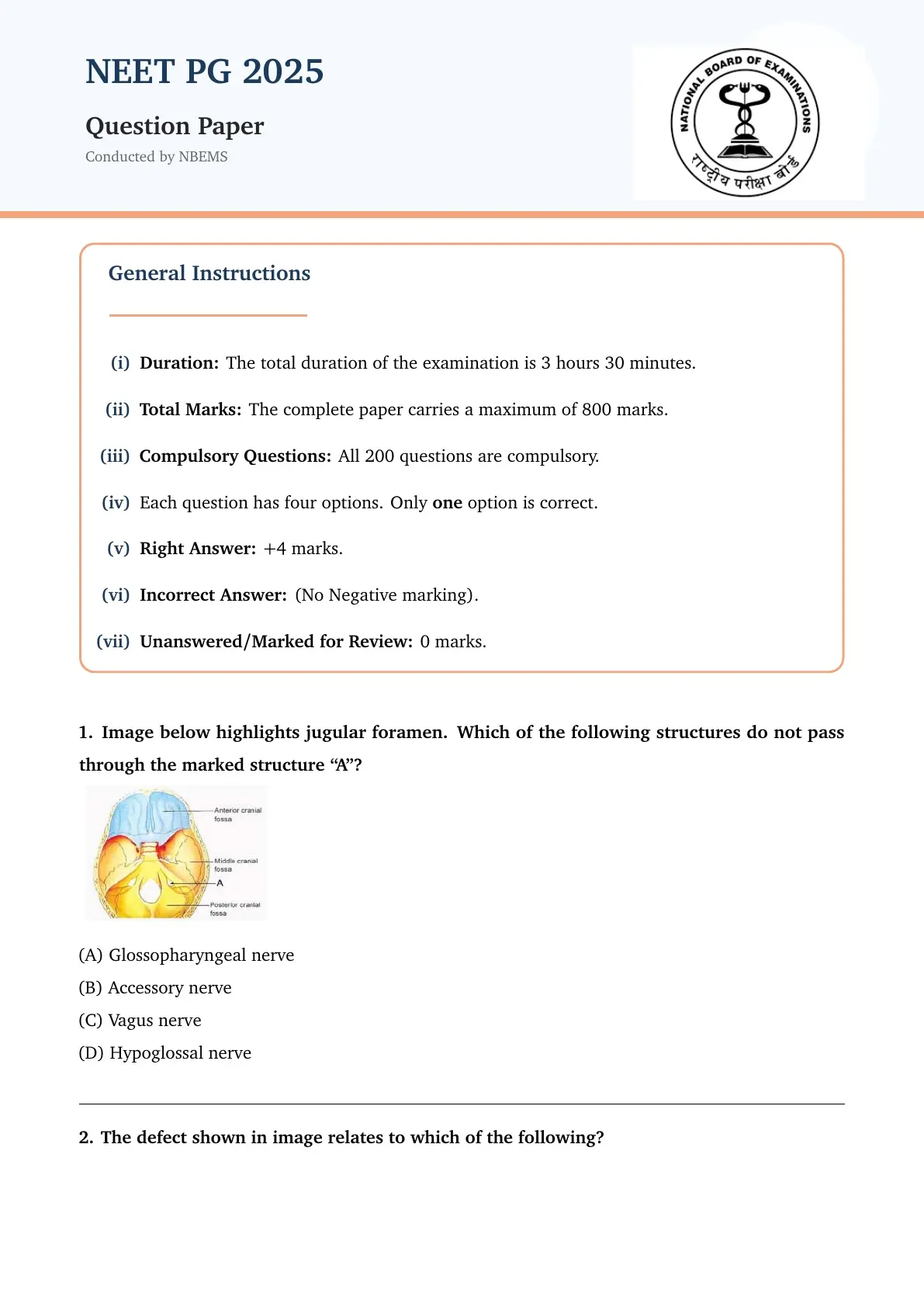
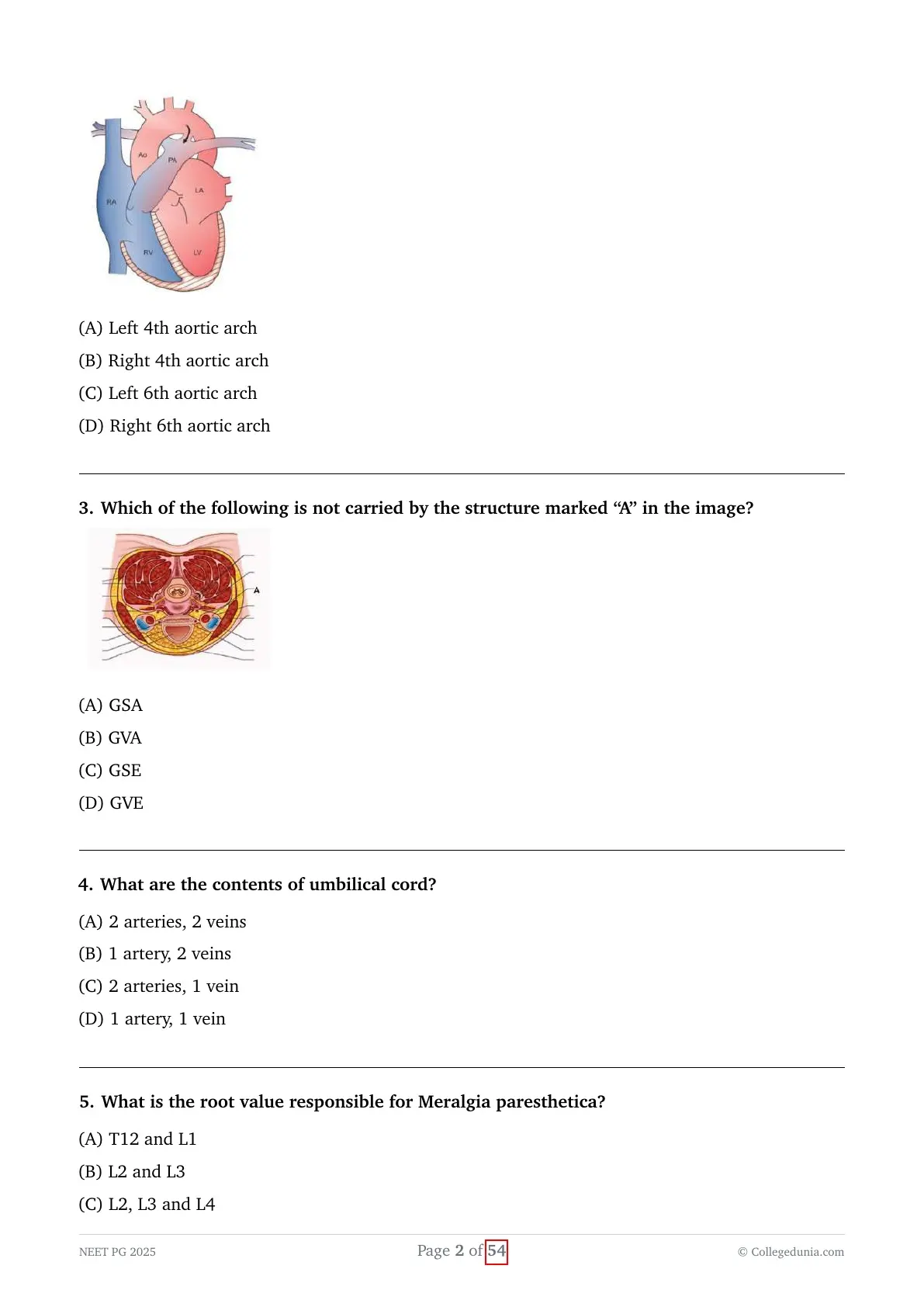
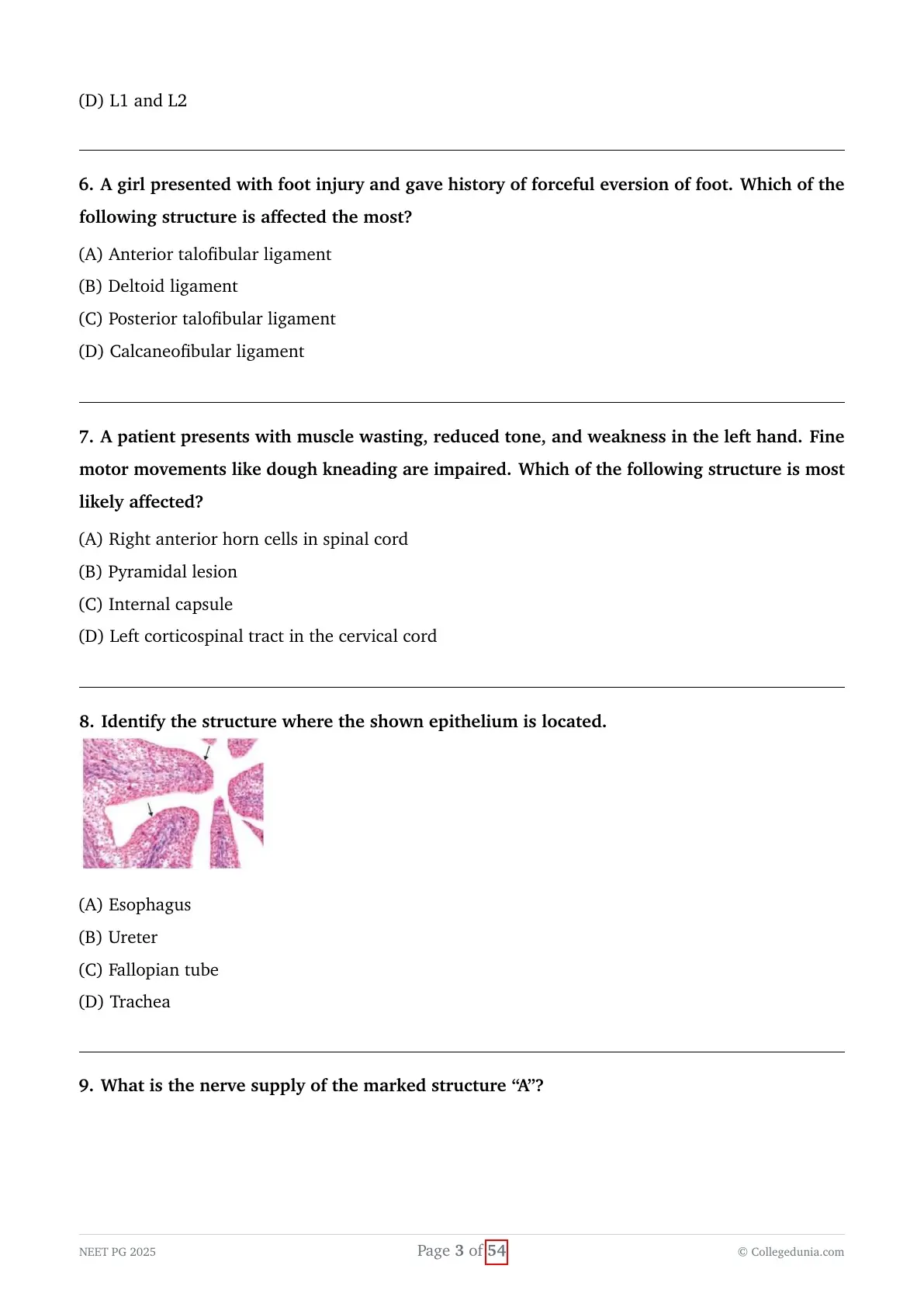
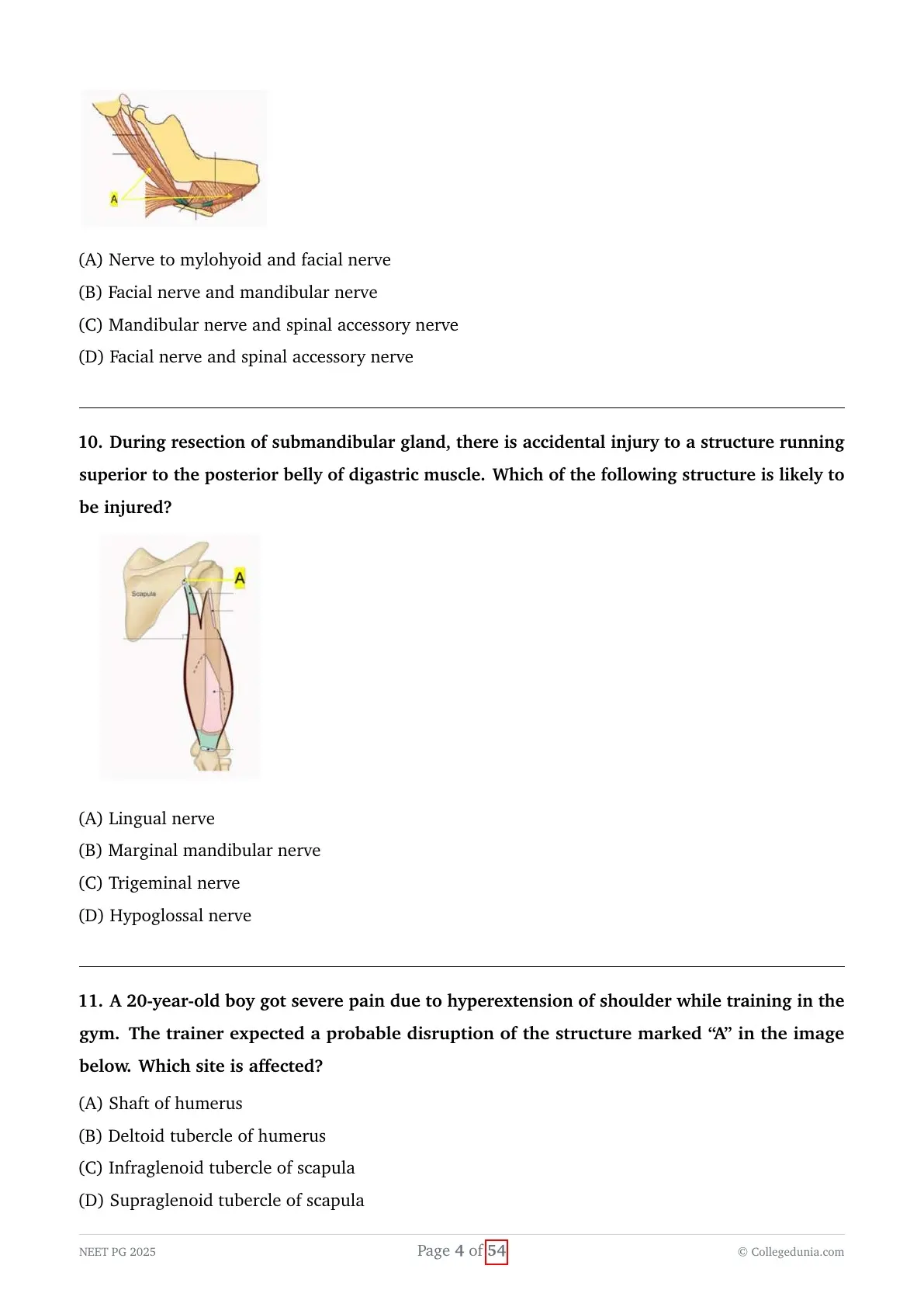
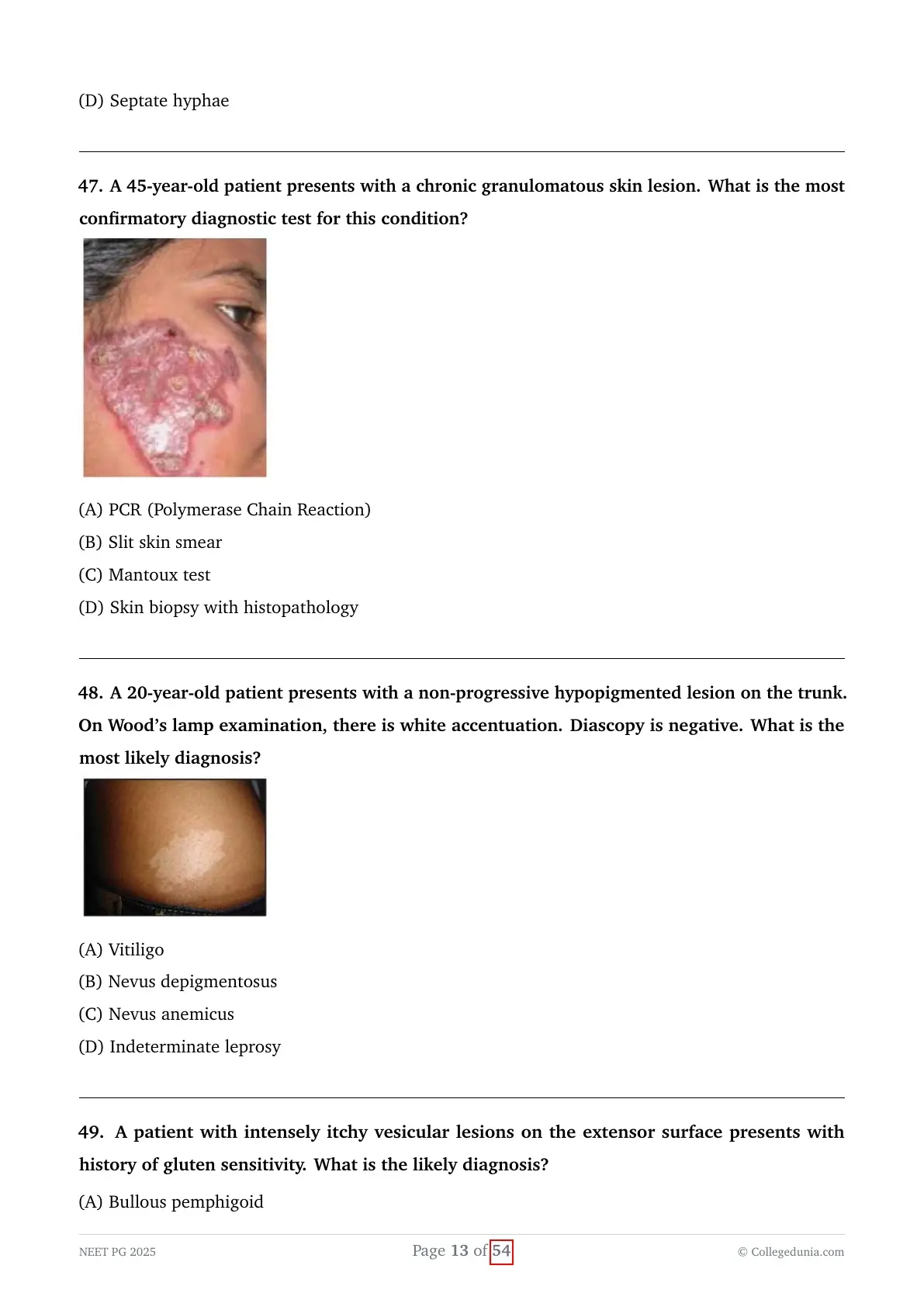
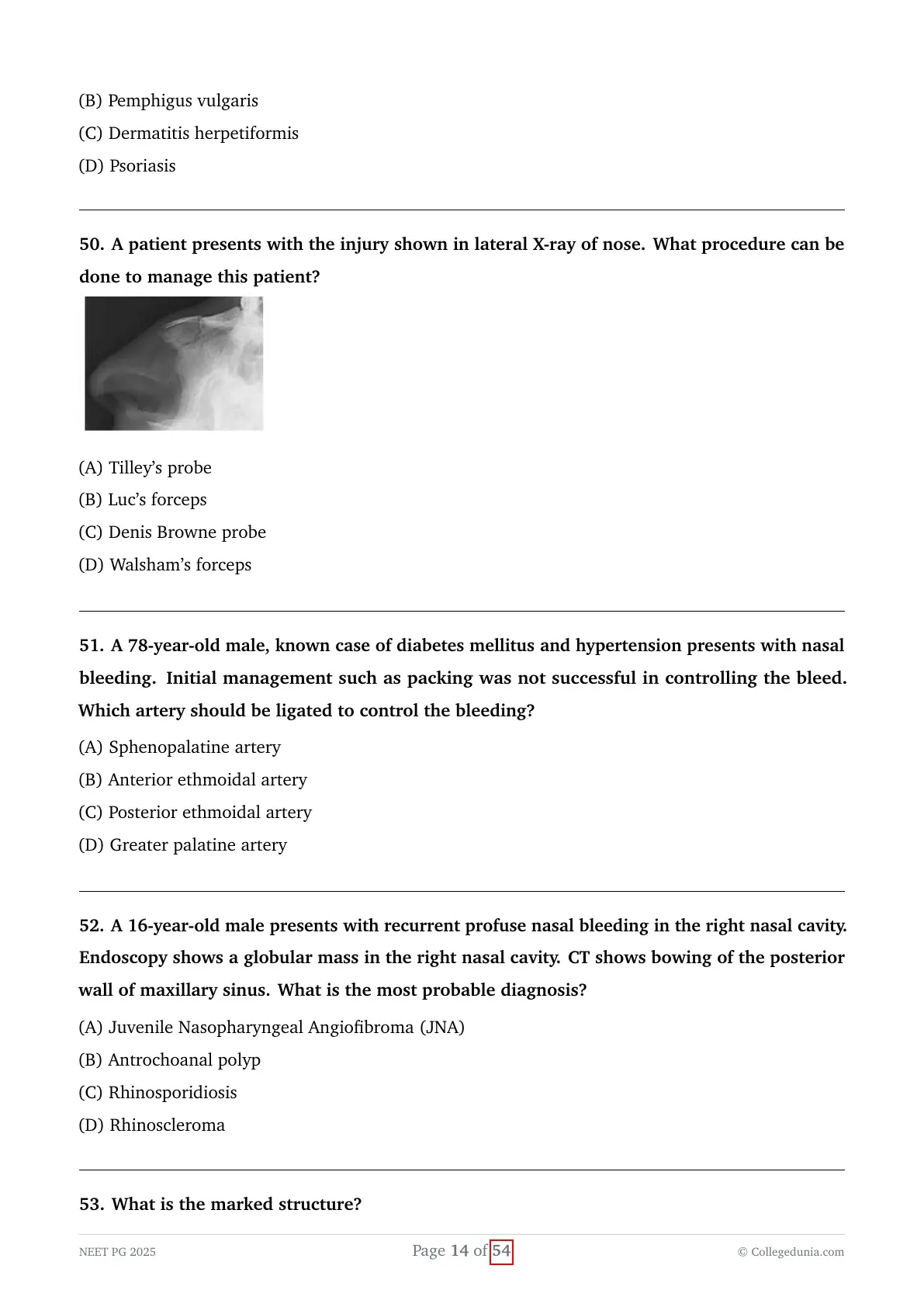
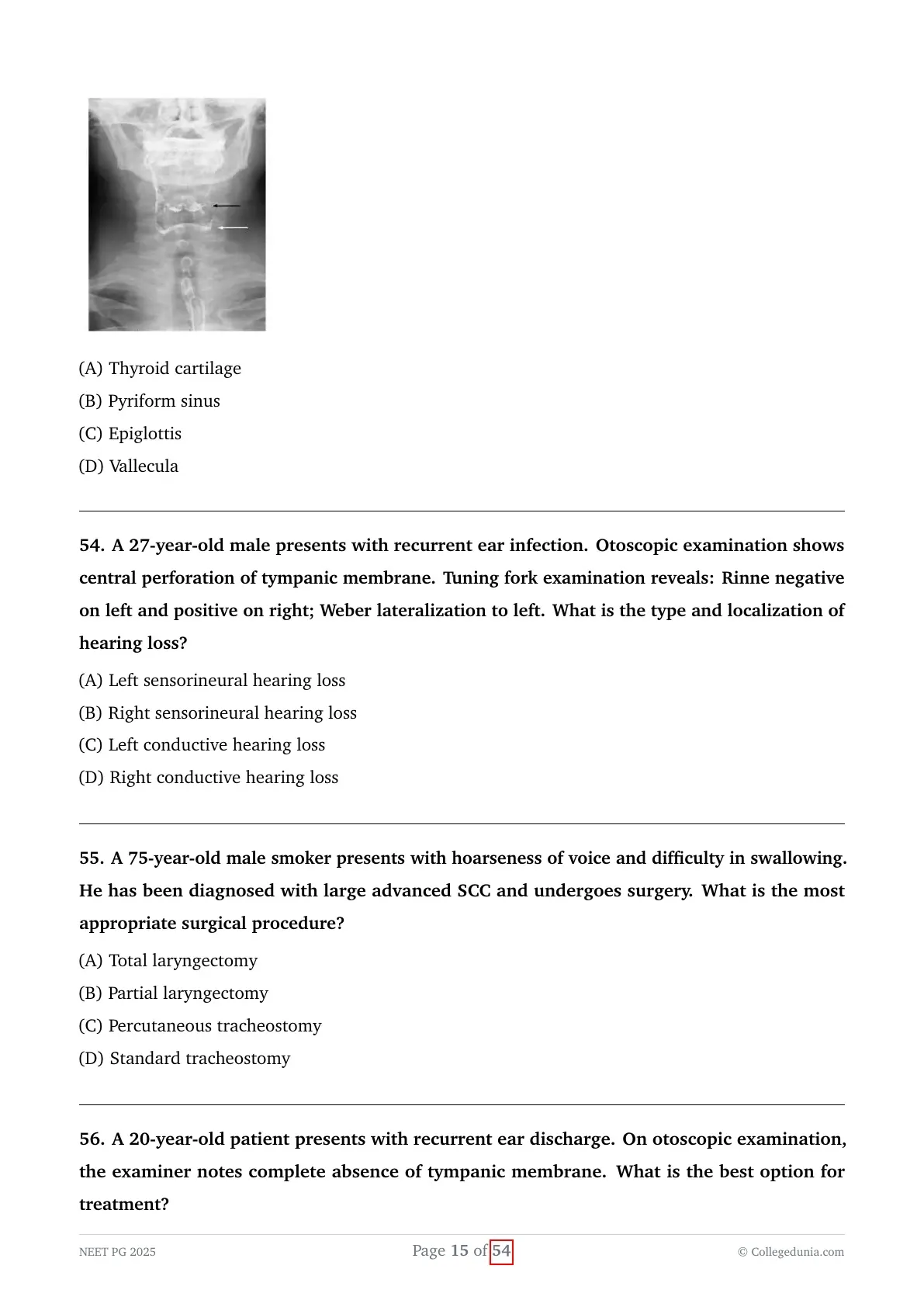
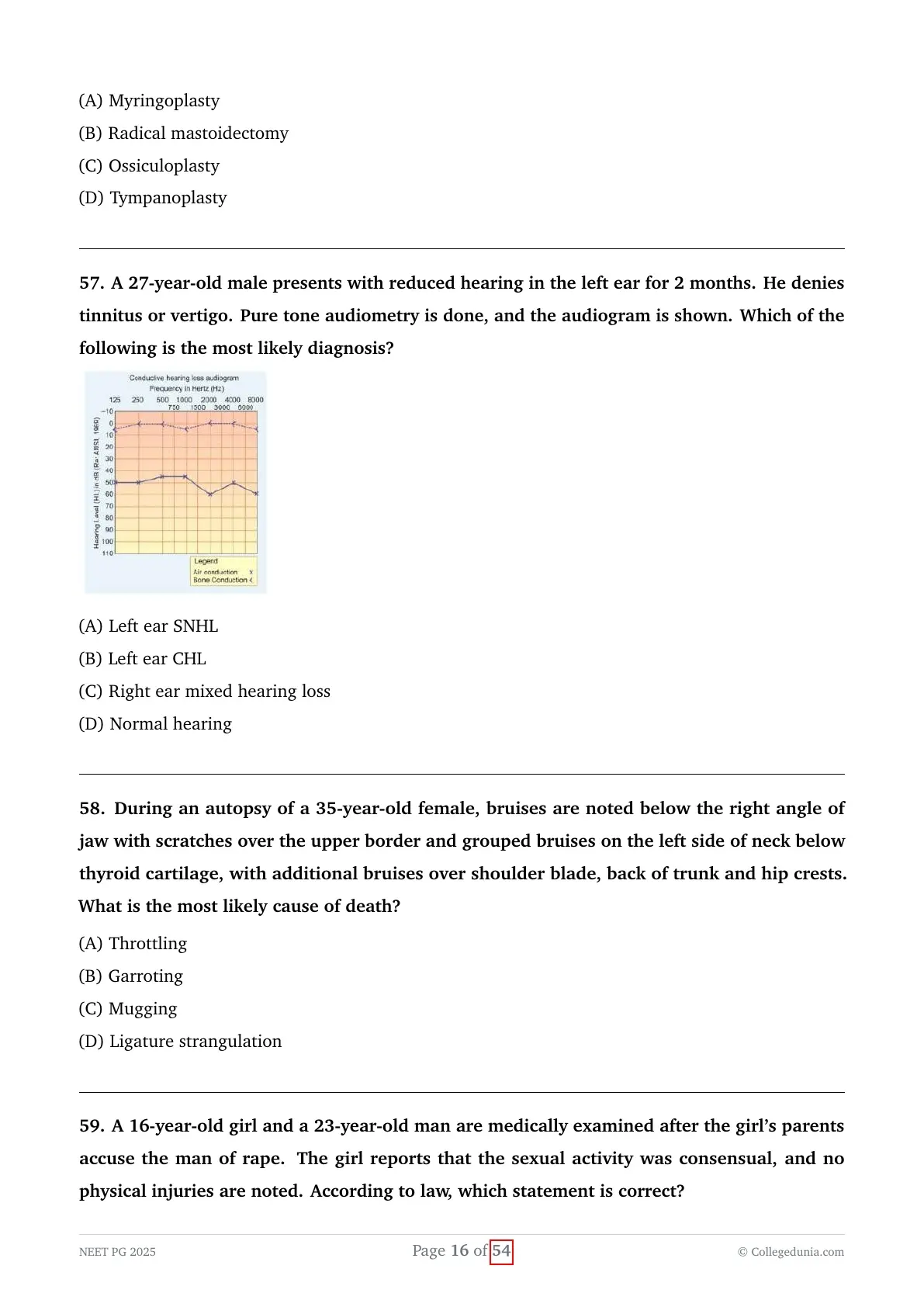
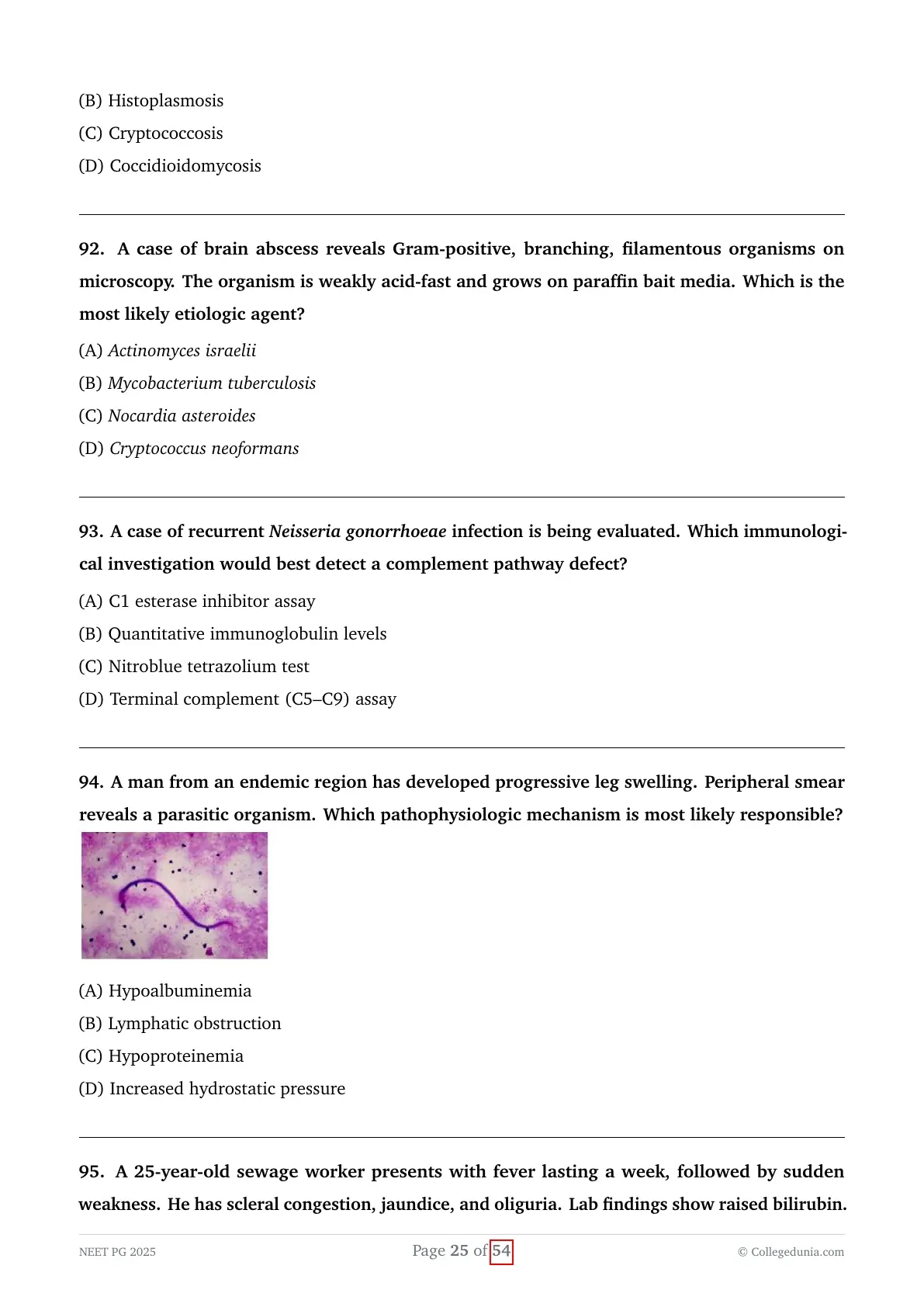
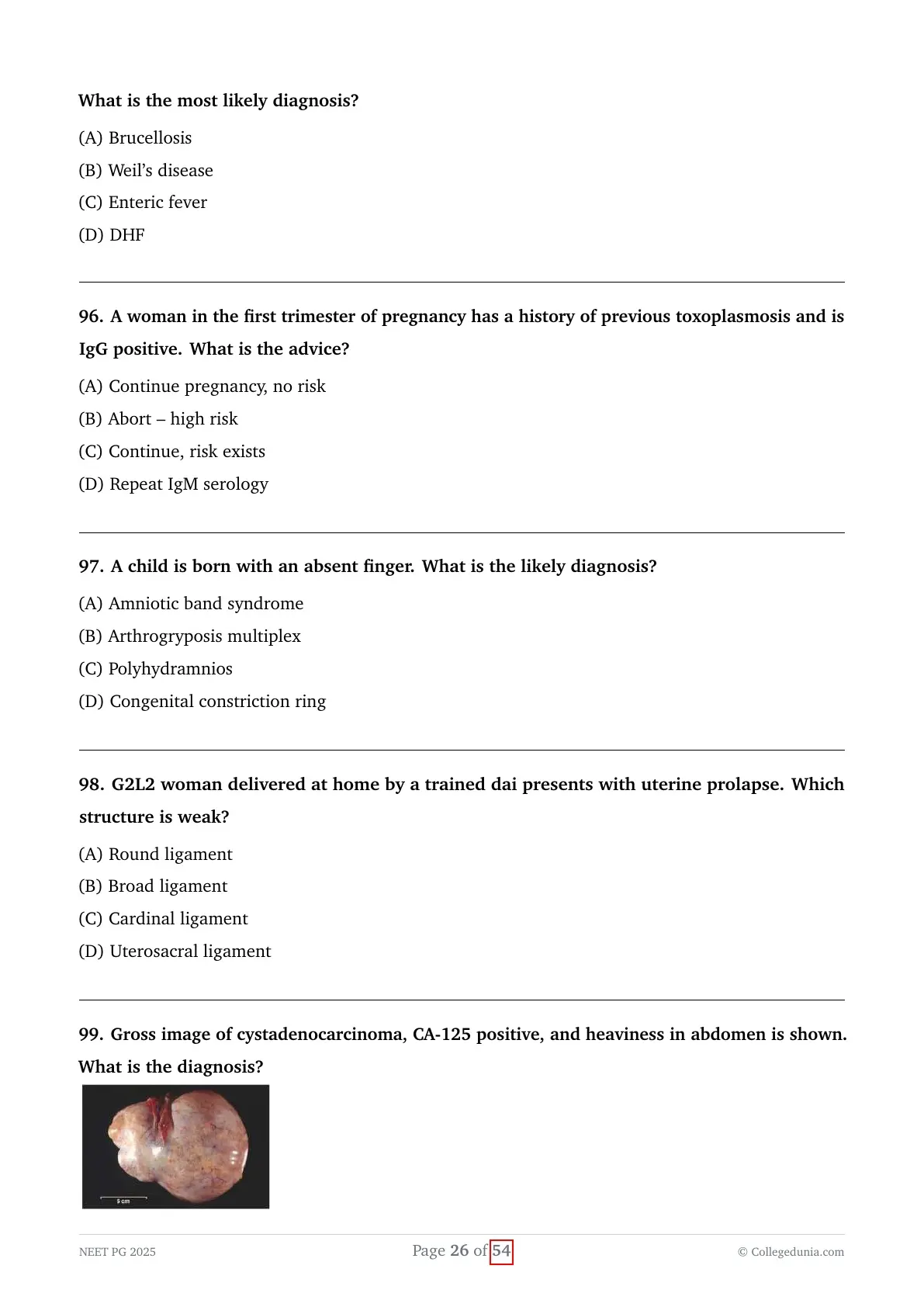
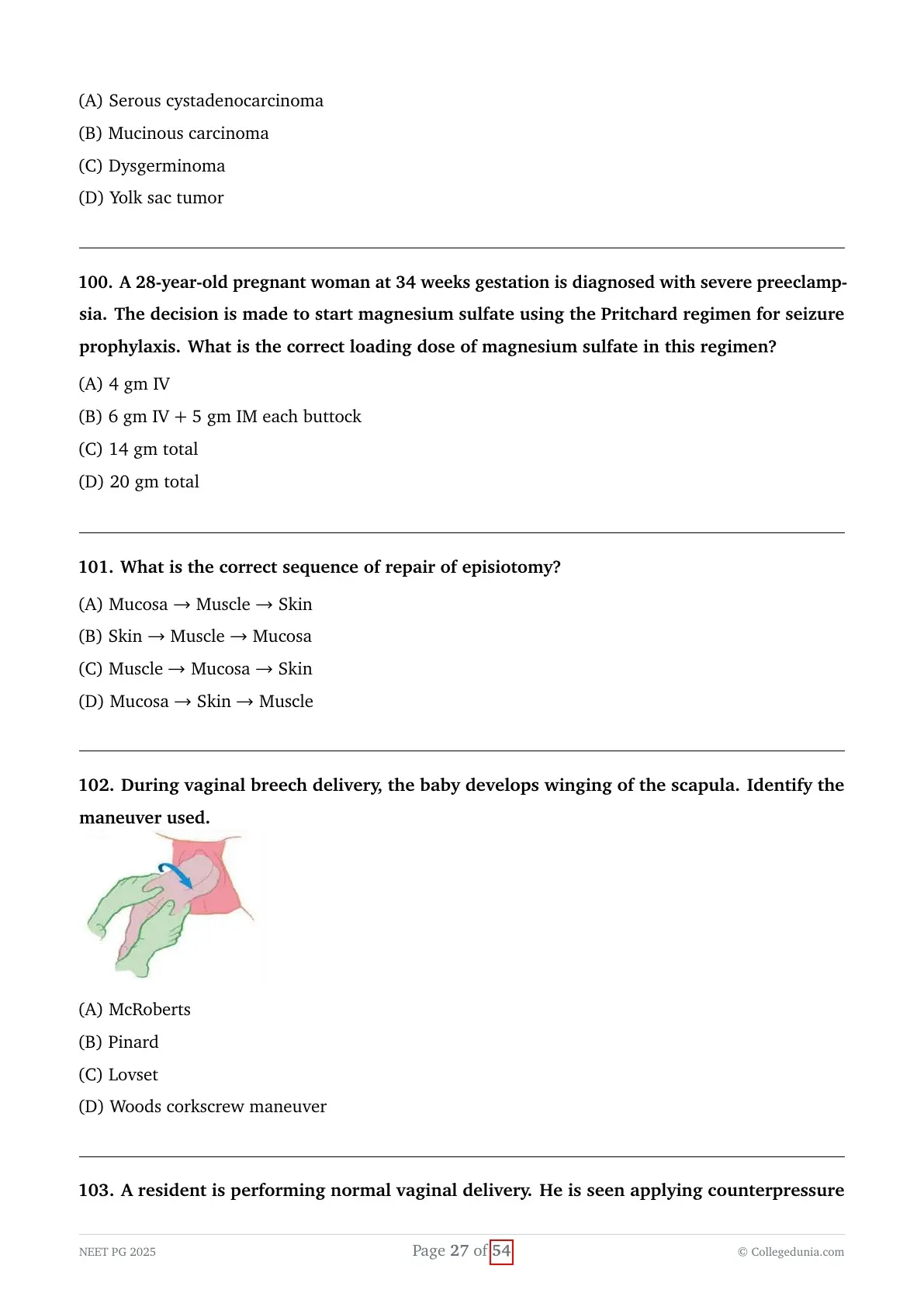
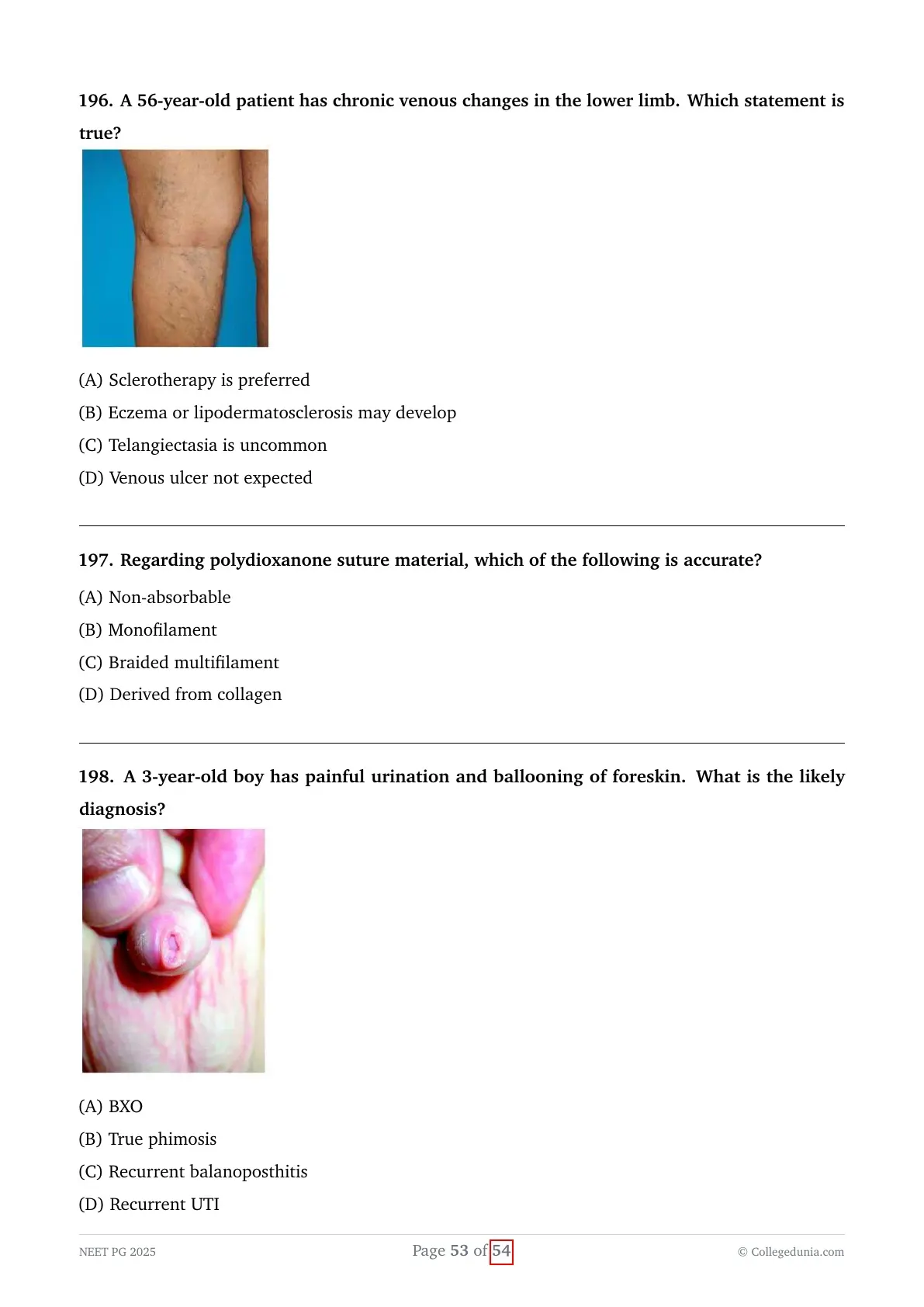

Image below highlights jugular foramen. Which of the following structures do not pass through the marked structure ``A''?

View Solution
Concept: The jugular foramen is an opening in the posterior cranial fossa through which important cranial nerves and venous structures pass. The cranial nerves passing through it are IX, X and XI.
Step 1: Recall the contents of jugular foramen.
The jugular foramen transmits: \[ \text{Glossopharyngeal nerve (IX), Vagus nerve (X), Accessory nerve (XI)} \] It also transmits the sigmoid sinus continuing as internal jugular vein.
Step 2: Identify the nerve that does not pass through it.
The hypoglossal nerve is cranial nerve XII. It passes through the hypoglossal canal, not through the jugular foramen.
Step 3: Choose the correct option.
Therefore, the structure that does not pass through the jugular foramen is: \[ \text{Hypoglossal nerve} \]
The defect shown in image relates to which of the following?

View Solution
Concept: Aortic arch derivatives are important in embryology. The 4th aortic arch contributes to major arterial structures on both sides.
Step 1: Recall derivatives of the 4th arch.
The left 4th aortic arch forms part of the arch of aorta. The right 4th aortic arch forms part of the right subclavian artery.
Step 2: Relate the image defect.
The defect shown in the heart and great vessel image corresponds to abnormal development involving the right-sided arch derivative.
Step 3: Choose the correct embryological structure.
Thus, the defect relates to: \[ \text{Right 4th aortic arch} \]
Which of the following is not carried by the structure marked ``A'' in the image?

View Solution
Concept: Cranial nerves carry different functional components such as GSA, GVA, GVE, SVE, SVA and GSE. GSE fibers are motor fibers supplying muscles derived from somites, such as extraocular muscles and tongue muscles.
Step 1: Understand GSE fibers.
GSE means: \[ \text{General Somatic Efferent} \] These fibers supply skeletal muscles derived from somites.
Step 2: Identify common nerves carrying GSE.
GSE fibers are classically carried by cranial nerves: \[ III,\ IV,\ VI,\ XII \] These supply extraocular muscles and tongue muscles.
Step 3: Select the component not carried.
The marked structure does not carry GSE fibers. Therefore, the correct answer is: \[ \text{GSE} \]
What are the contents of umbilical cord?
View Solution
Concept: The normal umbilical cord contains three blood vessels embedded in Wharton's jelly.
Step 1: Recall normal umbilical cord vessels.
The umbilical cord normally contains: \[ 2\ \text{umbilical arteries} + 1\ \text{umbilical vein} \]
Step 2: Understand function.
The two umbilical arteries carry deoxygenated blood from fetus to placenta. The single umbilical vein carries oxygenated blood from placenta to fetus.
Step 3: Choose the correct answer.
Therefore, the contents are: \[ 2\ \text{arteries and } 1\ \text{vein} \]
What is the root value responsible for Meralgia paresthetica?
View Solution
Concept: Meralgia paresthetica is caused by compression or irritation of the lateral femoral cutaneous nerve.
Step 1: Identify the nerve involved.
Meralgia paresthetica involves: \[ \text{Lateral femoral cutaneous nerve} \]
Step 2: Recall root value.
The lateral femoral cutaneous nerve arises from: \[ L2,\ L3 \]
Step 3: Relate with clinical feature.
Compression causes burning pain, tingling and numbness over the lateral thigh.
Therefore, the root value is: \[ L2\ \text{and}\ L3 \]
A girl presented with foot injury and gave history of forceful eversion of foot. Which of the following structure is affected the most?
View Solution
Concept: The deltoid ligament is the strong medial ligament of the ankle. It resists excessive eversion of the foot.
Step 1: Identify the movement causing injury.
The history mentions: \[ \text{Forceful eversion of foot} \]
Step 2: Recall ligament resisting eversion.
The ligament resisting eversion is the medial collateral ligament of ankle, also called: \[ \text{Deltoid ligament} \]
Step 3: Choose the affected structure.
Therefore, the structure most affected is: \[ \text{Deltoid ligament} \]
A patient presents with muscle wasting, reduced tone, and weakness in the left hand. Fine motor movements like dough kneading are impaired. Which of the following structure is most likely affected?
View Solution
Concept: Muscle wasting, reduced tone and weakness suggest a lower motor neuron lesion. Anterior horn cells are lower motor neurons.
Step 1: Identify clinical signs.
The findings are: \[ \text{Muscle wasting + reduced tone + weakness} \] These indicate lower motor neuron involvement.
Step 2: Recall lower motor neuron location.
The anterior horn cells of the spinal cord are lower motor neurons supplying skeletal muscles.
Step 3: Choose the best answer.
Among the options, anterior horn cell involvement best explains wasting and reduced tone.
Therefore, the correct answer is: \[ \text{Right anterior horn cells in spinal cord} \]
Identify the structure where the shown epithelium is located.

View Solution
Concept: The ureter is lined by transitional epithelium, also called urothelium. It allows stretching and recoil.
Step 1: Identify the epithelium.
The epithelium shown is transitional epithelium.
Step 2: Recall where transitional epithelium is found.
Transitional epithelium is found in: \[ \text{Renal pelvis, ureter, urinary bladder and upper urethra} \]
Step 3: Select the correct structure.
Among the options, the structure lined by transitional epithelium is: \[ \text{Ureter} \]
What is the nerve supply of the marked structure ``A''?

View Solution
Concept: The marked structure is supplied by two nerves: facial nerve and mandibular nerve. This is commonly tested in structures related to facial expression and mandibular arch muscle contribution.
Step 1: Identify the supplied structure.
The structure marked in the image has dual nerve supply.
Step 2: Recall the nerve supply.
The two nerves involved are: \[ \text{Facial nerve} + \text{Mandibular nerve} \]
Step 3: Choose the correct option.
Therefore, the correct nerve supply is: \[ \text{Facial nerve and mandibular nerve} \]
During resection of submandibular gland, there is accidental injury to a structure running superior to the posterior belly of digastric muscle. Which of the following structure is likely to be injured?

View Solution
Concept: The marginal mandibular branch of the facial nerve is clinically important during surgeries in the submandibular region.
Step 1: Identify the surgical area.
The surgery is: \[ \text{Submandibular gland resection} \]
Step 2: Recall nerve at risk.
The marginal mandibular nerve runs near the lower border of mandible and is at risk during submandibular gland surgery.
Step 3: Choose the injured structure.
Thus, the likely injured structure is: \[ \text{Marginal mandibular nerve} \]
A 20-year-old boy got severe pain due to hyperextension of shoulder while training in the gym. The trainer expected a probable disruption of the structure marked ``A'' in the image below. Which site is affected?
View Solution
Concept: The long head of triceps brachii originates from the infraglenoid tubercle of scapula. Shoulder hyperextension can stress structures attached near the glenoid region.
Step 1: Recall attachment.
The long head of triceps originates from: \[ \text{Infraglenoid tubercle of scapula} \]
Step 2: Relate with shoulder movement.
Hyperextension of the shoulder can cause traction injury at the origin of the long head of triceps.
Step 3: Choose the affected site.
Therefore, the affected site is: \[ \text{Infraglenoid tubercle of scapula} \]
Patients administered sevoflurane and succinylcholine for abdominal surgery develops post-operative muscle rigidity. What is the drug of choice here?
View Solution
Concept: Sevoflurane and succinylcholine can trigger malignant hyperthermia in susceptible individuals. It presents with muscle rigidity, hyperthermia, acidosis and hyperkalemia.
Step 1: Identify the condition.
The patient develops muscle rigidity after exposure to: \[ \text{Volatile anesthetic + succinylcholine} \] This suggests malignant hyperthermia.
Step 2: Recall drug of choice.
The drug of choice for malignant hyperthermia is: \[ \text{Dantrolene} \]
Step 3: Mechanism of action.
Dantrolene acts on ryanodine receptors and reduces calcium release from sarcoplasmic reticulum.
A patient was administered a muscle relaxant and subsequently developed erythema, facial flushing, and hypotension. Which drug is most likely responsible for these symptoms?
View Solution
Concept: Atracurium can cause histamine release. Histamine release may produce erythema, flushing, hypotension and bronchospasm.
Step 1: Identify symptoms.
The symptoms are: \[ \text{Erythema + facial flushing + hypotension} \] These suggest histamine release.
Step 2: Recall muscle relaxant causing histamine release.
Atracurium is known to cause histamine release more than cisatracurium.
Step 3: Choose the correct drug.
Therefore, the responsible drug is: \[ \text{Atracurium} \]
In Hurler syndrome, which glycosaminoglycans accumulate and cause organ enlargement?
View Solution
Concept: Hurler syndrome is a mucopolysaccharidosis caused by deficiency of alpha-L-iduronidase. It leads to accumulation of specific glycosaminoglycans.
Step 1: Recall enzyme deficiency.
Hurler syndrome is due to deficiency of: \[ \alpha\text{-L-iduronidase} \]
Step 2: Identify accumulated substances.
The accumulated glycosaminoglycans are: \[ \text{Heparan sulfate and dermatan sulfate} \]
Step 3: Relate with organ enlargement.
Their accumulation causes coarse facies, organomegaly and skeletal abnormalities.
A child presents with gum bleeding, perifollicular hemorrhages, petechiae, and recurrent fractures. Which enzyme deficiency is most likely?
View Solution
Concept: Gum bleeding, perifollicular hemorrhage and bone fragility suggest vitamin C deficiency. Vitamin C is required for hydroxylation of proline and lysine during collagen synthesis.
Step 1: Identify clinical syndrome.
The symptoms suggest: \[ \text{Scurvy} \] which is due to vitamin C deficiency.
Step 2: Recall enzyme affected.
Vitamin C is a cofactor for: \[ \text{Prolyl hydroxylase} \] and lysyl hydroxylase.
Step 3: Choose the best option.
Among the options, the most likely enzyme deficiency is: \[ \text{Prolyl hydroxylase} \]
A man survives 5 days without food. What is the brain's primary energy source during this prolonged fasting period?
View Solution
Concept: During prolonged fasting, the liver produces ketone bodies from fatty acids. After a few days of fasting, the brain starts using ketone bodies as a major energy source.
Step 1: Understand early fasting.
In early fasting, glucose is supplied by glycogenolysis and gluconeogenesis.
Step 2: Understand prolonged fasting.
After several days, glycogen stores are depleted and ketone body production increases.
Step 3: Brain fuel after 5 days.
At around 5 days of starvation, the brain significantly uses: \[ \text{Ketone bodies} \]
A patient has high phenylalanine levels despite normal phenylalanine hydroxylase. Which cofactor deficiency is most likely responsible?
View Solution
Concept: Phenylalanine hydroxylase converts phenylalanine to tyrosine. This enzyme requires tetrahydrobiopterin, also called BH4, as a cofactor.
Step 1: Recall the reaction.
\[ \text{Phenylalanine} \rightarrow \text{Tyrosine} \] This reaction is catalyzed by phenylalanine hydroxylase.
Step 2: Identify the required cofactor.
The required cofactor is: \[ BH_4 \]
Step 3: Interpret the condition.
If phenylalanine hydroxylase is normal but phenylalanine is high, the problem is likely BH4 deficiency.
A patient with vitamin B12 deficiency presents with anemia, positive Romberg sign, and elevated homocysteine. Which amino acid is most likely deficient?
View Solution
Concept: Vitamin B12 is required for conversion of homocysteine to methionine. Deficiency causes elevated homocysteine and reduced methionine formation.
Step 1: Recall B12-dependent reaction.
Vitamin B12 acts as a cofactor for methionine synthase: \[ \text{Homocysteine} \rightarrow \text{Methionine} \]
Step 2: Effect of B12 deficiency.
When B12 is deficient: \[ \text{Homocysteine increases} \] and methionine synthesis decreases.
Step 3: Select the deficient amino acid.
Therefore, the amino acid most likely deficient is: \[ \text{Methionine} \]
A patient on long-term hydrochlorothiazide develops neuropathy, heart failure, and symmetrical paresthesia. Which nutrient deficiency is most likely responsible?
View Solution
Concept: Thiamine deficiency can cause neuropathy and cardiac failure. It is associated with beriberi.
Step 1: Identify symptoms.
The patient has: \[ \text{Neuropathy + paresthesia + heart failure} \] This suggests thiamine deficiency.
Step 2: Recall thiamine deficiency syndromes.
Thiamine deficiency causes: \[ \text{Dry beriberi} = \text{neuropathy} \] \[ \text{Wet beriberi} = \text{heart failure} \]
Step 3: Choose the nutrient.
Therefore, the most likely deficiency is: \[ \text{Thiamine} \]
A frameshift mutation from nucleotide insertion at position 4 of a 900-base mRNA is observed. What is the likely outcome?
View Solution
Concept: A frameshift mutation occurs when nucleotides are inserted or deleted in numbers not divisible by three. This changes the reading frame of codons.
Step 1: Identify mutation type.
The question mentions nucleotide insertion at position 4. Since insertion shifts the reading frame, it is a frameshift mutation.
Step 2: Effect of early frameshift.
Because the insertion occurs near the beginning of the mRNA, most codons downstream will be changed.
Step 3: Final outcome.
This can cause a completely altered protein sequence or premature stop codon.
Therefore, the likely outcome is: \[ \text{Complete change in protein production} \]
A patient develops skin cancer and worsening hyperpigmentation following sun exposure. Which DNA repair pathway is most likely impaired?
View Solution
Concept: Ultraviolet radiation causes pyrimidine dimers in DNA. These are repaired by nucleotide excision repair.
Step 1: Identify clinical clue.
Skin cancer and hyperpigmentation after sun exposure suggest defective UV damage repair.
Step 2: Recall UV-induced lesion.
UV light causes: \[ \text{Thymine dimers} \]
Step 3: Recall repair mechanism.
Thymine dimers are repaired by: \[ \text{Nucleotide excision repair} \]
A patient with orange-colored tonsils has a triglyceride level of 140 mg/dL and very low HDL cholesterol, 5 mg/dL. What is the most probable diagnosis?
View Solution
Concept: Tangier disease is due to defective cholesterol transport caused by ABCA1 mutation. It is associated with very low HDL and orange tonsils.
Step 1: Identify key clue.
The important clue is: \[ \text{Orange-colored tonsils} \]
Step 2: Look at lipid profile.
The HDL is extremely low: \[ HDL = 5\ \text{mg/dL} \]
Step 3: Choose diagnosis.
Orange tonsils with very low HDL is classic for: \[ \text{Tangier disease} \]
A 10-year-old patient has high total cholesterol, tendon xanthomas, and a family history of similar findings. Triglyceride levels are normal. What type of familial dyslipidemia is most likely?
View Solution
Concept: Familial hypercholesterolemia is Type IIa hyperlipoproteinemia. It shows increased LDL cholesterol with normal triglycerides.
Step 1: Identify clinical features.
The patient has: \[ \text{High cholesterol + tendon xanthomas + family history} \] This suggests familial hypercholesterolemia.
Step 2: Interpret triglycerides.
Triglycerides are normal, which supports isolated LDL elevation.
Step 3: Identify Fredrickson type.
Isolated LDL elevation is: \[ \text{Type IIa} \]
To diagnose a syndromic illness like meningitis, which PCR technique is most appropriate?
View Solution
Concept: Multiplex PCR allows simultaneous detection of multiple pathogens in a single reaction. It is useful for syndromic diagnosis where several organisms can cause similar symptoms.
Step 1: Understand syndromic illness.
Meningitis can be caused by many pathogens such as bacteria, viruses and fungi.
Step 2: Need for multiple target testing.
A test that can detect multiple organisms at once is useful.
Step 3: Choose PCR type.
Multiplex PCR detects multiple genetic targets simultaneously.
A 45-year-old man is evaluated for electrolyte imbalance: \(Na^+ = 130\) mmol/L, \(Cl^- = 84\) mmol/L, \(HCO_3^- = 16\) mmol/L. What is his anion gap?
View Solution
Concept: Anion gap is calculated using: \[ \text{Anion gap} = Na^+ - (Cl^- + HCO_3^-) \]
Step 1: Substitute values.
\[ Na^+ = 130,\quad Cl^- = 84,\quad HCO_3^- = 16 \]
Step 2: Apply formula.
\[ \text{Anion gap}=130-(84+16) \]
Step 3: Calculate.
\[ \text{Anion gap}=130-100=30 \]
For prevention of coronary artery disease, what is the recommended dietary cholesterol intake limit per day?
View Solution
Concept: Dietary modification is important in prevention of coronary artery disease. Cholesterol intake should be limited to reduce atherogenic risk.
Step 1: Identify preventive measure.
For coronary artery disease prevention, diet should be low in saturated fat and cholesterol.
Step 2: Recall recommended limit.
The recommended dietary cholesterol intake limit is: \[ 200\ \text{mg}/1000\ \text{kcal} \]
Step 3: Choose correct option.
Therefore, the correct answer is: \[ 200\ \text{mg}/1000\ \text{kcal} \]
Toxic fumes are released after industry explosion. What advice should be given to the residents?
View Solution
Concept: During release of toxic fumes, residents should shelter indoors and prevent contaminated outdoor air from entering the house.
Step 1: Identify the hazard.
The hazard is: \[ \text{Toxic fumes after industrial explosion} \]
Step 2: Understand safe action.
Opening windows increases exposure. Instead, people should remain indoors and reduce air entry.
Step 3: Choose best advice.
The best advice is: \[ \text{Seal cracks and close windows} \]
A new community intervention is initiated to reduce prenatal sepsis. Researchers allocated 20 PHCs to receive standard care and 20 PHCs to receive a community-based intervention. What type of study design is this?
View Solution
Concept: In a cluster-randomized controlled trial, groups or clusters rather than individuals are allocated to intervention or control arms.
Step 1: Identify unit of allocation.
The allocation is done at the level of: \[ \text{PHCs} \] not individual patients.
Step 2: Identify comparison groups.
Some PHCs receive standard care and others receive community intervention.
Step 3: Name the study design.
Since clusters are allocated to intervention and control groups, it is: \[ \text{Cluster-randomized control trial} \]
A 20-year-old resident of Andhra Pradesh presents with outward bending of the lower limbs and signs of osteoporosis. His diet mainly consists of rice and jowar roti. Which of the following intervention will not be helpful?
View Solution
Concept: Skeletal fluorosis occurs due to excess fluoride intake. It can cause bone deformities, osteoporosis-like changes and limb bending. Treatment focuses on reducing fluoride exposure.
Step 1: Identify disease clue.
Outward bending of limbs with bone changes in an endemic region suggests: \[ \text{Skeletal fluorosis} \]
Step 2: Know helpful interventions.
Helpful measures include changing water source, using safer surface water and defluoridation methods like Nalgonda technique.
Step 3: Identify intervention not helpful.
Fluoride supplementation would worsen fluoride excess. Hence it is not helpful.
A student was asked to bring the correct boxes from lab for Nalgonda technique. Which pair is correct?
View Solution
Concept: Nalgonda technique is a defluoridation method used to remove excess fluoride from drinking water. It uses alum and lime.
Step 1: Identify purpose of Nalgonda technique.
Nalgonda technique is used for: \[ \text{Defluoridation of water} \]
Step 2: Recall chemicals used.
The main chemicals used are: \[ \text{Alum and lime} \]
Step 3: Choose correct pair.
Therefore, the correct pair is: \[ \text{Alum and Lime} \]
A study is conducted to compare the mean hemoglobin (Hb) levels between two groups. Which test is most appropriate?
View Solution
Concept: When the mean of a continuous variable is compared between two independent groups, the appropriate statistical test is the unpaired t-test.
Step 1: Identify the variable being compared.
Hemoglobin level is a continuous quantitative variable.
Step 2: Identify the number of groups.
The study compares mean Hb levels between two groups.
Step 3: Choose the correct test.
Since the two groups are independent: \[ \text{Unpaired t-test} \] is used.
An urban city has a population of 70,00,000, with 30% residing in slum areas. How many UPHCs are required for the slum population?
View Solution
Concept: Urban Primary Health Centres are planned based on the population they serve. For slum areas, one UPHC is generally considered for about 50,000 population.
Step 1: Calculate slum population.
Total population: \[ 70,00,000 \] Slum population: \[ 30\% \times 70,00,000 = 21,00,000 \]
Step 2: Apply UPHC norm.
One UPHC is required for: \[ 50,000 \] population.
Step 3: Calculate number of UPHCs.
\[ \frac{21,00,000}{50,000}=42 \]
Therefore, the number of UPHCs required is 42.
Identify the mosquito without a siphon tube and which rests parallel to the surface of water.
View Solution
Concept: Mosquito larvae can be identified by their resting position in water and presence or absence of siphon tube.
Step 1: Recall Anopheles larva feature.
Anopheles larva does not have a siphon tube.
Step 2: Recall resting position.
Anopheles larva rests parallel to the water surface.
Step 3: Select the mosquito.
Therefore, the mosquito is: \[ \text{Anopheles} \]
A 60-year-old diabetic patient with COVID-19 succumbed to death in the hospital. Which type of surveillance does this death report fall under?
View Solution
Concept: Passive surveillance is based on routine reporting of cases or deaths by health facilities without active search by investigators.
Step 1: Identify the source of report.
The death occurred in a hospital and was reported through routine health reporting.
Step 2: Understand passive surveillance.
In passive surveillance, health institutions report cases or deaths to the public health authority.
Step 3: Choose the surveillance type.
Thus, this is: \[ \text{Passive surveillance} \]
A dietary survey report indicates that the 5-year survival rate for breast cancer has increased following the introduction of a new screening method. However, autopsy data shows no change in overall mortality. What type of bias does this scenario illustrate?
View Solution
Concept: Lead time bias occurs when screening detects disease earlier, making survival time appear longer even though the actual time of death is unchanged.
Step 1: Understand what screening changes.
Screening detects breast cancer earlier than clinical presentation.
Step 2: Understand why survival appears increased.
The patient appears to survive longer from the time of diagnosis because diagnosis occurred earlier.
Step 3: Check mortality.
Since overall mortality is unchanged, the apparent survival improvement is due to: \[ \text{Lead time bias} \]
In ``de facto'' method of census data collection, data is collected based on which of the following?
View Solution
Concept: In census methods, de facto means counting people where they are physically present at the time of enumeration.
Step 1: Understand de facto method.
De facto method counts people based on: \[ \text{Actual location at the time of census} \]
Step 2: Differentiate from de jure method.
De jure method counts people based on usual place of residence.
Step 3: Choose the correct option.
Therefore, de facto method uses: \[ \text{Location at the time of enumeration} \]
Which of the following is the correct sequence in a Randomized Controlled Trial (RCT)?
View Solution
Concept: In an RCT, subjects are randomly allocated to intervention and control groups, then intervention is applied, followed by observation and outcome assessment.
Step 1: Start with randomization.
Participants are first randomly allocated to groups.
Step 2: Apply intervention.
The intervention or manipulation is then given to the experimental group.
Step 3: Follow and assess.
Participants are followed over time and outcomes are assessed.
Thus, the sequence is: \[ \text{Randomization} \rightarrow \text{Manipulation} \rightarrow \text{Follow-up} \rightarrow \text{Assessment} \]
Under the Weekly Iron and Folic Acid Supplementation scheme, what is the composition of IFA tablets given to children aged 10--19 years old?
View Solution
Concept: Weekly Iron and Folic Acid Supplementation is used to prevent anemia in school-going children and adolescents.
Step 1: Identify target group.
The question asks about children aged: \[ 10-19\ \text{years} \]
Step 2: Recall the IFA composition given
The composition given as the correct answer is: \[ 60\ \text{mg elemental iron} + 500\ \mu g\ \text{folic acid} \]
Step 3: Choose the correct option.
Therefore, the answer is: \[ 60\ \text{mg elemental iron} + 500\ \mu g\ \text{folic acid} \]
What is the time interval between acquiring an infection and reaching the period of maximum infectivity known as?
View Solution
Concept: Generation time refers to the interval between receipt of infection by a host and the period of maximum infectivity.
Step 1: Understand the given interval.
The question asks about the time from acquiring infection to maximum infectivity.
Step 2: Recall definition.
This interval is called: \[ \text{Generation time} \]
Step 3: Differentiate from incubation period.
Incubation period is the time from infection to appearance of symptoms, not maximum infectivity.
Which of the following is used to measure the degree of objective and target achievement, and assess the quality of results obtained in a health program?
View Solution
Concept: Evaluation is the systematic assessment of a program to determine the extent to which objectives and targets have been achieved.
Step 1: Identify the key phrase.
The question mentions: \[ \text{Degree of objective and target achievement} \]
Step 2: Recall meaning of evaluation.
Evaluation measures effectiveness, efficiency, relevance and quality of program results.
Step 3: Choose the correct answer.
Therefore, the correct answer is: \[ \text{Evaluation} \]
A young boy presents with clinical signs of rickets. Which government program specifically addresses this type of nutritional deficiency?
View Solution
Concept: Rickets is a nutritional deficiency disorder, commonly due to vitamin D deficiency. ICDS provides supplementary nutrition and health-related services to children.
Step 1: Identify deficiency disorder.
Clinical rickets is related to deficiency of vitamin D, calcium or phosphate.
Step 2: Identify child nutrition program.
ICDS targets young children and provides supplementary nutrition, health check-ups and nutrition education.
Step 3: Select correct program.
Therefore, the program is: \[ \text{Integrated Child Development Services} \]
A recently diagnosed HIV-positive patient with a CD4 count of 250 cells/mm\(^3\) also tests positive for active tuberculosis. He has not yet been started on ART. What is the correct approach to initiating treatment?
View Solution
Concept: In HIV-TB coinfection, antitubercular therapy is usually started first. ART is started soon after, depending on CD4 count and clinical status, to reduce mortality while limiting complications like IRIS.
Step 1: Identify coinfection.
The patient has: \[ \text{HIV + active tuberculosis} \]
Step 2: Start tuberculosis treatment first.
Active TB should be treated immediately with ATT.
Step 3: Start ART soon after.
With CD4 count of 250 cells/mm\(^3\), ART is initiated after starting ATT, here after 2 weeks.
Which of the following vaccines can be used in the clinics?

View Solution
Concept: Vaccine usability in clinics is commonly decided using vaccine vial monitor status, expiry date, cold chain maintenance and physical condition of the vial.
Step 1: Assess the usable vaccine vial.
A vaccine can be used if it is not expired, has been stored properly and its vaccine vial monitor has not reached the discard stage.
Step 2: Apply the image-based interpretation.
In the given image-based question, only vaccines marked A and B are suitable for use.
Step 3: Select the correct option.
Therefore, the correct answer is: \[ \text{Use A and B} \]
A young adult presents with facial pain and painful vesicular lesions in the mouth. Tzanck smear reveals multinucleated giant cells with intranuclear inclusions. What is the most likely causative organism?
View Solution
Concept: Herpes simplex virus causes painful vesicular lesions. Tzanck smear shows multinucleated giant cells and intranuclear inclusions.
Step 1: Identify the lesion.
Painful oral vesicles are suggestive of herpes infection.
Step 2: Use Tzanck smear clue.
Tzanck smear showing multinucleated giant cells is classically seen in: \[ \text{HSV infection} \]
Step 3: Choose organism.
Therefore, the causative organism is: \[ \text{Herpes simplex virus} \]
What is the most common cause for squamous cell carcinoma at the base of the tongue?
View Solution
Concept: Oropharyngeal squamous cell carcinoma, especially involving the base of tongue and tonsil, is strongly associated with human papillomavirus infection.
Step 1: Identify tumor location.
The base of tongue is part of the oropharynx.
Step 2: Recall viral association.
Oropharyngeal SCC is commonly associated with: \[ \text{HPV} \]
Step 3: Choose correct cause.
Therefore, the most common cause is: \[ \text{Human papillomavirus} \]
A patient presents with irregular swelling over the foot, multiple discharging sinuses, and black granules. A KOH mount is performed on the discharge. What is the most likely observation?

View Solution
Concept: Multiple discharging sinuses with grains from the foot suggest mycetoma. Black granules often point toward eumycetoma, which shows fungal hyphae.
Step 1: Identify clinical condition.
The triad is: \[ \text{Swelling + sinuses + granules} \] This suggests mycetoma.
Step 2: Interpret black granules.
Black granules suggest fungal mycetoma.
Step 3: KOH finding.
Fungal mycetoma shows: \[ \text{Septate hyphae} \]
A 45-year-old patient presents with a chronic granulomatous skin lesion. What is the most confirmatory diagnostic test for this condition?

View Solution
Concept: For chronic granulomatous skin infections, molecular diagnosis by PCR can provide high specificity and confirmation by detecting organism DNA.
Step 1: Identify lesion type.
The lesion is chronic and granulomatous, suggesting an infective granulomatous dermatosis.
Step 2: Need for confirmatory test.
Clinical features and routine microscopy may suggest diagnosis, but confirmatory diagnosis requires detecting the causative organism.
Step 3: Choose confirmatory test.
The most confirmatory test among the options is: \[ \text{PCR} \]
A 20-year-old patient presents with a non-progressive hypopigmented lesion on the trunk. On Wood's lamp examination, there is white accentuation. Diascopy is negative. What is the most likely diagnosis?

View Solution
Concept: Nevus depigmentosus is a stable, non-progressive hypopigmented patch. It is usually present from early life and does not show the progressive depigmentation seen in vitiligo.
Step 1: Identify key clinical clue.
The lesion is: \[ \text{Non-progressive hypopigmented lesion} \]
Step 2: Differentiate from nevus anemicus.
Diascopy is negative, which helps rule out nevus anemicus.
Step 3: Choose diagnosis.
The most likely diagnosis is: \[ \text{Nevus depigmentosus} \]
A patient with intensely itchy vesicular lesions on the extensor surface presents with history of gluten sensitivity. What is the likely diagnosis?
View Solution
Concept: Dermatitis herpetiformis is associated with gluten sensitivity and celiac disease. It presents with intensely itchy grouped vesicles, commonly over extensor surfaces.
Step 1: Identify clinical clue.
The lesion is: \[ \text{Intensely itchy vesicular lesion on extensor surface} \]
Step 2: Use associated history.
The patient has gluten sensitivity, which is strongly associated with dermatitis herpetiformis.
Step 3: Select diagnosis.
Therefore, the likely diagnosis is: \[ \text{Dermatitis herpetiformis} \]
A patient presents with the injury shown in lateral X-ray of nose. What procedure can be done to manage this patient?

View Solution
Concept: Nasal bone fracture is commonly reduced using Walsham's forceps. It is a standard instrument used for manipulation and reduction of nasal bone fractures.
Step 1: Identify the injury.
The lateral X-ray of nose suggests nasal bone injury or fracture.
Step 2: Recall instrument for nasal fracture.
Walsham's forceps are used for reduction of nasal bone fracture.
Step 3: Choose correct instrument.
Therefore, the procedure uses: \[ \text{Walsham's forceps} \]
A 78-year-old male, known case of diabetes mellitus and hypertension presents with nasal bleeding. Initial management such as packing was not successful in controlling the bleed. Which artery should be ligated to control the bleeding?
View Solution
Concept: Severe posterior epistaxis in elderly patients commonly arises from branches of the sphenopalatine artery. If packing fails, sphenopalatine artery ligation may be required.
Step 1: Identify type of epistaxis.
Elderly patient with uncontrolled nasal bleeding suggests posterior epistaxis.
Step 2: Recall main artery.
The main artery responsible for posterior epistaxis is: \[ \text{Sphenopalatine artery} \]
Step 3: Choose artery for ligation.
Therefore, ligation of the sphenopalatine artery is done.
A 16-year-old male presents with recurrent profuse nasal bleeding in the right nasal cavity. Endoscopy shows a globular mass in the right nasal cavity. CT shows bowing of the posterior wall of maxillary sinus. What is the most probable diagnosis?
View Solution
Concept: Juvenile nasopharyngeal angiofibroma is a benign but highly vascular tumor seen in adolescent males. It presents with recurrent profuse epistaxis and nasal obstruction.
Step 1: Identify patient profile.
The patient is a 16-year-old male, which is typical for JNA.
Step 2: Identify clinical clue.
Recurrent profuse nasal bleeding strongly suggests a vascular nasal tumor.
Step 3: Use CT clue.
Bowing of posterior wall of maxillary sinus is known as Holman-Miller sign and is associated with JNA.
Therefore, the diagnosis is: \[ \text{Juvenile Nasopharyngeal Angiofibroma} \]
What is the marked structure?

View Solution
Concept: The pyriform sinus is a recess in the hypopharynx on either side of the laryngeal inlet. It is clinically important because foreign bodies may lodge there.
Step 1: Identify anatomical region.
The marked structure lies in the laryngopharyngeal region.
Step 2: Recall pyriform sinus location.
Pyriform sinus is located lateral to the laryngeal inlet.
Step 3: Select structure.
Therefore, the marked structure is: \[ \text{Pyriform sinus} \]
A 27-year-old male presents with recurrent ear infection. Otoscopic examination shows central perforation of tympanic membrane. Tuning fork examination reveals: Rinne negative on left and positive on right; Weber lateralization to left. What is the type and localization of hearing loss?
View Solution
Concept: Rinne test compares air conduction and bone conduction. In conductive hearing loss, bone conduction is better than air conduction, giving Rinne negative. Weber test lateralizes to the affected ear in conductive hearing loss.
Step 1: Interpret Rinne test.
Rinne is negative on the left side: \[ BC > AC \] This suggests left conductive hearing loss.
Step 2: Interpret Weber test.
Weber lateralizes to the left side. In conductive hearing loss, Weber lateralizes to the affected ear.
Step 3: Final localization.
Both findings indicate: \[ \text{Left conductive hearing loss} \]
A 75-year-old male smoker presents with hoarseness of voice and difficulty in swallowing. He has been diagnosed with large advanced SCC and undergoes surgery. What is the most appropriate surgical procedure?
View Solution
Concept: Advanced laryngeal squamous cell carcinoma may require total laryngectomy, especially when the tumor is large and organ preservation is not suitable.
Step 1: Identify disease.
The patient has: \[ \text{Large advanced SCC of larynx} \]
Step 2: Assess surgical need.
Advanced tumors often require complete removal of the larynx.
Step 3: Choose procedure.
The appropriate surgery is: \[ \text{Total laryngectomy} \]
A 20-year-old patient presents with recurrent ear discharge. On otoscopic examination, the examiner notes complete absence of tympanic membrane. What is the best option for treatment?
View Solution
Concept: Tympanoplasty is a reconstructive surgery of the tympanic membrane with or without ossicular chain reconstruction. It is used for chronic otitis media with tympanic membrane perforation.
Step 1: Identify the ear finding.
There is complete absence of tympanic membrane.
Step 2: Select repair procedure.
A large tympanic membrane defect requires tympanoplasty rather than simple myringoplasty.
Step 3: Choose best treatment.
Therefore, the best option is: \[ \text{Tympanoplasty} \]
A 27-year-old male presents with reduced hearing in the left ear for 2 months. He denies tinnitus or vertigo. Pure tone audiometry is done, and the audiogram is shown. Which of the following is the most likely diagnosis?

View Solution
Concept: Pure tone audiometry differentiates conductive hearing loss from sensorineural hearing loss by comparing air conduction and bone conduction.
Step 1: Identify side of symptom.
The patient complains of reduced hearing in the left ear.
Step 2: Interpret conductive pattern.
In conductive hearing loss, air conduction is reduced while bone conduction is relatively preserved, creating an air-bone gap.
Step 3: Choose diagnosis.
The audiogram pattern corresponds to: \[ \text{Left ear conductive hearing loss} \]
During an autopsy of a 35-year-old female, bruises are noted below the right angle of jaw with scratches over the upper border and grouped bruises on the left side of neck below thyroid cartilage, with additional bruises over shoulder blade, back of trunk and hip crests. What is the most likely cause of death?
View Solution
Concept: Throttling means manual strangulation by hands. It commonly produces finger pad bruises and nail scratch marks on the neck.
Step 1: Identify neck findings.
Bruises and scratches around the neck suggest manual pressure by fingers and nails.
Step 2: Differentiate from ligature strangulation.
Ligature strangulation produces a ligature mark. Here, grouped bruises and scratches are more suggestive of manual strangulation.
Step 3: Choose cause of death.
Therefore, the most likely cause is: \[ \text{Throttling} \]
A 16-year-old girl and a 23-year-old man are medically examined after the girl's parents accuse the man of rape. The girl reports that the sexual activity was consensual, and no physical injuries are noted. According to law, which statement is correct?
View Solution
Concept: Under POCSO and Indian law, a person below 18 years is a child. Consent of a minor is not legally valid for sexual activity.
Step 1: Identify age.
The girl is: \[ 16\ \text{years old} \] which is below 18 years.
Step 2: Apply legal rule.
Consent given by a minor is legally invalid.
Step 3: Choose correct statement.
Therefore: \[ \text{Consent is invalid as the girl is under 18 years} \]
What is ZASKO's phenomenon?
View Solution
Concept: ZASKO's phenomenon refers to postmortem excitability of muscles where tendon reflexes may be elicited shortly after death.
Step 1: Identify forensic phenomenon.
The question asks about a postmortem phenomenon.
Step 2: Recall definition.
ZASKO's phenomenon is: \[ \text{Tendon reflex occurring after death} \]
Step 3: Choose correct option.
Therefore, the correct answer is: \[ \text{Tendon reflex occurring after death} \]
Under the POCSO Act 2012, which group is protected by the law?
View Solution
Concept: The POCSO Act protects children from sexual offences. It is gender-neutral and applies to all children below 18 years.
Step 1: Recall age definition.
Under POCSO, a child means: \[ \text{Any person below 18 years} \]
Step 2: Recall gender applicability.
The Act applies to both boys and girls.
Step 3: Choose correct option.
Therefore, POCSO protects: \[ \text{All children under 18 years of age} \]
A male patient with recent history of RTA was brought to hospital. His CT scan was normal, but he died within three hours of admission. Autopsy revealed retraction ball appearance and petechial hemorrhages in the corpus callosum. What is the most likely diagnosis?
View Solution
Concept: Diffuse axonal injury occurs due to acceleration-deceleration trauma causing shearing injury to axons. It may have minimal findings on early CT.
Step 1: Identify mechanism.
Road traffic accident can cause acceleration-deceleration brain injury.
Step 2: Use autopsy clue.
Retraction balls and petechial hemorrhages in corpus callosum are characteristic of: \[ \text{Diffuse axonal injury} \]
Step 3: Choose diagnosis.
Therefore, the most likely diagnosis is: \[ \text{Diffuse axonal injury} \]
A 68-year-old female has breathlessness, poor health status and multiple metastases. She is awake and anxious. Doctors believe aggressive chemotherapy, radiotherapy and ICU admission will not help, but her daughter insists on trying everything. How should the doctor handle this scenario?
View Solution
Concept: In end-of-life care, patient autonomy, best interests, communication with family and shared decision-making are important.
Step 1: Assess patient status.
The patient is awake and anxious, so her preferences and comfort should be considered.
Step 2: Avoid futile aggressive care.
If doctors believe aggressive therapy will not benefit, it should not be started merely due to family pressure.
Step 3: Choose ethical response.
The best approach is to convene family discussion and consider the patient's needs.
A 65-year-old patient with history of atrial flutter is being considered for long-term prophylaxis to prevent recurrence. The cardiologist decides to start a calcium channel blocker for rate control and prevention of rapid ventricular response. Which calcium channel blocker is most appropriate?
View Solution
Concept: Non-dihydropyridine calcium channel blockers such as diltiazem and verapamil are used for rate control in atrial arrhythmias.
Step 1: Identify required action.
The drug should slow AV nodal conduction and control ventricular rate.
Step 2: Choose correct CCB class.
Diltiazem is a non-dihydropyridine calcium channel blocker.
Step 3: Exclude other CCBs.
Amlodipine, nifedipine and felodipine mainly act on vessels and are not preferred for atrial flutter rate control.
A diabetic patient on insulin glargine and metformin has persistent hyperglycemia with HbA1c 8.3% and signs of heart failure. Which is the most appropriate medication to add next?
View Solution
Concept: SGLT2 inhibitors such as empagliflozin are beneficial in type 2 diabetes with heart failure because they reduce heart failure hospitalization and provide cardiovascular benefit.
Step 1: Identify comorbidity.
The patient has diabetes with signs of: \[ \text{Heart failure} \]
Step 2: Choose drug with heart failure benefit.
Empagliflozin is an SGLT2 inhibitor with proven heart failure benefit.
Step 3: Avoid harmful option.
Pioglitazone can worsen fluid retention and heart failure.
Therefore, the best drug is: \[ \text{Empagliflozin} \]
A patient with atrial fibrillation and mitral stenosis presents within 4 hours of symptom onset and is hemodynamically stable. What is the next best step?
View Solution
Concept: In recent-onset atrial fibrillation within 48 hours, rhythm control with cardioversion may be considered, especially when onset is clearly known.
Step 1: Identify rhythm problem.
The patient has: \[ \text{Atrial fibrillation} \]
Step 2: Check duration.
Symptoms started within: \[ 4\ \text{hours} \] which is less than 48 hours.
Step 3: Choose next step.
Therefore, cardioversion is the next best step.
A 2-year-old child presents to the emergency department with a generalized tonic-clonic seizure lasting 3 minutes associated with high fever \(39.5^\circ C\). The child has no previous seizure history or neurological problems. The seizure has now stopped, but parents are concerned about recurrence. What is the most appropriate immediate management for this febrile seizure?
View Solution
Concept: Febrile seizures occur in young children during fever. Benzodiazepines such as diazepam are used for acute seizure control and can also be used if seizures recur.
Step 1: Identify the condition.
A 2-year-old with fever and generalized seizure suggests: \[ \text{Febrile seizure} \]
Step 2: Identify acute medication.
For immediate seizure control, benzodiazepines are preferred.
Step 3: Choose drug.
Among the options: \[ \text{Diazepam} \] is the correct drug.
A 45-year-old female presents with 6-month history of paroxysmal nocturnal dyspnea, palpitations and breathlessness. JVP is elevated, pulse is irregularly irregular, tender hepatomegaly is present, apex is heaving, and a mid-diastolic murmur is heard at the apex. She has a history of acute rheumatic fever. Which statement is false?
View Solution
Concept: The patient has rheumatic mitral stenosis with atrial fibrillation and right heart failure features. In atrial fibrillation, atrial contraction is lost.
Step 1: Identify disease.
Mid-diastolic murmur at apex with rheumatic fever history suggests: \[ \text{Mitral stenosis} \]
Step 2: Identify rhythm.
Irregularly irregular pulse suggests: \[ \text{Atrial fibrillation} \]
Step 3: Understand why option D is false.
Presystolic accentuation occurs due to atrial contraction. In atrial fibrillation, atrial contraction is absent, so presystolic accentuation disappears.
Therefore, the false statement is: \[ \text{Presystolic accentuation is a hallmark feature} \]
A 15-year-old adolescent with known type 1 diabetes mellitus presents with fatigue, vomiting and diarrhea. Random blood glucose is 700 mg/dL, serum sodium is 125 mEq/L, and potassium is 4.2 mEq/L. Which of the following is not recommended during initial management?
View Solution
Concept: This presentation suggests diabetic ketoacidosis or severe hyperglycemic crisis. Initial management includes isotonic saline, insulin and electrolyte monitoring.
Step 1: Identify emergency.
Type 1 diabetes with glucose: \[ 700\ \text{mg/dL} \] and vomiting suggests diabetic ketoacidosis.
Step 2: Recall initial management.
Initial management includes: \[ 0.9\% \text{ normal saline} + \text{IV insulin} + \text{potassium monitoring} \]
Step 3: Identify not recommended option.
Routine administration of hypertonic saline is not recommended initially.
Therefore, the answer is: \[ 3\% \text{ saline} \]
A patient presents with irregularly irregular pulse and palpitations. He arrives 2.5 hours after symptom onset. There is no history of diabetes and BP is 160/100 mmHg. What is the next best step?
View Solution
Concept: Irregularly irregular pulse suggests atrial fibrillation. In a hemodynamically stable patient, ventricular rate control is often the initial step.
Step 1: Identify rhythm.
Irregularly irregular pulse with palpitations suggests: \[ \text{Atrial fibrillation} \]
Step 2: Assess stability.
The patient is hypertensive but not described as hypotensive, shocked, unconscious or in pulmonary edema. Therefore, he is stable.
Step 3: Choose management.
For stable AF, rate control may be done using AV nodal blockers such as verapamil.
Therefore, the next best step is: \[ \text{Control ventricular rate with verapamil} \]
A 36-year-old woman with symmetrical small joint arthritis tests positive for anti-CCP. Which histological feature is most characteristic?
View Solution
Concept: Symmetrical small joint arthritis with anti-CCP positivity strongly suggests rheumatoid arthritis. The characteristic pathological feature in rheumatoid arthritis is pannus formation.
Step 1: Identify the disease.
The patient has: \[ \text{Symmetrical small joint arthritis + anti-CCP positive} \] This is highly suggestive of: \[ \text{Rheumatoid arthritis} \]
Step 2: Recall the histology.
In rheumatoid arthritis, there is chronic synovial inflammation with proliferation of synovium. This forms: \[ \text{Pannus} \] Pannus can destroy cartilage and bone.
Step 3: Choose the characteristic feature.
The most characteristic histological feature is: \[ \text{Pannus formation and reactive lymphocytic infiltrate} \]
A 65-year-old man presents with enlarged hat size, shin pain, elevated alkaline phosphatase, and normal calcium and PTH levels. X-ray reveals mixed lytic and sclerotic bone lesions. What is the most likely diagnosis?
View Solution
Concept: Paget's disease of bone is a disorder of excessive and disorganized bone remodeling. It commonly affects elderly patients and causes bone pain, deformity, increased skull size, and raised alkaline phosphatase with normal calcium and phosphate.
Step 1: Identify the clinical clues.
The patient has: \[ \text{Enlarged hat size + shin pain} \] This indicates skull and long bone involvement.
Step 2: Interpret laboratory findings.
Alkaline phosphatase is elevated, but calcium and PTH are normal: \[ ALP \uparrow,\quad Ca^{2+} \text{ normal},\quad PTH \text{ normal} \] This pattern is typical of Paget's disease.
Step 3: Use radiological clue.
Mixed lytic and sclerotic bone lesions occur due to abnormal bone resorption and formation.
Therefore, the most likely diagnosis is: \[ \text{Paget's disease} \]
A 64-year-old man with chronic kidney disease presents with pallor, exertional breathlessness, and signs of heart failure. Investigations reveal normocytic anemia. What is the most appropriate next step in management?
View Solution
Concept: Anemia in chronic kidney disease is usually normocytic and occurs mainly due to reduced erythropoietin production. However, iron status must be corrected before or along with erythropoiesis-stimulating agents.
Step 1: Identify the anemia type.
The patient has chronic kidney disease with: \[ \text{Normocytic anemia} \] This commonly occurs due to reduced erythropoietin.
Step 2: Understand initial correction.
Iron supplementation is commonly used when treating anemia, especially before starting erythropoiesis-stimulating therapy.
Step 3: Choose the answer from the given key.
Among the given options, the correct answer is: \[ \text{Oral iron} \]
A 42-year-old woman presents with enlarged hands, coarsened facial features, and increased shoe size. Her IGF-1 level is elevated. Which of the following is the most specific test to confirm the diagnosis?
View Solution
Concept: Enlarged hands, coarse facial features, and increased shoe size suggest acromegaly. Elevated IGF-1 is a screening clue, while failure of GH suppression after oral glucose is confirmatory.
Step 1: Identify the diagnosis.
The clinical features are: \[ \text{Enlarged hands + coarse facial features + increased shoe size} \] This suggests: \[ \text{Acromegaly} \]
Step 2: Recall screening and confirmatory tests.
IGF-1 is useful for screening. The confirmatory test is: \[ \text{Oral glucose tolerance test} \]
Step 3: Interpret OGTT in acromegaly.
Normally, glucose suppresses GH. In acromegaly: \[ \text{GH fails to suppress after OGTT} \]
A 54-year-old man with a history of chronic hyponatremia develops sudden-onset quadriparesis after rapid sodium correction. Which investigation is most appropriate to confirm the diagnosis?
View Solution
Concept: Rapid correction of chronic hyponatremia can cause osmotic demyelination syndrome, classically central pontine myelinolysis. MRI brain is the investigation of choice for confirmation.
Step 1: Identify the trigger.
The patient had: \[ \text{Chronic hyponatremia} \] followed by rapid sodium correction.
Step 2: Identify clinical consequence.
Sudden quadriparesis after rapid correction suggests: \[ \text{Osmotic demyelination syndrome} \]
Step 3: Choose confirmatory investigation.
The most appropriate investigation is: \[ \text{MRI brain} \]
Which hormone is elevated in Addison's disease, leading to hyperpigmentation?
View Solution
Concept: Addison's disease is primary adrenal insufficiency. Low cortisol causes increased ACTH due to loss of negative feedback. ACTH shares a precursor with melanocyte-stimulating hormone, causing hyperpigmentation.
Step 1: Understand primary adrenal insufficiency.
In Addison's disease, the adrenal cortex cannot produce enough cortisol.
Step 2: Effect on pituitary.
Low cortisol causes increased pituitary secretion of: \[ ACTH \]
Step 3: Cause of hyperpigmentation.
High ACTH is derived from POMC, which is related to melanocyte-stimulating activity. This causes: \[ \text{Hyperpigmentation} \]
A 50-year-old man presents with altered sensorium and deep labored breathing. ABG shows: pH \(7.20\), \(pCO_2 = 35\) mmHg, \(HCO_3^- = 16\) mEq/L, \(Na^+ = 130\) mEq/L, \(Cl^- = 84\) mEq/L, \(PaO_2 = 80\) mmHg. What is the most likely acid-base abnormality?
View Solution
Concept: Low pH indicates acidemia. Low bicarbonate indicates metabolic acidosis. The anion gap helps classify metabolic acidosis.
Step 1: Identify acidemia.
\[ pH = 7.20 \] This is low, so the patient has acidemia.
Step 2: Identify primary disorder.
\[ HCO_3^- = 16\ \text{mEq/L} \] Low bicarbonate indicates: \[ \text{Metabolic acidosis} \]
Step 3: Calculate anion gap.
\[ AG = Na^+ - (Cl^- + HCO_3^-) \] \[ AG = 130-(84+16) \] \[ AG = 130-100=30 \]
Therefore, the abnormality is: \[ \text{Acute metabolic acidosis with anion gap 30} \]
A patient collapses with breathlessness and pink frothy sputum. Autopsy shows hemosiderin-laden macrophages. In which condition is this not seen?
View Solution
Concept: Hemosiderin-laden macrophages in lungs are called heart failure cells. They are seen in chronic pulmonary congestion due to raised pulmonary venous pressure.
Step 1: Identify the finding.
Hemosiderin-laden macrophages indicate repeated leakage of RBCs into alveoli with breakdown of hemoglobin.
Step 2: Identify associated conditions.
They may be seen in conditions causing pulmonary congestion such as: \[ \text{Left-sided heart failure, volume overload, pulmonary venous obstruction} \]
Step 3: Find where it is not seen.
Protein-losing enteropathy causes loss of plasma proteins through the gut. It does not primarily cause pulmonary venous congestion.
Therefore, the correct answer is: \[ \text{Protein-losing enteropathy} \]
A 14-year-old boy presents with fatigue, mild jaundice, and splenomegaly. His hemoglobin is 10.5 g/dL, MCV is 82 fL, and MCHC is high at 37 g/dL. His father had a similar history of chronic anemia and underwent splenectomy. What is the most likely diagnosis?
View Solution
Concept: Hereditary spherocytosis is an inherited hemolytic anemia due to red cell membrane defects. It commonly presents with jaundice, splenomegaly, anemia, family history, and increased MCHC.
Step 1: Identify hemolytic features.
The patient has: \[ \text{Fatigue + jaundice + splenomegaly} \] These suggest chronic hemolysis.
Step 2: Use family history.
His father had similar chronic anemia and underwent splenectomy, suggesting an inherited hemolytic anemia.
Step 3: Use MCHC clue.
High MCHC is a classic clue for: \[ \text{Hereditary spherocytosis} \]
A patient arrives with hypotension, fever, joint pain, petechiae on limbs, and respiratory distress. Which of the following is the most likely diagnosis?
View Solution
Concept: Septic shock is a life-threatening condition due to infection causing circulatory failure and organ dysfunction. It presents with fever, hypotension, respiratory distress, and signs of systemic inflammation.
Step 1: Identify systemic illness.
The patient has: \[ \text{Fever + hypotension + respiratory distress} \] This indicates severe systemic infection.
Step 2: Use shock clue.
Hypotension in the setting of infection suggests: \[ \text{Septic shock} \]
Step 3: Differentiate from localized arthritis.
Septic arthritis and rheumatoid arthritis would not usually explain hypotension and respiratory distress together.
Therefore, the most likely diagnosis is: \[ \text{Septic shock} \]
A critically ill patient with COVID-19 is admitted to the ICU and is currently on mechanical ventilation. The \(PaO_2/FiO_2\) ratio is 100, indicating severe ARDS. Which of the following is the most appropriate ventilatory strategy?
View Solution
Concept: ARDS is managed with lung-protective ventilation. This includes low tidal volume ventilation and adequate or high PEEP to improve oxygenation and prevent alveolar collapse.
Step 1: Identify ARDS severity.
\[ PaO_2/FiO_2 = 100 \] This indicates severe ARDS.
Step 2: Recall lung-protective strategy.
Low tidal volume helps reduce ventilator-induced lung injury.
Step 3: Role of PEEP.
High PEEP helps keep alveoli open and improves oxygenation.
Therefore, the best ventilatory strategy is: \[ \text{High PEEP and low tidal volume} \]
A 58-year-old patient has prolonged PT and factor IX deficiency. Parenteral vitamin K is planned. In which condition will this help?
View Solution
Concept: Vitamin K is fat-soluble and requires bile for absorption. Bile duct obstruction can cause vitamin K deficiency, leading to prolonged PT due to reduced vitamin K-dependent clotting factors.
Step 1: Recall vitamin K-dependent factors.
Vitamin K is needed for synthesis of: \[ II,\ VII,\ IX,\ X,\ Protein\ C,\ Protein\ S \]
Step 2: Identify condition causing deficiency.
Bile duct obstruction reduces bile flow into the intestine. This impairs absorption of fat-soluble vitamins, including vitamin K.
Step 3: Choose condition where vitamin K helps.
Therefore, parenteral vitamin K will help in: \[ \text{Bile duct obstruction} \]
A case of sudden onset aphasia and right arm weakness for the last 5 hours is seen. Which investigation is indicated?
View Solution
Concept: Sudden aphasia with right arm weakness suggests acute ischemic stroke, likely involving the dominant cerebral hemisphere. Evaluation of embolic source may require echocardiographic assessment, and TEE is useful for detecting cardiac and aortic arch sources of emboli.
Step 1: Identify neurological event.
Sudden onset aphasia and right arm weakness suggests: \[ \text{Acute stroke} \]
Step 2: Consider embolic source.
Cardioembolic causes are important in ischemic stroke evaluation.
Step 3: Choose indicated investigation from options.
Among the given options, the: \[ \text{TEE} \] which can detect cardiac thrombus, valvular lesions, and other embolic sources.
A patient already on salbutamol and ipratropium continues to have nocturnal exacerbations of asthma. What is the next step?
View Solution
Concept: Persistent asthma symptoms, especially nocturnal symptoms, require controller therapy. Inhaled corticosteroids are the foundation, and LABA is added when symptoms are not controlled.
Step 1: Identify poor control.
Nocturnal exacerbations indicate asthma is not adequately controlled.
Step 2: Recognize current therapy.
Salbutamol and ipratropium are bronchodilators, but they do not provide adequate long-term anti-inflammatory control.
Step 3: Choose next step.
The next step is: \[ \text{LABA plus inhaled corticosteroids} \]
A 32-year-old male with history of recurrent paroxysmal supraventricular tachycardia is stable in sinus rhythm. What is the best choice for long-term prophylaxis?
View Solution
Concept: Paroxysmal supraventricular tachycardia can be prevented by drugs that slow AV nodal conduction. Oral calcium channel blockers such as diltiazem can be used for long-term prophylaxis.
Step 1: Identify condition.
The patient has recurrent: \[ \text{Paroxysmal supraventricular tachycardia} \]
Step 2: Differentiate acute and long-term drugs.
IV adenosine is used for acute termination, not long-term prophylaxis.
Step 3: Choose long-term option.
Oral diltiazem is appropriate for long-term prophylaxis.
A farmer presents with a necrotic ulcerative skin lesion. Microscopy using polychrome methylene blue stain reveals capsulated bacilli showing a positive McFadyean reaction. What is the most likely causative organism?
View Solution
Concept: Cutaneous anthrax presents with a painless necrotic ulcer or black eschar. Bacillus anthracis shows a capsule that gives a positive McFadyean reaction with polychrome methylene blue stain.
Step 1: Identify clinical clue.
A farmer with necrotic ulcerative skin lesion suggests: \[ \text{Cutaneous anthrax} \]
Step 2: Use staining clue.
Polychrome methylene blue stain showing McFadyean reaction is characteristic of: \[ \textit{Bacillus anthracis} \]
Step 3: Choose organism.
Therefore, the causative organism is: \[ \textit{Bacillus anthracis} \]
Which structural component of Group A Streptococcus enables its attachment to pharyngeal epithelium by binding to fibronectin?
View Solution
Concept: Group A Streptococcus adheres to pharyngeal epithelial cells through surface structures. Lipoteichoic acid helps attachment by binding to fibronectin on epithelial cells.
Step 1: Identify organism.
Group A Streptococcus commonly causes pharyngitis.
Step 2: Recall adhesion factor.
The component involved in attachment to pharyngeal epithelium is: \[ \text{Lipoteichoic acid} \]
Step 3: Mechanism.
Lipoteichoic acid binds to fibronectin and helps colonization of the throat.
Several residents in a village develop watery followed by bloody diarrhea after consuming unpasteurized milk. Stool microscopy reveals Gram-negative curved bacilli with polymorphonuclear leukocytes. Identify the most likely pathogen.
View Solution
Concept: Campylobacter jejuni causes inflammatory diarrhea, often after ingestion of contaminated food or unpasteurized milk. It is a Gram-negative curved or comma-shaped bacillus.
Step 1: Identify exposure.
The outbreak occurred after consuming: \[ \text{Unpasteurized milk} \]
Step 2: Identify stool findings.
Gram-negative curved bacilli with polymorphonuclear leukocytes indicate invasive inflammatory diarrhea.
Step 3: Choose pathogen.
The most likely pathogen is: \[ \textit{Campylobacter jejuni} \]
A man presents with hemoptysis, fever, and breathlessness. Microscopic analysis of bronchoalveolar lavage reveals septate hyphae with acute angle branching. Which fungal infection is most likely?
View Solution
Concept: Aspergillus species show septate hyphae with acute angle branching, classically around 45 degrees. They can cause pulmonary disease with hemoptysis.
Step 1: Identify fungal morphology.
The microscopy shows: \[ \text{Septate hyphae + acute angle branching} \]
Step 2: Recall organism.
This morphology is characteristic of: \[ \textit{Aspergillus} \]
Step 3: Choose infection.
Therefore, the most likely fungal infection is: \[ \text{Aspergillosis} \]
A 5-year-old child presents with intense perianal itching, predominantly during nighttime. Microscopic examination reveals an egg. Which organism is most likely responsible for the condition?

View Solution
Concept: Enterobius vermicularis, also called pinworm, commonly causes nocturnal perianal itching in children. Eggs are usually detected by the perianal tape test.
Step 1: Identify clinical clue.
The key symptom is: \[ \text{Nocturnal perianal itching} \]
Step 2: Recall causative organism.
This is classic for: \[ \textit{Enterobius vermicularis} \]
Step 3: Interpret egg finding.
The egg of Enterobius is typically oval and flattened on one side.
Therefore, the organism is: \[ \textit{Enterobius vermicularis} \]
A patient presents with chronic cough, weight loss, and intermittent low-grade fever. Fungal culture from respiratory samples shows a yeast with narrow-based budding. Which of the following is the most probable diagnosis?

View Solution
Concept: Histoplasmosis is caused by Histoplasma capsulatum. In tissue or culture, it may appear as small yeast forms with narrow-based budding. It commonly causes pulmonary symptoms and may mimic tuberculosis.
Step 1: Identify clinical presentation.
The patient has: \[ \text{Chronic cough + weight loss + low-grade fever} \] This suggests a chronic pulmonary infection.
Step 2: Use fungal morphology.
The fungal culture shows: \[ \text{Yeast with narrow-based budding} \]
Step 3: Choose diagnosis.
Among the options, this is most consistent with: \[ \text{Histoplasmosis} \]
A case of brain abscess reveals Gram-positive, branching, filamentous organisms on microscopy. The organism is weakly acid-fast and grows on paraffin bait media. Which is the most likely etiologic agent?
View Solution
Concept: Nocardia is an aerobic, Gram-positive, branching filamentous bacterium. It is characteristically weakly acid-fast because of the presence of mycolic acids in its cell wall. It commonly causes pulmonary infection and can spread to the brain, producing brain abscesses.
Step 1: Identify the key microscopy clue.
The question mentions: \[ \text{Gram-positive + branching + filamentous organisms} \] This points toward either Actinomyces or Nocardia.
Step 2: Use acid-fastness to differentiate.
Actinomyces is not acid-fast, whereas Nocardia is weakly acid-fast. Since the organism is weakly acid-fast, the diagnosis strongly favors: \[ \textit{Nocardia asteroides} \]
Step 3: Connect with brain abscess.
Nocardia asteroides can cause lung infection and may disseminate hematogenously to the brain, causing brain abscess, especially in immunocompromised patients.
Therefore, the most likely etiologic agent is Nocardia asteroides.
A case of recurrent Neisseria gonorrhoeae
View Solution
Concept: Recurrent infections with Neisseria species are classically associated with deficiency of the terminal complement pathway, especially C5 to C9. These components form the membrane attack complex.
Step 1: Identify the organism.
The patient has recurrent Neisseria gonorrhoeae infection. Recurrent infections by Neisseria suggest a defect in complement-mediated bacterial killing.
Step 2: Recall the role of terminal complement.
The terminal complement components C5, C6, C7, C8, and C9 form: \[ \text{Membrane Attack Complex (MAC)} \] MAC is important for killing Gram-negative bacteria, especially Neisseria.
Step 3: Select the best investigation.
To detect a defect in this pathway, the best test is: \[ \text{Terminal complement } (C5-C9) \text{ assay} \]
Therefore, the correct answer is Terminal complement (C5--C9) assay.
A man from an endemic region has developed progressive leg swelling. Peripheral smear reveals a parasitic organism. Which pathophysiologic mechanism is most likely responsible?

View Solution
Concept: Progressive leg swelling in an endemic region with a parasite in peripheral smear suggests lymphatic filariasis. The main mechanism of swelling is obstruction of lymphatic vessels by adult worms and chronic inflammatory damage.
Step 1: Identify the clinical picture.
Progressive leg swelling is suggestive of: \[ \text{Elephantiasis} \] Elephantiasis is commonly caused by lymphatic filariasis.
Step 2: Understand the mechanism.
In filariasis, adult worms live in lymphatic vessels. They cause: \[ \text{Lymphangitis + lymphatic blockage + chronic edema} \]
Step 3: Choose the pathophysiology.
Since lymphatic drainage is blocked, fluid accumulates in the limb and causes progressive swelling.
Therefore, the responsible mechanism is lymphatic obstruction.
A 25-year-old sewage worker presents with fever lasting a week, followed by sudden weakness. He has scleral congestion, jaundice, and oliguria. Lab findings show raised bilirubin. What is the most likely diagnosis?
View Solution
Concept: Weil's disease is the severe icteric form of leptospirosis. It is commonly seen in people exposed to contaminated water, sewage, or rat urine. Important features include fever, jaundice, renal failure, conjunctival suffusion, and oliguria.
Step 1: Identify the occupational risk.
The patient is a sewage worker. This increases exposure to contaminated water and rat urine, which are common sources of: \[ \textit{Leptospira interrogans} \]
Step 2: Identify the clinical triad.
The important findings are: \[ \text{Fever + jaundice + oliguria} \] Along with scleral congestion, this is very typical of severe leptospirosis.
Step 3: Name the severe form.
The severe icteric form of leptospirosis is called: \[ \text{Weil's disease} \]
Therefore, the most likely diagnosis is Weil's disease.
A woman in the first trimester of pregnancy has a history of previous toxoplasmosis and is IgG positive. What is the advice?
View Solution
Concept: Toxoplasmosis in pregnancy is important because primary infection during pregnancy can lead to congenital toxoplasmosis. IgG positivity usually indicates past exposure, but clinical interpretation depends on timing, avidity, and IgM status.
Step 1: Understand IgG positivity.
IgG positivity generally indicates previous infection or immunity. However, in pregnancy, especially in the first trimester, fetal risk assessment should be careful.
Step 2: Assess the given option.
The question states previous toxoplasmosis with IgG positivity. This does not directly mean immediate abortion. Pregnancy is usually continued, but risk assessment and follow-up are required.
Step 3: Choose the best advice.
Among the given options, the best answer is: \[ \text{Continue pregnancy, risk exists} \] because fetal risk cannot be ignored without proper evaluation.
Therefore, the correct answer is Continue, risk exists.
A child is born with an absent finger. What is the likely diagnosis?
View Solution
Concept: Amniotic band syndrome occurs when fibrous amniotic bands entangle fetal parts. This can cause constriction rings, limb deformities, amputations, or absent digits.
Step 1: Identify the congenital defect.
The child has an absent finger. A missing digit at birth suggests an intrauterine amputation-like defect.
Step 2: Understand the cause.
In amniotic band syndrome, fibrous strands can wrap around fingers, toes, or limbs. This may cut off blood supply and cause: \[ \text{Constriction ring or amputation of digits} \]
Step 3: Select the likely diagnosis.
Since the main feature is an absent finger, the most likely diagnosis is: \[ \text{Amniotic band syndrome} \]
Therefore, the correct answer is Amniotic band syndrome.
G2L2 woman delivered at home by a trained dai presents with uterine prolapse. Which structure is weak?
View Solution
Concept: The cardinal ligament is one of the most important supports of the uterus. Weakness of pelvic supports, especially after childbirth, can lead to uterine prolapse.
Step 1: Identify the condition.
Uterine prolapse means downward displacement of the uterus due to weakness of its supports.
Step 2: Recall major uterine supports.
Important supports of the uterus include: \[ \text{Cardinal ligament + uterosacral ligament + pelvic floor muscles} \] Among these, the cardinal ligament provides major transverse support to the cervix and uterus.
Step 3: Choose the most important weak structure.
In uterine prolapse, weakness of the cardinal ligament is a key factor.
Therefore, the correct answer is Cardinal ligament.
Gross image of cystadenocarcinoma, CA-125 positive, and heaviness in abdomen is shown. What is the diagnosis?

View Solution
Concept: CA-125 is a commonly used tumor marker for epithelial ovarian cancers, especially serous ovarian carcinoma. Serous cystadenocarcinoma is the most common malignant epithelial ovarian tumor.
Step 1: Identify the tumor marker.
The question mentions CA-125 positivity. CA-125 is strongly associated with: \[ \text{Epithelial ovarian carcinoma} \]
Step 2: Connect with symptoms.
Heaviness in abdomen in an adult woman with an ovarian mass suggests ovarian malignancy.
Step 3: Choose the most likely epithelial ovarian tumor.
Among the options, serous cystadenocarcinoma is the most likely diagnosis because it is a common CA-125 positive ovarian malignancy.
Therefore, the correct answer is Serous cystadenocarcinoma.
A 28-year-old pregnant woman at 34 weeks gestation is diagnosed with severe preeclampsia. The decision is made to start magnesium sulfate using the Pritchard regimen for seizure prophylaxis. What is the correct loading dose of magnesium sulfate in this regimen?
View Solution
Concept: Magnesium sulfate is used for seizure prophylaxis and treatment in severe preeclampsia and eclampsia. In the Pritchard regimen, the loading dose is a combination of IV and IM magnesium sulfate.
Step 1: Recall the Pritchard loading dose.
The loading dose is: \[ 4 \text{ gm IV slowly} + 10 \text{ gm IM} \] The 10 gm IM dose is given as: \[ 5 \text{ gm in each buttock} \]
Step 2: Calculate the total dose.
\[ 4 \text{ gm IV} + 5 \text{ gm IM} + 5 \text{ gm IM} = 14 \text{ gm} \]
Step 3: Select the correct option.
Thus, the total loading dose in the Pritchard regimen is: \[ 14 \text{ gm total} \]
Therefore, the correct answer is 14 gm total.
What is the correct sequence of repair of episiotomy?
View Solution
Concept: Episiotomy repair is done layer by layer. The usual order is vaginal mucosa first, then perineal muscles, and finally the skin.
Step 1: Start from the deepest visible internal layer.
The repair begins with the vaginal mucosa because it is the inner lining that must be closed first.
Step 2: Repair the muscular layer.
After mucosal closure, the perineal muscles are approximated to restore support and strength.
Step 3: Close the skin last.
Finally, the skin is closed to complete the repair.
Thus, the sequence is: \[ \text{Mucosa} \rightarrow \text{Muscle} \rightarrow \text{Skin} \]
Therefore, the correct answer is Mucosa ⇒ Muscle ⇒ Skin.
During vaginal breech delivery, the baby develops winging of the scapula. Identify the maneuver used.

View Solution
Concept: Lovset maneuver is used in breech delivery to deliver extended arms. It involves rotation of the fetal trunk to bring the posterior shoulder anteriorly and deliver the arms.
Step 1: Identify the delivery situation.
The question describes vaginal breech delivery with difficulty related to the scapula and arms.
Step 2: Recall the maneuver for extended arms in breech.
In breech delivery, when the arms are extended or trapped, the maneuver used is: \[ \text{Lovset maneuver} \]
Step 3: Differentiate from other options.
McRoberts maneuver is used in shoulder dystocia. Pinard maneuver helps deliver the legs in breech. Woods corkscrew maneuver is also used for shoulder dystocia.
Therefore, the correct answer is Lovset maneuver.
A resident is performing normal vaginal delivery. He is seen applying counterpressure above the pubic symphysis while gently pulling the umbilical cord. Which maneuver is being demonstrated?

View Solution
Concept: Controlled cord traction is part of active management of the third stage of labor. It helps deliver the placenta while preventing uterine inversion by applying counterpressure over the uterus.
Step 1: Identify the action.
The doctor is gently pulling the umbilical cord while applying counterpressure above the pubic symphysis.
Step 2: Understand the purpose.
This technique helps deliver the placenta safely and prevents uterine inversion.
Step 3: Name the maneuver.
This is called: \[ \text{Controlled cord traction} \]
Therefore, the correct answer is Controlled cord traction.
A postmenopausal woman presents with blood-stained discharge. Her BP is 170/100 mm Hg. What is the next best step?
View Solution
Concept: Postmenopausal bleeding or blood-stained discharge is abnormal and must be evaluated for malignancy, especially endometrial and cervical cancer.
Step 1: Identify the red flag symptom.
Any bleeding after menopause is considered abnormal until proven otherwise.
Step 2: Plan the evaluation.
Initial evaluation includes: \[ \text{Pelvic examination + Pap smear + Transvaginal ultrasonography} \] TVUSG helps assess endometrial thickness.
Step 3: Avoid reassurance or waiting.
Reassurance and wait-and-watch are wrong because malignancy must be ruled out.
Therefore, the correct answer is PV exam, Pap smear, TVUSG.
A 65-year-old postmenopausal woman presents with bleeding per vagina. She undergoes a total hysterectomy. What is the most likely diagnosis?

View Solution
Concept: Endometrial cancer commonly presents with postmenopausal bleeding. It is an important diagnosis to rule out in any elderly woman with bleeding per vagina.
Step 1: Identify the age group.
The patient is 65 years old and postmenopausal.
Step 2: Identify the symptom.
Postmenopausal bleeding is a classic presentation of: \[ \text{Endometrial carcinoma} \]
Step 3: Choose the most likely diagnosis.
Fibroid, adenomyosis, and endometriosis are more commonly associated with reproductive age symptoms. In this case, malignancy is the most likely.
Therefore, the correct answer is Endometrial cancer.
What is the postpartum anticoagulant of choice?
View Solution
Concept: Low molecular weight heparin is commonly preferred for anticoagulation in pregnancy and the postpartum period because it is effective and has a predictable safety profile.
Step 1: Understand postpartum risk.
The postpartum period is a hypercoagulable state. Therefore, women at risk of thrombosis may require anticoagulation.
Step 2: Identify the preferred drug.
LMWH is commonly used because it has predictable action and lower risk of complications compared with unfractionated heparin.
Step 3: Compare options.
Aspirin and clopidogrel are antiplatelet drugs, not the main anticoagulants for this indication. Warfarin can be used in some postpartum situations, but LMWH is generally preferred as the drug of choice in this question.
Therefore, the correct answer is LMWH.
A 36-year-old P2L2 woman with 9 months of secondary amenorrhea has FSH 36, LH 56, and AMH 0.5. What is the diagnosis?
View Solution
Concept: Premature ovarian failure, also called primary ovarian insufficiency, occurs before 40 years of age. It is characterized by amenorrhea, elevated FSH and LH, and low ovarian reserve markers such as AMH.
Step 1: Identify the age and symptom.
The patient is 36 years old and has secondary amenorrhea.
Step 2: Interpret the hormone levels.
FSH and LH are high: \[ FSH = 36, \quad LH = 56 \] AMH is low: \[ AMH = 0.5 \] This indicates reduced ovarian reserve and ovarian failure.
Step 3: Choose the diagnosis.
Ovarian failure before 40 years is called: \[ \text{Premature ovarian failure} \]
Therefore, the correct answer is Premature ovarian failure.
A 46-year-old woman presents with heavy menstrual bleeding. USG shows endometrial thickness of 16 mm. What is the next best step?
View Solution
Concept: Abnormal uterine bleeding in a perimenopausal woman with increased endometrial thickness should be evaluated by endometrial biopsy to rule out hyperplasia or malignancy.
Step 1: Identify the age group.
A 46-year-old woman is in the perimenopausal age group, where abnormal bleeding must be evaluated carefully.
Step 2: Interpret endometrial thickness.
Endometrial thickness of: \[ 16 \text{ mm} \] is increased and needs tissue diagnosis.
Step 3: Choose the next best step.
Before giving hormonal therapy or doing hysterectomy, diagnosis should be confirmed by: \[ \text{Endometrial biopsy} \]
Therefore, the correct answer is Endometrial biopsy.
Atonic postpartum hemorrhage is not responding to medical management. What is the next best step?
View Solution
Concept: Atonic postpartum hemorrhage is initially treated with uterotonics and uterine massage. If medical management fails, a conservative mechanical method such as balloon tamponade is often the next step before surgical procedures.
Step 1: Identify the cause.
The cause is atonic PPH, meaning the uterus is not contracting properly.
Step 2: Understand failed medical management.
If uterotonics fail, the next step should be a conservative intervention to control bleeding.
Step 3: Choose the next best option.
Bakri balloon tamponade applies pressure inside the uterine cavity and helps stop bleeding.
Therefore, the correct answer is Bakri balloon tamponade.
What is the correct order of maneuvers in shoulder dystocia?
View Solution
Concept: Shoulder dystocia is an obstetric emergency. Management begins with simple maneuvers and progresses to more advanced maneuvers if needed.
Step 1: Start with the first-line maneuver.
The first maneuver is usually: \[ \text{McRoberts maneuver} \] It involves hyperflexion and abduction of the mother's thighs.
Step 2: Move to internal rotation maneuvers.
If McRoberts fails, internal maneuvers such as Rubin maneuver can be tried.
Step 3: Use advanced maneuvers later.
Gaskin maneuver and Zavanelli maneuver are later options, with Zavanelli being a last-resort maneuver.
Therefore, the best sequence among the options is McRoberts $\rightarrow$ Rubin $\rightarrow$ Gaskin $\rightarrow$ Zavanelli.
A 30-year-old G2P1 woman presents in labor. She has a previous cesarean, active labor, fetal bradycardia, maternal tachycardia, and cervix 8 cm dilated. What is the next step?
View Solution
Concept: In a woman with previous cesarean section, fetal bradycardia and maternal tachycardia during labor may suggest uterine rupture or impending rupture. This is an obstetric emergency.
Step 1: Identify the risk factor.
Previous cesarean section is a major risk factor for uterine scar rupture during labor.
Step 2: Identify danger signs.
The warning signs include: \[ \text{Fetal bradycardia + maternal tachycardia} \] These indicate fetal distress and possible uterine rupture.
Step 3: Choose immediate management.
Since the cervix is only 8 cm dilated and there is fetal distress, instrumental delivery is not appropriate. The next step is: \[ \text{Emergency Cesarean section} \]
Therefore, the correct answer is Emergency Cesarean section.
On day 21 of a 28-day menstrual cycle, which hormone profile is correct?
View Solution
Concept: Day 21 of a 28-day cycle lies in the luteal phase. In the luteal phase, the corpus luteum secretes progesterone. FSH and LH are suppressed by negative feedback.
Step 1: Identify the phase.
Ovulation occurs around day 14. Day 21 is after ovulation, so it is the: \[ \text{Luteal phase} \]
Step 2: Identify the dominant hormone.
The corpus luteum produces progesterone: \[ P \uparrow \]
Step 3: Understand feedback effect.
Progesterone suppresses pituitary gonadotropins: \[ FSH \downarrow, \quad LH \downarrow \] Among the given options, the best matching profile is: \[ \uparrow P, \downarrow E, \downarrow FSH, \downarrow LH \]
Therefore, the correct answer is Option B.
A female in labor presents with cord prolapse. What is the next best step?
View Solution
Concept: Cord prolapse is an obstetric emergency because compression of the umbilical cord can rapidly cause fetal hypoxia. If vaginal delivery is not imminent, emergency cesarean section is required.
Step 1: Identify the emergency.
Cord prolapse means the umbilical cord lies below the presenting part. This causes cord compression.
Step 2: Understand fetal risk.
Cord compression can reduce blood flow and oxygen supply to the fetus, causing fetal distress.
Step 3: Choose definitive management.
The best definitive management is: \[ \text{Emergency Cesarean section} \] Supportive measures such as head-low position and lifting the presenting part are temporary measures while preparing for delivery.
Therefore, the correct answer is Emergency C-section.
Cervical cancer with hydronephrosis belongs to which FIGO stage?
View Solution
Concept: In cervical cancer staging, hydronephrosis or a non-functioning kidney due to tumor involvement is classified as stage IIIB.
Step 1: Identify the key staging clue.
The question specifically mentions: \[ \text{Hydronephrosis} \]
Step 2: Recall FIGO staging.
Cervical cancer stage IIIB includes: \[ \text{Pelvic wall involvement and/or hydronephrosis} \]
Step 3: Select the stage.
Since hydronephrosis is present, the stage is: \[ \text{FIGO Stage IIIB} \]
Therefore, the correct answer is IIIB.
A woman presents with amenorrhea, linea nigra, nausea, vomiting, and bluish vagina. These are:
View Solution
Concept: Pregnancy signs are classified into presumptive, probable, and positive signs. Amenorrhea, nausea, vomiting, and pigmentation are suggestive but not confirmatory. Bluish discoloration of vagina is a probable sign.
Step 1: Identify symptoms.
The features given are: \[ \text{Amenorrhea + nausea + vomiting + linea nigra + bluish vagina} \]
Step 2: Classify pregnancy signs.
Bluish discoloration of the vagina is known as Chadwick sign and is considered a probable sign of pregnancy.
Step 3: Rule out confirmed pregnancy.
Confirmed pregnancy requires positive signs such as fetal heart sounds, fetal movements felt by examiner, or ultrasound visualization.
Therefore, these are probable signs of pregnancy.
A woman presents with chronic lower abdominal pain and dysmenorrhea. MRI is shown. What is the diagnosis?

View Solution
Concept: Adenomyosis is the presence of endometrial glands and stroma within the myometrium. It commonly presents with dysmenorrhea, chronic pelvic pain, and heavy menstrual bleeding.
Step 1: Identify the clinical symptoms.
The patient has: \[ \text{Chronic lower abdominal pain + dysmenorrhea} \] These are common symptoms of adenomyosis.
Step 2: Understand the pathology.
In adenomyosis, endometrial tissue is found within the myometrium, leading to uterine enlargement and painful menstruation.
Step 3: Select the diagnosis.
Based on symptoms and MRI-based diagnosis, the most likely answer is: \[ \text{Adenomyosis} \]
Therefore, the correct answer is Adenomyosis.
A woman at her first antenatal visit reports LMP 2 months ago. Which ultrasound parameter is most accurate for dating pregnancy at this stage?
View Solution
Concept: Crown-rump length is the most accurate ultrasound parameter for dating pregnancy in the first trimester.
Step 1: Identify gestational age.
LMP 2 months ago means approximately: \[ 8 \text{ weeks gestation} \] This is the first trimester.
Step 2: Recall the best dating parameter.
In the first trimester, the most accurate parameter is: \[ \text{Crown-rump length} \]
Step 3: Compare with other parameters.
Biparietal diameter and abdominal circumference are more useful in later pregnancy. Mean gestational sac diameter is useful very early, but CRL is more accurate once the embryo is visible.
Therefore, the correct answer is Crown-rump length.
A 36 weeks pregnant woman has decreased fetal movements. NST shows 1 acceleration and no deceleration in 20 minutes. What is the next step?
View Solution
Concept: A non-stress test is usually observed for 20 minutes. If criteria for a reactive NST are not met, it can be extended to 40 minutes to account for the fetal sleep cycle.
Step 1: Identify NST finding.
The NST shows only 1 acceleration in 20 minutes. A reactive NST generally requires at least 2 accelerations in 20 minutes.
Step 2: Understand fetal sleep cycle.
The fetus may be sleeping, so the NST duration may be extended.
Step 3: Choose next step.
The next step is: \[ \text{Continue NST for 40 minutes} \] Emergency delivery is not indicated immediately because there are no decelerations.
Therefore, the correct answer is Continue NST for 40 min.
An elderly patient presents with white dandruff-like deposits on the anterior lens capsule seen on slit-lamp examination. What is the most likely diagnosis?

View Solution
Concept: Pseudoexfoliation syndrome is characterized by deposition of whitish flaky material on the anterior lens capsule, pupillary margin, and other anterior segment structures. It is common in elderly patients and is associated with secondary open-angle glaucoma.
Step 1: Identify the slit-lamp finding.
The key phrase is: \[ \text{White dandruff-like deposits on anterior lens capsule} \]
Step 2: Connect with the diagnosis.
This appearance is classic for: \[ \text{Pseudoexfoliation syndrome} \]
Step 3: Recall clinical importance.
Pseudoexfoliation can block trabecular meshwork and increase intraocular pressure, causing glaucoma.
Therefore, the correct answer is Pseudoexfoliation syndrome.
The device shown in the image is ``INTACS.'' What is the primary indication for its use?

View Solution
Concept: INTACS are intracorneal ring segments used to flatten and regularize the cornea. They are mainly used in keratoconus, especially when contact lens intolerance or irregular astigmatism is present.
Step 1: Identify the device.
INTACS are small semicircular intracorneal ring segments placed within the corneal stroma.
Step 2: Understand the effect.
They help flatten the steep cornea and reduce irregular astigmatism.
Step 3: Connect with disease.
Keratoconus is characterized by progressive corneal thinning and conical protrusion. INTACS are used to improve corneal shape in such patients.
Therefore, the correct answer is Keratoconus.
A 16-year-old female presents with a gradually enlarging, painless orbital swelling that has persisted for 10 years. What is the most likely diagnosis?

View Solution
Concept: A dermoid cyst is a congenital benign cystic lesion commonly seen around the orbit. It is usually painless, slowly progressive, and may be present for many years.
Step 1: Identify the nature of swelling.
The swelling is: \[ \text{Painless + gradually enlarging + long duration} \] This suggests a benign congenital lesion.
Step 2: Relate with orbital location.
Dermoid cysts commonly occur near the orbital margin and may present as a painless swelling since childhood.
Step 3: Rule out other options.
Capillary hemangioma usually presents in infancy. Lacrimal gland carcinoma is painful and progressive. Osteoma is a bony lesion and less likely here.
Therefore, the most likely diagnosis is Dermoid cyst.
A patient presents with guttate lesions in one eye and bullous keratopathy in the other. What is the most likely diagnosis?
View Solution
Concept: Fuchs' endothelial dystrophy is a disease of corneal endothelium. It is characterized by corneal guttata and progressive endothelial failure, which may lead to corneal edema and bullous keratopathy.
Step 1: Identify the key finding.
The question mentions: \[ \text{Guttate lesions} \] These are corneal guttata, classically seen in Fuchs' endothelial dystrophy.
Step 2: Understand progression.
As endothelial cells fail, corneal hydration increases and causes: \[ \text{Corneal edema} \rightarrow \text{Bullous keratopathy} \]
Step 3: Select the diagnosis.
The combination of guttata and bullous keratopathy strongly indicates: \[ \text{Fuchs' endothelial dystrophy} \]
Therefore, the correct answer is Fuchs' endothelial dystrophy.
Which of the following is true about orbital cellulitis?
View Solution
Concept: Orbital cellulitis is an infection involving tissues posterior to the orbital septum. It commonly occurs due to spread of infection from the paranasal sinuses, especially the ethmoid sinus.
Step 1: Differentiate orbital from preseptal cellulitis.
Preseptal cellulitis is anterior to the orbital septum, while orbital cellulitis is posterior to the septum.
Step 2: Identify the common source.
The ethmoid sinus is very close to the orbit, separated by the thin lamina papyracea. Hence, ethmoidal sinusitis can easily spread to the orbit.
Step 3: Check clinical findings.
Orbital cellulitis can cause: \[ \text{Proptosis + painful eye movement + restricted extraocular movements + visual risk} \] It requires systemic antibiotics, not only topical antibiotics.
Therefore, the correct answer is Ethmoidal sinusitis is the most common cause in all age groups.
Identify A and B components from the image about binocular vision.

View Solution
Concept: Binocular single vision has three grades: simultaneous perception, fusion, and stereopsis. Simultaneous perception means both eyes perceive images at the same time. Fusion means the brain combines two similar images into one.
Step 1: Understand simultaneous perception.
If the right eye and left eye see different images and the person perceives both, it represents simultaneous perception.
Step 2: Understand fusion.
When similar images from both eyes are combined into a single image, it is called fusion.
Step 3: Match A and B.
In the image-based question, A represents simultaneous perception and B represents fusion.
Therefore, the correct answer is A -- Simultaneous perception and B -- Fusion.
A 27-year-old individual presents with chronic lower back pain that improves with physical activity and is associated with early morning stiffness. There is a past history of anterior uveitis. A recent X-ray of the sacroiliac joints appears normal. What is the most appropriate next step in evaluation?
View Solution
Concept: Inflammatory back pain with morning stiffness and improvement with activity suggests axial spondyloarthritis. Anterior uveitis is a common extra-articular feature. MRI detects early sacroiliitis before X-ray changes appear.
Step 1: Identify inflammatory back pain.
The symptoms are: \[ \text{Morning stiffness + improvement with exercise} \] This pattern suggests inflammatory back pain.
Step 2: Connect with associated feature.
Anterior uveitis is commonly associated with ankylosing spondylitis or axial spondyloarthritis.
Step 3: Choose best investigation.
If X-ray is normal but suspicion remains high, the best next test is: \[ \text{MRI of sacroiliac joints} \]
Therefore, the correct answer is MRI of the sacroiliac joints.
What is the most appropriate diagnosis for the image shown?

View Solution
Concept: Spondylolisthesis is the anterior slipping of one vertebral body over the vertebra below it. It is commonly seen at the lumbosacral region.
Step 1: Understand the image clue.
The lateral spine image shows displacement of one vertebra over another.
Step 2: Differentiate from spondylolysis.
Spondylolysis means a defect in the pars interarticularis. Spondylolisthesis means actual slippage of the vertebra.
Step 3: Select the diagnosis.
Since vertebral slipping is shown, the diagnosis is: \[ \text{Spondylolisthesis} \]
Therefore, the correct answer is Spondylolisthesis.
An 11-year-old boy presented with a painless limp. X-ray was done and the image was obtained. What is the most likely diagnosis?

View Solution
Concept: Perthes disease is avascular necrosis of the femoral head in children. It commonly presents with painless limp and hip or knee pain.
Step 1: Identify the age and symptom.
A child with painless limp strongly suggests a pediatric hip disorder.
Step 2: Recall Perthes disease.
Perthes disease involves: \[ \text{Avascular necrosis of femoral head} \] It commonly occurs in boys and presents with limp.
Step 3: Compare with other options.
Slipped capital femoral epiphysis is more common in obese adolescents. Developmental dysplasia is usually detected earlier. TB hip usually has pain and systemic features.
Therefore, the correct answer is Perthes disease.
A 25-year-old male presents after a motorbike accident with a closed midshaft tibial fracture. Six hours later, he complains of severe pain disproportionate to the injury, worsened by passive dorsiflexion. Distal pulses are palpable, but there is loss of sensation in the first web space. What is the most appropriate next step in management?
View Solution
Concept: Acute compartment syndrome is a surgical emergency. It commonly occurs after tibial fractures. Severe pain out of proportion and pain on passive stretch are early and important signs.
Step 1: Identify the warning symptoms.
The patient has: \[ \text{Severe pain out of proportion + pain on passive dorsiflexion} \] These are classic signs of compartment syndrome.
Step 2: Understand pulse finding.
Palpable distal pulses do not rule out compartment syndrome because vascular compromise is a late feature.
Step 3: Choose urgent treatment.
The definitive treatment is: \[ \text{Immediate fasciotomy} \]
Therefore, the correct answer is Immediate fasciotomy.
A male patient sustains a road traffic accident with closed midshaft fractures of the femur and tibia. Two days later, he develops breathlessness, tachycardia, and petechial rash on the chest and conjunctiva. What is the most probable diagnosis?
View Solution
Concept: Fat embolism syndrome occurs after long bone fractures, especially femur fractures. It classically presents after 24--72 hours with respiratory distress, neurological signs, and petechial rash.
Step 1: Identify the trigger.
The patient has femur and tibia fractures after trauma. Long bone fractures are a major risk factor.
Step 2: Identify the classic triad.
Fat embolism syndrome presents with: \[ \text{Respiratory distress + neurological symptoms + petechial rash} \]
Step 3: Match the timing.
Symptoms developing two days after trauma strongly support fat embolism syndrome.
Therefore, the correct answer is Fat embolism syndrome.
A 45-year-old male presents with discomfort in his joints. Synovial fluid aspiration reveals rhomboid-shaped positively birefringent crystals under polarized light microscopy. What is the most likely diagnosis?
View Solution
Concept: Pseudogout is caused by calcium pyrophosphate crystal deposition. The crystals are rhomboid-shaped and positively birefringent under polarized light.
Step 1: Identify the crystal shape.
The crystals are: \[ \text{Rhomboid-shaped} \]
Step 2: Identify birefringence.
Positive birefringence is typical of calcium pyrophosphate crystals.
Step 3: Select diagnosis.
Calcium pyrophosphate deposition disease is also called: \[ \text{Pseudogout} \]
Therefore, the correct answer is Pseudogout.
Which of the following types of cell death involves activation of caspase enzymes?
View Solution
Concept: Caspases are proteolytic enzymes involved in programmed cell death. Apoptosis involves caspase activation, and pyroptosis is an inflammatory form of programmed cell death mediated by inflammatory caspases.
Step 1: Recall apoptosis.
Apoptosis involves activation of initiator and executioner caspases.
Step 2: Recall pyroptosis.
Pyroptosis is mediated by inflammatory caspases and is associated with inflammasome activation.
Step 3: Choose the correct combination.
Both apoptosis and pyroptosis involve caspase activation.
Therefore, the correct answer is Apoptosis and pyroptosis.
Anti-mitochondrial antibody (AMA) is most commonly seen in which condition?
View Solution
Concept: Anti-mitochondrial antibody is the characteristic autoantibody of primary biliary cholangitis. It is associated with autoimmune destruction of small intrahepatic bile ducts.
Step 1: Identify the antibody.
The antibody given is: \[ \text{Anti-mitochondrial antibody} \]
Step 2: Recall the association.
AMA is classically associated with: \[ \text{Primary biliary cholangitis} \]
Step 3: Differentiate from others.
Autoimmune hepatitis is associated with ANA, SMA, or anti-LKM antibodies. Primary sclerosing cholangitis is associated with p-ANCA.
Therefore, the correct answer is Primary biliary cholangitis.
Which of the following conditions is most likely to follow this pattern of inheritance?
View Solution
Concept: Marfan syndrome follows an autosomal dominant pattern of inheritance. Autosomal dominant disorders often affect multiple generations and both males and females.
Step 1: Identify the likely inheritance pattern.
The pedigree pattern suggests vertical transmission, meaning the condition appears in successive generations.
Step 2: Recall Marfan inheritance.
Marfan syndrome is caused by mutation in the FBN1 gene and is inherited as: \[ \text{Autosomal dominant} \]
Step 3: Compare with other options.
Duchenne muscular dystrophy is X-linked recessive. Kearns-Sayre syndrome is mitochondrial. Prader-Willi syndrome involves imprinting defects.
Therefore, the correct answer is Marfan syndrome.
A 68-year-old man presents with persistent fatigue and generalized lymphadenopathy. CBC shows leukocytosis with an absolute lymphocyte count of 35,000/ μL. Which investigation of choice confirms the diagnosis and determines CD markers of CLL?
View Solution
Concept: Chronic lymphocytic leukemia is commonly seen in elderly patients and presents with persistent lymphocytosis. Flow cytometry of peripheral blood confirms the diagnosis by identifying characteristic CD markers.
Step 1: Identify CLL clues.
The patient is elderly and has: \[ \text{Generalized lymphadenopathy + absolute lymphocytosis} \] This suggests CLL.
Step 2: Know the confirmatory test.
CLL diagnosis is confirmed by immunophenotyping using: \[ \text{Flow cytometry} \]
Step 3: Understand CD marker role.
Flow cytometry detects markers such as CD5, CD19, CD20, and CD23 on B cells.
Therefore, the correct answer is Flow cytometry of peripheral blood.
A 35-year-old woman undergoes abdominal imaging for nonspecific right upper quadrant pain. A liver mass is identified and surgically excised. The gross specimen is shown. What is the most likely diagnosis?

View Solution
Concept: Focal nodular hyperplasia is a benign liver lesion, often seen in young to middle-aged women. Grossly, it classically shows a central stellate scar.
Step 1: Identify patient profile.
A young woman with an incidental liver mass suggests a benign liver lesion.
Step 2: Recall gross appearance.
Focal nodular hyperplasia typically has: \[ \text{Central stellate scar} \]
Step 3: Choose the diagnosis.
Among the options, central scar and benign liver mass most strongly indicate: \[ \text{Focal nodular hyperplasia} \]
Therefore, the correct answer is Focal nodular hyperplasia.
A patient with history of cough, chest pain, and dyspnea has imaging that reveals giant cell granuloma formation and stellate inclusions. What is the likely diagnosis?
View Solution
Concept: Sarcoidosis is a multisystem granulomatous disease characterized by non-caseating granulomas. Histology may show giant cells with asteroid bodies or Schaumann bodies.
Step 1: Identify granuloma type.
The question mentions giant cell granuloma formation. Sarcoidosis commonly shows non-caseating granulomas.
Step 2: Identify inclusions.
Stellate inclusions are asteroid bodies seen within giant cells in sarcoidosis.
Step 3: Select the diagnosis.
Pulmonary symptoms with granulomas and stellate inclusions point toward: \[ \text{Sarcoidosis} \]
Therefore, the correct answer is Sarcoidosis.
A very tall man presents with visual problems and is found to have ectopia lentis on ophthalmological evaluation. Which gene is most likely defective in this patient?
View Solution
Concept: Marfan syndrome is caused by mutation in the FBN1 gene, which codes for fibrillin-1. It is associated with tall stature, long limbs, cardiovascular abnormalities, and ectopia lentis.
Step 1: Identify the syndrome.
Tall stature with ectopia lentis strongly suggests: \[ \text{Marfan syndrome} \]
Step 2: Recall the defective gene.
Marfan syndrome is due to mutation in: \[ \text{FBN1} \]
Step 3: Select the correct option.
FBN1 encodes fibrillin-1, which is important in connective tissue structure.
Therefore, the correct answer is FBN1.
A patient presents with hearing loss and balance problems. Histopathology of the lesion shows Antony A and Antony B areas and Verocay bodies. What is the most likely diagnosis?
View Solution
Concept: Schwannoma is a benign tumor of Schwann cells. Vestibular schwannoma commonly presents with hearing loss and balance problems. Histology shows Antoni A and Antoni B areas with Verocay bodies.
Step 1: Identify clinical features.
Hearing loss and balance problems suggest involvement of the vestibulocochlear nerve.
Step 2: Identify histological clues.
The classic histological findings are: \[ \text{Antoni A areas + Antoni B areas + Verocay bodies} \]
Step 3: Select diagnosis.
These features are diagnostic of: \[ \text{Schwannoma} \]
Therefore, the correct answer is Schwannoma.
A child presents with visual disturbances and delayed growth. Imaging reveals a suprasellar mass, and histopathology shows wet keratin compact, eosinophilic anucleate keratin. What is the most likely diagnosis?
View Solution
Concept: Craniopharyngioma is a suprasellar tumor derived from remnants of Rathke pouch. It commonly affects children and causes visual disturbances and endocrine abnormalities.
Step 1: Identify location.
The lesion is suprasellar, which is a common location for craniopharyngioma.
Step 2: Identify symptoms.
Visual disturbance occurs due to compression of the optic chiasm. Delayed growth occurs due to pituitary-hypothalamic involvement.
Step 3: Identify histology.
Wet keratin and eosinophilic anucleate keratin are classic for craniopharyngioma.
Therefore, the correct answer is Craniopharyngioma.
Which of the following lab techniques is most commonly used to compare and quantify CD markers in cells?
View Solution
Concept: Flow cytometry is used to identify, compare, and quantify cell surface markers such as CD markers. It is widely used in hematological malignancies and immunology.
Step 1: Understand CD markers.
CD markers are cell surface proteins used to identify different immune cell populations.
Step 2: Recall the best method.
Flow cytometry uses fluorescent-tagged antibodies to detect and quantify CD markers on cells.
Step 3: Compare with other tests.
ELISA detects soluble proteins, Western blot detects proteins by size, and IHC detects markers in tissue sections. Flow cytometry is best for quantifying CD markers in cell populations.
Therefore, the correct answer is Flow cytometry.
Anti-Scl-70 antibody is most strongly associated with which condition?
View Solution
Concept: Anti-Scl-70 antibody, also called anti-topoisomerase I antibody, is associated with diffuse systemic sclerosis. It is strongly linked with interstitial lung disease.
Step 1: Identify the antibody.
Anti-Scl-70 is a marker of systemic sclerosis, especially diffuse cutaneous systemic sclerosis.
Step 2: Recall major association.
A serious complication associated with anti-Scl-70 positivity is: \[ \text{Interstitial lung disease} \]
Step 3: Choose the best option.
Among the options, interstitial lung disease is most strongly associated with anti-Scl-70.
Therefore, the correct answer is Interstitial lung disease.
A 30-year-old man presents with a painless testicular mass. Ultrasound shows a well-circumscribed, homogeneous, non-hemorrhagic tumor. Histology is shown. What is the likely diagnosis?
View Solution
Concept: Seminoma is a common testicular germ cell tumor in young adult males. It usually presents as a painless testicular mass and is classically homogeneous and non-hemorrhagic.
Step 1: Identify the clinical presentation.
A painless testicular mass in a young adult male suggests a testicular tumor.
Step 2: Identify gross features.
Seminoma is usually: \[ \text{Well-circumscribed + homogeneous + non-hemorrhagic} \]
Step 3: Compare with other tumors.
Choriocarcinoma is often hemorrhagic. Yolk sac tumor is common in children. Teratoma usually contains multiple tissue elements.
Therefore, the correct answer is Seminoma.
A lymphoma characterized by centrocytes and centroblasts, along with BCL2 positivity and CD10 expression, is most commonly associated with which chromosomal translocation?
View Solution
Concept: Follicular lymphoma contains centrocytes and centroblasts and commonly expresses CD10 and BCL2. It is associated with t(14;18), causing BCL2 overexpression.
Step 1: Identify the lymphoma.
Centrocytes and centroblasts with CD10 positivity suggest: \[ \text{Follicular lymphoma} \]
Step 2: Recall the translocation.
Follicular lymphoma is classically associated with: \[ t(14;18) \]
Step 3: Understand BCL2 role.
This translocation causes increased BCL2 expression, preventing apoptosis.
Therefore, the correct answer is t(14;18).
A 68-year-old man presents with bleeding. Peripheral smear shows a ``faggot cell.'' Which translocation is associated?
View Solution
Concept: Faggot cells are promyelocytes containing bundles of Auer rods. They are characteristic of acute promyelocytic leukemia, also called AML M3, which is associated with t(15;17).
Step 1: Identify faggot cells.
Faggot cells contain multiple Auer rods and are seen in: \[ \text{Acute promyelocytic leukemia} \]
Step 2: Recall the genetic abnormality.
APL is caused by: \[ t(15;17) \] This forms the PML-RARA fusion gene.
Step 3: Connect with bleeding.
APL commonly presents with bleeding due to DIC.
Therefore, the correct answer is t(15;17).
A middle-aged woman presents with dry eyes and dry mouth. Laboratory tests reveal positive anti-Ro (SSA) and anti-La (SSB) antibodies. What is the most likely underlying pathological mechanism?
View Solution
Concept: Dry eyes and dry mouth with anti-Ro and anti-La antibodies suggest Sjogren syndrome. The pathology involves autoimmune lymphocytic destruction of exocrine glands.
Step 1: Identify the syndrome.
The symptoms are: \[ \text{Dry eyes + dry mouth} \] This is sicca syndrome, commonly due to Sjogren syndrome.
Step 2: Use antibody clue.
Anti-Ro and anti-La antibodies are classically associated with Sjogren syndrome.
Step 3: Understand mechanism.
The mechanism is lymphocytic infiltration and destruction of salivary and lacrimal glands.
Therefore, the correct answer is Lymphocytic infiltration and destruction of salivary and lacrimal glands.
A patient has a neck mass with odynophagia and dyspnea. Histology shows amyloid deposition. What is the most likely diagnosis?
View Solution
Concept: Medullary thyroid carcinoma arises from parafollicular C cells of the thyroid. It secretes calcitonin and is characteristically associated with amyloid deposition in the tumor stroma.
Step 1: Identify the histology clue.
The important clue is: \[ \text{Amyloid deposition} \]
Step 2: Connect with thyroid cancer type.
Amyloid deposition is classically seen in: \[ \text{Medullary thyroid carcinoma} \]
Step 3: Recall origin.
Medullary carcinoma arises from C cells and produces calcitonin.
Therefore, the correct answer is Medullary thyroid carcinoma.
A patient is diagnosed with AML M3. Which chromosomal translocation is characteristically associated with this condition?
View Solution
Concept: AML M3 is acute promyelocytic leukemia. It is characteristically associated with t(15;17), which produces the PML-RARA fusion gene.
Step 1: Identify AML subtype.
AML M3 means: \[ \text{Acute promyelocytic leukemia} \]
Step 2: Recall characteristic translocation.
The classical translocation is: \[ t(15;17) \]
Step 3: Understand clinical importance.
APL commonly causes DIC and bleeding, but responds well to ATRA therapy.
Therefore, the correct answer is t(15;17).
A 3-year-old child is brought to the emergency department with generalized convulsions following a high-grade fever. Which of the following is the most appropriate first-line medication to manage seizures in this acute febrile episode?
View Solution
Concept: Febrile seizures occur in young children with fever. If the seizure is ongoing, a benzodiazepine such as diazepam is used as first-line acute management.
Step 1: Identify the condition.
A 3-year-old child with fever and generalized convulsion suggests: \[ \text{Febrile seizure} \]
Step 2: Choose acute seizure control drug.
For acute seizure termination, benzodiazepines are first-line.
Step 3: Select the best option.
Among the options, diazepam is the appropriate first-line drug.
Therefore, the correct answer is Diazepam.
A 6-month-old infant presents with frequent infections and failure to thrive. Tests show adenosine deaminase (ADA) deficiency. Which immunodeficiency disorder is most likely responsible?
View Solution
Concept: Adenosine deaminase deficiency causes accumulation of toxic purine metabolites, leading to lymphocyte dysfunction. It is a classic cause of severe combined immunodeficiency.
Step 1: Identify clinical features.
Frequent infections and failure to thrive in infancy suggest a severe immunodeficiency.
Step 2: Use enzyme clue.
ADA deficiency is strongly associated with: \[ \text{Severe Combined Immunodeficiency} \]
Step 3: Understand immune defect.
SCID affects both T-cell and B-cell immune function, leading to severe recurrent infections.
Therefore, the correct answer is Severe Combined Immunodeficiency (SCID).
A family pedigree reveals multiple individuals with progressive eye movement limitation, retinal pigment changes, and disturbances in cardiac conduction. Based on these findings and the inheritance pattern, which of the following is the most probable diagnosis?

View Solution
Concept: Kearns--Sayre syndrome is a mitochondrial disorder. It is characterized by progressive external ophthalmoplegia, pigmentary retinopathy, and cardiac conduction defects.
Step 1: Identify the classic triad.
The given features are: \[ \text{Eye movement limitation + retinal pigment changes + cardiac conduction defect} \]
Step 2: Match with syndrome.
This triad is typical of: \[ \text{Kearns--Sayre syndrome} \]
Step 3: Understand inheritance.
Kearns--Sayre syndrome is related to mitochondrial DNA abnormalities, so inheritance may show maternal or mitochondrial pattern.
Therefore, the correct answer is Kearns--Sayre syndrome.
A 2-year-old child has choked on a peanut. What is the most appropriate immediate management?
View Solution
Concept: Foreign body airway obstruction in a conscious child requires immediate maneuvers to expel the foreign body. In children older than 1 year, abdominal thrusts are used.
Step 1: Identify the emergency.
The child has choked on a peanut, meaning there is suspected foreign body airway obstruction.
Step 2: Apply age-based management.
For infants less than 1 year, back blows and chest thrusts are preferred. For children older than 1 year, abdominal thrusts are used.
Step 3: Choose the immediate management.
The child is 2 years old, so the best immediate management is: \[ \text{Abdominal thrusts} \]
Therefore, the correct answer is Abdominal thrusts.
A child demonstrates progressive neurological decline and a cherry-red spot on fundus examination. Enzyme analysis reveals a deficiency in hexosaminidase A. What is the most likely diagnosis?
View Solution
Concept: Hexosaminidase A deficiency causes Tay--Sachs disease, which is a GM2 gangliosidosis. It presents with progressive neurodegeneration and cherry-red spot on the macula.
Step 1: Identify the enzyme deficiency.
The enzyme deficient is: \[ \text{Hexosaminidase A} \] This is the classic enzyme defect in Tay--Sachs disease.
Step 2: Connect with accumulated substance.
In Tay--Sachs disease, there is accumulation of: \[ \text{GM2 ganglioside} \]
Step 3: Match with clinical findings.
Progressive neurological decline with cherry-red spot strongly supports GM2 gangliosidosis.
Therefore, the correct answer is GM2 gangliosidosis.
A child with coarse facial features and developmental delay is found to have a deficiency of alpha-L-iduronidase on enzyme testing. Which substances are expected to accumulate in this disorder?
View Solution
Concept: Deficiency of $\alpha$-L-iduronidase causes Hurler syndrome, a mucopolysaccharidosis. In this condition, dermatan sulfate and heparan sulfate accumulate.
Step 1: Identify the enzyme deficiency.
The enzyme deficient is: \[ \alpha\text{-L-iduronidase} \] This is seen in Hurler syndrome.
Step 2: Identify the disease group.
Hurler syndrome belongs to mucopolysaccharidoses, where glycosaminoglycans accumulate.
Step 3: Recall the accumulated substances.
The substances accumulated are: \[ \text{Dermatan sulfate + Heparan sulfate} \]
Therefore, the correct answer is Dermatan sulfate + Heparan sulfate.
A 7-month-old infant has just started complementary feeding using the katori method. What is the recommended quantity and frequency of feeding during the first day?
View Solution
Concept: Complementary feeding is started after 6 months of age. Feeding should be given in appropriate quantity and frequency along with continued breastfeeding.
Step 1: Identify the age group.
The infant is 7 months old, so complementary feeding has been started after 6 months.
Step 2: Recall recommended amount.
For this age group, the initial complementary feeding quantity is generally: \[ \frac{1}{2}\text{ to }1 \text{ katori} \]
Step 3: Recall recommended frequency.
The appropriate frequency given in the option is: \[ 4 \text{ times daily} \]
Therefore, the correct answer is $\frac{1}{2}$--1 katori, 4 times daily.
A neonate is born to an HIV-positive mother with a viral load of 1200 copies/mL. What is the recommended antiretroviral prophylaxis for the newborn?
View Solution
Concept: Newborns of HIV-positive mothers require antiretroviral prophylaxis depending on risk status. Higher maternal viral load increases the risk of vertical transmission.
Step 1: Identify risk status.
The mother is HIV-positive and has a viral load of: \[ 1200 \text{ copies/mL} \] This suggests increased transmission risk.
Step 2: Select prophylaxis.
For higher-risk newborns, combination prophylaxis is preferred: \[ \text{Nevirapine + Zidovudine} \]
Step 3: Recall duration.
The recommended duration in the given option is: \[ 12 \text{ weeks} \]
Therefore, the correct answer is Nevirapine + Zidovudine for 12 weeks with exclusive breastfeeding.
A 5-year-old child with known chronic kidney disease presents with bowing of the legs. Lab results reveal normal calcium, elevated phosphate, increased alkaline phosphatase, and low 25(OH) Vitamin D. What is the most appropriate next intervention?
View Solution
Concept: Chronic kidney disease can cause renal osteodystrophy due to phosphate retention, vitamin D deficiency, and secondary hyperparathyroidism. Management includes correction of calcium-vitamin D balance and control of hyperphosphatemia.
Step 1: Identify the bone disorder.
The child has CKD with bowing of legs, suggesting renal rickets or renal osteodystrophy.
Step 2: Interpret lab findings.
The findings are: \[ \text{Elevated phosphate + increased ALP + low Vitamin D} \] This supports abnormal bone mineral metabolism in CKD.
Step 3: Choose management.
The child needs phosphate control and calcium support: \[ \text{Calcium supplementation with phosphate binder} \]
Therefore, the correct answer is Calcium supplementation with phosphate binder.
A 1-day-old newborn with significant respiratory distress is admitted to the ICU. Chest radiograph is performed. What is the most probable diagnosis based on the clinical and radiological findings?

View Solution
Concept: Congenital diaphragmatic hernia occurs due to a defect in the diaphragm, allowing abdominal contents to enter the thoracic cavity. It causes severe respiratory distress in the newborn.
Step 1: Identify neonatal presentation.
A 1-day-old newborn with significant respiratory distress suggests a serious congenital thoracic condition.
Step 2: Understand radiological clue.
In congenital diaphragmatic hernia, bowel loops may be seen in the chest, with mediastinal shift and poor lung expansion.
Step 3: Select diagnosis.
The most probable diagnosis is: \[ \text{Congenital diaphragmatic hernia} \]
Therefore, the correct answer is Congenital Diaphragmatic Hernia (CDH).
Which receptor does Benralizumab act on?
View Solution
Concept: Benralizumab is a monoclonal antibody used in severe eosinophilic asthma. It targets the IL-5 receptor alpha subunit on eosinophils and basophils.
Step 1: Identify the drug class.
Benralizumab is a biologic monoclonal antibody used for eosinophilic asthma.
Step 2: Recall its target.
Benralizumab acts against: \[ \text{IL-5 receptor} \] This reduces eosinophil survival and activity.
Step 3: Choose the best option.
Among the given options, IL-5 is the correct target pathway.
Therefore, the correct answer is IL-5.
What is the drug of choice for chemoprophylaxis in close contacts of a patient diagnosed with meningococcal meningitis?
View Solution
Concept: Close contacts of meningococcal meningitis require chemoprophylaxis to prevent secondary cases. Ciprofloxacin is commonly used as a single-dose prophylactic drug.
Step 1: Identify the organism.
Meningococcal meningitis is caused by: \[ \textit{Neisseria meningitidis} \]
Step 2: Understand need for prophylaxis.
Close contacts are at increased risk of infection and should receive chemoprophylaxis.
Step 3: Select drug of choice.
Among the options, ciprofloxacin is the best choice for chemoprophylaxis.
Therefore, the correct answer is Ciprofloxacin.
Which of the following, if given in large volumes, can lead to hyperchloremic metabolic acidosis?
View Solution
Concept: Large-volume administration of normal saline can cause hyperchloremic metabolic acidosis because normal saline contains a high chloride concentration.
Step 1: Identify the fluid.
Normal saline contains: \[ Na^+ = 154 \text{ mEq/L}, \quad Cl^- = 154 \text{ mEq/L} \]
Step 2: Understand the mechanism.
Excess chloride reduces bicarbonate concentration and produces a normal anion gap metabolic acidosis.
Step 3: Select the correct option.
The fluid most associated with hyperchloremic metabolic acidosis is: \[ \text{Normal saline} \]
Therefore, the correct answer is Normal saline (NS).
A 60-year-old man with ischemic cardiomyopathy and palpitations is started on amiodarone. Which phase of the cardiac action potential is its primary site of action?

View Solution
Concept: Amiodarone is mainly a Class III antiarrhythmic drug. Class III drugs block potassium channels and prolong repolarization.
Step 1: Identify the drug class.
Amiodarone acts primarily as a: \[ \text{Class III antiarrhythmic} \]
Step 2: Recall Class III action.
Class III drugs block potassium channels and prolong: \[ \text{Action potential duration} \]
Step 3: Identify phase affected.
Potassium efflux is responsible for phase 3 repolarization. Therefore, amiodarone mainly acts on: \[ \text{Phase 3} \]
Therefore, the correct answer is Phase 3 -- Repolarization.
A patient presents with headache, palpitations, and diaphoresis with elevated 24-hour urine metanephrine levels. Which drug is given preoperatively?
View Solution
Concept: Headache, palpitations, diaphoresis, and raised urine metanephrines suggest pheochromocytoma. Preoperative preparation requires adrenergic blockade to prevent hypertensive crisis during surgery.
Step 1: Identify the diagnosis.
The classical triad is: \[ \text{Headache + palpitations + diaphoresis} \] With elevated metanephrines, this suggests pheochromocytoma.
Step 2: Understand preoperative goal.
The aim is to control catecholamine-induced hypertension and prevent intraoperative hypertensive crisis.
Step 3: Choosing the correct answer.
The correct option is: \[ \text{Labetalol} \]
Therefore, the correct answer is Labetalol.
A 35-year-old woman is diagnosed with migraine and has a family history of coronary artery disease. She has been previously treated with sumatriptan. What is the drug of choice for migraine prophylaxis?
View Solution
Concept: Migraine prophylaxis is used when attacks are frequent or disabling. Beta blockers such as propranolol are commonly used for migraine prevention.
Step 1: Differentiate acute treatment and prophylaxis.
Sumatriptan is used for acute migraine attacks. Prophylaxis requires drugs such as beta blockers, topiramate, or valproate.
Step 2: Identify the best option.
Among the given options, propranolol is a standard migraine prophylactic drug.
Step 3: Avoid acute-only drugs.
Ergotamine and naratriptan are mainly used for acute migraine treatment, not routine prophylaxis.
Therefore, the correct answer is Propranolol.
A patient with tumor lysis syndrome has elevated uric acid levels and is prescribed Pegloticase. What is the mechanism of action of Pegloticase?
View Solution
Concept: Pegloticase is a recombinant uricase enzyme. It converts uric acid into allantoin, which is more soluble and easily excreted.
Step 1: Identify the drug type.
Pegloticase is an enzyme preparation with uricase-like activity.
Step 2: Recall its action.
It catalyzes oxidation of uric acid to: \[ \text{Allantoin} \]
Step 3: Choose the mechanism.
Since it converts uric acid by oxidation, the correct mechanism is: \[ \text{Oxidizes uric acid} \]
Therefore, the correct answer is Oxidizes uric acid.
A 40-year-old male patient presents with GERD. Which of the following drugs helps in contraction of the lower esophageal sphincter and increases gastric emptying?
View Solution
Concept: Metoclopramide is a prokinetic drug. It increases lower esophageal sphincter tone and enhances gastric emptying.
Step 1: Identify the required action.
The question asks for a drug that: \[ \text{Increases LES contraction + increases gastric emptying} \]
Step 2: Recall prokinetic drug.
Metoclopramide acts as a dopamine D2 antagonist and has prokinetic effects.
Step 3: Differentiate from acid suppressants.
Pantoprazole and vonoprazan reduce acid secretion but do not primarily increase LES tone or gastric emptying.
Therefore, the correct answer is Metoclopramide.
A patient presents with oral lesions and burning sensation on eating spicy food. Which of the following drugs is responsible here?

View Solution
Concept: Lithium can cause cutaneous and mucosal adverse effects, including oral lesions and lichenoid drug reactions. Such lesions can cause burning sensation, especially with spicy food.
Step 1: Identify the symptom pattern.
Oral lesions with burning on spicy food suggest an inflammatory mucosal lesion.
Step 2: Relate with drug-induced lesion.
Lithium is known to cause dermatological and mucosal adverse effects, including lichenoid eruptions.
Step 3: Select the responsible drug.
Among the options, the drug most likely responsible is: \[ \text{Lithium} \]
Therefore, the correct answer is Lithium.
A patient with history of hypertension presents with renal stones. He was started on hydrochlorothiazide. Which statement is true regarding the choice of drug?
View Solution
Concept: Hydrochlorothiazide is a thiazide diuretic. Thiazides decrease urinary calcium excretion and are used in calcium stone prevention.
Step 1: Recall thiazide action.
Thiazides increase calcium reabsorption in the distal convoluted tubule, which generally leads to: \[ \text{Decreased urinary calcium excretion} \]
Step 2: Connect with renal stones.
Because thiazides reduce calcium loss in urine, they can help reduce recurrence of calcium-containing stones.
Step 3: Use the provided options.
According to the given options in the PDF, the correct option is: \[ \text{Decreased citrate excretion} \]
Therefore, the correct answer is Decreased citrate excretion.
A patient with HIV is recently diagnosed with multidrug-resistant tuberculosis. What is the appropriate regimen, and what should the patient be monitored for?
View Solution
Concept: BPaLM is a regimen used for drug-resistant tuberculosis. In HIV patients starting or receiving ART along with anti-TB treatment, immune reconstitution inflammatory syndrome should be monitored.
Step 1: Identify the disease combination.
The patient has: \[ \text{HIV + multidrug-resistant tuberculosis} \]
Step 2: Recall MDR-TB regimen.
BPaLM includes: \[ \text{Bedaquiline + Pretomanid + Linezolid + Moxifloxacin} \] It is used for drug-resistant TB in suitable patients.
Step 3: Identify important monitoring.
In HIV-TB coinfection, immune recovery after ART may worsen inflammatory symptoms. This is called: \[ \text{Immune reconstitution inflammatory syndrome} \]
Therefore, the correct answer is BPaLM; monitor for immune reconstitution syndrome.
In a patient with pulmonary embolism causing complete obstruction of blood flow, which point on the V/Q graph indicates the effect of pulmonary embolism?

View Solution
Concept: Pulmonary embolism blocks blood flow to a ventilated part of the lung. Ventilation is present but perfusion is absent, producing increased V/Q ratio and dead space ventilation.
Step 1: Understand V/Q ratio.
The V/Q ratio is: \[ \frac{\text{Ventilation}}{\text{Perfusion}} \]
Step 2: Effect of pulmonary embolism.
In pulmonary embolism: \[ \text{Ventilation is present, but perfusion decreases or becomes absent} \] So: \[ V/Q \rightarrow \infty \]
Step 3: Match with graph point.
The graph point representing very high V/Q or dead space effect is marked as: \[ D \]
Therefore, the correct answer is D.
A patient has the following Starling forces measured at the capillary level: capillary hydrostatic pressure = 18 mmHg, capillary oncotic pressure = 27 mmHg, interstitial oncotic pressure = 7 mmHg. If there is no net movement of fluid across the capillary wall, what is the value of the interstitial hydrostatic pressure?
View Solution
Concept: Starling forces determine fluid movement across capillary walls. For no net movement, outward forces must equal inward forces.
Step 1: Write the balance equation.
Outward forces: \[ P_c + \pi_i \] Inward forces: \[ P_i + \pi_c \] For no net movement: \[ P_c + \pi_i = P_i + \pi_c \]
Step 2: Substitute values.
\[ 18 + 7 = P_i + 27 \] \[ 25 = P_i + 27 \]
Step 3: Calculate interstitial hydrostatic pressure.
\[ P_i = 25 - 27 = -2 \text{ mmHg} \]
Therefore, the correct answer is $-2$ mmHg.
A patient flying to high altitude of 3700 m develops headache, nausea, dyspnea, and dizziness. What explains these symptoms?
View Solution
Concept: At high altitude, atmospheric oxygen pressure decreases, leading to hypoxia. Cerebral hypoxia causes cerebral vasodilation, which contributes to headache and symptoms of acute mountain sickness.
Step 1: Identify the setting.
The patient is at high altitude, where oxygen availability is reduced.
Step 2: Understand the physiological response.
Hypoxia causes cerebral vasodilation to increase blood flow to the brain.
Step 3: Connect with symptoms.
Cerebral vasodilation increases intracranial blood volume, leading to: \[ \text{Headache + dizziness + nausea} \]
Therefore, the correct answer is Hypoxia causing vasodilation.
In an experimental study, blood glucose levels were elevated to 2--3 times the normal and maintained at that level. What is the most likely pattern of insulin secretion in response?
View Solution
Concept: Insulin secretion in response to sustained high glucose is biphasic. There is an initial rapid release of preformed insulin followed by a sustained second phase due to new insulin release.
Step 1: Identify the stimulus.
Blood glucose is increased and maintained at a high level.
Step 2: Recall biphasic insulin response.
First phase: \[ \text{Rapid insulin release from stored granules} \] Second phase: \[ \text{Sustained insulin secretion} \]
Step 3: Choose the pattern.
The correct pattern is: \[ \text{Initial rise followed by sustained elevation} \]
Therefore, the correct answer is Initial rise followed by sustained elevation.
In the sarcomere length--tension relationship curve, at which point is the maximum active tension generated due to optimal overlap between actin and myosin filaments?

View Solution
Concept: Maximum active tension in skeletal muscle occurs at the optimal sarcomere length, where actin and myosin overlap is ideal for maximum cross-bridge formation.
Step 1: Understand active tension.
Active tension depends on the number of actin-myosin cross-bridges formed during contraction.
Step 2: Identify optimal overlap.
Maximum active tension occurs when actin and myosin have optimal overlap, not too much and not too little.
Step 3: Match with the graph point.
In the length--tension curve, the point representing optimal overlap and maximum active tension is: \[ \text{Point B} \]
Therefore, the correct answer is Point B.
A patient presents with fatigue, muscle cramps, and strong salt cravings. What is the most likely diagnosis?
View Solution
Concept: Addison's disease is primary adrenal insufficiency. It causes deficiency of cortisol and aldosterone. Aldosterone deficiency leads to sodium loss and salt craving.
Step 1: Identify symptoms.
The symptoms are: \[ \text{Fatigue + muscle cramps + salt craving} \]
Step 2: Understand aldosterone deficiency.
In Addison's disease, aldosterone deficiency causes sodium loss, dehydration, and craving for salt.
Step 3: Select diagnosis.
These symptoms are most typical of: \[ \text{Addison's disease} \]
Therefore, the correct answer is Addison's disease.
What acid-base disturbance is expected in a person trekking at high altitude due to hyperventilation?
View Solution
Concept: At high altitude, hypoxia stimulates peripheral chemoreceptors, causing hyperventilation. Hyperventilation decreases carbon dioxide levels, leading to respiratory alkalosis.
Step 1: Identify the stimulus.
High altitude causes hypoxia.
Step 2: Understand respiratory response.
Hypoxia stimulates ventilation: \[ \text{Hyperventilation} \]
Step 3: Determine acid-base change.
Hyperventilation removes excess CO$_2$: \[ CO_2 \downarrow \Rightarrow pH \uparrow \] This causes: \[ \text{Respiratory alkalosis} \]
Therefore, the correct answer is Respiratory alkalosis.
A woman presenting with amenorrhea and galactorrhea is diagnosed with a pituitary adenoma and elevated prolactin levels. What is the most likely cause of her amenorrhea?
View Solution
Concept: Hyperprolactinemia inhibits hypothalamic GnRH secretion. Reduced GnRH decreases LH and FSH secretion, leading to anovulation and amenorrhea.
Step 1: Identify the clinical syndrome.
Amenorrhea with galactorrhea and pituitary adenoma suggests: \[ \text{Hyperprolactinemia} \]
Step 2: Understand prolactin effect.
High prolactin suppresses GnRH secretion from the hypothalamus.
Step 3: Explain amenorrhea.
Low GnRH causes low LH and FSH stimulation of ovaries, resulting in anovulation and amenorrhea.
Therefore, the correct answer is Low GnRH.
A schizophrenia patient on haloperidol was responding well for the last 2 years. Now he presents with orofacial dyskinesia, choreiform, tic-like movements, and dystonia features. What can be the probable diagnosis and treatment?
View Solution
Concept: Tardive dyskinesia is a late-onset extrapyramidal side effect of long-term antipsychotic use, especially typical antipsychotics like haloperidol. It commonly causes involuntary orofacial movements.
Step 1: Identify the drug exposure.
The patient has been taking haloperidol for 2 years. Long-term dopamine blockade increases the risk of tardive dyskinesia.
Step 2: Identify the movement disorder.
The features are: \[ \text{Orofacial dyskinesia + choreiform movements + tic-like movements} \] These are typical of tardive dyskinesia.
Step 3: Choose treatment.
Valbenazine is a VMAT2 inhibitor used for treatment of tardive dyskinesia.
Therefore, the correct answer is Tardive dyskinesia -- Valbenazine.
A patient says that he follows the way birds fly whenever he is in an open place because God is giving him instructions through the birds. What is the diagnosis?
View Solution
Concept: Delusional perception occurs when a real perception is given an abnormal delusional meaning. The perception is real, but the interpretation is false and fixed.
Step 1: Identify the real perception.
The patient actually sees birds flying. So this is not a hallucination.
Step 2: Identify the abnormal meaning.
He believes that God is giving instructions through the birds. This is a false delusional interpretation.
Step 3: Name the phenomenon.
A real perception with delusional interpretation is: \[ \text{Delusional perception} \]
Therefore, the correct answer is Delusional perception.
Mr. K was brought to a psychiatrist by his friend, saying that Mr. K needs everything to be in perfect order and has difficulty in getting rid of things stored with him, both of which are affecting his work quality. He is a perfectionist. However, Mr. K denies such complaints. What is the diagnosis?
View Solution
Concept: Obsessive Compulsive Personality Disorder is characterized by perfectionism, orderliness, control, rigidity, and difficulty discarding items. The person often lacks insight and may consider the behavior normal.
Step 1: Identify personality traits.
The patient has: \[ \text{Perfectionism + need for order + difficulty discarding things} \]
Step 2: Note the lack of insight.
He denies complaints, suggesting ego-syntonic behavior. This is typical of personality disorder.
Step 3: Differentiate from OCD.
In OCD, obsessions and compulsions are usually ego-dystonic and distressing. In OCPD, traits are long-standing and ego-syntonic.
Therefore, the correct answer is Obsessive Compulsive Personality Disorder.
A patient is brought in by a social worker after a recent earthquake. He has been living in a town different from his place of origin and is unaware of how he traveled 110 km away from home. He cannot recall his identity. There is no substance abuse history. What is the most likely diagnosis?
View Solution
Concept: Dissociative fugue is characterized by sudden unexpected travel away from home with inability to recall one's past or identity. It usually occurs after psychological stress or trauma.
Step 1: Identify the trigger.
The patient recently experienced an earthquake, which is a major psychological stressor.
Step 2: Identify the key feature.
The patient traveled 110 km away from home and does not remember how he reached there.
Step 3: Identify loss of identity.
He cannot recall his identity. This combination of travel and amnesia is typical of: \[ \text{Dissociative fugue} \]
Therefore, the correct answer is Dissociative fugue.
A 21-year-old female presents with amnesia of events following her father's death in a road traffic accident. Symptoms have persisted for 2 weeks, and she experiences flashbacks. What is the most probable diagnosis?
View Solution
Concept: Acute stress disorder occurs after exposure to a traumatic event and presents with symptoms such as flashbacks, anxiety, emotional disturbance, and dissociative symptoms. The duration is from 3 days to 1 month after trauma.
Step 1: Identify the traumatic event.
The patient developed symptoms after her father's death in a road traffic accident. This is a significant traumatic event.
Step 2: Identify the symptoms.
She has: \[ \text{Amnesia + flashbacks} \] These are trauma-related symptoms.
Step 3: Use the duration to differentiate.
The symptoms have persisted for: \[ 2 \text{ weeks} \] Since the duration is less than 1 month, the diagnosis is acute stress disorder, not PTSD.
Therefore, the correct answer is Acute stress disorder.
A person attacks his co-worker, complaining that the co-worker has been plotting to harm him. He hears voices. On examination, the person is found to have disorganized speech. What is the next step in this case?
View Solution
Concept: When a person commits a violent act and has symptoms of psychosis such as delusions, hallucinations, and disorganized speech, psychiatric assessment is necessary. Legal responsibility and fitness for trial should be assessed by appropriate mental health professionals.
Step 1: Identify psychotic symptoms.
The patient believes that his co-worker is plotting to harm him. This suggests a persecutory delusion.
Step 2: Identify hallucination and thought disorder.
He hears voices and has disorganized speech. These features strongly suggest psychosis.
Step 3: Choose the next step.
Since there is violence with possible psychosis, the next step is not direct punishment or simple anger management. The patient should be referred for psychiatric assessment and evaluation of fitness for trial.
Therefore, the correct answer is Refer for psychiatric assessment and check if he is fit for trial.
What is correct regarding the image shown?

View Solution
Concept: Imaging modalities such as renal scans or functional imaging can be used non-invasively to diagnose pelvi-ureteric junction obstruction. PUJ obstruction causes impaired drainage from the renal pelvis into the ureter.
Step 1: Identify the key diagnostic purpose.
The question asks about an image-based investigation related to urinary tract evaluation.
Step 2: Understand PUJ obstruction.
PUJ obstruction causes obstruction at the junction between renal pelvis and ureter. It can be diagnosed using non-invasive imaging.
Step 3: Select the correct statement.
Among the given options, the correct statement is: \[ \text{Non-invasive and can diagnose PUJ obstruction} \]
Therefore, the correct answer is Non-invasive and can diagnose PUJ obstruction.
What is the most appropriate diagnosis for the image shown?

View Solution
Concept: Lobar collapse occurs due to loss of volume in a lung lobe, usually from bronchial obstruction. Radiological clues include volume loss, fissure displacement, and shift of surrounding structures.
Step 1: Identify the radiological pattern.
The image-based diagnosis involves the right upper lobe.
Step 2: Differentiate collapse from consolidation.
Consolidation usually causes opacity without marked volume loss. Collapse shows volume loss and displacement of fissures or mediastinal structures.
Step 3: Select the diagnosis.
The image is most consistent with: \[ \text{Collapse of right upper lobe} \]
Therefore, the correct answer is Collapse of right upper lobe.
A 35-year-old male presents with recurrent headaches. On further investigation, MRI is obtained. What is the most likely diagnosis?

View Solution
Concept: Meningioma is an extra-axial brain tumor arising from arachnoid cap cells. On MRI, it is often seen as a well-defined dural-based mass and may show a dural tail sign.
Step 1: Identify the clinical presentation.
Recurrent headache can occur due to an intracranial mass causing pressure effect.
Step 2: Use MRI clue.
A dural-based, well-circumscribed mass on MRI strongly suggests: \[ \text{Meningioma} \]
Step 3: Differentiate from other options.
Gliomas are usually intra-axial. Medulloblastoma is more common in children and posterior fossa. Pilocytic astrocytoma is also common in children.
Therefore, the correct answer is Meningioma.
A 32-year-old male presents with dysphagia and regurgitation. A barium swallow image is shown. Which investigation is considered the gold standard for confirming the diagnosis?

View Solution
Concept: Dysphagia with regurgitation and a typical barium swallow finding suggests achalasia cardia. The gold standard investigation for confirming achalasia is esophageal manometry.
Step 1: Identify symptoms.
The patient has: \[ \text{Dysphagia + regurgitation} \] This suggests an esophageal motility disorder.
Step 2: Connect with barium swallow.
Achalasia classically shows a bird-beak appearance on barium swallow.
Step 3: Recall gold standard test.
The gold standard investigation for achalasia is: \[ \text{Esophageal manometry} \]
Therefore, the correct answer is Esophageal manometry.
A patient presents with dyspnea and tachycardia 7 days after undergoing knee replacement surgery. Which investigation will confirm the diagnosis?
View Solution
Concept: Postoperative dyspnea and tachycardia after knee replacement suggest pulmonary embolism. CT pulmonary angiography is the confirmatory investigation in most clinically suspected cases.
Step 1: Identify risk factor.
Knee replacement surgery increases risk of deep vein thrombosis and pulmonary embolism.
Step 2: Identify symptoms.
Dyspnea and tachycardia after surgery are classic signs of pulmonary embolism.
Step 3: Choose confirmatory test.
The best confirmatory investigation is: \[ \text{CT Pulmonary Angiography} \]
Therefore, the correct answer is CT Pulmonary Angiography (CTPA).
A 35-year-old man diagnosed with pheochromocytoma is scheduled for surgery. Which medication should be given as preoperative preparation?
View Solution
Concept: Pheochromocytoma is a catecholamine-secreting tumor. Preoperative preparation requires alpha blockade before surgery to prevent hypertensive crisis.
Step 1: Identify the condition.
Pheochromocytoma secretes catecholamines, causing episodic hypertension, headache, palpitations, and sweating.
Step 2: Recall preoperative preparation.
Before surgery, alpha blockade is given first. The classical drug is: \[ \text{Phenoxybenzamine} \]
Step 3: Avoid beta blocker first.
Beta blockers should not be given before alpha blockade because unopposed alpha stimulation can worsen hypertension.
Therefore, the correct answer is Phenoxybenzamine.
During a complex duodenal surgery, a vessel posterior to the duodenum is cut, resulting in massive bleeding and blood collection. Which vessel is most likely injured?
View Solution
Concept: The second part of the duodenum is retroperitoneal and lies anterior to important major vessels. The inferior vena cava lies posterior to the duodenum and can be injured during deep duodenal surgery.
Step 1: Identify anatomical relation.
The question asks about a vessel lying posterior to the duodenum.
Step 2: Recall posterior relations.
The inferior vena cava is an important posterior relation of the duodenum.
Step 3: Connect with massive bleeding.
Injury to the inferior vena cava can cause massive venous bleeding and blood collection.
Therefore, the correct answer is Inferior vena cava.
A patient presents with the fingertip changes shown in the image. What is the most likely diagnosis?

View Solution
Concept: Wet gangrene occurs when tissue death is associated with infection and swelling. It is commonly moist, edematous, and may progress rapidly.
Step 1: Identify the image clue.
The fingertips show gangrenous changes with features suggesting infection and tissue necrosis.
Step 2: Differentiate dry and wet gangrene.
Dry gangrene is usually black, dry, shriveled, and mummified. Wet gangrene appears swollen, moist, infected, and spreads rapidly.
Step 3: Select the diagnosis.
The given image is most consistent with: \[ \text{Wet gangrene} \]
Therefore, the correct answer is Wet gangrene.
A patient presents with the breast condition shown in the image. According to TNM staging, what stage would this represent?

View Solution
Concept: In breast cancer staging, distant metastasis makes the disease stage IV, regardless of the primary tumor size or nodal status.
Step 1: Recall TNM staging principle.
TNM staging depends on: \[ T = \text{Tumor size/local invasion}, \quad N = \text{Nodes}, \quad M = \text{Metastasis} \]
Step 2: Understand significance of metastasis.
If distant metastasis is present: \[ M1 = \text{Stage IV disease} \]
Step 3: Select the given stage.
Hence, the represented stage is: \[ \text{Stage IVD} \]
Therefore, the correct answer is Stage IVD.
A 50-year-old patient presents with a slowly growing, painless neck mass at the angle of the mandible. ``Lyre's sign'' is observed. What is the most likely diagnosis?
View Solution
Concept: Carotid body tumor is a paraganglioma located at the carotid bifurcation. On angiography, it splays the internal and external carotid arteries, producing the classic Lyre's sign.
Step 1: Identify the mass location.
A painless neck mass near the angle of the mandible suggests a lesion near the carotid bifurcation.
Step 2: Use the specific sign.
Lyre's sign is due to splaying of carotid arteries.
Step 3: Select the diagnosis.
The condition classically associated with Lyre's sign is: \[ \text{Carotid body tumor} \]
Therefore, the correct answer is Carotid body tumor.
The knot shown in the image is commonly used in surgical procedures. What type of knot is depicted?

View Solution
Concept: A surgeon's knot is a secure surgical knot in which the first throw is usually doubled to increase friction and prevent loosening before the second throw is placed.
Step 1: Identify the surgical knot feature.
The knot is used in surgical procedures where extra security is required.
Step 2: Recall surgeon's knot structure.
A surgeon's knot has an extra turn in the first throw, giving better hold and reducing slippage.
Step 3: Select the knot type.
The depicted knot is: \[ \text{Surgeon's knot} \]
Therefore, the correct answer is Surgeon's knot.
A 35-year-old male presents with stab wound to the epigastrium, hypotension, and guarding. What is the immediate intervention of choice?
View Solution
Concept: Penetrating abdominal trauma with hemodynamic instability and peritonitis requires immediate surgical exploration. Imaging should not delay life-saving surgery.
Step 1: Identify hemodynamic instability.
The patient is hypotensive, which means he is unstable.
Step 2: Identify peritonitis.
Guarding suggests peritoneal irritation due to intra-abdominal injury.
Step 3: Choose immediate intervention.
In penetrating abdominal trauma with shock and guarding, the immediate intervention is: \[ \text{Exploratory laparotomy} \]
Therefore, the correct answer is Exploratory laparotomy.
Based on Park's classification, identify the type of anorectal fistula shown in the image.

View Solution
Concept: Park's classification divides anorectal fistulas according to their relation with the anal sphincters. Intersphincteric fistula is the most common type and lies between the internal and external sphincters.
Step 1: Recall Park's classification.
Common types include: \[ \text{Intersphincteric, transsphincteric, suprasphincteric, extrasphincteric} \]
Step 2: Identify the tract location.
In intersphincteric fistula, the tract passes in the intersphincteric plane.
Step 3: Select the answer.
The image corresponds to: \[ \text{Intersphincteric fistula} \]
Therefore, the correct answer is Intersphincteric.
A 56-year-old patient has chronic venous changes in the lower limb. Which statement is true?

View Solution
Concept: Chronic venous insufficiency causes venous hypertension in the lower limbs. It can lead to edema, pigmentation, venous eczema, lipodermatosclerosis, and venous ulcers.
Step 1: Identify the condition.
The question describes chronic venous changes in the lower limb.
Step 2: Recall complications.
Chronic venous insufficiency may cause: \[ \text{Venous eczema + pigmentation + lipodermatosclerosis + venous ulcer} \]
Step 3: Select the true statement.
The true statement is: \[ \text{Eczema or lipodermatosclerosis may develop} \]
Therefore, the correct answer is Eczema or lipodermatosclerosis may develop.
Regarding polydioxanone suture material, which of the following is accurate?
View Solution
Concept: Polydioxanone, commonly called PDS, is a synthetic absorbable monofilament suture. It is commonly used when prolonged wound support is needed.
Step 1: Identify the suture.
Polydioxanone is also known as: \[ \text{PDS} \]
Step 2: Recall its properties.
PDS is: \[ \text{Synthetic + absorbable + monofilament} \]
Step 3: Choose the accurate option.
Among the given options, the accurate property is: \[ \text{Monofilament} \]
Therefore, the correct answer is Monofilament.
A 3-year-old boy has painful urination and ballooning of foreskin. What is the likely diagnosis?

View Solution
Concept: True phimosis is a pathological narrowing of the preputial opening, preventing retraction of the foreskin. It can cause ballooning of the foreskin during urination and painful micturition.
Step 1: Identify the symptom.
Ballooning of foreskin during urination suggests obstruction at the preputial opening.
Step 2: Connect with diagnosis.
A narrowed foreskin opening that causes urinary symptoms is typical of: \[ \text{True phimosis} \]
Step 3: Rule out other options.
BXO can cause pathological phimosis but is less likely in a typical 3-year-old presentation. Recurrent balanoposthitis and UTI do not primarily explain ballooning of the foreskin.
Therefore, the correct answer is True phimosis.
A woman with deep partial-thickness burns on the lower limb is shown undergoing a procedure. What is the procedure?

View Solution
Concept: Deep partial-thickness burns may require removal of devitalized tissue to reduce infection risk and prepare the wound bed for healing or later grafting. This removal of dead or contaminated tissue is called surgical debridement.
Step 1: Identify the burn type.
The question mentions: \[ \text{Deep partial-thickness burns} \] These burns involve deeper dermis and may not heal rapidly without intervention.
Step 2: Understand the procedure shown.
The image shows removal of damaged burn tissue and wound bed preparation rather than a simple linear release incision.
Step 3: Differentiate from escharotomy.
Escharotomy is usually a long incision through constricting eschar, especially in circumferential full-thickness burns causing vascular or respiratory compromise.
Therefore, the most appropriate answer is Surgical debridement.
A known case of anal carcinoma with mass near the anal opening comes for follow-up. Which of the following lymph nodes are most likely involved?
View Solution
Concept: Lymphatic drainage of the anal canal depends on the location relative to the pectinate line. Lesions near the anal opening or below the pectinate line commonly drain to superficial inguinal lymph nodes.
Step 1: Identify tumor location.
The mass is near the anal opening, which suggests involvement of the lower anal canal or perianal region.
Step 2: Recall lymphatic drainage.
Below the pectinate line, lymph drains mainly to: \[ \text{Superficial inguinal lymph nodes} \]
Step 3: Select the most likely nodes.
Therefore, anal carcinoma near the anal opening most likely involves: \[ \text{Superficial inguinal lymph nodes} \]
Therefore, the correct answer is Superficial inguinal lymph nodes.
Difficulty Level of NEET PG Exam 2025
| Aspect | NEET PG 2024 Exam | Expected NEET PG 2025 Exam |
| Overall Difficulty Level | Moderate to High | Moderate to High (Expected) |
| Clinical Questions | More clinical-based questions | Likely to include more clinical-based questions |
| Theory-based Questions | Balanced mix of theory and clinical | Expected to have a similar mix, but with slightly more clinical application |
| Image-based Questions | Moderate number of image-based questions | Increased image-based questions expected, especially from anatomy and pathology |
| MCQ Distribution | Balanced across subjects | Similar distribution, but may lean towards clinical subjects |
| Subject-wise Difficulty | - Anatomy: Moderate- Physiology: Moderate- Biochemistry: Easy to Moderate- Pathology: Moderate to High- Pharmacology: Moderate- Microbiology: Moderate | - Anatomy: Likely to remain Moderate- Physiology: Moderate to High- Biochemistry: Moderate- Pathology: High (expected)- Pharmacology: Moderate- Microbiology: Moderate |
| Time Management | Manageable with 3.5 hours | Same, but may require faster response for more image-based questions |
| Topics with Higher Weightage | Pathology, Pharmacology, Physiology | Expected similar weightage, with a slight increase in clinical topics |
| Overall Experience | Steady, manageable, with mixed difficulty | Expected to be similar, with a slight increase in clinical and image-based questions |



Comments