



Content Writer
Acoelomate is an animal that does not have a coelom or body fluid. Scientists frequently utilize a range of shared characteristics to categorize animals and determine which groups are most closely related. Although DNA data has significantly increased our understanding of this subject, it is still only one piece of the picture. One trait that has been used by scientists to distinguish between several phyla is the development of a bodily cavity.
In a large animal, it is simple to identify a coelom, but in a microscopic animal, it could be difficult to do so. Because of the tiny size of the real body cavity, an acoelomate may appear to be a microscopic coelomate. Despite the fact that they are acoelomates, they have evolved several sophisticated traits such as organs, spines, and intricate intestines. Simple contrasting methods for surviving on our planet include having or not having a bodily cavity. The acoelomate body plan is straightforward but extremely efficient.
Read more: Classification of animal kingdom
| Table of Content |
KeyTerms: Coelomates, Acoelomates, Pseudocoelomates, Endoderm, Mesoderm, Ectoderm, Triploblastic body, Embryonic cell layers, Germ cell layers, False body tissues, True body tissues.
Acoelomates and Acoelomate animals
[Click Here for Sample Questions]
Acoelomates are animals that lack a fluid-filled body located between their body wall and digestive tract.
- They also lack body cavities and these body cavities form in multicellular organisms.
- They have a triploblastic body, and their organs and tissues are developed from three tissue layers (also known as Embryonic cell layers, and germ cell layers).
- These three tissues are the Endoderm layer, mesoderm, and Ectoderm layer.
- The Endoderm layer is the innermost layer that forms the digestive tract, the Mesoderm layer is the middle layer and the organs are surrounded by it, the Ectoderm layer is the skin and is the outermost layer.
- These tissues are lined up in order from inside to out.
Read more:
| Relevant Concepts | ||
|---|---|---|
| Coelomic Fluid | Invertebrates | Phylum Nematoda |
| Primary wall | Genetics & Evolution | Epithelial Cells |
What is Coelom?
[Click Here for Sample Questions]
A Coelom is a body cavity filled with fluid and is present in an animal. It is present between the body wall and the gut wall. The inner layer of the Coelom is surrounded by mesodermal cells. Animals are distinguished on the basis of the presence or absence of Coelom. An animal that possesses a Coelom is known as Coelomates.
Further, it can be categorized as coelom and acoelomate, pseudocoelomate, and coelomate. These are distinguished on the basis of the presence or absence of coelom in animals.
Acoelomate
As mentioned earlier Acoelomates are animals that don't have fluid-filled body cavities. For example flatworms.
Pseudocoelomate
Pseudocoelomates have a false body cavity and this cavity is not lined by mesoderm; instead it is present between ectoderm and endoderm. For example aschelminthes.
Coelomates
Animals that possess coeloms are called coelomates. For example arthropods, echinoderms, hemichordates, and chordates.
The diagram given below shows a Comparison between Acoelomate, Pseudocoelomate, and Coelomate.

Comparison of Coelom
Coelomic cavity
[Click Here for Sample Questions]
The coelomic cavity protects and envelopes the internal organs in animals. This Coelomic cavity is a fluid fill space located between the body wall and the alimentary canal.
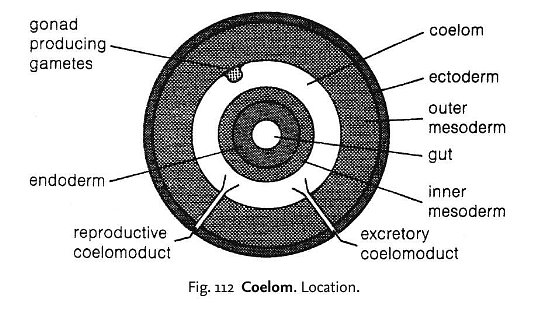
Coelom
Examples of Acoelomate
[Click Here for Sample Questions]
1) PHYLUM PLATYHELMINTHES

Phylum Platyhelminthes
Phylum Platyhelminthes: Examples like tapeworms and fluke worms.
- Leaf-like structure
- Body is dorso-ventrally flattened
- They are Triploblastic and show bilateral symmetry.
- They have three layers: Ectoderm, Mesoderm, and Endoderm. (Refer to the above figure)
- Mesoderm being the middle layer consists of Parenchyma cells, helps in transportation, and acts as a support. ‘
- Circulatory system and digestive system are completely absent in Flatworms.
- Anus is also absent so excretion takes place by an organ called a Flame cell.
- Nervous system consists of nerve fibers and ganglions.
- Reproductive system is well developed.
2) PHYLUM PORIFERA-SPONGES

Phylum Porifera
Phylum Porifera: Example like sponges
Phylum Porifera is an acoelomate animal that does not have a true body cavity. It is called sponges because it belongs to the phylum.
Phylum Porifera sponges have
- An asymmetrical body plan.
- A water transport and canal system.
- They have tiny pores known as Ostia, in their outer walls through which the water enters into a central cavity known as spongocoel, and it goes out through the osculum.
- The water flows in the same direction. (unidirectional) and this pathway helps in the excretion of waste products from animals, food gathering, and respiratory exchange.
- Collar cells which are known as choanocytes line the spongocoel and canals.
Things to remember
- Acoelomate is an animal that does not have a coelom or body fluid.
- They have a triploblastic body, and their organs and tissues are developed from three tissue layers.
- The Endoderm layer is the innermost layer that forms the digestive tract.
- The Mesoderm layer is the middle layer and the organs are surrounded by it.
- The Ectoderm layer is the skin and is the outermost layer.
- Animals that possess coeloms are called coelomates.
Sample Questions
Ques. What are Acoelomates and Acoelomate animals? (2 marks)
Ans. Acoelomates are animals that do not have a fluid-filled body which is located between their body wall and digestive tract. Acoelomate animals are animals that do not have a coelom.
Ques. What do you mean by Triploblastic body plan? Explain in detail with suitable examples and diagrams. (5 marks)
Ans. The triploblastic body plan in animals means their organs and tissues are developed from three tissue layers which are also known as Embryonic cell layers, and germ cell layers. These three tissues are the Endoderm layer, mesoderm, and Ectoderm layer.
The Endoderm layer is the innermost layer that forms the digestive tract, the Mesoderm layer is the middle layer and the organs are surrounded by it, the Ectoderm layer is the skin and is the outermost layer. These tissues are lined up in order from inside to out.

Triploblastic body plan
Ques. What is a Coelomic cavity? (1 mark)
Ans. The Coelomic cavity is a fluid-filled space located between the body wall and the alimentary canal.
Ques. Explain Acoelomate animals with their examples and diagrams. (10 marks)
Ans. Acoelomate is an animal that does not have a coelom.
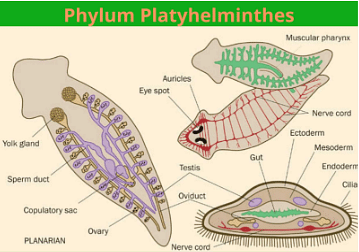
Phylum Platyhelminthes
Example: Phylum Platyhelminthes are Leaf-like structures and their body is dorso-ventrally flattened. They have a Triploblastic body and show bilateral symmetry. They have three layers Ectoderm, Mesoderm, and Endoderm. Mesoderm is the middle layer, consisting of Parenchyma cells that help in transportation, and acts as a support. In Phylum Platyhelminthes the circulatory system and digestive system are completely absent. The anus is also absent so excretion takes place by an organ called a Flame cell. The Nervous system consists of nerve fibers and ganglions. The Reproductive system is well developed.

Phylum Porifera
Another example of an Acoelomate animal is Phylum Porifera. It is an acoelomate animal that does not have a true body cavity. It is called sponges because it belongs to the phylum.
Phylum Porifera sponges have an asymmetrical body plan. They consist of water transport and a canal system.
They have tiny pores known as Ostia, in their outer walls through which the water enters into a central cavity known as spongocoel, and it goes out through the osculum. In phylum Porifera, the water flows in the same direction. (unidirectional) and this pathway helps in the excretion of waste products from animals, food gathering, and respiratory exchange. Collar cells which are known as choanocytes line the spongocoel and canals.
Ques. Explain the terms Acoelomates, Pseudocoelomates, and Coelomates. (5 marks)
Ans. Acoelomates are animals that don't have fluid-filled body cavities whereas Animals that have a coelom are called coelomates. Pseudocoelomates have a false body cavity that is not lined by mesoderm; instead it is present between ectoderm and endoderm. Examples of Acoelomates, Pseudocoelomates, and Coelomates are flatworms, arthropods, and aschelminthes respectively.
Ques. Classify the animals based on the presence and absence of coelom. (5 marks)
Ans. They are classified into three categories which define each one of them in the presence and absence of coelom.
Acoelomate: As we saw earlier Acoelomates are animals that don't have fluid-filled body cavities. For example flatworms.
Pseudocoelomate: Pseudocoelomates have a false body cavity and this cavity is not lined by mesoderm instead it is present between ectoderm and endoderm. For example aschelminthes.
Coelomates: Animals that possess coeloms are called coelomates. For example chordates.
Ques. Draw a diagram displaying germinal layers with proper labels. (5 marks)
Ans. 
Ques. In Phylum Platyhelminthes which system is not present? (1 mark)
(a) Reproductive system.
(b) Circulatory system.
(c) Nervous system.
Ans. Circulatory system.
Ques. In Phylum Platyhelminthes excretion takes by which cell? (1 mark)
Ans. Flame cell.
Ques. Members of the Phylum Porifera are commonly known as? (1 mark)
Ans. Sponges.
Check out:



Comments