



Education Content Expert
Phylum Porifera is a classification of aquatic animals. They are the lowest multicellular animals belonging to the Kingdom Animalia. Phylum Porifera has a structure resembling a sponge and is therefore called sponges. They are attached to the substratum and are not able to move. Poriferans have the ability to absorb and withhold fluids. Porifera are the first pore-bearing multicellular animals. So far, 5000 species of various shapes and colors have been discovered in this phylum.
Each species in Phylum Porifera has unique characteristics. They are capable of sexual and asexual reproduction. Again being asexual, they engage in both the budding and fragmentation processes. In sexual reproduction, the eggs and sperm are fused together. They were initially regarded as plants owing to their green color and their symbiotic relationship with algae. Later on, as their life cycle and feeding system were discovered, they were included in the animal kingdom.
Read More: NCERT Solutions For Class 11 Biology Animal Kingdom
| Table of Content |
Key Terms: Phylum Porifera, Porifera, Animal Kingdom, Sponges, Poriferans, Sycon, Spongecoel, Reproduction, Calcarea
Structure of Porifera
[Click Here for Sample Questions]
Poriferan species have spicules, which are a collection of tiny needle-like structures. Additionally, some of the large pores are referred to as Ostia, which aid in drawing fluid into the spongocoel internal canal. This water is separated from the organism by exit pores known as the osculum and filtered into the radical canal. This water serves only to support thereproductive system of porifera, either by assisting in egg production or sperm transportation.
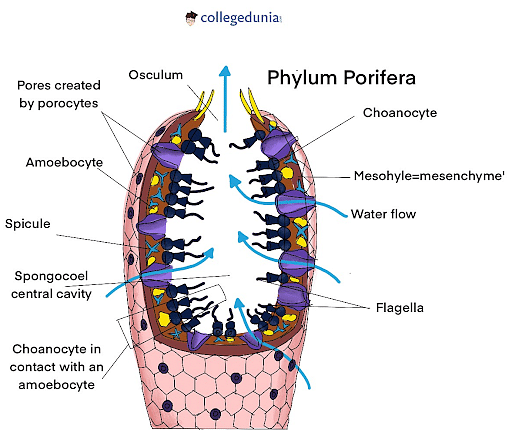
Structure of Porifera
Read More:
Origin and Life Cycle of Porifera
[Click Here for Previous Year Questions]
Phylum Porifera are initially thought of be plants due to their immobility. They have an aquatic algal appearance. Later findings such as the inability to prepare its own food, lack of chlorophyll, reproductive system, extended lifespan, etc. confirmed that they belong to the animal kingdom.
They can be found in both shallow and deep seas as well as in freshwater lake beds. Apart from these features, sponges have been classified into four classes.
Classification of Porifera
[Click Here for Sample Questions]
Phylum Porifera types can be divided into three groups based on their calcium carbonate spicules.

Classes of Phylum Porifera
The three classes of Phylum Porifera are as follows:
Calcarea
- These type of Porifera are tiny and live in shallow water in marine forms.
- The cylindrical body shape of the animal, which is symmetrical, is the result of a skeleton made of Calcarea spicules.
- The development is aided by coeloblastula or amphiblastula, and the body may be arranged in an asconoid or conoid type fashion.
- Large cells in this are referred to as choanocytes.
- Once more, these choanocytes are divided into two orders depending on their structural characteristics.
- The two sub-orders are Homocoela and Heterocoela.
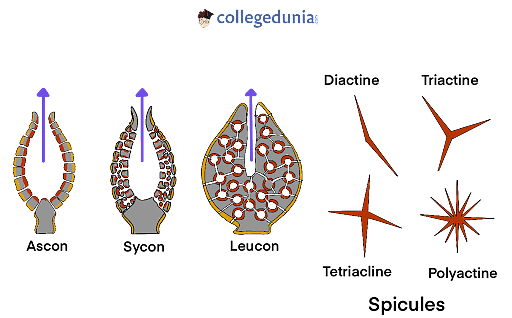
Class Calcarea
Hexactinellida
- There are sizable sponges or porifera present in this class.
- It contains six-rayed, shiny spicules that can help it reach lengths of 10 to 30 cm.
- They are primarily located in the ocean's deepest strata.
- They have some inorganic components and finger-like channels.
- Its form resembles that of a cup or vase.
- Examples include Hyalonema and Euplectella.
Read More: Animal Kingdom Important Questions
Demospongia
- These porifera come in a variety of hues with pigment granules.
- They can be found from the surface of the ocean to its depths.
- The majority of species of this phylum are in this group.
- The body will be either circular or flattened, and the skeleton may or may not be visible.
- Examples include Geodia, Platina, and Pascarella.
Different classifications, including carnivorous and many others, have been categorized based on each species' distinctive eating strategy. Additionally, there are subclasses within these categories that can be studied in the following way.
Characteristics of Porifera
[Click Here for Previous Year Questions]
Here are a few important characteristics possessed by the species in Phylum Porifera:
- The majority of porifera are freshwater species, although there are a few marine species as well.
- The body's shape can be spherical, rounded, vase-like, or sac-like.
- They have two layers- an exterior dermal layer and an inner gastral layer, making them diploblastic animals.
- Between these two layers is a gelatinous, noncellular mesoglea. This has a large number of unbound amoeboid cells.
- The Ostia is the body's numerous pores, and the osculum is the top opening.
- The bodily cavity is called a spongecoel.
- Their bodies have a recognizable canal system for the movement of water.
- There is an endoskeleton made up of sponging fibers, siliceous spicules, or calcareous spicules (calcium carbonate) (protein).
- Asexual reproduction in Porifera is demonstrated by fragmentation and blossoming. Several animals exhibit sexual reproduction.
Read More: Animal Kingdom MCQs
Porifera Examples
[Click Here for Sample Questions]
Some of the common Porifera examples are
Sycon
- These marine sponges can be found in groups or alone, adhering to rocks in shallow water.
- The body of the sycon is shaped like a cylinder and contains lots of spores.
- Flagellated cells make up the radial canal.
- Water enters the body through the Ostia and travels through prosopyles to the radial canals.
- Both sexual and asexual modes of reproduction are used in these animals.
Hylonema
- These are also referred to as glass rope sponges, and they are found in seawater.
- The body is oblong or spherical, and the root tufts are twisted.
- There are tiny amphidiscs in the skeleton.

Examples of Porifera
Cliona
- They can also be found in coral skeletons, mollusk shells, and other calcareous structures.
- They are known as "boring sponges."
- They are either pale yellow, green, or purple in color.
- The leuconoid kind of sponges are distinguished by their canal system, and they can reproduce both asexually and sexually.
Euplectella
- These can be found in deep waters and are also referred to as Venus flower baskets.
- The body is long and curved, cylindrical, and anchored in the mud at the seafloor.
- They have a simple synconoid type canal system.
- Siliceous spicules united at the tips form a three-dimensional network with parietal gaps that make up the skeleton.
Spongilla
- They can be mostly found growing on submerged plants and sticks in ponds, streams, and lakes.
- The bodily wall is made up of a thin dermis with Ostia, or pores.
- They have a canal system in the rhagon style.
- These porifera can reproduce both sexually and asexually.
Read More:
| Related Topics | ||
|---|---|---|
| Animalia Lower Invertebrates | Difference Between Endoskeleton and Exoskeleton | Coelom |
| Symbiosis | Difference Between Fragmentation and Regeneration | Gemmule Formation |
Reproduction in Porifera
[Click Here for Previous Year Questions]
Reproduction plays a vital role in sponges as this system only transformed this animal kingdom from plant life. Poriferans can reproduce both sexually and asexually.
- In asexual reproduction, it undertakes the budding process as well as the fragmentation process.
- The sexual process involves a combination of ova and sperm, just like common to all other species.
- The majority of sponges are hermaphroditic which means that the same individual produces both eggs and sperm, however, certain species have different sexes.
Read More: Animal Kingdom Concept Map
Things to Remember
- Phylum Porifera is considered probably the oldest animal group that lives in an aquatic habitat.
- They are the simplest multicellular animals that do not have any tissues or organs.
- They are also referred to as Sponges and have many holes or pores called Ostia.
- Phylum Porifera has a water transport system, which achieves the functions of digestion, excretion, and exchange of gases.
- They feed on bacteria and other food particles that are present in the water.
- Phylum Porifera is classified into three classes namely Calcarea, Hexactinellids, and Desmospongiae.
- Some common examples of Porifera include Sycon, Hylonema, Cliona, Spongilla, and Euplectella.
Previous Years’ Questions (PYQs)
- Classification of Porifera is based on… (NEET 1991)
- The simplest type of canal system in Porifera is… (AIPMT 1992)
- The commercial bath sponges belong to… (JIPMER 1999)
- Sycon belongs to a group of animals, which are best… (NEET 2003)
- Which group of animals belong to the same phylum… (NEET 2013)
- Canal system in Porifera is not concerned with… (AFMC 2005)
- Which of the following is not related to porifers…
- Symmetry in Cnidaria is…
- When an animal has both the characters of male and… (NEET 1996)
- The taxonomic unit phylum in the classification of animals… (UPSEE 2016)
- Cuttlefish belongs to a phylum… (JIPMER 1995)
- One of the representatives of Phylum Arthropoda is… (JIPMER 2012)
Sample Questions
Ques. What characteristics does the phylum Porifera possess? (3 Marks)
Ans. Phylum Porifera has the following characteristics:
- These multicellular creatures have pores.
- They are radially symmetrical or asymmetrical.
- They usually have a cylindrical body.
- Their body lacks organs.
- They display holozoic nutrition.
- They have radially symmetrical bodies.
- They have the ability to regrow lost body parts.
Ques. Where are the Choanocytes present in the sponges? (1 Mark)
Ans. The cells called Choanocytes are present lining the spongocoel and canals. with their flagella protruding out.
Ques. Explain the importance of Porifera for the ecosystem. (3 Marks)
Ans. Porifera, also known as Sponges, consists of coral reefs and deep-sea communities. Sponges excrete high amounts of ammonium and, due to the activity of associated microorganisms, nitrite, and nitrate, are essential nutrients. Sponges are thus considered important nutrient sources in the marine ecosystem.
Ques. How do Poriferans live? (2 Marks)
Ans. Poriferans are “sessile” creatures that is they don’t move around and they live by siphoning huge volumes of water through their bodies and sifting through minuscule life forms and natural particles for food.
Ques. Where are these Porifera found? (1 Mark)
Ans. Since these sponges are aquatic organisms, the majority of the species are found in marine environments, but some can be found in freshwater and at the bottom of the ocean.
Ques. Who consumes sponges? (2 Marks)
Ans. The organisms that consume sponges appear to belong to several different families. They include boxfishes (Ostraciidae), wrasses (Labridae), leatherjackets (Monacanthidae), angelfishes (Pomacanthidae), and pufferfishes (Tetraodontidae). Some species' diets consist of more than 70% sponge eating.
Ques. Do sponges have the ability to regenerate? (2 Marks)
Ans. In addition to repairing damaged or destroyed areas, sponge regeneration can also result in the complete regeneration of an adult from small pieces or even a single cell. Archaeocytes play a crucial role in the settlement, movement, and formation of active aggregates from the fragmented cells
Ques. List a few examples of Poriferans. (2 Marks)
Ans. Some examples of Poriferans are
- Sycon
- Spongilla
- Hylonema
- Cliona
- Euplectella
Ques. Where may one find sponges? (1 Mark)
Ans. Although they can be found in both shallow and deep waters, sponges are always found adhering to the ocean floor. At a depth of more than 8000 meters, they can be found.
Ques. What do you mean by Desmospongiae? Explain its characteristics. (3 Marks)
Ans. Desmospongiae is one of the three classes of Phylum Porifera. Its characteristics are as follows:
- The species in this class are found in marine or freshwater.
- They have an asymmetrical and cylindrical body shape.
- The canal system of this class is a leuconoid type.
- The skeleton includes spongin fibers, and siliceous spicules, which are monoaxon and triaxon.
Ques. How do Poriferans consume their food? (2 Marks)
Ans. Poriferans exhibit holozoic nutrition. They are known as filter-feeders because they filter the minuscule, float-ing organic particles and plankton that they consume. They gather the food in specialized cells known as choanocytes, which are then carried by amoebocytes throughout the body.
Ques. Why are Poriferans mistaken for plants rather than animals? (1 Mark)
Ans. Poriferans are attached to the seafloor, thus, they are unable to migrate. They are frequently mistaken for plants rather than animals since they share this trait with plants.
Ques. Why are sponges considered an animal? (2 Marks)
Ans. Sponges cannot make their own food because they lack chlorophyll. For food, they capture various organisms and feed on them. The majority of sexually reproducing sponges produce sperm and eggs. Thus, they are regarded as animals and not plants because of this particular reason.
Check-More:



Comments