



Content Writer
Phylum Arthropoda is the largest phylum in the animal kingdom. The animals in this phylum have three parts to their bodies: a segmented body, an exoskeleton, and jointed appendages.
- Phylum Arthropoda is a type of phylum that may be aquatic, terrestrial or even parasitic.
- These animals have exoskeletons with a cuticle made of chitin.
The term Arthropods is derived from the Greek words "arthron" (joint) and "podos" (foot or leg), which collectively mean "jointed leg."
- The animals in this phylum have the ability to survive in every habitat.
- Phylum Arthropoda undergoes different stages of mouling in order for their growth.
- Insects, bees, shrimps, centipedes, millipedes, and other animals are included in this phylum.
| Table of Content |
Key Terms: Phylum Arthropoda, Animals Kingdom, Parasitic, Habitat, Trilobitomorpha, Chelicerata, Crustacea, Myriapoda, Classification of Phylum Arthropoda, Hexapoda, Aquatic Animals, Terrestrial Animals
Classification of Phylum Arthropoda
[Click Here for Sample Questions]
Arthropoda is subdivided into five subphyla. The following is a description of the five subphylums of phylum arthropoda:
Trilobitomorpha
The characteristics of Trilobitomorpha are as follows:
- Trilobitomorpha are the earliest form of arthropods.
- They are no longer extant.
- These species of animals have three lobes on their body: one median and two lateral lobes.
- Their body is divided into three sections: the head, the abdomen, and the pygidium.
- There are two antennas and compound eyes.
- Trilobita was the only class in this subphylum.
Chelicerata
The characteristics of Chelicerata are as follows:
- Chelicerata are mostly found on land.
- The body is divided into two parts: the cephalothorax and the abdomen.
- Antennae are missing in these species.
- The abdomen is divided into 13 segments.
- In chelicerata, respiration occurs through the trachea or gills.
- Malpighian tubules are found in the excretory organ.
The Chelicerata subphylum is further subdivided into the following classes:
- Arachnida
- Merostomata
- Pycnogonida
Examples of ChelicerataExample: Aramea, Limulus, and so on. |
Myriapoda
The characteristics of Myriapoda are as follows:
- Myriapoda are mostly terrestrial in nature.
- Their body is long and slender, with numerous segments.
- They have two antennae and two simple eyes.
- These species have a lot of legs.
- Epistome and labrum are located on the upper lip of the mouth.
- A pair of maxillae are located on the lower lip.
- The presence of two mandibles inside the mouth.
- The trachea is responsible for respiration in myriapoda
- Malpighian tubules are responsible for excretion.
The Myriapoda subphylum is further subdivided into the following classes:
- Chilopoda
- Diplopoda
- Pauropoda
- Symphyla
Example of MyriapodaExample: Julus, Scolopendra, and other examples. |
Crustacea
The characteristics of Crustacea are as follows:
- Crustacea are mostly aquatic, with a few parasitic species thrown in for good measure.
- The body is divided into two parts: the cephalothorax (head + thorax) and the abdomen.
- Respiration occurs through the body's surface or through the gills.
- They have two pairs of antennae and compound eyes.
- Coxal glands, green glands, and antennary glands are examples of excretory organs.
- Crustacea demonstrate indirect development.
Crustacea is further subdivided into six classes. They are as follows:
- Branchiopoda
- Remipedia
- Cephalocarida
- Maxillopoda
- Ostracoda
- Malacostraca
Example of CrustaceaExample: Examples include Palaeman (Prawn), Macrobrachium (Prawn), Daphnia, Cancer (Crab), Palinurus (Lobster), and others. |
Hexapoda
The characteristics of Hexapoda are as follows:
- Hexapoda have the greatest diversity of species which can be found in a variety of habitats.
- The body is divided into three sections: the head, the thorax, and the abdomen.
- They have three pairs of appendages and two compound eyes.
- The thorax is divided into three sections in hexapoda.
- Respiration is accomplished through the use of the lungs or the trachea.
- Malpighian tubules are responsible for excretion.
- They demonstrate indirect development.
Example of HexapodaExample: Periplaneta (Cockroach), Musca (Housefly), Mosquitoes, Butterflies, Bees, Wasps, Termites, and so on. |
Also Read:
Arthropoda Characteristics
[Click Here for Sample Questions]
Some important characteristics of phylum arthropoda are as follows:
- Phylum Arthropoda contains roughly 80% of all animal species in the animal kingdom.
- They are coelomate animals that are bilaterally symmetrical and triploblastic.
- Organisms have a chitinous exoskeleton covering their bodies.
- It is divided into three distinct parts: the head, the thorax, and the abdomen.
- In some cases, the head and thorax are fused, resulting in a cephalothorax.
- They have a body that is segmented on the outside.
Phylum Arthropoda has an open circulatory system where blood flows in the haemocoel, which is colourless blood (hemolymph). They are made up of a dorsal heart.
- Different arthropods have different respiratory organs.
- Respiration occurs through gills in aquatic forms and through book lungs or trachea in terrestrial forms.
- The double ventral nerve cord that runs along the ventral body wall forms the nervous system.
Each segment has a segmental ganglia. The excretory structures in most arthropods are the Malpighian tubules or green glands.
- Sensory organs in arthropods include antennae, eyes (compound and simple), statocysts, and balancing organs.
- They demonstrate sexual reproduction and fertilisation occur internally.
- With the larval stage, development can be direct or indirect.
- Parthenogenesis occurs in some arthropods, such as honey bee drones.
Examples of Phylum Arthropoda
[Click Here for Sample Questions]
Some common examples of Phylum Arthropoda are as follows:
Palaemon
The characteristics of Palaemon are as follows:
- Palaemon are found in freshwater streams, rivers, lakes, and ponds.
- They are bilaterally symmetrical and elongated.
- The body is split into two parts: the cephalothorax and the abdomen.
- Shrimp and Prawns are common examples of Palaemon.
The divisions of Palaemon are as follows:
- Kingdom: Animalia
- Phylum: Arthropoda
- Subphylum: Crustacea
- Class: Malacostraca
- Order: Decapoda
- Family: Palaemonidae
- Genus: Palaemon

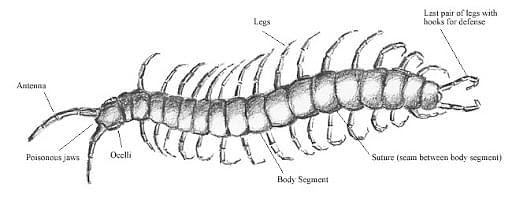
Scolopendra
The characteristics of Scolopendra are as follows:
- Scolopendra is found in burrows, crevices, logs of wood, and fallen leaves.
- They are nocturnal species and live in damp areas.
- They are elongated and flattened dorsoventrally.
- The body is divided into two sections: the head and the trunk.
- The digestive or alimentary system includes the alimentary canal and digestive glands.
- Centipede is a common example of Scolopendra.
The divisions of Scolopendra are as follows:
- Kingdom: Animalia
- Phylum: Arthropoda
- Subphylum: Myriapoda
- Class: Chilopoda
- Order: Scolopendromorpha
- Family: Scolopendridae
- Genus: Scolopendra
Periplaneta
The characteristics of Periplaneta are as follows:
- Periplaneta are omnivorous nocturnal scavengers.
- They prefer dark, warm kitchen corners, godowns, underground drains, and places with food and humid atmospheres.
- They are flattened dorsoventrally, segmented, elongated, and reddish-brown in colour.
- The body is divided into three sections: the head, the thorax, and the abdomen.
- The cockroach's exoskeleton is made of chitin and is jointed.
They have spiracles (respiratory openings) on the lateral sides of the thorax and abdomen segments, which facilitate gas exchange.
- Periplaneta has well-developed compound eyes.
- They have long antennae that allow them to move in the dark.
- The cockroach is a common example of this category.
The divisions of Periplaneta are as follows:
- Kingdom: Animalia
- Phylum: Arthropoda
- Subphylum: Hexapoda
- Class: Insecta
- Order: Blattodea
- Family: Blattidae
- Genus: Periplaneta

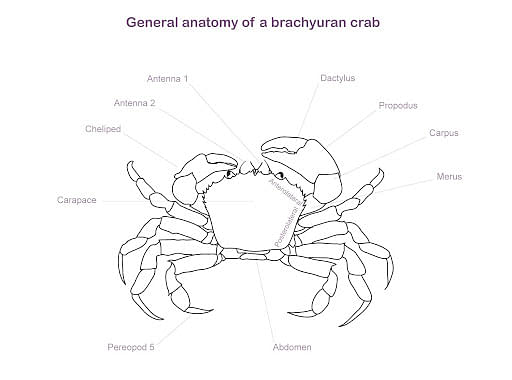
Brachyura
The characteristics of Brachyura are as follows:
- Brachyura includes a hard carapace, which covers the head and thorax dorsally.
- The ventral boundary between the head and thorax is clearly defined.
- Only the last five segments of the thorax are readily visible.
- The attachment of the thoracic legs to the exoskeleton is clearly apparent.
- It consists of one pair of legs on each of these last five thoracic segments.
- The first pair is modified as chelipeds, or claws, while the remaining four pairs are adapted for walking and the last pair for swimming.
- Crab is a common example of Brachyura.
The divisions of Brachyura are as follows:
- Kingdom: Animalia
- Phylum: Arthropoda
- Subphylum: Mandibulata
- Class: Crustacea
- Order: Decapods
- Family: Brachyura
- Genus: Cancer
Things to Remember
- Arthropoda is the most diverse phylum, with approximately nine lakh species.
- They can be aquatic, terrestrial, or even parasitic in nature.
- The animal species in this category of phylum have chitinous exoskeletons and appendages with joints.
- This phylum contains several large classes, including the class Insecta, which accounts for a large proportion of all species on the planet.
- There are six subphylum in Phylum Arthropoda, which are: Crustacea, Myriapoda, Hexapoda, Chelicerata and Trilobitomorpha.
Also Read:
Sample Questions
Ques: What are the characteristics of the Phylum Arthropoda? (3 marks)
Ans: This is the animal kingdom's largest Phylum. The phylum Arthropoda contains roughly 80% of all animal species in the animal kingdom. They are coelomate animals that are bilaterally symmetrical and triploblastic.
- It is divided into three distinct parts: the head, the thorax, and the abdomen.
- In some cases, the head and thorax are fused, resulting in a cephalothorax.
- They have a body that is segmented on the outside.
Ques: What is the significance of the name Arthropods? (3 marks)
Ans: The term Arthropod is derived from the Greek words arthron, which means "joint," and podos, which means "foot" or "leg," and thus means "jointed leg."
- We hope this comprehensive article on the Phylum Arthropoda aids you in your preparation.
- If you get stuck, please let us know in the comments section below, and we will get back to you as soon as possible.
Ques: In Arthropod, write a few lines about the exoskeleton? (2 marks)
Ans: Arthropods have a hardened exoskeleton made of chitin. Calcium carbonate can stiffen it further in a few species. The exoskeleton in arthropods is non-expandable, so as the organism grows, it must shed its exoskeleton to be replaced by a new exoskeleton. This is known as moulting.
Ques: Which of the following belongs to the phylum Arthropoda? (2 marks)
Termite, Octopus, Termite, Neries, Leech
Ans: Both Nereis and Leech are members of the phylum Annelida. The phylum Mollusca includes the octopus. Termites are members of the Arthropoda phylum. Termites are also known as white ants, and they are classified as arachnids.
Ques: Write a note on Phylum Arthropoda? (5 marks)
Ans: This is Animalia's largest phylum, which includes insects. Arthropods account for more than two-thirds of all named species on the planet. They are organised at the organ-system level.
- They are animals that are bilaterally symmetrical, triploblastic, segmented, and coelomate. A
- rthropods have a chitinous exoskeleton covering their bodies.
- They have appendages that are joined.
- Gills, book gills, book lungs, and the tracheal system are examples of respiratory organs.
- The circulatory system is of the open variety.
- There are sensory organs such as antennae, eyes (compound and simple), statocysts, and balance organs.
- Malpighian tubules are responsible for excretion.
- They are primarily oviparous. Development can take place in either a direct or indirect manner.
Ques: Write a note on Hexapoda? (3 marks)
Ans: Hexapods have the most species diversity. These can be found in a wide range of environments. The body is divided into three parts: the head, thorax, and abdomen.
- They are equipped with three pairs of appendages.
- They have two eyes that are joined together.
- There are three sections to the thorax.
- Respiration is accomplished through the use of the trachea or the book lungs.
- Malpighian tubules are in charge of excretion.
Ques: What does arthropod mean? Give examples? (2 marks)
Ans: The term arthropod refers to animals with jointed legs. It is clear from the description of arthropods that jointed legs are one of the most common features of the phylum Arthropoda. Arthropods include scorpions, crabs, centipedes, lobsters, ants, mosquitoes, and other insects.
Ques: What are the subphylum of Chelicerata and Myriapoda? (2 marks)
Ans: The subphylum of Chelicerata are as follows:
- Arachnida
- Merostomata
- Pycnogonida
The subphylum of Myriapoda are as follows:
- Chilopoda
- Diplopoda
- Pauropoda
- Symphyla
Ques: Answer the following: (A) What is the biggest class of arthropods?
(B) Which arthropods have six legs? (2 marks)
Ans: (A) Class Inesecta is the biggest class of arthropods.
(B) Insects have six legs.
Ques: What are the characteristics of Crustacea? (3 marks)
Ans: The characteristics of Crustacea are as follows:
- They are mostly aquatic, with a few parasitic species thrown in for good measure.
- The body is divided into two parts: the cephalothorax (head + thorax) and the abdomen.
- Respiration occurs through the body's surface or through the gills.
- They have two pairs of antennae and compound eyes.
- These animals demonstrate indirect development.
Ques: What are the characteristics of brachyura? (3 marks)
Ans: The characteristics of brachyura are as follows:
- Hard carapace covers the head and thorax dorsally.
- The ventral boundary between the head and thorax is clearly defined.
- Only the last five segments of thorax are readily visible and attachment of the thoracic legs to the exoskeleton is clearly apparent.
- One pair of leg on each of these last five thoracic segments.
- The first pair of brachyura is modified as chelipeds, or claws.
- Other remaining pairs are adapted for walking.
- The last pair is used for swimming.
For Latest Updates on Upcoming Board Exams, Click Here: https://t.me/class_10_12_board_updates
Also Check:



Comments