



Education Journalist | Study Abroad Lead
The altitude of a triangle can be defined as a perpendicular line segment drawn from the vertex to the opposite side of the triangle.
- Based on the triangle types, the altitude's position can be changed.
- There are three altitudes of a triangle, this altitude can be used to find the height of the triangle.
- It forms the right angle with the base.
The formula for expressing the altitude of the triangle is
Altitude = \(\frac{2 \times Area}{ Base}\)
| Table of Content |
Key Terms: Altitude of triangle, perpendicular, line segment, right angle, Vertex
What is the Vertex of a Triangle?
[Click Here for Sample Questions]
The point of interaction, of any two sides of a triangle is called the vertex of the triangle.
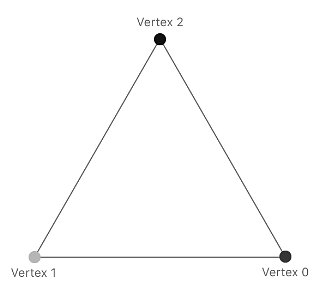
Vertex of a triangle
The properties of a vertex are:
- A triangle has three vertexes.
- A line can be drawn from the opposite side to the vertex of a triangle.
- In an equilateral triangle, the perpendicular line from the middle point from the base can be drawn from any side of the triangle.
- But in the case of an isosceles triangle, the base from where the perpendicular can be drawn is not equal in length.
Read more: Similarity of triangles
What is the Altitude of a Triangle?
[Click Here for Previous Year Questions]
The altitude of a triangle is the line drawn perpendicular to the base from the opposite vertex. The line makes a right angle to the triangle and is called the height of the triangle.

Altitude of a triangle
The latitude of the triangle can be used to calculate the area of the triangle. The area of the triangle can be given by, ½ base * height. Now, the base can also be calculated with the formula: Base= 2 x area/height
Properties of Altitude of a Triangle
[Click Here for Sample Questions]
The properties of the altitude are as follows:
- There can be three altitudes of a triangle, in the case of an equilateral triangle all the side are equal so altitude can be calculated from any side.
- The altitude is perpendicular to the opposite side of the triangle.
- The altitude of the triangle can be both inside and outside the triangle.
- The triangle's orthocenter is where the three altitudes intersect.
Also Read: Height and Difference
Altitudes of Triangles
[Click Here for Previous Year Questions]
The altitudes of different types of triangles are as follows:
Obtuse triangle
The obtuse triangle has one of the angles more than 90 degrees. For an obtuse triangle, the altitude of the triangle is outside. For this, we need to extend the triangle's base and then draw a perpendicular line.
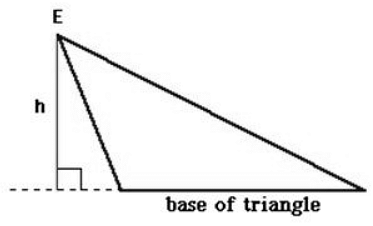
Obtuse triangle
Equilateral Triangle
An equilateral triangle has all the sides equal. The latitude of an equilateral triangle bisects the base and also the angle of the vertex.
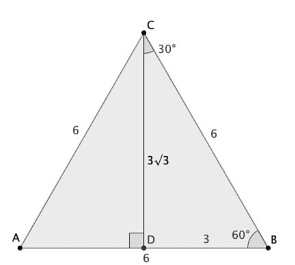
Equilateral Triangle
For an equilateral triangle:
In triangle ADB,
sin 60° = h/AB
∴ sin 60° = h/6
√3/2 = h/6
h = (√3/2)6
The height of the triangle will be (√3/2) * side of the triangle.
Right Triangle
For an equilateral triangle, the altitude is done on the hypotenuse of the triangle, and is the geometrical mean of the line segment. The segment to the hypotenuse form two similar triangle. This is called as right triangle altitude theorem.
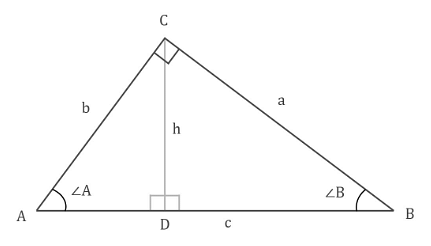
Right Triangle
What is the median of a Triangle?
[Click Here for Sample Questions]
The median of a triangle is the line segment that joins the vertex of the triangle to the midpoint of the opposite side.
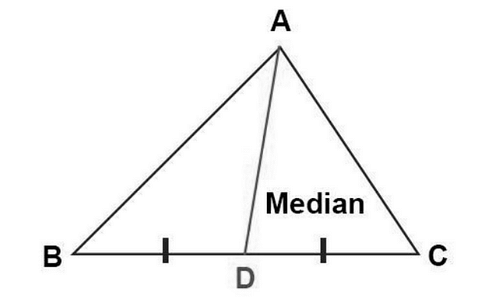
Median of a Triangle
Also check:
| Related Topics | ||
|---|---|---|
| Right angled triangle | Scalene triangle | Isosceles Triangle |
| Right Angled Triangle Theorem | Equilateral triangle | Isosceles Triangle Theorems |
Things to Remember
- Altitude is the height of the triangle.
- The altitude of the triangle can be both inside and outside the triangle.
- In the case of an obtuse triangle, extend the base of the triangle and then draw a perpendicular to find the altitude.
- Altitude can be given by Altitude = \(\frac{2 \times Area}{ Base}\)
- The altitude can also be used to find the area of the triangle.
- There can be a maximum of three altitudes of a triangle.
- For an equilateral triangle, the altitude can be made from any side of the triangle.
Previous Year Questions
- Nascent hydrogen consists of..
- In which of the following reactions the hydrogen peroxide acts as a reducing agent?..[JEE MAIN 2023]
- Major product of the following reaction is..[JEE MAIN 2023]
- The total current supplied to the circuit by the battery is...[AIEEE 2004]
- The reading of voltmeter in the circuit shown is….[Rajasthan PMT 2023]
- The oxidation of toluene to benzaldehyde by chromyl chloride is called...[NEET UG 1996]
- An aggregate fruit is one which develops from..[NEET UG 2014]
- The order of stability of the following carbocations..[JEE MAIN 2013]
- Complete hydrolysis of cellulose gives...[BITSAT 2012]
- Which one among the following metals is the weakest reducing agent?..[JEE MAIN 2023]
Sample Questions
Ques: What are the formulas for calculating the altitudes of different types of triangles? (3 marks)
Ans: The altitude is the line drawn from the vertex to the opposite side of the triangle. Different triangles have different altitudes some are outside and some are inside the triangle. The formulas for calculating the altitude are as follows:
Equilateral triangle: h = (½) × √3 × s, where s is the side of the triangle
Right angled triangle: h =√(xy), where xy is the hypotenuse
Isosceles triangle: h =√(a2 − b2/4), where ab is the side of the triangle
Ques: What is the difference between a median and an altitude of a triangle? (5 marks)
Ans:
| Median of triangle | Altitude of a triangle |
|---|---|
| Median is drawn from the vertex to the opposite side of the triangle. | Altitude is drawn from the vertex to the perpendicular to the opposite side of the vertex. |
| It will divide the opposite side into equal sides. | It may or may not bisect the side. |
| It always lies inside the triangle | It can be both inside and outside the triangle. Eg: An obtuse triangle has altitude outside the triangle |
| The triangle is divided into two equal parts | It does not divide the triangle. |
| The point of intersection of the three medians is called the centroid of the triangle | The point of intersection of the three altitudes is called the orthocenter of the triangle |
Ques: Calculate the altitude of the equilateral triangle with the side 7cm. (3 marks)
Ans: The side of the triangle is given as 7 cm.
The formula for calculating the altitude of an equilateral is given by h = s√3/2
= 7√3/2
=3.5√3 cm
Ques: What are the properties of the altitude of the triangle (3 marks)
Ans: The properties of the altitude are as follows:
- There can be three altitudes in a triangle.
- The altitude may or may not bisect the side of the triangle.
- The altitude of the triangle can be both inside and outside the triangle.
- The point of intersection of the three altitudes is called the orthocenter of the triangle
Ques: What is the height of an isosceles triangle, if the length of equal sides is 10 cm and the unequal side is 8 cm? (3 marks)
Ans: The formula for the altitude of the isosceles triangle is given by: h =√(a2−b2/4)
h=√(102−82/4)
h=√(100−64/4)
h =√(36/4)
h=6/4
h=1.5cm
Ques: Find the side of the equilateral triangle, if the height is 2√3 cm. (2 marks)
Ans: the formula for the altitude of the triangle is h = s√3/2, where s is the side of the triangle.
Given that the height of the triangle is 2√3 cm.
2√3 = s√3/2
s= 4 cm.
Ques: In the given figure, ∠A = 90°, AD ⊥ BC. If BD = 2 cm and CD = 8 cm, find AD. (3 marks)

Ans: ∆ADB ~ ∆CDA
Therefore, sides are proportional
\(\frac{BD}{AD} = \frac{AD}{CD}\)
So, AD2= BD*CD
AD2= 2*8
AD2=16
AD=4 cm
Ques: In ∆ABC, if AP ⊥ BC and AC2 = BC2 – AB2, then prove that PA2 = PB × CP. (2 Marks)

Ans: AC2 = BC2 – AB2
AC2 + AB2 = BC2
By Pythagoras’s theorem
∴ ∠BAC = 90°
∆APB ~ ∆CPA
∴ \(\frac{AP}{CP}=\frac{PB}{PA}\) [In ~∆s, corresponding sides are proportional]
∴ PA2 = PB. CP (Hence Proved)
For Latest Updates on Upcoming Board Exams, Click Here: https://t.me/class_10_12_board_updates
Check-Out:



Comments