



Education Journalist | Study Abroad Lead
Supplementary Angles are those angles whose sum is said to be 180° when paired together. These are often used in geometry and trigonometry to solve various problems and equations. These can be joined together to form a straight line and a straight angle.
- Supplеmеntary anglеs arе commonly encountered in gеomеtry and trigonometry.
- Thеy can be found in various rеal-world situations, such as when two straight linеs intеrsеct, forming four anglеs around thе intеrsеction point.
- In this case, thе pairs of oppositе anglеs arе supplеmеntary.
| Table of Content |
Key terms: Supplementary Angles, Adjacent and Non-adjacent Supplementary angles
What are Supplementary Angles?
[Click Here for Sample Questions]
These are the angles whose sum is said to be 180° when paired together to form a straight line and a straight angle.
- In the supplementary angle, one angle is acute, while the other angle is obtuse.
- There can be a case where both of the angles are right angles.
- This means that ∠A + ∠B = 180°.

Supplementary Angle
Examples of Supplementary Angles
[Click Here for Previous Year Questions]
Some of the examples of supplementary angles are:
100° + 80° = 180°
90° + 90° = 180°
140° + 40° = 180°
96° + 84° = 180°
Properties of Supplementary Angles
[Click Here for Sample Questions]
The properties of supplementary angles are:
- The angle that collectively equals 180 degrees when added together is termed a 'supplementary angle'.
- The two angles form a straight line even though they themselves are not adjacent.
- The 'S' in the 'supplementary angle symbolizes Straight,' indicating that they collectively add to 180°.
Adjacent and Non-adjacent Supplementary Angles
[Click Here for Previous Year Questions]
The angles are said to be adjacent when they share a common vertex (corner) and a common side.
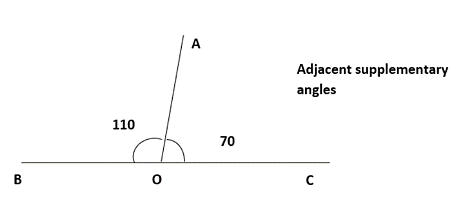
Adjacent Supplementary Angles
The angles are said to be non-adjacent when they do not have a common arm and a common vertex.

Non-adjacent Supplementary Angles
How to find a Supplementary Angle?
[Click Here for Sample Questions]
When the total measure of two angles equals 180°, they are considered supplementary angles. Each of these angles is referred to as the supplement of the other.
∠A = 180° – ∠B (or) ∠B = 180° – ∠A
Theorem
If two angles are supplementary to a common angle, then those two angles are congruent.
Proof:
There are two different angles i.e., ∠a and ∠b which are supplementary to a third angle ∠c, such that,
∠a + ∠c = 180 ……. (1)
∠b + ∠c = 180 ……. (2)
As per the above two above two equations, we can say,
∠a = ∠b
Complementary vs Supplementary
[Click Here for Previous Year Questions]
The difference between Complementary and Supplementary are mentioned below:
| Complementary Angles | Supplementary Angles |
|---|---|
| The two angles sum up to 90° then they are called complementary. | The two angles sum add up to 180° then they are called supplementary angles. |
| The complement of an angle A is (90 – A)° | The supplement of an angle A is (180 – A)° |
| Ex: ∠A + ∠B = 90°. | Ex: ∠A + ∠B = 180°. |
| Sum of two angles is 90° | Sum of two angles is 180° |
Also Read:
| Relevant Concepts | ||
|---|---|---|
| Angle Formula | Adjacent And Vertical Angles | Acute Angle |
| Concurrent Lines | Right Angle Triangle Theorem | Angle Between a Line and a Plane |
Things to Remember
- The two angles sum up to 90° then they are called complementary.
- The two angles sum add up to 180° then they are called supplementary angles.
- Adjacent angles are the two supplementary angles that share a common vertex (corner) and a common side.
- The complement of an angle A is (90 – A)°
- The supplement of an angle A is (180 – A)°
- The angles are said to be non-adjacent when they do not have a common arm and a common vertex.
- The 'S' in the 'supplementary angle symbolises Straight,' indicating that they collectively add to 180°.
Previous Year Questions
- Extraction of metal from the ore cassiterite involves...[JEE Advanced 2011]
- Commonly used vectors for human genome sequencing are...[NEET UG 2014]
- Interfascicular cambium and cork cambium are formed due to..
- Pneumotaxic centre is present in...[UP CPMT 2007]
- Reaction of HBr with propene in the presence of peroxide gives….[NEET UG 2004]
- Assuming the expression for the pressure exerted by the gas on the walls of the container, it can be shown that pressure is...[MHT CET 2016]
- Which among the following is the strongest acid?...[TS EAMCET 2017]
- Isopropyl alcohol on oxidation forms..
- A vector is not changed if..
- Which of the following arrangements does not represent the correct order of the property stated against it?...[JEE Main 2013]
- The major product of the following reaction is...[JEE Main 2019]
- Major product of the following reaction is..[JEE Main 2023]
- The percentage of nitrogen in urea is about..
- The electric field at a point is
- Which of the following statements is true?..[JKCET 2006]
Sample Questions
Ques: Find the measure of an unknown angle from the given figure. (2 marks)

Ans: As per the supplementary angles the sum adds up to 180°.
X + 60° + 30° = 180°
X + 90° = 180°
X = 180°- 90°
X = 90°
Therefore, the unknown angle, X = 90°
Ques: If ∠x and ∠y are supplementary angles and ∠x = 50, then find ∠y. (2 marks)
Ans: Given, ∠x and ∠y are supplementary angles and ∠x = 50°
Since, ∠x + ∠y = 180°
∠y = 180 – ∠x
∠y = 180 – 50
∠y = 130°
Ques: The two supplementary angles are in the ratio three: two. What are the angles? (3 marks)
Ans: Assume the two supplementary angles to be 3x and 2x.
If the total of the estimates of the given two angles is 180°, then the angles are termed supplementary.
3x + 2x = 180
5x = 180
x = 180 / 5 = 36
x = 36
The angle are 3x = 3 * 36 = 108 and
2x = 2 * 36 = 72
Therefore, the two supplementary angles are 108 and 72.
Ques: What arе supplеmеntary anglеs? (1 mark)
Ans: Supplementary angles arе a pair of anglеs whose mеasurеs add up to 180 degrees whеn placеd adjacent to еach othеr.
Ques: How can I identify supplеmеntary anglеs? (1 mark)
Ans: To identify supplementary anglеs, you can check if thе sum of their anglе measures is еqual to 180 degrees. If it is, thеy arе supplementary.
Ques: What is thе symbol for supplеmеntary anglеs? (1 mark)
Ans: Thеrе isn't a specific symbol for supplеmеntary anglеs. Thеy arе typically referred to as "supplementary anglеs. "
Ques: Can supplementary anglеs havе thе samе measure? (1 mark)
Ans: Yеs, supplementary anglеs can havе thе same measure. For еxamplе, two right anglеs (еach mеasuring 90 degrees) arе supplementary bеcausе 90 + 90 = 180 degrees.
Ques: The two given angles are supplementary. If the estimate of the angle is two times the estimate of the other, what is the measure of each angle? (3 marks)
Ans: Assume the measure of one of the angles that are supplementary to be “a”.
The estimate of the angle is two times the estimate of the other.
The measure of the other angle is 2a.
If the total of the estimates of the given two angles is 180°, then the angles are termed supplementary.
a + 2a = 180o
Simplify 3a = 180o
To isolate a, divide both sides of the equation by 3.
\(\frac{3a}{3} = \frac{180^o}{3}\)
a = 60o
The measure of the second angle is,
2a = 2 x 60o
= 120o
The 2 supplementary angles are 60 and 120.
Ques: What are the values of angles A and B if the values of angles A and B are supplementary in a way that angle A = 2x + 10 and angle B = 6x – 46? (3 marks)
Ans : If the total of the estimates of the given two angles is 180°, then the angles are termed supplementary.
∠A + ∠B = 180
(2x + 10) + (6x – 46) = 180
8x – 36 =180
8x = 216
x = 216 / 8
x = 27
A = 2x + 10 and angle B = 6x – 46
Angle A = 2 (27) + 10 = 64
Angle B = 6 (27) – 46 = 116
Ques: The two angles P and Q are supplementary, find the angles given that ∠P = 2x + 15 and ∠Q = 5x – 38. (3 marks)
Ans: If the total of the estimates of the given two angles is 180°, then the angles are termed supplementary.
∠P + ∠Q = 180
It is given that ∠P = 2x + 15 and ∠Q = 5x – 38.
Substitute the values of P and Q respectively.
2x + 15 + 5x – 38 = 180o
7x – 23 = 180o
7x = 203o
\(\frac{7x}{7} = \frac{203^o}{7}\)
x = 29o
To find angle P, substitute 29 for x
2(29) + 15 = 58 + 15
58 + 15 = 73
∠P = 73o
To find angle Q, substitue 29 for x
5(29) – 38 = 145 – 3
For Latest Updates on Upcoming Board Exams, Click Here: https://t.me/class_10_12_board_updates
Check-Out:



Comments