



Education Content Expert
Degree and Radian are two important units of measurement of an angle in Geometry. They are widely used in geometry for representing the value or the measure of the angles.
- Radian is the SI unit of representing angular measures, especially in Trigonometric Functions.
- An angle represented using Radians is equal to the length of the corresponding arc of a unit circle.
- Degree is another commonly used unit of measurement of a plane angle in Geometry denoted by (°).
Degrees to Radians Conversion is done using the given formula:
| Angle in Radian = Angle in Degree x π/180 |
Radians to Degrees Conversion is done by the given formula:
| Angle in Degrees = Angle in Radians x (180/π) |
Read More: NCERT Solutions for Class 11 Mathematics Trigonometric Functions
Key Terms: Radians, Degrees, Trigonometric Functions, Degrees to Radians, Radians to Degrees, Geometry, Angle, Unit Circle, Rotation
What are Degrees and Radians?
[Click Here for Sample Questions]
Degrees and Radians are two commonly used units of measurement of an angle. Degrees and Radians are often converted into each other depending upon the necessity in Geometry, Trigonometry, and related fields. Degree is the most commonly used unit for representing angles while Radian is used to represent the angles of trigonometric functions.
- Degree is a unit of measurement of a plane angle denoted by (°).
- Radian is the angle subtended at the center by an arc of length 1 unit in a unit circle.
- It is calculated as Radian = Arc Length/Radius Length.
- Radian is the SI unit of measurement of angles in Mathematics.
- One complete rotation is 360° in Degrees and is 2π in Radians.
- A 180o angle, i.e. a straight angle is expressed as π radians.
- A 90o angle, i.e. a right angle is expressed as π/2 radians.
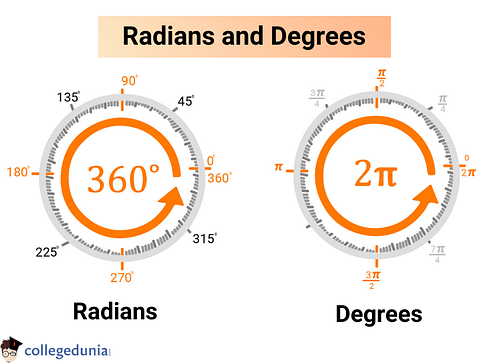
Radians and Degrees
Read More:
Degrees and Radians Formula
[Click Here for Previous Years’ Questions]
Degrees and Radians are the two important units used for representing the measurement of angles in Geometry. Both degrees and Radians are converted to each other depending on the situation of the problem. Here are some common values in Degrees and Radians:
- 360° = 2π Radians
- 180° = π Radians
- 90° = π/2 Radians
The value of an angle in Degrees can be calculated using the given value in Radians using the formula:
| Angle in Degrees = Angle in Radians x (180/π) |
If the value of an angle is given in Degrees, it can be calculated in Radians using the given formula:
| Angle in Radian = Angle in Degree x π/180 |
Trigonometric Functions Detailed Video Explanation
Degrees to Radians Conversion
[Click Here for Sample Questions]
Degrees to Radians Conversion is used to convert different angles given in Degrees to Radians. It is useful in measuring different angles in Geometry. The value of 360° is equal to 2π in Radians while the value of 180° is equal to π radians. Similarly, all the values given in degrees can be converted to Radians.
Degrees to Radians Conversion is done by multiplying the given value by π/180. Degrees to Radians Formula is given as:
| Angle in Radian = Angle in Degree x π/180 |
Solved ExampleExample: Convert 240° into Radians. Solution: The given angle is 240 Degrees (240°). Using the Degrees to Radians Formula, we get Angle in Radian = Angle in Degree x (π/180) Substitute the value of the given angle, Angle in Radian = 240 × π / 180 = 4π/3 Therefore, 240 Degrees is equal to 4π/3 in Radians. |
Radians to Degrees Conversion
[Click Here for Previous Years’ Questions]
Radians to Degrees Conversion is almost similar to Degrees to Radians Conversion. In order to convert Radians to Degrees, multiply the given angle in Radians by 180/π.
Radians to Degrees Formula is given as follows:
| Angle in Degrees = Angle in Radians x (180/π) |
Solved ExampleExample: Convert the angle π/5 into Degrees. Solution: The given angle in Radians is π/5. Using the Radians to Degrees Formula, we get Angle in Degrees = Angle in Radians x (180/π) Angle in Degrees = (π/5) × (180°/π ) Angle in Degrees = 180°/5 = 36° Thus, π/5 rad is equal to 36°. |
Degrees and Radians Conversion Table
[Click Here for Sample Questions]
Degrees and Radians Conversion Table enlists the common radian values for the corresponding angle measures in degrees. The table helps in faster calculations when dealing with Degrees and Radians.
The conversion table for common angles in Degrees and Radians is as follows:
| Angle in Degrees | Angle in Radians |
|---|---|
| 0° | 0 |
| 30° | 30° × (π/180°) = π/6 |
| 45° | 45° × (π/180°) = π/4 |
| 60° | 60° × (π/180°) = π/3 |
| 90° | 90° × (π/180°) = π/2 |
| 120° | 120° × (π/180°) = 2π/3 |
| 150° | 150° × (π/180°) = 5π/6 |
| 180° | 180° × (π/180°) = π |
| 210° | 210° × (π/180°) = 7π/6 |
| 240° | 240° × (π/180°) = 4π/3 |
| 270° | 270° × (π/180°) = 3π/2 |
| 300° | 300° × (π/180°) = 5π/3 |
| 330° | 330° × (π/180°) = 11π/6 |
| 360° | 360° × (π/180°) = 2π |
Read More: Trigonometric Functions Important Questions
Degrees and Radians Chart
[Click Here for Previous Years’ Questions]
Degrees to Radians Chart is a graphical representation of the values of some standard angles in Degrees and Radians that can be useful for an easy and fast conversion.
Degrees to Radians Chart is given as follows:
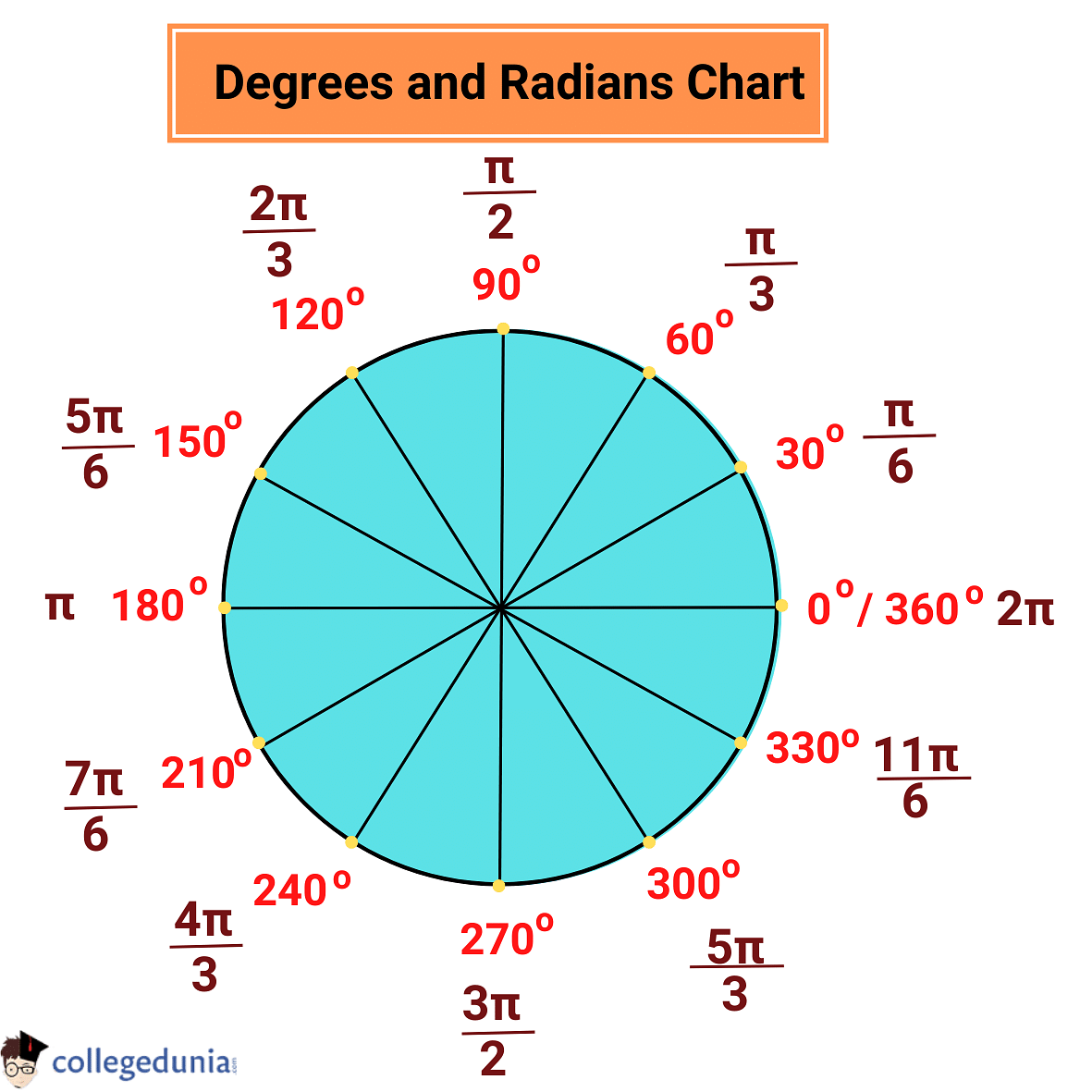
Degrees and Radians Chart
Check More:
Things to Remember
- Degree is a unit used for representing the measure of an angle in Geometry.
- Radian is the SI unit of measurement of angles and is widely used for representing the angles of trigonometric functions.
- One complete clockwise rotation is 2π in Radians and 360° in Degrees.
- Angle in Degree = Angle in Radian × 180° / π
- Angle in Radian = Angle in Degree × π / 180°
- Radian is given by the formula Radian = Arc Length/Radius Length.
- Radian is represented in form of pi (π) which is equal to 22/7 or 3.14.
For Latest Updates on Upcoming Board Exams, Click Here: https://t.me/class_10_12_board_updates
Previous Years’ Questions
- The value of sin251∘ + sin239∘ is… (KCET - 2020)
- If tan A + cot A = 2, then the value of tan… (KCET - 2020)
- √3cosec20∘ − sec20∘… (KCET - 2019)
- Consider a triangular plot ABC with sides AB = 7m… (JEE Main - 2019)
- Convert 6 radians into degree measure…
- Find the degree measure corresponding to…
- If [x] denotes the greatest integer ≤x, then the system of linear equations… (JEE Main - 2019)
- Let a vertical tower AB have its end A on the level ground. Let… (JEE Main - 2017)
- If \(L=Sin ^{2}({\Pi\over 16}) - Sin ^{2}({\Pi\over 8}) \) and M = cos... (JEE Main - 2020)
- If cosecθ − cotθ = 2017, then the quadrant in which θ lies... (TS EAMCET – 2017)
- The value of tan \({\Pi\over 8}\) is equal to... (KCET - 2016)
Sample Questions
Ques. What are Degrees and Radians? (3 Marks)
Ans. Degrees and Radians are two units of measurement of angles.
- Degree is a unit used to represent angular measures or denote the angles.
- Radian is the unit of measurement of angles commonly used in Trigonometric Functions.
- One complete clockwise rotation is equal to 2π Radian whereas, in Degrees, one complete rotation is written as 360°.
Ques. State the Degree and Radian Formula. (3 Marks)
Ans. Radian Formula is derived from the relationship between the arc length and the radius of a unit circle. It is expressed as follows:
Radian = Arc Length/Radius Length
Radian Formula is also given in terms of Degrees as follows:
Angle in Radian: Angle in Degree × π / 180°
Degree Formula is expressed in terms of Radians as follows:
Angle in Degree: Angle in Radian × 180° / π
Ques. Convert 20° into Radians. (3 Marks)
Ans. The given angle is 20°.
Using the Degrees to Radian Conversion Formula,
Angle in Radian = Angle in Degree x (π/180)
Angle in Radian = 20 × π/180 = π/9 Radians
Thus, 20 Degrees is equal to π/9 Radians.
Ques. Convert 10° into Radians. (3 Marks)
Ans. The given angle is 10°.
According to the Degrees to Radian Conversion Formula,
Angle in Radian = Angle in Degree x (π/180)
Angle in Radian = 10 × π/180° = π/18.
Thus, 10 Degrees is equal to π/18 Radians.
Ques. Points A and B lie on a circle with center O. ∠AOB has a measure of π/4 rad. Convert the measurement of the angle from Radians to Degrees. (3 Marks)
Ans. It is given that, ∠AOB = π/4 rad
To convert, π/4 rad to Degrees, we need to use the Radians to Degrees Formula.
Angle in Radian = Angle in Degree x (π/180)
π/4 rad × (180°/π ) = (Angle in Degrees)
Angle in Degrees = 180°/4 = 45°
Thus, the measure of ∠AOB is equal to 45° in degrees.
Ques. Convert 12° into Radians. (3 Marks)
Ans. The angle is given as 12°.
Using the Degrees to Radian Conversion Formula,
Angle in Radian = Angle in Degree x (π/180)
Angle in Radian = 12 × π/180°
Angle in Radian = 12π/180° = 2π/3.
Thus, 12°is equal to 2π/3 in Radians.
Ques. Convert π/6 Radians into Degrees. (3 Marks)
Ans. The angle is given as π/6 in Radians.
Using the Radian to Degrees Conversion Formula, we get
Angle in Degrees = Angle in Radians x (180/π)
= π/6 x (180/π) = 180/6 = 30 Degrees
Thus, π/6 Radians is equal to 30 Degrees.
Ques. Convert 200 Degrees into Radians measure. (3 Marks)
Ans. The angle is given as 200 Degrees.
According to the Degrees to Radian Conversion Formula, we get
Angle in Radian = Angle in Degree x (π/180)
= 200 x (π/180) = 10π/9 = 3.491 Rad
Therefore, 200 Degrees is equal to 3.491 Radians.
Ques. How to convert 60 Degrees to Radians? (3 Marks)
Ans. 60 Degrees can be converted to Radians using the Degrees to Radian Conversion Formula.
Angle in Radian = Angle in Degree x (π/180)
= 60 x (π/180)
= π/3
Therefore, 60 Degrees is equal to π/3 in Radians.
Ques. What is π/2 in Degrees? (3 Marks)
Ans. The angle is given as π/2 in Radians.
Using the Radian to Degrees Conversion Formula, we get
Angle in Degrees = Angle in Radians x (180/π)
= π/2 x (180/π) = 180/2 = 90 Degrees
Therefore, π/2 is equal to 90 Degrees.
Check-Out:



Comments