



Education Content Expert
Degrees to Radians is a conversion method used to convert the unit of measurement of angles in Geometry and Trigonometry. Degrees and Radians are two important units of measurement of angles in Geometry.
- Degree is a unit of measurement of horizontal angles denoted by (°).
- Radian is the angle formed at the center of a circle by an arc whose length is equal to the radius of the circle.
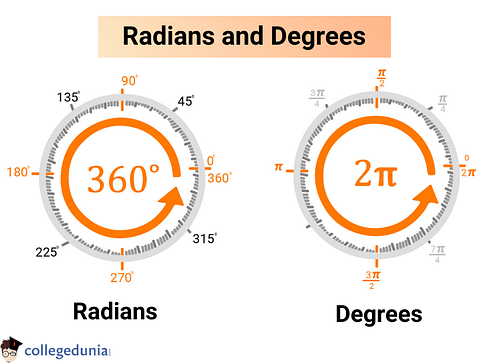
- A complete counterclockwise rotation is expressed as 2π in Radians and 360° in Degrees.
Degrees to Radians Conversion is essential to convert the given measurement of an angle in Degrees to Radians. The values of angles in Degrees are converted to Radians using the given equation:
| Angle in Radian = Angle in Degree x π/180 |
Read More: NCERT Solutions for Class 11 Mathematics Trigonometric Functions
Key Terms: Degrees, Radians, Degrees to Radians, Degrees to Radians Formula, Geometry, Rotation, Angles, Degrees to Radians Chart
What is Degree?
[Click Here for Sample Questions]
Degree is a unit used for measuring horizontal angles in Geometry.
- It is denoted by the symbol (°).
- Degree in Maths is also known as Degree of Arc or Arc Degree.
- One complete rotation of an angle in Geometry is denoted by a 360° angle.
- Angles in Degrees are measured using a Protractor in Geometry.
Radians and Degrees
What is Radian?
[Click Here for Previous Years’ Questions]
Radian is a commonly used unit of measuring angles, especially in Trigonometric Functions and Geometry.
- One radian is defined as the angle subtended at the center by an arc of length 1 unit in a unit circle.
- It is denoted by ‘π (Pi)’ which has an approximate value of 3.14 or 22/7.
- One complete rotation of an angle (360o) is 2π in radians.
- Thus, a straight angle, i.e. a 180o angle, is denoted as π radians.
- A right angle, i.e. a 90o angle is denoted as π/2 radians.
Trigonometric Functions Detailed Video Explanation
Degrees to Radians Formula
[Click Here for Sample Questions]
Degrees and Radians are two commonly used units of angle measurement in Geometry. Degrees to Radians Formula is a generalized formula that is used to convert the given value in Degrees to value in Radians.
Degrees to Radians Formula is given as:
| Angle in Radian = Angle in Degree x π/180 |
Derivation of Degrees to Radians Formula
One complete counterclockwise revolution is 360°in Degrees while it is 2π in Radians.
- 1 Complete Counterclockwise Revolution in Degrees = 360°
- 1 Complete Counterclockwise Revolution in Radians = 2π
Degrees to Radians Equation: The relation between degrees and radians can be expressed as follows:
| 360° = 2π Radians |
On dividing the equation by 2, the simpler form of the relationship between degrees and radians is
| 180° = π Radians |
Thus,
| 1° = (π)/180 Radians |
Read More:
How to Convert Degrees to Radians?
[Click Here for Previous Years’ Questions]
Degrees to Radians Conversion is used for measuring the different angles in Geometry in different units. The value of angle 180° is equal to π radians. In order to convert any specified angle from the measure of degrees to radians, the value must be multiplied by π/180. The formula for Degrees to Radians Conversion is:
| Angle in Radian = Angle in Degree x π/180 |
Where, π = 22/7 or 3.14.
The following steps need to be followed to convert angles in Degrees to Radians.
- Write the numerical value of the measure of the given angle in degrees.
- Multiply the number by π / 180.
- Simplify the formula by canceling the common factors.
- After the simplification, the obtained value will be the measure of the angle in radians.
Solved ExampleExample: Convert 90 Degrees to Radians. Solution: Given angle is 90 Degrees (90°). Using the Degrees to Radian Formula, Angle in Radian = Angle in Degree x (π/180) = 90 x (π/180) = π/2 Thus, 90 Degrees is equal to π/2 in Radians. |
Negative Degree to Radians
The conversion method for negative degrees to radians is the same as for positive degrees. In order to convert negative degrees into radians, multiply the specified value of the angle in degrees by π / 180.
Example: 180 Degrees can be converted into Radians as follows:
Radian = (π/180) x (Degrees)
Radian = (π/180) x (-180°)
Angle in Radian = -π
Radians to Degrees Conversion
[Click Here for Sample Questions]
The measurement of an angle in Radians can also be converted into Degrees in a similar manner as Degrees to Radians Conversion.
- 360o = 2π Radians
- 180o = π Radians
- 90o = π/2 Radians
Radians to Degrees Conversion is done through the given formula:
| Angle in Degrees = Angle in Radians x (180/π) |
Solved ExampleExample: Convert π/6 in Degrees. Solution: Given angle in Radians is π/6. Using the Radian to Degrees Conversion Formula, we get Angle in Degrees = Angle in Radians x (180/π) = π/6 x (180/π) = 180/6 = 30 Degrees Thus, π/6 is equal to 30 Degrees. |
Radian to Degree Equation
One complete revolution, i.e. a counterclockwise in the XY plane is equal to 2π in Radians or 360° in Degrees. Thus, the Radian to Degree Equation is given as:
| 2π = 360° |
It can also be written as:
| π = 180° |
Degrees to Radians Solved Examples
[Click Here for Previous Years’ Questions]
Here are some solved examples on Degrees to Radians Conversion for a better understanding of the formula:
Example 1: Convert 15 Degrees to Radians.
Solution: The given angle is 15 Degrees (15°).
Degrees to Radian Formula is given as:
Angle in Radian = Angle in Degree x (π/180)
Substituting the values, we get
= 15 x (π/180)
= π/12
Therefore, 15 Degrees is equal to π/12 in Radians.
Example 2: Convert 330 Degrees to Radians.
Solution: The given angle is 330 Degrees (330°).
Using the Degrees to Radian Formula,
Angle in Radian = Angle in Degree x (π/180)
Putting the values in the formula,
= 330 x (π/180)
= 11π/6
Thus, 330 Degrees is equal to 11π/6 in Radians.
Check More:
Degrees to Radians Conversion Table
[Click Here for Sample Questions]
Degrees to Radians Conversion Table shows the radian values for the corresponding angle measures in degrees. It helps in the easier and faster calculation for some commonly used angles:
| Measure of Angle in Degrees | Measure of Angle in Radians |
|---|---|
| 0° | 0 |
| 30° | 30° × (π/180°) = π/6 = 0.524 Rad |
| 45° | 45° × (π/180°) = π/4 = 0.785 Rad |
| 60° | 60° × (π/180°) = π/3 = 1.047 Rad |
| 90° | 90° × (π/180°) = π/2 = 1.571 Rad |
| 120° | 120° × (π/180°) = 2π/3 = 2.094 Rad |
| 150° | 150° × (π/180°) = 5π/6 = 2.618 Rad |
| 180° | 180° × (π/180°) = π = 3.14 Rad |
| 210° | 210° × (π/180°) = 7π/6 = 3.665 Rad |
| 240° | 240° × (π/180°) = 4π/3 = 4.188 Rad |
| 270° | 270° × (π/180°) = 3π/2 = 4.713 Rad |
| 300° | 300° × (π/180°) = 5π/3 = 5.235 Rad |
| 330° | 330° × (π/180°) = 11π/6 = 5.764 Rad |
| 360° | 360° × (π/180°) = 2π = 6.283 Rad |
Degrees to Radians Chart
[Click Here for Previous Years’ Questions]
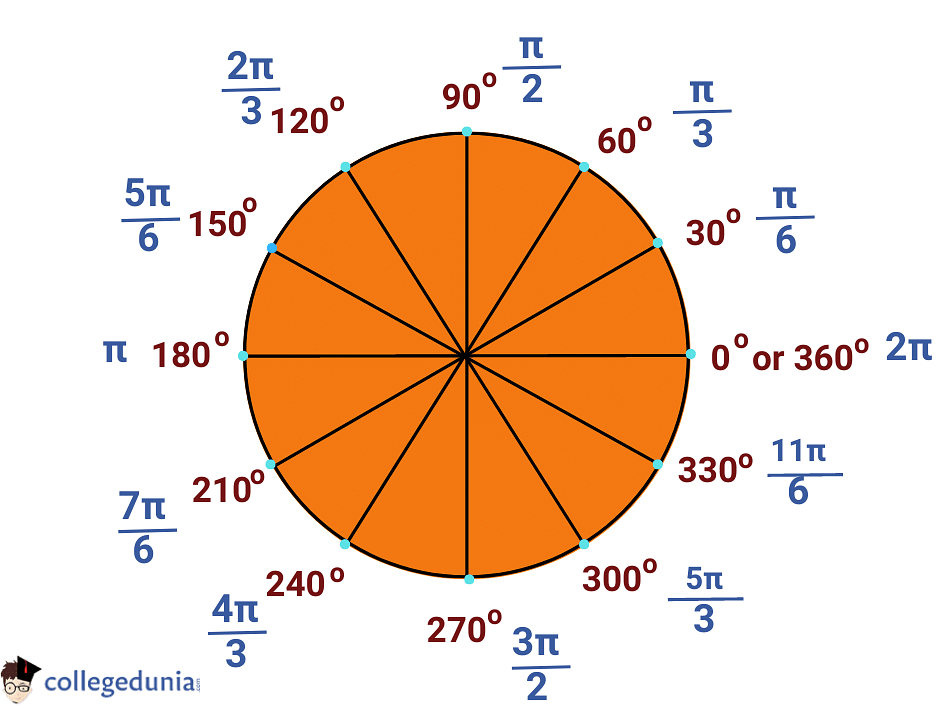
Degrees to Radians Chart is used to make the calculations easier and faster during Degrees to Radians Conversion. It shows the degree measures and their corresponding radian measures.
Degrees to Radians Chart is as follows:
Degrees to Radians Chart
Degrees to Radians Conversion of Some Common Angles
[Click Here for Sample Questions]
Here is the conversion of some common angles in comparison to the number of turns:
| Turns | Radian Measure | Degree Measure |
|---|---|---|
| 0 Turn | 0 Rad | 0° |
| 1/24 Turn | π/12 Rad | 15° |
| 1/16 Turn | π/8 Rad | 22.5° |
| 1/12 Turn | π/6 Rad | 30° |
| 1/10 Turn | π/5 Rad | 36° |
| 1/8 Turn | π/4 Rad | 45° |
| 1/2π Turn | 1 Rad | 57.3° |
| 1/6 Turn | π/3 Rad | 60° |
| 1/5 Turn | 2π/5 Rad | 72° |
| 1/4 Turn | π/2 Rad | 90° |
| 1/3 Turn | 2π/3 Rad | 120° |
| 2/5 Turn | 4π/5 Rad | 144° |
| 1/2 Turn | π Rad | 180° |
| 3/4 Turn | 3π/2 Rad | 270° |
| 1 Turn | 2π Rad | 360° |
Things to Remember
- Degrees and Radians are two commonly used units for the measurement of angles.
- Degree is a unit used for measuring angles in Geometry with the help of a protractor.
- Radians is the angle made at the center of a circle by an arc whose length is equal to the radius of the circle.
- Radian is the SI unit of measurement of an angle in the International System of Units.
- One complete rotation is 360° in Degrees and 2π in Radians.
- 360o is equal to 2π Radians, 180o is equal to π Radians, and 90o is equal to π/2 Radians.
- Degrees to Radians Conversion is done through the formula: Angle in Radian = Angle in Degree x π/180.
- Radians to Degrees Conversion is done through the formula: Angle in Degrees = Angle in Radians x (180/π).
For Latest Updates on Upcoming Board Exams, Click Here: https://t.me/class_10_12_board_updates
Previous Years’ Questions
- If cosecθ − cotθ = 2017, then the quadrant in which θ lies... (TS EAMCET – 2017)
- A cow is tied to a post by a rope. The cow moves along… (KCET – 2009)
- A value of θ satisfying sin 5θ – sin 3θ + sin θ... (KCET – 2011)
- In any triangle ABC, the simplified form of… (KCET – 2011)
- Angles of elevation of the top of a tower from three points... (KCET – 2011)
- The range of the function f(x) = sin [x]… (KCET – 2013)
- The value of Cos(270∘ + θ) Cos (90o – θ)… (KCET – 2005)
- In triangle ΔABC , if \({{b+c} \over 9} = {{c+a} \over 10}\)… (AP EAMCET – 2009)
- The value of \(cos{π \over 15}cos {2π \over 15}\)… (WBJEE – 2008)
- Convert 6 radians into degree measure...
Sample Questions
Ques. Convert 200 Degrees to Radians. (3 Marks)
Ans. The angle is given as 200 Degrees (200°).
According to the Degrees to Radian Formula,
Angle in Radian = Angle in Degree x (π/180)
Substituting the values to get
= 200 x (π/180)
= 10π / 9 = 3.491 Rad
Therefore, 200 Degrees is equal to 3.491 in Radians.
Ques. Convert 450 Degrees to Radians. (3 Marks)
Ans. The angle is given as 450 Degrees.
Using the Degrees to Radian Formula,
Angle in Radian = Angle in Degree x (π/180)
Putting the values in the formula,
= 450 × π / 180 = 7.854 Rad
Thus, 450 Degrees is equal to 7.854 in Radians.
Ques. How to Convert Radians to Degrees? (3 Marks)
Ans. To convert an angle value from radians to degrees, the specified value needs to be multiplied by 180 / π. For example, a value of 2π in Radians will be converted as follows:
Angle in Degrees = Angle in Radians x (180/π)
= 2π x 180 / π = 360 Degrees
Thus, 2π in radians is equal to 360 Degrees.
Ques. How to convert 30 Degrees to Radians? (3 Marks)
Ans. To convert 30 Degrees into Radians, multiply 30 degrees by π/180.
Angle in Radian = Angle in Degree x (π/180)
= 30 x (π/180)
= π/6
Therefore, 30 degrees is equal to π / 6 in radians.
Ques. Convert the following Degree measure into Radian measure:
(a) 60°
(b) 150°
(c) 240°
(d) – 320° (3 Marks)
Ans. We know that, 1° = π / 180 radians
(a) 60° = π/180 x 60 radians = π/3 radians
(b) 150° = π/180 x 150 radians = 5π/6 radians
(c) 240° = π/180 x 240 radians = 4π/3 radians
(d) -320° = π/180 x -320 radians = -6π/9 radians
Ques. How is Pi equal to 180 Degrees? (2 Marks)
Ans. One rotation counterclockwise in the XY plane gives 2π (radians) or 360 ° (degrees).
It can written as: 2π = 360°
On dividing the equation by 2, we get
π = 180°
Therefore, the value of Pi is equal to 180 Degrees.
Ques. Convert 240° into Radians. (3 Marks)
Ans. The angle is given as 240 Degrees.
Using the Degrees to Radian Formula,
Angle in Radian = Angle in Degree x (π/180)
Substitute the values,
= 240 × π / 180 = 4π/3
Thus, 240 Degrees is equal to 4π/3 in Radians.
Ques. Convert the given degree measure to radian measure.
(a) 20 Degrees
(b) 28 Degrees (3 Marks)
Ans. The Degrees to Radian Formula is given as:
Angle in Radian = Angle in Degree x (π/180)
(a) 20° × (π/180°) = π/9 Radians
(b) 28° × (π/180°) = 7π/45 Radians
Ques. Which unit of measurement is more useful- Degrees or Radians? (2 Marks)
Ans. Degrees and Radians are both used as units of measurement of angles. However, mathematicians prefer using radians instead of degrees to measure angles. Radian is used while calculating the area of a sector of a circle, arc length, and angular velocity. Also, it is essential to always use radians when dealing with either object moving in circular paths or parts of a circular path. In case the initial problem statement has the angle given in degrees, it should be converted to radians before using them in any calculations.
Ques. How to use the Degrees To Radians Formula? (3 Marks)
Ans. In order to convert degrees to radians using the Degrees to Radians Formula, the following steps need to be followed:
- Step 1: Take the value given in degrees.
- Step 2: Multiply the given angle in degrees by π/180°.
Thus, Radians = (Degrees × π)/180°.
Check-Out:



Comments