



Education Content Expert
Anthrax is an infectious disease caused by the bacteria Bacillus anthracis. It is a rare but serious disease that affects mostly livestock like cows and goats. Anthrax came into existence in 2001 in the United States of America. Bacillus anthracis is commonly found in the soil of endemic areas. It damages the soil, which in turn has an impact on both domestic and wild creatures. Humans can be infected with Anthrax if they come in direct or indirect contact with the infected animals. It can affect humans through the skin, gastrointestinal, or respiratory tract. Anthrax is not contagious, hence it can not be transmitted from person to person.
| Table of Content |
Key Terms: Anthrax, Bacillus Anthracis, Cutaneous Anthrax, Inhalation Anthrax, Gastrointestinal Anthrax, Infectious Disease
What is Anthrax?
[Click Here for Sample Questions]
Anthrax is an infectious disease caused by a gram-positive, rod-shaped bacteria known as Bacillus anthracis.
- It is a rare yet serious illness that mainly affects livestock.
- Humans may get infected through direct or indirect contact with sick animals.
- There is no evidence yet that anthrax is transmitted from person to person.
- However, anthrax skin lesions may be contagious through direct contact or through contact with a contaminated object.
- Signs and symptoms of anthrax include skin sores, vomiting, and shock.
- It can be treated with antibiotics easily, however, inhaled anthrax is more difficult to treat and can be fatal.
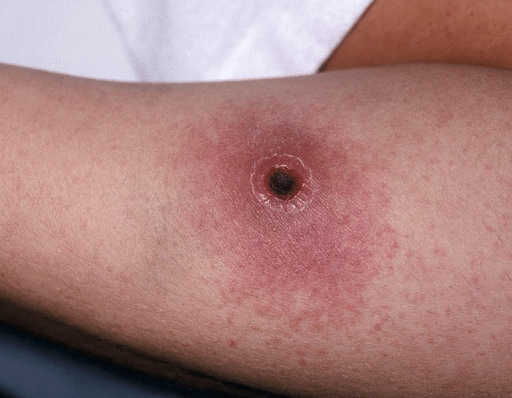
Anthrax on Human Skin
Check More:
| Relevant Concepts | ||
|---|---|---|
| Human Bacterial Diseases | Pneumonia | Difference between Bacteria And Virus |
| Acute and Chronic Diseases | Human Health and Diseases | Antimicrobial Resistance |
Causes of Anthrax
[Click Here for Sample Questions]
Anthrax bacteria, which are present naturally in soil, produce anthrax spores.
- Before entering a host, the spores can lay dormant for many years.
- Livestock, such as sheep, cattle, horses, and goats, can serve as common hosts for anthrax.
- If not treated with antibiotics, all forms of anthrax can eventually spread throughout the body and result in death.
- Humans may also get infected by anthrax disease with the exposure of spores to the skin or lungs by inhalation or ingestion.
- When these spores enter the human body, they become activated and multiply to produce poisonous toxins.
Read More: Modes of Transmission of Diseases
Types of Anthrax
[Click Here for Sample Questions]
Depending on how anthrax enters the body, a person may experience different types of sickness. Anthrax bacteria typically enter the body through the skin, lungs, or digestive tract. There are four types of Anthrax which are explained in detail below:
Cutaneous Anthrax
When anthrax spores enter the body through the skin, generally through a cut or scrape, cutaneous anthrax, can develop. It is also known as skinned anthrax. If a person comes into contact with sick animals or animal products like wool, skins, or hair, this could happen.
Some symptoms of Cutaneous Anthrax are
- An itchy bump develops in the affected area which is painless with sore skin.
- Lymph glands are swollen.
- The symptoms are observable 4 to 5 days after the exposure.
- Fever, headache and other flu symptoms are some other signs of this anthrax.
Read More: Plague
Inhalation Anthrax
When exposed to anthrax spores, a person may acquire inhalation anthrax. The spores can be inhaled by people who work around sick animals. It can also spread due to contaminated animal products from sick animals, such as in wool mills, slaughterhouses, and tanneries.
Symptoms of Inhalation Anthrax are
- Difficulty in swallowing food or breathing.
- Sore throat, mild fever, and fatigue.
- Vomiting blood during coughing.
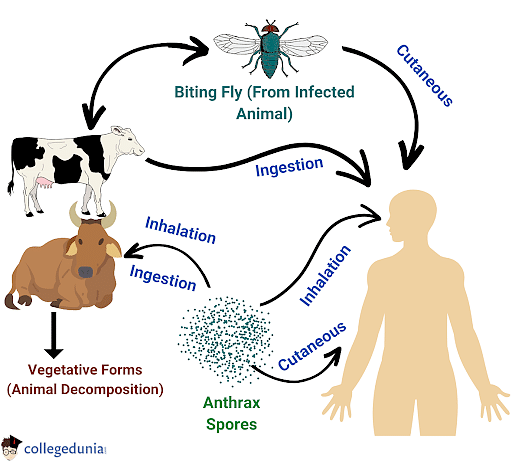
Anthrax Cycle
Gastrointestinal Anthrax
If a person eats raw or undercooked meat from an animal that has been exposed to anthrax, they could develop gastrointestinal anthrax. Thus disease affects the body from the throat to the colon. Some of the symptoms of this type of anthrax include
- Nausea
- Vomitings And Sensations
- Abdominal Pain
- Headache
- Swollen Neck
- Loss of Appetite
- Fever
- Sore Throat
Read More: Appendicitis
Injection Anthrax
When a person injects certain diseases such as heroin, the person can be diagnosed with Injection Anthrax. The symptoms of this type of anthrax are
- Redness at the area of injection.
- Pain or itching in the area.
- Observable swelling on the injected part.
- Shock
- Meningitis
Read More: Analgesics
Diagnosis of Anthrax
[Click Here for Sample Questions]
Diagnosis of Anthrax can be recommended by a doctor if he has any suspicion of the disease caused. Following are the tests a doctor may perform to diagnose anthrax:
- Skin Examination: A tiny tissue sample (biopsy) or a sample of fluid from a suspicious skin lesion may be examined in a laboratory for indicators of cutaneous anthrax.
- Blood Test: A tiny amount of blood may be collected from you, and the anthrax bacteria will be examined in a lab.
- Computerized Tomography (CT) Scan or X-Ray: To help with the diagnosis of anthrax inhalation, your doctor can ask for a CT scan or a chest X-ray.
- Stool Analysis: A doctor might examine a sample of your stool for anthrax bacteria in order to identify gastrointestinal anthrax.
Treatment of Anthrax
[Click Here for Sample Questions]
Anthrax is a rare disease and can be cured with the help of antibiotics.
- An antibiotic such as ciprofloxacin (Cipro), doxycycline (Vibramycin), or levofloxacin is the conventional treatment for anthrax.
- Depending on the mode of transmission, the person’s age, general health, and other circumstances, the treatment for the disease is decided.
- The best antibiotic or combination of medicines, as well as the length of therapy, will depend on the patient.
Check More:
| Related Topics | ||
|---|---|---|
| Antibiotics Classification | Respiratory System Disorders | Principle of Treatment of Diseases |
| Viral Diseases | Colon Cancer | Chronic Disease and Poor Health |
Things to Remember
- Anthrax is a disease caused by Bacillus anthracis, a gram-positive and rod-shaped bacteria.
- Bacillus anthracis is found in the soil of endemic areas where it can survive for many years.
- Anthrax has four types namely Cutaneous Anthrax, Inhalation Anthrax, Gastrointestinal Anthrax, and Injection Anthrax.
- Anthrax is diagnosed when the Bacillus anthracis bacteria is found in the blood, skin, or respiratory secretions.
- Treatment of Anthrax can be done through antibiotics such as ciprofloxacin, doxycycline, or levofloxacin.
Sample Questions
Ques. What is Anthrax? (3 Marks)
Ans. Anthrax is a disease commonly found in livestock. This disease is caused by the bacteria Bacillus anthracis. Anthrax is a rare but serious disease that can affect humans also through direct or indirect contact with sick animals. Though it is very rare in the developed world, the illness remains a concern because the bacteria have been used in bioterrorism attacks in the United States.
Ques. How is Anthrax caused? (3 Marks)
Ans. Anthrax disease is caused by Bacillus anthracis. Anthrax spores are created by anthrax bacteria, which are normally found in soil. The spores might remain inactive for a long time before they infect a host. Livestock, including sheep, cattle, horses, and goats, can frequently act as anthrax hosts. These grazing animals that consume grass become hosts for Bacillus anthracis, which causes anthrax, when they move through the soil while grazing.
Ques. What is Bacillus anthracis? (2 Marks)
Ans. Bacillus anthracis is a gram-positive, rod-shaped, aerobic, facultatively anaerobic, sporulating, and capsuled bacteria having a width of 1-1.2 m and a length of 3-5 m. If seen under the microscope, it appears like a chain-like structure.
Ques. What are the different types of Anthrax? (2 Marks)
Ans. Anthrax a commonly categorized into four variants which are as follows:
- Cutaneous Anthrax
- Inhalation Anthrax
- Gastrointestinal Anthrax
- Injection Anthrax
Ques. How Anthrax can be detected? (3 Marks)
Ans. Anthrax can be detected by performing various tests as suggested by doctors. The types of tests that can be performed to detect anthrax are
- Skin Examination
- Blood Test
- Computerized Tomography (CT) Scan
- Chest X-Ray
- Stool Analysis
- Spinal Tap
Ques. What treatment can be performed for curing Anthrax? (2 Marks)
Ans. The typical therapy for anthrax is an antibiotic such as levofloxacin, ciprofloxacin, or doxycycline (Cipro, Vibramycin). The optimal antibiotic or combination of medications, as well as the length of therapy, will vary on the patient depending on how they caught anthrax, their age, general health, and other factors.
Ques. Can Anthrax spread from person to person? (1 Mark)
Ans. Anthrax can not spread from person to person. Even if one develops symptoms of Anthrax, it will not be contagious to another person.
Ques. What is Cutaneous anthrax? (2 Marks)
Ans. Cutaneous anthrax is the most common type of anthrax which affects the skin. One of the first symptoms of this type of anthrax is itching where the skin has been exposed. Then, a large boil or sore appears in that particular area.
Ques. Who has more risk of contracting Anthrax? (1 Mark)
Ans. Anthrax is commonly found in Livestock such as cattle, Goats, and horses. A human can contract with Anthrax virus if they have come in contact with contracted animals.
Ques. What precautions are being taken to limit anthrax disease? (3 Marks)
Ans. The centers for disease control and prevention recommend a few simple preventive steps to lessen anthrax disease's risk factors and causes.
- Three doses of the anthrax vaccination are given.
- Monoclonal antibiotics can be used as a treatment in a very small number of situations.
- Uncooked meat from diseased animals should be avoided.
- Veterinarians should exercise caution when treating animals and interacting with their injured areas.
- When processing animal products like milk, silk, or any other, take the appropriate precautions.
Check-Out:



Comments