



Content Curator
Apical Meristem is called plants' root and shoot tips have an area of cells that may divide and develop. The major plant body and the growth of the roots and shoots are produced by apical meristems. Because this and other meristems may divide indefinitely, unlike the majority of mammals, plants can grow continuously for the entirety of their lives.
- The cells of the apical meristems are generally tiny and practically spherical, much like in other meristematic regions.
- They contain a few tiny vacuoles (watery sac-like enclosures) and thick cytoplasm.
- Initials, a subset of these cells, keep the meristem functioning as a constant supply of new cells and may divide several times before differentiating into the precise cells needed for the root or shoot development.
- Primary meristems are lineages of partly differentiated tissues composed of the cells that emerge from the apical meristem.
- The protoderm will develop into the epidermis, the ground meristem, which will create the ground tissues made up of parenchymal, collenchymal, and sclerenchymal cells, and the procambium.
- This will develop into the vascular tissues (xylem and phloem), the three main meristems.
Read More: Plant Tissues
| Table of Content |
Key Terms: Tissue, Plant Tissue, Plant Cell, Roots, Meristem, Shoot, Xylem
What is Apical Meristematic Tissue?
[Click Here for Sample Questions]
The growing area within the root tips and the beginnings of emerging shoots and leaves on plants are known as the apical meristem. One of three types of meristems, or tissues, that may develop into various cell types, is the apical meristem. The tissue in which plant growth takes place is called a meristem. Apical growth refers to development that takes place at the top and bottom points of the plant. While lateral meristem expands in girth, as in the case of woody plants, the intercalary meristem is located between branches.
- The apical meristem is essential for increasing access to light energy via the leaves as well as nutrition and water availability through the roots.
- To succeed, plants must grow in both of these directions.
- Only one primary branch apical meristem is the most noticeable in some plants, a condition known as apical dominance.
- Such plants have a single primary trunk that rises to tremendous heights.
- The branches below will begin to take on the function of the primary apical meristem if the apical meristem is removed, which will result in a bushier plant.
- Horticulturists use this phenomenon to boost the productivity of specific agricultural crops.
Read More: Plant Tissue Vs Animal Tissue
Apical Meristem Function
[Click Here for Sample Questions]
The apical meristem, which is constantly dividing, is situated just below the surface of the branches and roots that are located the farthest from the plant's center. While some cells divide and develop into additional meristematic cells, others divide and become structural or vascular cells. Most plants have two apical meristem sites.
- The tops of plants contain the shoot apical meristem.
- The apical meristem produces the cells and growth that propel the plant into light and air, where it may engage in photosynthetic activity and exchange accumulated gases.
- The apex of roots contains the root apical meristem.
- Signals are produced inside the apical meristem that directs the plant towards the water and needed nutrients based on the circumstances of the soil around the root.
- For this reason, roots frequently encroach into drainage and water pipelines, which supply them with much of the nutrients they require.
- Even when the root cap is scraped off as the plant pushes through the soil, the apical meristem, which is shielded by it, continues to develop cells.
- In addition to extending into the soil, the apical meristem has to create enough new cells to replenish those destroyed by abrasion.
Read More: Tendon
Apical Meristem Structure
[Click Here for Sample Questions]
The apical meristem is found in the roots right below the root cap. The real apical meristem is a mass of undifferentiated cells that are closely packed together. These cells will produce all of the plant's numerous cell shapes.
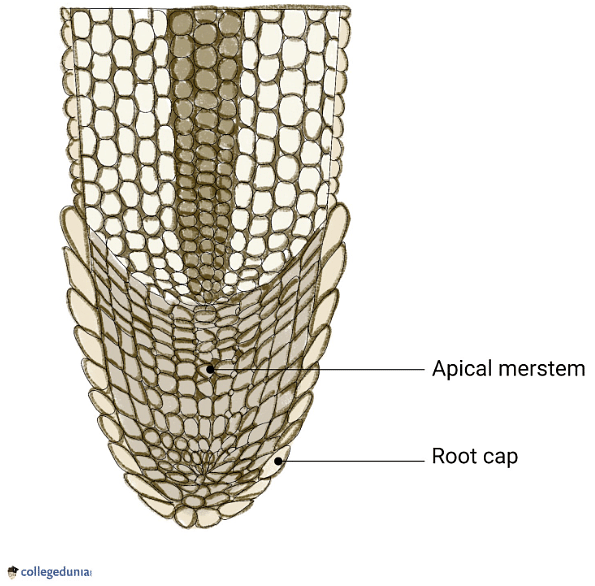
Apical Meristem Structure
- Repeated divisions will cause an undifferentiated apical meristem cell to gradually develop into a specialized cell.
- Two routes for cell production are present in the root apical meristem.
- Only one way in which cells are generated occurs in the shoot apical meristem.
- Like in many dicots, the shoot apical meristem can be found at the terminals of plants, or, like in most monocots, it can originate just below the soil and produce leaves that grow upward.
- The shoot apical meristem, however, serves as the development center for all above-ground growth in both groups.
- It's interesting to note that while the root apical meristem cannot produce a full plant, the shoot apical meristem can.
- Numerous plant species have been cloned by scientists using the shoot apical meristem's capacity.
- The apical meristem may be easily removed and moved to a suitable growth medium where it will differentiate into a new plant and generate roots.
- Additionally, the plant produces additional apical meristems, which may be harvested to produce more clones.
- A desired plant can be propagated in this way practically endlessly.
Read More: Permanent Tissue
Types of Apical Meristem
[Click Here for Sample Questions]
Mostly two types of apical meristems are found in nature – 1) Shoot apical meristem (SAM) and 2) root apical meristem (RAM).
- Shoot Apical Meristem (SAM)-- Shoot apical meristems are where all above-ground organs, like leaves and blooms, are derived.
- Higher plants' above-ground aerial organs are produced by it.
- The cells at the shoot's Apical Meristem's greatest point spread out into the surrounding fringe region as undifferentiated organisms before fast multiplying and condensing into distinct leaf or bloom primordia.
- The majority of embryogenesis occurs in the shoot apical meristem of flowering plants.
- Root Apical Meristem (RAM)-- The little area at the tip of a root known as the root apex, or root apical meristem, is where all main root tissues are formed and where all cells are capable of recurrent division.
- An outer area of live parenchyma cells known as the root cap serves as protection for the root apical meristem as it travels through the soil.
- The calyptrogen, a distinct interior layer of meristematic cells, adds new cells when the root cap's cells are damaged and shed off.
- Near the root apical meristem, root hairs also start to form as straightforward cell extensions.
- They significantly expand the root's surface area and aid in the soil's mineral and water uptake.
Read More: Modifications Of Stem
Things to Remember
- Apical meristem is called plants' root and shoot tips have an area of cells that may divide and develop.
- The cells of the apical meristems are generally tiny and practically spherical, much like in other meristematic regions.
- One of three types of meristems, or tissues, that may develop into various cell types, is the apical meristem.
- The apical meristem is essential for increasing access to light energy via the leaves as well as nutrition and water availability through the roots.
- The apical meristem, which is constantly dividing, is situated just below the surface of the branches and roots that are located the farthest from the plant's center.
- The apical meristem is found in the roots right below the root cap.
- Mostly two types of apical meristems are found in nature – 1) Shoot apical meristem (SAM) and 2) root apical meristem (RAM).
Sample Questions
Ques: What is the difference between an apical meristem and an intercalary meristem? (1 Mark)
Ans: Apical simply means at the tip in this context. Simply said, a meristem is a section of the organism that contains stem cells. The term "intercalary" refers to the region between apical meristems where lesser branches develop.
Ques: Where is the apical meristem found? (1 Mark)
Ans: The plant's shoot and root "tips" include apical meristems.
Ques: How can the apical meristem be manipulated to increase the harvest of a crop? (2 Marks)
Ans: The majority of fruits and vegetables are the result of a fertilized bloom, yet they can also produce a bushy plant. The meristem is where flowers usually develop. Therefore, more blooms can be produced if cutting the apical meristem results in additional meristems.
Ques: What is the function of apical meristem? (2 Marks)
Ans: At the tips of plants, there are specific growth zones called apical meristems. These are in charge of the main body of the plant as well as the expansion of shoots and roots.
Ques: How is the apical meristem similar to stem cells in a human fetus? (2 Marks)
Ans: Both sets of cells are totipotent, meaning they can develop into diverse types of organisms. While the apical meristem may continue to be totipotent, human stem cells are often reduced to multipotent and may only differentiate into a small number of closely related cell types. This is one of the reasons cloning a person is substantially more difficult.
Ques: What are the types of apical meristem? (1 Mark)
Ans: Shoot apical meristem (SAM) and root apical meristem (RAM) are two different forms of the apical meristem.
Ques: What are the characteristics of apical meristems? (2 Marks)
Ans: They are formed of pluripotent, undifferentiated cells that may divide. The tips of roots and shoots contain them. These cells have rich protoplasm and are very active.
Ques: What is the shoot apex? (1 Mark)
Ans: The term "shoot apex" refers to the shoot's tip.
For Latest Updates on Upcoming Board Exams, Click Here: https://t.me/class_10_12_board_updates
Check-Out:



Comments