



Education Content Expert
Cytoplasm is a gelatinous fluid that fills the cell that consists of water, salts and various organic molecules. Cytoplasm comprises the nucleus and other cell organelles such as mitochondria, lysosomes, endoplasmic reticulum, etc. The nucleus and other cell organelles are surrounded by a membrane that separates them from the cytoplasm. The prokaryotic cells have an uncomplicated arrangement of the cytoplasm in comparison to the eukaryotic ones.
Key Terms: Cytoplasm, Protoplasm, Cell Organelles, Plasma Membrane, Cytoplasmic Streaming, Cytoplasmic Organelles, Nucleus
What is Cytoplasm?
[Click Here for Sample Questions]
Cytoplasm is the fluid-like substance that fills cells. Cell organelles and structures are suspended in the cytoplasm. It contains the cytosol with filaments, ions, proteins and macromolecular structures and other organelles suspended in the cytosol.
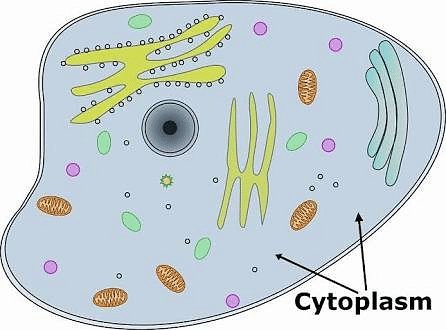
Cytoplasm
In 1863, a Swiss biologist named Rudolf von Kalliker coined the term "cytoplasm", but it was considered a synonym for protoplasm. But this term gradually changed its meaning to the concept of "cytoplasm".
- Cytoplasm was earlier thought to be a liquid-like substance, but new evidence suggests that it is more like glass-forming liquids.
- In eukaryotic cells, the cytoplasm is connected to the cell contents except for the nucleus.
- But in prokaryotic cells, since they do not have a nuclear membrane, the cytoplasm holds the cell's genetic material.
- Prokaryotic Cells, compared to eukaryotes, are smaller and have a more complex arrangement of cytoplasm.
Read More:
| Difference Between Cytoplasm and Protoplasm | Difference Between Cytosol and Cytoplasm | Nucleoplasm |
| Prokaryotic and Eukaryotic Cells | Cell Biology | Cell Wall and Cell Membrane |
Structure of Cytoplasm
[Click Here for Previous Years Questions]
Cell organelles are different structures found inside cells. All these structures perform different and specific functions. Cells have three main elements- plasma membrane, cytoplasm and nucleus.
- The plasma membrane or cell membrane is a bi-lipid membrane layer that separates cell organelles from the external environment and other cells. It is the outer layer of the cell that contains various parts, including the cytoplasm and nucleus.
- Next is one of the largest organelles. They have exclusive control over the cell. Finally, the cytoplasm is the jelly-like material in which the cell's organelles are embedded.
- The cytoplasm is an important component of the cell and is a semi-liquid gel-like material that connects the nucleus and the cell membrane. The cytoplasm is placed inside the cell, while the endoplasmic reticulum, mitochondria, ribosomes, vacuoles etc. float in it.
The cytoplasm can be easily examined under a microscope through staining techniques. Functionally, it is the site of several chemical reactions in the cell. Most cellular metabolism takes place here.
Functions of Cytoplasm
[Click Here for Sample Questions]
The major functions of cytoplasm are as follows:
- One of the main functions of the cytoplasm is to allow cells to maintain their turgidity, which allows cells to maintain their shape. Other functions of cytoplasm are as follows:
- The jelly-like fluid in the cytoplasm is composed of salt and water and is present in the cell membrane and contains all parts of cells and organelles.
- The cytoplasm performs many functions in the cell because it contains the molecules and enzymes needed to break down waste products.
- The cytoplasm also helps in metabolic activities.
- The cytoplasm gives shape to the cell. It fills cells and allows organelles to remain in place. Without cytoplasm, cells would be empty, and substances would not pass easily from one organelle to another.
- A part of the cytoplasm, the cytosol has no organelles. In contrast, the cytosol is surrounded by a matrix boundary that fills the cell compartment that does not contain organelles.
- The entire cellular content of a living cell is called protoplasm. The cytoplasm, nucleus, and all living components of the cell together make up the cell's protoplasm.
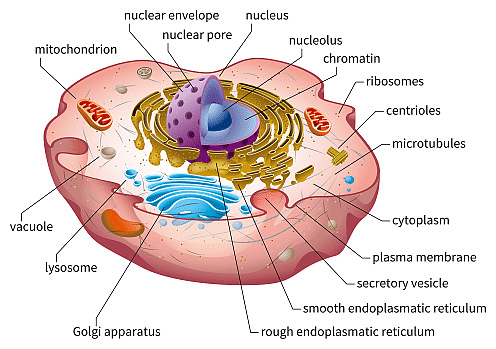
Structure of a Cell
Read More:
| Difference Between Mitochondria and Chloroplast | Plastids | Cell Wall and Cell Membrane |
| Difference between Plant Cell and Animal Cell | Cell Division | Eukaryotic Nucleus |
Previous Year Questions (PYQs)
- Continuity of cytoplasm from cell to cell is… (COMEDK UGET 2012)
- Which part of the sperm has the aggregation of Golgi bodies… (JIPMER 1999)
- A bacterial flagellum is composed of… (JIPMER 2021)
- Duplication of DNA occurs during which stage of the cell cycle…
- The organelles that are included in the endomembrane system… (NEET 2021)
- The prokaryotic flagella possess… (NEET 1995)
- Cell recognition and adhesion occur due to biochemicals… (NEET 1993)
- Chlorophyll in the chloroplast is located… (NEET 2005)
- Which one of the following does not differ in…
- During anaphase, I of meiosis…
Things to Remember
- The cytoplasm contains the substance inside and outside the nucleus of the plasma membrane.
- The main difference between eukaryotic and prokaryotic cytoplasm is the complex internal structure of the eukaryotic cytoplasm.
- The word "cytoplasm" was coined in 1863 by the Swiss scientist Rudolf von Külliker, but it was considered a synonym for protoplasm.
- The cytoplasm is located between the nucleus and the cell membrane in eukaryotic cells and is the most important component of protoplasm.
- It contains all the organelles. It maintains cell structure and regulates the cell environment. It stores nutrients and chemicals needed by the organelle.
Sample Questions
Ques. What is the structural and functional unit of all organisms? What are the three important parts of a cell? [3 Marks]
Ans. All organisms are made up of cells. Cells are the structural and functional units of all organisms. They make up an organism.
The three main parts or components of all cells are the plasma membrane, the nucleoid or nucleus, and the cytoplasm.
Ques. What is the difference between unicellular and multicellular organisms? [1 Marks]
Ans. Unicellular organisms are made up of a very small single cell, while multicellular organisms, like us, are made up of many cells.
Ques. Where is cytoplasm located? What is cytoplasmic streaming? [1 Mark]
Ans. The cytoplasm contains the substance inside and outside the nucleus and the plasma membrane of the eukaryotic cells.
Cytoplasmic streaming is the movement of the eukaryotic cytoplasm from one part of the cell to another, which helps distribute nutrients and move the cell upward.
Ques. How is the cytoskeleton maintains the shape of a cell? [3 Marks]
Ans. The complex internal structure of the eukaryotic cytoplasm consists of very small rods (microfilaments and intermediate filaments) and cylinders (microtubules). Together they form the cytoskeleton. The cytoskeleton supports and shapes the cell and is helpful in the transport of substances.
Ques. What is the historical background of cytoplasm? [3 Marks]
Ans. Using a pure compound microscope, English researcher Robert Hooke saw the basic unit of life in 1665. He coined the term "cell," which is derived from the Latin word "Cella," meaning "small apartment." Later, many scientists added to Robert Hooke's discoveries, and the cell theory was finally proposed.
Modern interpretations of cell theory emerged as technology evolved, including new principles and current changes. The word "cytoplasm" was coined in 1863 by the Swiss scientist Rudolf von Külliker, but it was considered a synonym for protoplasm.
Ques. What are the different cytoplasmic organelles? [3 Marks]
Ans. Cytoplasmic organelles are small cytoplasmic structures that perform specialized functions. Cytoplasmic organelles are classified as membranous or non-membranous organelles depending on whether they surround a membrane.
Membranous organelles of the cytoplasm are the endoplasmic reticulum, Goggle complex, mitochondria, plastids (in animal cells) and lysosomes (in plant cells), while non-membranous organelles of cytoplasm are ribosomes, cytoskeleton and centrioles.
Ques. How is cytoplasm different from protoplasm? [3 Marks]
Ans. Protoplasm is commonly referred to as the living part of a cell. It is a clear, jelly-like material composed of macromolecules, water, and various small molecules. It is described as the inorganic and organic material that makes up the cytoplasm, nucleus, mitochondria, and plastids of a cell. The cytoplasm is located between the nucleus and the cell membrane in eukaryotic cells and is the most important component of protoplasm.
Ques. Write different functions of cytoplasm. [3 Marks]
Ans. Functions of cytoplasm are as follows:
- The jelly-like fluid in the cytoplasm contains salts and water and is found in the cell membrane and present in all remaining cells and organelles.
- The cytoplasm plays a vital role in the cell because it contains the molecules and enzymes needed to break down waste products.
- The cytoplasm is also involved in metabolic processes.
- The cytoplasm gives the cell shape. It fills cells and holds organs in place. Without cytoplasm, cells would be empty and material would not easily pass from one organ to another.
- Part of the cytoplasm, the cytosol contains no organelles. In contrast, the cytosol is surrounded by a matrix boundary within the cell where organelles are absent.
Ques. What do you understand by Protoplasm? [3 Marks]
Ans. It is commonly referred to as the living part of a cell. It is a colourless, jelly-like substance composed of macromolecules, water, and a mixture of small molecules. It has both the inorganic and organic substances that make up the cytoplasm, nucleus, mitochondria and plastids of the cell. It is the main substance responsible for all life processes.
The main component of protoplasm is the cytoplasm, which is located between the cell membrane in eukaryotic cells. It contains all the organelles. It regulates the cell environment and maintains cell shape. It protects substances and chemicals.
Check-More:



Comments