



Education Content Expert
Trapezium is a quadrilateral that has two parallel sides. Area of Trapezium is the measure of space occupied by a trapezium within its boundary. It is important in various fields including architecture, engineering, and construction.
Area of Trapezium Formula is given as
| Area of Trapezium = \(\frac{1}{2}\)(a + b) h |
Where a and b are the lengths of the parallel sides of the trapezium and h is the distance between the parallel sides, known as the height of the trapezium.
Read More: NCERT Solutions for Class 9 Maths Areas of Parallelograms and Triangles
Key Terms: Trapezium, Trapezoid, Quadrilateral, Area of Trapezium, Isosceles Trapezium, Parallel Sides, Height
What is Trapezium?
[Click Here for Sample Questions]
Trapezium is a quadrilateral with two sides that are parallel to each other, known as the "bases" of the trapezium. The other two sides are called the "legs" of the trapezium. The bases of a trapezium can be any length, and the distance between the two bases, known as the height, is the same throughout the length of the trapezium.
- The parallel sides of a trapezium are not necessarily equal in length.
- If the parallel sides are equal, the trapezium is referred to as an "isosceles trapezium".
- If the opposite angles of a trapezium are equal, the trapezium is called an "isosceles trapezoid."
- A trapezium has four angles, and the sum of these angles is 360о.
- The opposite angles of a trapezium are supplementary, meaning that they add up to 180о.
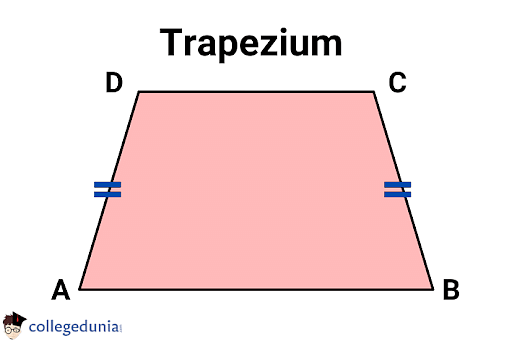
Trapezium
Read More: Areas of Parallelograms and Triangles Important Questions
Types of Trapezium
[Click Here for Sample Questions]
Trapezium is classified on the basis of various criteria such as angles and side lengths. Some of the well-known types of Trapezium are as follows:
- Isosceles Trapezium: A trapezium in which the two non-parallel sides are of equal length.
- Right Trapezium: A trapezium in which one of the non-parallel sides is a right angle.
- Scalene Trapezium: A trapezium in which all sides have different lengths.
- Rectangle Trapezium: A trapezium in which the non-parallel sides are both right angles. This type of trapezium is also known as a parallelogram.
- Obtuse Trapezium: A trapezium in which one of the interior angles is obtuse (greater than 90 degrees).
- Acute Trapezium: A trapezium in which all of the interior angles are acute (less than 90 degrees).
- Regular Trapezium: A trapezium in which all of the sides and angles are equal. This type of trapezium is also known as a kite.
Read More:
Properties of Trapezium
[Click Here for Sample Questions]
There are several properties of trapezium that can be determined based on its shape and the lengths of its sides.
- Opposite sides of Trapezium are parallel.
- Opposite angles of Trapezium are supplementary.
- The sum of the interior angles is 360 degrees.
- The diagonals of a trapezium bisect each other.
- The height of a trapezium is the perpendicular distance between the bases.
Area of Trapezium
[Click Here for Sample Questions]
Area of Trapezium can be calculated using the following formula:
| Area of Trapezium = \(\frac{1}{2}\)(a+b) h |
Where
- a and b are the lengths of the bases of the trapezium.
- h is the height of the trapezium, which is the shortest distance between the two bases and is perpendicular to the bases.
Derivation of Area of Trapezium
[Click Here for Sample Questions]
Trapezium is a quadrilateral with two sides that are parallel. It is also known as a Trapezoid. Area of Trapezium Formula is given as:
Area of Trapezium= \(\frac{1}{2}\)(a+b) h
Where "a" and "b" are the lengths of the parallel sides of the trapezium, and "h" is the height of the trapezium. The height is the perpendicular distance between the parallel sides.

Trapezium ABEF
To derive this formula, we can start with a trapezium ABEF as shown in the diagram above.
- The area of a trapezoid is equal to the sum of the areas of the two triangles and the area of the rectangle.
- The area of this trapezium can be found by dividing it into two right triangles named triangle ACF, triangle BDE, and a rectangle CDEF.
- The base of the rectangle is the difference between the lengths of the parallel sides (AB-EF), and the height of the rectangle is the height of the trapezium (DE).
We know that
Area of Trapezium = Area of Triangle ACF + Area of Rectangle CDEF + Area of Triangle BDE
Area of Trapezium = \(\frac{ih}{2}\) + bh + \(\frac{jh}{2}\)
Area of Trapezium= A = \(\frac{ih+2bh+jh}{2}\)
Simplifying the equation, rearranging the terms, and factoring result to:
A = \(\frac{h}{2}\)[b + (i + b + j)] ….(i)
If the longer base of the trapezium be L, then
a = i + b + j …..(ii)
Substituting (ii) in equation (i),
A =\(\frac{h}{2}\) (b + a)
Therefore, the area of a trapezoid with bases b, a and altitude h is;
A = \(\frac{h}{2}\) (b+a)
Where a and b are the lengths of the bases of the trapezium and, h is the height of the trapezium, which is the shortest distance between the two bases and is perpendicular to the bases.
Read More: MCQs on Areas of Parallelograms and Triangles
Calculation of Area of Trapezium
[Click Here for Sample Questions]
To calculate the area of a trapezium, one needs to know the lengths of its base and its height. The base is the longer pair of parallel sides, and the height is the perpendicular distance between the bases.
To find the area of a trapezium, one need to follow these steps:
- Multiply the height of the trapezium by the sum of its bases.
- Divide the result by 2.
Area of Trapezium Formula is given as
Area of Trapezium = \(\frac{1}{2}\) h (a+b)
Where
- A is the area of the trapezium
- a and b are the lengths of the two bases
- H is the height of the trapezium
Solved ExampleExample: If there is a trapezium with bases of 5 cm and 9 cm and a height of 7 cm. Find its area. Solution: Given that,
Area of Trapezium = \(\frac{1}{2}\)(a + b) H Area of Trapezium = \(\frac{1}{2}\)(5 + 9) x 7 = \(\frac{1}{2}\)x14 x 7 = 49 cm2 Thus, the area of the trapezium is 49 cm2. |
Applications of Trapezium
[Click Here for Sample Questions]
Trapezium is a geometric shape with four sides, two of which are parallel to each other. They are useful in a variety of applications, including
- Trapeziums can be used as the cross-sectional shape of beams and columns in building construction.
- Trapeziums are often used in graphic design to create visual interest and balance in compositions.
- Trapeziums is a common topic in geometry, and are used to teach concepts such as area, perimeter, and the properties of parallelograms.
- Trapeziums can be used in landscaping and gardening to create outdoor spaces that are visually interesting and functional.
Check More:
Things to Remember
- Area of Trapezium is the area or space enclosed within its boundaries.
- Area of Trapezium Formula is A = \(\frac{1}{2}\) (a + b) x H, where A is the area, a and b are the lengths of the two bases, and H is the height of the trapezium.
- The height of the trapezium must be perpendicular to the bases.
- The area of a trapezium is equal to the sum of the areas of two triangles, each with a base equal to one of the bases of the trapezium and a height equal to the height of the trapezium.
- Area of a trapezium is expressed in square units, such as square centimetres (cm2), square metres (m2), or square inches (in2).
Sample Questions
Ques. The length of the parallel sides of a trapezium are in the ratio 5:2 and the distance between them is 40 cm. If the area of the trapezium is 700 cm², find the length of the parallel sides. (3 Marks)
Ans. Let x = Common Ratio
- The parallel sides are 5x and 2x.
- Altitude = 40 cm
- Area of trapezium = 700 cm²
Area of Trapezium = \(\frac{1}{2}\)(a + b) x H
700 = \(\frac{1}{2}\) x [5x + 2x] x 40 = 700
\(\frac{1}{2}\) x 7x x 40 = 700
x = 700 x 2 / 7 x 40
x = 5 cm
Hence, the parallel sides are 5x = 25 cm and 2x = 10 cm.
Therefore, the length of the non-parallel sides is 25 cm and 10 cm.
Ques. Two parallel sides of a trapezium are of lengths 25 cm and 40 cm respectively, and the distance between them is 100 cm. Find the area of the trapezium. (3 Marks)
Ans. Given that,
- Parallel sides of the trapezium are 25 cm and 40 cm.
- Distance between the parallel sides is 100 cm.
Area of Trapezium = \(\frac{1}{2}\)(a + b) x H
Area = \(\frac{1}{2}\) x [25+40 ] x 100 = 3250
Therefore, the area of the trapezium is 3250 cm².
Ques. Find the perimeter and area of the trapezium whose parallel sides are 40 cm and 25 cm. The distance between the bases is 50 cm and the non-parallel side length is 70 cm each. (3 Marks)
Ans. Given that
- Length of Parallel Sides = 40 cm and 25 cm
- Altitude = 50 cm
Area of Trapezium = \(\frac{1}{2}\)(a + b) x H
Area =\(\frac{1}{2}\) x [25+40 ] x 50 = 1625 cm²
Perimeter = Sum of All Sides= 40 + 25 + 70 + 70 = 205 cm
Hence, the area and perimeter of the trapezium is 1625 cm² and 205 cm respectively.
Ques. Find the area of a trapezium whose length of parallel sides are 10 cm and 20 cm respectively and whose height is 30 cm. (3 Marks)
Ans. Given,
- a = 10 cm
- b = 20 cm
- Height of Trapezium, h = 30 cm
Area of Trapezium = \(\frac{1}{2}\)(a + b) x H
= \(\frac{1}{2}\)(10 + 20) x 30
= 450 sq cm
Ques. What is the area of a trapezium when bases are 10 cm and 20 cm respectively and the distance between the two parallel sides is 50 cm? (3 Marks)
Ans.Given,
- a = 10 cm
- b = 20 cm
- Distance between two parallel side, h = 50 cm
Area of Trapezium = \(\frac{1}{2}\)(a + b) x H
Area of trapezium = \(\frac{1}{2}\)(10 + 20) 50
= 750 sq.cm
Ques. Find the altitude of a trapezium whose area is 75 cm2 and whose bases are 15 cm and 30 cm respectively. (3 Marks)
Ans. Given that,
- Length of the bases of Trapezium = 15 cm and 30 cm
- Area = 75 cm2
Area of the Trapezium = \(\frac{1}{2}\)(Sum of the lengths of the parallel sides) x Altitude
Area of Trapezium = \(\frac{1}{2}\)(a + b) x H
75 = \(\frac{1}{2}\)(15+30) x Altitude
75 = \(\frac{1}{2}\)x45 x Altitude
Altitude =(75 x 2)/45 = 150 / 45 = 3.34 cm
Hence, the length of altitude is 3.34 cm.
Ques. The area of the trapezium is 1000 sq. cm and the lengths of the parallel sides 50 cm and 100 cm. Find the height of the trapezium. (5 Marks)
Ans. Given that,
Area of Trapezium A = 1000 sq. cm
- a = 50 cm
- b = 00 cm
Let h be the height of the trapezium. Then,
A=\(\frac{1}{2}\)×(a+b)h
We know that the area of the trapezium is given by
A=\(\frac{1}{2}\)×(a+b)h
A=\(\frac{1}{2}\)×(a+b)h
On substituting the values of a, b and area in the above formula, we get
1000=\(\frac{1}{2}\)×(50+100)h
⇒1000×2=150h
Divide both sides by 150.
h = 13.34cm
h = 13.34cm
Here, the height of the trapezium is 13.34 cm.
Ques. Two parallel sides of a trapezium are of lengths 10 cm and 100 cm respectively, and the distance between them is 1000 cm. Find the area of the trapezium. (3 Marks)
Ans. Given:
Parallel Sides of Trapezium = 10 cm and 100 cm
Distance between Parallel Sides = 1000 cm
Area of Trapezium = \(\frac{1}{2}\)(a + b) x H
= \(\frac{1}{2}\) x [10+100 ] x 1000 = 110000
Therefore, the area of the trapezium is 110000 cm².
Ques. Find the perimeter and area of the trapezium whose parallel sides are 20 cm and 40 cm. The distance between the bases is 80 cm and the non-parallel side length is 100 cm each. (3 Marks)
Ans. Given:
- Parallel Sides = 20 cm and 40 cm
- Altitude = 80 cm
Area of Trapezium = \(\frac{1}{2}\)(a + b) x H
= \(\frac{1}{2}\) x [20+40 ] x 80 = 2400 cm²
Perimeter = Sum of all the sides= 40 + 20 + 100 + 100= 260 cm
Hence, the area and perimeter is 2400 cm² and 260 cm respectively.
Ques. Find the area of a trapezium whose length of parallel sides are 30 cm and 60 cm respectively and whose height is 30 cm. (3 Marks)
Ans. Given,
- a = 30 cm
- b = 60 cm
- Height of trapezium, h = 30 cm
Area of Trapezium = \(\frac{1}{2}\)(a + b) x H
= \(\frac{1}{2}\)x(30 + 60) x 30
= 1350 sq cm.
Hence, The area of Trapezium is 1350 sq.cm.
Check-Out:



Comments