



Exams Prep Master
We learned equations in geometry to determine the areas of various geometrical forms such as triangles, rectangles, trapezius, and circles. These equations are essential in the application of mathematics to a wide range of real-world issues. We can determine the areas of several basic forms using elementary geometry techniques. However, they are insufficient, for determining the regions encompassed by curves. We'll need some Integral Calculus principles for it. The mathematical study of changes in geometrical forms and algebra for arithmetic calculation simplification is called calculus. In theory, integral calculus and differential calculus are the two primary parts of calculus. The collection of quantities is referred to as integral calculus, and the areas between or under curve calculus are referred to as area under curve calculus. Differential calculus mainly deals with instantaneous rates of change and curve slopes.
Read More: Negative of a Vector
Key terms: Area under the curve, Area of the curve with respect to the x-axis, Formula for the area under the curve, Different methods of finding the area of the curve
What is Area under Curve?
[Click Here for Sample Questions]
Before we get started, it's important to understand that talking about the area under a curve only makes sense when there's a graph of that curve. Now consider the x-function y = f. (x). The curve shown below is an example of a generic curve whose values can be both positive and negative depending on the value of x.

The region below the curve is clearly limitless, as seen in the graph! In other words, if no exact x values are given within which the area under the curve must be determined, the answer is ambiguous. The limiting values of x in the diagram below define the bounds of the area accessible beneath the curve.

The video below explains this:
Area under the curve Detailed Video Explanation:
Read More: Differentiation and Integration Formula
Determining Area Under Curve
[Click Here for Sample Questions]
Three simple procedures may be used to compute the area under the curve. To begin, we must understand the curve's equation (y = f(x)), the limits within which the area must be determined, and the axis encompassing the area. Second, we must determine the curve's integration (antiderivative). Finally, we need to make the difference between the integrated solution and the upper and lower limits to get the area under the curve.
Area = a∫by.dx
= a∫bf(x).dx
=[g(x)]ab
=g(b)−g(a)

Different Methods of Finding Area Under the Curve
[Click Here for Sample Questions]
There are three ways to calculate the area under the curve. In addition, the method for determining the area under the curve is dependent on the requirement and the data inputs available. We'll look at the three ways of calculating the area under the curve in this section.
Method I: The region beneath the curve is divided into the smallest rectangles feasible. The area under the curve is calculated by adding the areas of these rectangles. A curve y = f(x) is divided into several rectangles of different widths δx. We're going to restrict the number of rectangles to infinite in this situation. The formula for calculating the total area under the curve is as follows:
A = limx→∞ ∑n i=1 f(x).δx
Method II: To find the area under the curve, this method follows a similar procedure to the one described previously. The region beneath the curve is split into a few rectangles in this example. To acquire the area under the curve, the areas of these rectangles are combined together. This approach is simple to use, but it only gives you a rough estimate of the area under the curve.
Method III: To find the area under the curve, this method uses the integration process. The equation of the curve, knowledge of the bounding lines or axes, and the boundary limiting points are all required to obtain the area under the curve using this technique integration. The formula for the area under a curve with the equation y = f(x), which is confined by the x-axis and has limit values of a and b correspondingly, is
A = a∫bf(x).dx
Formula for Finding Area Under the Curve
[Click Here for Sample Questions]
The area of the curve can be calculated along different axes, as a limit for a given curve. The area under the curve can be calculated in either the x or y axis. For special cases, the curve is below the axes and partly below the axes. For all these cases, we have the derived formula to find the area under the curve
Read More: Methods of Integration
Area of the Curve with Respect to the x-axis
The region encompassed by the curve y = f(x) and the x-axis will be considered first. The region contained by the curve and the x-axis is shown in the image below. With respect to the x-axis, the bounding values for the curve are a and b. The x-axis formula for calculating the area under the curve is:


Area of the Curve with Respect to the y-axis
The area of the curve is limited by the curve x = f(y), the y-axis, over the lines y = a, and y = b is given by the following formula with regard to the y-axis. The region between the curve and the y-axis may also be seen in the graph below.
A = a∫bx.dy = a∫bf(y).dy

Area of the Curve Below the Axis
Because the area of the curve below the axis is negative, the modulus of the area is calculated. Taking the limits a and b, the area of the curve y = f(x) below the x-axis and limited by the x-axis is found. The following is the formula for the area above the curve and the x-axis.
A = |a∫bf(x).dx|

Area Above and Below the Axis
The section of the curve that is below the axis and part of the curve that is above the axis is separated into two regions and computed separately. Because the area beneath the axis is negative, a modulus of the area is considered. As a result, the total area equals the sum of the two regions: (A=|A1|+A2).
A = |(a∫bf(x).dx| + b∫cf(x).dx

Area Under The Curve - Circle
[Click Here for Sample Questions]
The area of the circle is obtained by first determining the area of the first quadrant of the circle. The circle's equation is shown here: x2 + y2 = a2 is transformed into a curve equation as y = √(a2 - x2) .The area of the curve with respect to the x-axis and the limits from {0 to a} are calculated using this equation of the curve.

The area of the circle is four times that of the circle's quarter. The area of the quadrant is derived by integrating the curve's equation over the first quadrant's bounds.
A = 4∫0ay.dx
= 4∫0aa2−x2.dx
= 4[x2a2−x2+a22Sin−1xa]0a
= 4[((a/2)× 0 + (a2/2)Sin-11) - 0]
= 4(a2/2)(π/2)
= 2πr
Hence the area of the circle is πa2 square units.
Read More: Maxima and Minima
Area Under a Curve - Parabola
[Click Here for Sample Questions]
The axis of a parabola divides the parabola into two symmetric sections. We'll use a parabola with an equation that's symmetric along the x-axisy2 = 4ax. This can also be written as y = √(4ax). The area of the parabola in the first quadrant with respect to the x-axis and along the boundaries from 0 to a is first determined. To get the area of the entire parabola, we integrate the equation within the border and double it. The following are the derivations for the parabola's area.


As a result, the area contained by the parabola beneath the curve is (8a2)/3 square units
Read More: Integration by Parts
Area Under a Curve - Ellipse
[Click Here for Sample Questions]
The ellipse equation has a major axis of 2a and a minor axis of 2b is is x2/a2 + y2/b2 = 1, It can also be written as y = b/a .√(a2 - x2). The area enclosed by the ellipse in the first coordinate and with the x-axis is calculated here, and then multiplied by 4 to get the ellipse's area. On the x-axis, the boundary limitations range from 0 to a. The following are the calculations for the ellipse's area.


Hence the area of the ellipse is πab sq units.
Area Under The Curve - Between a Curve and A-Line
[Click Here for Sample Questions]
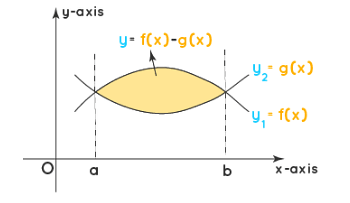
The difference between the areas of one curve and the area under the line may be used to calculate the area between a curve and a line. Both the curve and the line have the same boundary with respect to the axis. The curve y1 = f(x ) and the line y2 = g(x) are shown in the diagram below, and the goal is to calculate the area between the curve and the line. To calculate the resulting area, we take the integral of the difference of the two curves and apply the limits.
A = ∫ba[f(x)−g(x)].dx

Read More: Signum Function
Area Under a Curve - Between Two Curves
[Click Here for Sample Questions]
The difference between the areas of one curve and the area under the line may be used to calculate the area between a curve and a line. Both the curve and the line have the same boundary with respect to the axis. The curve y1 = f(x) and the line y2 = g(x) are shown in the diagram below, and the goal is to calculate the area between the curve and the line. To calculate the resulting area, we take the integral of the difference of the two curves and apply the limits.
A = ∫ba[f(x)−g(x)].dx
Things to Remember
[Click Here for Sample Questions]
- The mathematical study of changes in geometrical forms and algebra for arithmetic calculation simplification is called calculus
- The collection of quantities is referred to as integral calculus, and the areas between or under curve calculus is referred to as area under curve calculus.
- Here are three ways to calculate the area under the curve
- The method for determining the area under the curve is dependent on the requirement and the data inputs available
- The area under the curve can be calculated in either the x or y axis.
- For special cases, the curve is below the axes and partly below the axes.
- The area of the circle is obtained by first determining the area of the first quadrant of the circle.
- The area of the curve with respect to the x-axis and the limits from {0 to a} are calculated using this equation of the curve as y = √(a2 - x2)
Read More: Rolle’s Theorem
Sample Questions
Ques: Find the area under the curve, for the region bounded by the circle x2 + y2 = 16 in the first quadrant. (3 marks)
Ans: The given equation of the circle is x2 + y2 = 16
Simplifying this equation we have

Therefore the area of the region bounded by the circle in the first quadrant is 4π sq units
Ques: Find the area under the curve, for the region enclosed by the ellipse.  (3 marks)
Ans: The given equation of the ellipse is
This can be transformed to obtain 

Therefore the area of the ellipse is 30π sq units
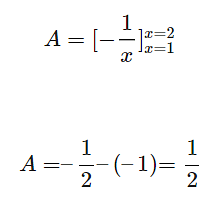
Ques: Calculate the area under the curve Y=1/(x2) in the domain x = 1 to x = 2. (4 marks)
Ans: Only the first quadrant contains the domain of x. As a result, we only need to worry with the graph of the supplied function in the first quadrant. We may see the applicability of our formula by generating vertical rectangular strips under the curve and adding over all of them to get the area, as explained in the stages before. Below is the graph for this problem:

The area under the curve in the region shown above can be given by:

Solving the integral, we can get:
Ques: Let us find the area bounded by the curve y = f(x), x-axis, and the ordinates x = a and x = b. Consider the area under the curve as composed of a large number of thin vertical stripes. (4 marks)
Ans: 
Let there be an arbitrary strip of height y and width dx.
Area of elementary strip dA = y dx, where y = f(x).
Total area A of the region between x-axis, ordinates x – a, x = b and the curve y = f(x)
= sum of areas of elementary thin strips across the region PQML.
A = ∫ab dA = ∫ab ydx = ∫ab f(x) dx
Ques: Determine the area below: (5 marks)
f(x)=3+2x−x2 and above the x-axis.
Ans: 
It should be clear from the graph that the upper function is the parabola (i.e. y=3+2x−x2) and the lower function is the x-axis (i.e. y = 0y=0).
Since we weren’t given any limits on xx in the problem statement we’ll need to get those. From the graph it looks like the limits are (probably) −1≤x≤3−1≤x≤3. However, we should never just assume that our graph is accurate or that we were able to read it accurately. For all we know the limits are close to those we guessed from the graph but are in fact slightly different.
So, to determine if we guessed the limits correctly from the graph let’s find them directly. The limits are where the parabola crosses the xx-axis and so all we need to do is set the parabola equal to zero (i.e. where it crosses the line y=0y=0) and solve. Doing this gives,
3+2x−x2=0→−(x+1)(x−3)=0→x=−1,x=3
At this point there isn’t much to do other than step up the integral and evaluate it.
We are assuming that you are comfortable with basic integration techniques so we’ll not be including any discussion of the actual integration process here and we will be skipping some of the intermediate steps.
The area is,
Ques: Determine the area to the left of g(y)=3−y2 and to the right of x=−1. (5 marks)
Ans: 
It should be clear from the graph that the right function is the parabola (i.e. x=3−y2) and the left function is the line x=−1. Since we weren’t given any limits on y in the problem statement we’ll need to get those. However, we should never just assume that our graph is accurate or that we will be able to read it accurately enough to guess the limits from the graph. This is especially true when the intersection points of the two curves (i.e. the limits on y that we need) do not occur on an axis (as they don’t in this case).
So, to determine the intersection points correctly we’ll need to find them directly. The intersection points are where the two curves intersect and so all we need to do is set the two equations equal and solve. Doing this gives,
3 − y2 = -1 → y2 = 4 → y = −2, y = 2
So, the limits on y are :
−2 ≤ y ≤ 2
Ther Area is: 



Comments