



Education Journalist | Study Abroad Lead
Beer-Lambert Law or Beer’s Law states that energy absorbed or transmitted by a solution is directly proportional to the molar absorptivity of the solution and the concentration of solute. The law is used in analytical chemistry to measure the absorbance of several samples. Beer-Lambert Law is a combination of two laws: Beer’s Law and Lambert’s law. Beer-lambert law describes the link between the attenuation or weakening of intensity of light through any substance and the properties of the medium through which it travels.
- The application of beer lambert law ranges from pharmaceutics to organic chemistry analysis and measurements.
- The law explains the direct relationship between the path length and concentration of a sample under study with the absorbance of the incident light ray.
- The lambert beer law was first stated by August Beer and is given by the formula: I = Ioe-μ(x).
Read More: Rectilinear Propagation of Light
Key Terms: Beer-Lambert Law, Spectrophotometer, Spectroscopy, Absorbance, Concentration, Absorption Coefficient, Transmittance, Optical Coefficient
Beer-Lambert Law
[Click Here for Sample Questions]
Beer-Lambert law states that-
The absorbance of a solution is proportional to its concentration, molar absorption coefficient, and optical coefficient.
t is also known as the Beer-Lambert–Bouguer law, or Beer's law. Some important characteristics of the law are:
- Beer Lambert’s law states that when monochromatic light passes through a homogeneous medium, the intensity of the transmitted radiation decreases at a constant rate as the thickness of the medium increases.
- The concentration of the solution varies directly with the intensity of received radiation.
- Beer-Lambert Law states a linear relationship between the absorbance and concentration of the solution enables the calculation of the concentration of the solution using its absorbance.
- The absorption of a quantity of light by a material dissolved in a fully transmitting solvent is directly proportional to the concentration of the substance and the path of the light through the solution.
The more the number of molecules that absorb light of a particular wavelength, the higher will be the peak intensity in the absorption spectrum. If fewer molecules absorb this radiation, the total absorption of energy is lowered and we get a low-intensity peak

Beer-Lambert Law
The Beer Lambert law was discovered in 1729 by Pierre Bouguer.
- In 1760, Johann Heinrich Lambert quoted Pierre Bouguer's discovery by stating that the absorbance of a given sample is proportional to the path length of light
- In 1852, August Beer discovered a corresponding law which stated that the absorbance is proportional to the concentration of a sample.
Important QuestionsQues: What is Beer Law? Ans. Beer law states that concentration and absorbance are directly proportional to each other. Ques: What is Lambert’s Law? Ans. Lambert's law states that absorbance and path length is directly proportional to each other. Ques: What is Transmittance? Ans. Transmittance is the ratio of light incident on an object to the light reflected. Transmittance is expressed as, \(T = \frac{I}{I_0}\) Ques: What is Absorbance? Ans. Absorbance is the maximum capacity of a substance to absorb light of any specified wavelength. Absorbance is equal to the logarithm of the reciprocal of transmittance. Absorbance is expressed as: \(A = -log_{10} \ T\) |
Also Read:
| Important Topics Related to Beer-Lambert Law | ||
|---|---|---|
| Angle of Incidence | Particle nature of light | Total Internal Reflection |
| Polarisation of Light | Scattering of Light | Snell’s Law |
| Luminance | Critical Angle and Refractive Index Relation | Light Sources |
Beer Lambert Law Equation
[Click Here for Previous Year Questions]
The Beer Lambert law equation is given as:
I = Ioe-μ(x)
Where,
- I = Intensity
- Io = Initial Intensity
- μ = Coefficient of absorption
- x = Depth (meter)
Concentration of a Solution Using Beer-Lambert LawExample: A chemist has a sample of Adenine with an absorbance of 0.67 at a wavelength of 260 nm. The molar absorption coefficient (ε260) is 7100 M−1cm−1M−1cm−1. The path length of light is 1.00 cm. What is the concentration of the sample? Solution: The concentration of the sample can be determined by: \(A=εcl\) or \(c = \frac{A}{εcl} = \frac{0.67}{(7100 M^{-1} cm^{-1})(1.00 cm)} \) = 9.4⋅10−5M |
Also Read: Optical Density
Beer-Lambert Law Derivation
[Click Here for Sample Questions]
When the radiation of light travels through a solution, the quantity of light transmitted or absorbed is an exponential function of the molecular concentration of the minor component or the solute and a function of the length of the path of radiation through the sample. Therefore, Beer Lambert law derivation can be derived by the following steps:
log I₀/I = εcl
- Where I₀ = Intensity of the incident light
- I = Intensity of light transmitted through the sample solution
- c = concentration of the solute in mol l-1
- L = path length of the sample in cm
- ε = molar absorptivity constant
The ratio I/I₀ is known as transmittance T and absorbance is the logarithm of the inverse ratio I₀/I.
- Log I /I₀ = - log T = ε c L
Log I₀/I = A = ε c L
Therefore, the Beer-Lambert law equation is A = εLc

Transmittance and Absorbance
The relationship between the amount of light transmitted to the detector after passing through the sample (L) and the initial amount of light, is known as transmittance.
ε = \({A \over Lc}\)
Therefore, A = log10\({I_o \over I_T}\)
The concentration can be estimated if you know the absorption coefficient for a certain wavelength and the thickness of the path length for light transmitted through the solution by Beer-Lambert Law.
Beer-Lambert Law ExampleExample: A chemist has a sample of Phenylalanine with an absorbance of 0.81 at a wavelength of 257 nm. The molar absorption coefficient (ε257) is 8850 M−1cm−1. The path length of light is 3.00 cm. What is the concentration of the sample? Solution: The concentration of the sample can be determined by: \(A=εcl\) or \(c = \frac{A}{εcl} = \frac{0.81}{(8850 M^{-1} cm^{-1})(3.00 cm)} \) = 3.1⋅10−5M |
Also Read:
| Important Concept Related to Optics | ||
|---|---|---|
| Refraction through a Prism | Colorimeter | Power of Lens |
| Diffraction | Photometry | Periscope |
| Convex Mirror | Plane Mirror | Real Image and Virtual Image |
Applications of Beer-Lambert Law
[Click Here for Previous Year Questions]
Beer-Lambert Law finds application in the field of analytical chemistry which deals with the separation, measurement, and identification of matter. This is mostly done by the use of spectrophotometry. The applications of beer lambert law are listed below:
- Spectroscopy: Beer Lambert law is the basic governing principle behind Beer – Lambert Law.
- Blood Analysis: Pre-processing of material is not required instead a spectrophotometer can be used to determine the bilirubin count in a blood sample.
- Atmospheric Phenomena: Beer Lambert’s law is used to describe solar or stellar radiation in the atmosphere.
- Qualitative and quantitative examination: Biological and dosimetric materials that may contain organic or inorganic elements can be analysed.
- Measuring Concentration: By analyzing the absorption spectra of various chemicals in cell structures, Beer-Lambert Law can help determine the concentration.
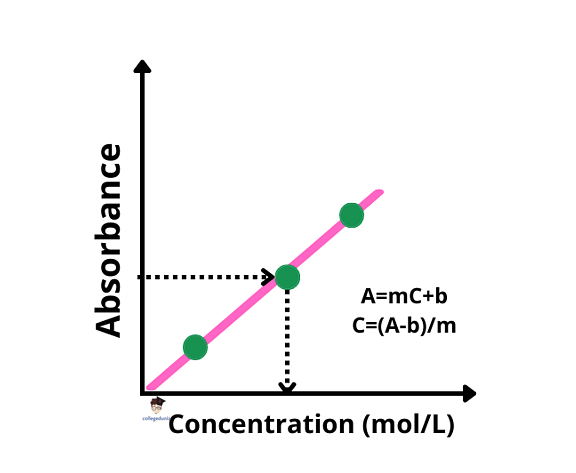
Beer-Lambert Law Graph
Beer Lambert Law applications are also there in our atmosphere. For instance, solar radiation in the atmosphere can be described using the Beer Lambert law. The equation of the Beer Lambert law in atmospheric applications is as given:
\(\begin{array}{l}\large T=e^{-m(T_{a}+T_{g}+T_{RS}+T_{NO2}+T_{w}+T_{O3}+T_{r}+..)}\end{array}\)
Where,
- a = aerosols
- g = mixed gases
- RS = Raman scattering effect.
- NO2 = Nitrogen dioxide
- w = water vapour absorption
- O3 = Ozone
- r = Rayleigh scattering
Limitations of Beer-Lambert law
[Click Here for Sample Questions]
The limitation of the Beer-Lambert law is based on the few situations where the law maintains linearity:
- As the molecules of the analyte have stronger intermolecular and electrostatic interactions due to the smaller amount of space between them, the law will produce false results at high concentrations.
- This can alter the analyte's molar absorptivity.
- High concentrations alter not just molar absorptivity but also the refractive index of the solution, resulting in deviations from the Beer-Lambert law.
For instance, when the concentration is low, i.e. < 10mM, it becomes simpler to analyze the absorptivity coefficient of the sample using this rule, but as the concentration rises, i.e. >10mM, there is a deviation due to the increase of the electrostatic interactions.
Also Read: Refraction at Spherical Surfaces & Lenses
Things to Remember
- Beer-Lambert law states that the absorbance of a solution is proportional to its concentration, absorption coefficient, molar, and optical coefficient.
- Beer law states that concentration and absorbance are exactly proportional to one other.
- Lambert's law states that absorbance and path length are exactly related.
- Beer-Lambert law Equation: I = Ioe-μ(x)
- Beer-Lambert's law can be expressed as A= εLc, where A refers to the absorbance, ε denotes the molar extinction coefficient, L denotes path length, and c denotes concentration.
- The limitations of the Beer-Lambert law claim that, as the concentration of the sample rises, there is a deviation due to the increase of the electrostatic interactions.
Also Read:
| Important Class 11 Physics Practicals | ||
|---|---|---|
| Conductometric Titration | Quantitative Analysis | Non Aqueous Titration |
| Precipitation Titration | Mass Spectrometry | Types of Titration |
| Redox Titration | Volumetric Analysis | Thin Layer Chromatography |
Sample Questions
Ques 1. What role does absorbance play in determining a solution's concentration? (1 mark)
Ans. The absorbance value ranges from 0.1 and 1. We can argue that the solution has a higher concentration if the absorbance of the substance is greater than or equal to 1.0 (too high).
Ques 2. What is Beer-Lambert Law? Who discovered it? (2 marks)
Ans. The Beer-Lambert law states that the absorbance of a solution is proportional to its concentration, absorption coefficient, molar, and optical coefficient. It was discovered by Pierre Bouger in 1729.
Beer-Lambert law Equation: I = Ioe-μ(x)
Ques 3. State Beer and Lambert Law? (2 marks)
Ans. The two laws can be described as:
- Beer law asserts that concentration and absorbance are exactly proportional to one other.
- Lambert law asserts that absorbance and path length are exactly related.
Ques 4. In absorption spectroscopy, what is the use of Beer-Lambert Law? (2 marks)
Ans. Many uses of the Beer-Lambert law can be found in electromagnetic spectroscopy. This law establishes a linear relationship between the absorbance of a solution sample and its concentration, allowing us to calculate the molar concentration of any number of solutions.
Ques 5. What does it signify when the Beer-Lambert Law deviates? (3 marks)
Ans. The deviation is a part of the limitations of Beer-Lambert Law. Only under certain conditions does the Beer-Lambert law preserve linearity. Furthermore, at large concentrations, the law will provide erroneous measurements. This is because the molecules of the analyte have greater electrostatics and intermolecular interactions. Furthermore, this is owing to the smaller amount of space between molecules.
The molar absorptivity of the analyte may alter as a result of this. The molar absorptivity changes dramatically at large doses. Furthermore, the high concentrations alter the refractive index of the solution, causing deviations from the Beer-Lambert law.
Ques 6. Describe some of the applications of beer-lambert law. (3 marks)
Ans. The Beer-Lambert law is applied to the spectrophotometric examination of a mixture. Furthermore, no considerable sample pre-processing is required for this application. The determination of bilirubin in blood plasma samples is an example of the Beer-Lambert law.
- As the spectrum of pure bilirubin is known, the molar absorbance can be calculated. Furthermore, bilirubin may be measured at a single wavelength that is almost unique to it. Another measurement can be made at a different wavelength to help eliminate any discrepancies or interferences.
- It can be used to determine the concentrations of a drug or the molar absorptivity of a substance in general.
Ques 7. Calculate the molar absorptivity of a 1×10⁻⁴ M solution which has an absorbance of 0.20, when the path length is 2.5 cm. (1 mark)
Ans. \(A = ε c l\)
ε = A/c l = 0.20/1×10-4×2.5 = 800 dm3/mol/cm
Ques 8. How are concentration and absorbance related? What is the formula used to calculate the absorbance? (3 marks)
Ans. There is a linear relationship between concentration and absorbance. As concentration increases, more radiation is absorbed, which leads to increased absorbance.
The formula used to calculate the absorbance is A = e * c * p where E is the molar extinction coefficient. Unit of absorbance is L mol -1 cm -1. The concentration of the solution is denoted as c.
Ques 9. Which instrument is used in the verification of Lamberts Beer's law? (1 mark)
Ans. Colorimeter is used to measure the concentration of a known solute in a given solution with the help of the Beer-Lambert law.
Ques 10. Why is monochromatic light used in Beer-Lambert law? (2 marks)
Ans. Strict adherence to Beer's law is observed only with monochromatic radiation. Monochromators isolate the portions of output from continuum light sources. Thus, true monochromatic radiation never exists and can only be approximated by using a very narrow exit slit on the monochromator.
Ques 11. A solution of thickness 2 cm transmits 40% incident light. Calculate the concentration of the solution given that ε =6000 dm³/mol/cm. (3 marks)
Ans. A = 2log10 % T
= -2 log 10 40
= 2 1.6020
= 0.398
A = ε c l
c = A/ εl
= 0.398/6000*2
A = 3.316× 10⁻⁵ mol/dm³
Ques 12. Find out the molar absorptivity of a 1×10⁻⁴ M solution with an absorbance of 0.20, when the path length is 2.5 cm. (3 marks)
Ans. A = εcl
ε = A/cl
= 0.20/1×10⁻⁴×2.5
= 800 dm³/mol/cm.
Ques 13. A solution having a concentration of 0.18 M is measured with an absorbance of 0.5. Another solution that is measured under the same conditions has 0.35 absorbance. What is the concentration? (2 marks)
Ans. The equation of beer lambert law can be written as A = εcl
As absorbance is directly proportional to concentration.
So C1/C2 = A1/A2.
C1 = (A1/A2)*C2
= 0.35/0.5*0.18
= 0.126M
Ques 14. A student measures the absorbance of 5 standard solutions of a compound at 300nm and prepares a calibration curve. A cuvette with a 5 cm path length was used in the stratosphere and the slope of the curve was 300 L/mol. Calculate the molar absorptivity of the compound. (3 marks)
Ans. Slope = 300 L/mol
Path Length = 5 cm
Slope = Molar Absorptivity x Path Length
= 60 L/mol cm
Ques 15. What is the formula of Beer-Lambert Law? (1 mark)
Ans. The Beer Lambert Law formula is I – I0 e- μ (x).
Ques 16. What is the equation of coefficient of the molar equation? (1 mark)
Ans. The coefficient of the molar equation is ε = A/Lc.
Ques 17. What is the unit of absorbance? (1 mark)
Ans. Absorbance is measured in absorbance units (Au).
Ques 18. Explain path length in Beer-Lambert law. (1 mark)
Ans. In Beer Lambert Law, the path length is the length through which the light travels in a solution.
Ques 19. Why is the Beer-Lambert law significant? (1 mark)
Ans. The Beer-Lambert Law allows the concentration of a substance to be determined from its absorbance in a spectrophotometer.
Ques 20. What are the three important factors of Beer's law? (2 marks)
Ans. The 3 significant factors of Beer’s law are –
- Absorption Coefficient – A
- Concentration of the absorbing species – C
- Path length through which the ray of light passes from source to detector – L
Do Check Out:



Comments